Castello di Pietratagliata: A Medieval Lookout Fortress in Sicily


Site at a Glance
- Rating
- 4.5
- Popularity
- Low
- Country
- Italy
- Primary era
- Medieval
- Eras represented
- Medieval
- Civilizations
- Kingdom of Sicily, Norman
- Site type
- Military
- Remains
- Castle
On this page12 sections
History
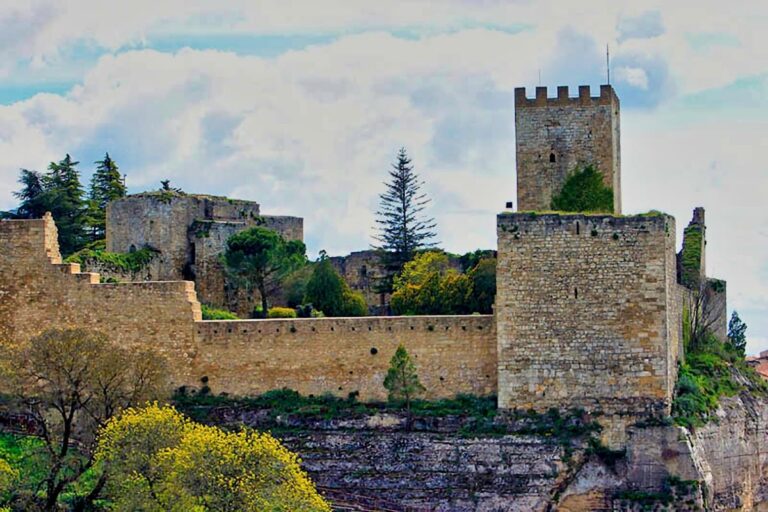
Castello di Pietratagliata, also known as the Castle of Gresti, is a ruined fortress in Italy, near Aidone in Sicily. Its surviving structure is generally assigned to the Arab-Norman period, when Sicily was shaped first by Islamic rule and later by Norman rule between approximately the ninth and twelfth centuries, although its origins remain uncertain. The castle occupied a strategic position above the Gornalunga valley, a natural route between the Ionian coast and central Sicily, and served as a lookout fortress rather than a conventional noble residence.
Origins and strategic setting
The castle stands on the highest part of an elevated sandstone ridge extending for about 2 kilometres along a northeast to southwest axis. Its position allowed observation of the valley and of routes connecting coastal centres such as Catania, Syracuse, Lentini, and Naxos with inland settlements including Morgantina, Enna, and Agira. This location suggests that the site was occupied from very early times, although the first documented historical references belong to the fourteenth century.
The name Pietratagliata refers to spaces cut into the rock and appears in medieval references to the fief of Fessinia or Pietratagliata. The alternative name Castle of Gresti probably derives from nearby Cozzo dei Gresti, where numerous pottery fragments indicate a Greco-Roman settlement. The Sicilian dialect word gresti means pottery sherds.
The Gioeni fief
In 1374, Frederick III of Sicily granted the fief and fortification of Pietratagliata to Perronus de Iuenio of the Gioeni family. Frederick III was the fourteenth-century king of Sicily who reigned from 1295 to 1337. The Gioeni also held Aidone and neighbouring fiefs. Giovanni Luca Barberi, a Sicilian historian and administrator who compiled the Capibrevi, registers of feudal holdings and privileges, still recorded the family’s ownership in 1512.
Later ownership and the treasure tradition
The property subsequently passed through several owners. In 1668, Baron Giacomo Caprini placed a Latin inscription on a marble slab at the lintel of a pointed window. Addressed to a young successor, possibly his son, the inscription presented him with fertile lands, herds, and pastures, comparing their abundance with the mythical Garden of the Hesperides, whose precious apples made it a traditional image of exceptional fertility. The text was later read and translated by Giacomo Magno.
Because the inscription was set high on the castle, it became connected with a local truvatura, a Sicilian treasure-finding legend in which a clue, inscription, or supernatural circumstance reveals hidden wealth. According to the tradition, a knight who could read and interpret the words while riding past the castle would discover a great treasure. The marble slab was later carried away, probably when the northern facade collapsed.
The story may also have been linked to silver and electrum coins reportedly found on the hill above the castle in the late nineteenth century. These finds were attributed uncertainly to a mint accompanying a Punic army, possibly one associated with Hippocrates. They reportedly included silver coins from Morgantina’s SIKELIOTAN series, showing a galloping rider on the reverse and possibly Zeus on the obverse.
Observation and preservation
The elevated tower and its broad visibility may have connected Pietratagliata to an optical signaling network of beacons or fires along the route from Enna through Valguarnera, Pietratagliata, Morgantina, Aidone, Mongialino, and Mineo. Such systems used elevated lookout points to transmit warnings or messages across long distances. The ruins have remained privately owned and neglected for many decades. The site is designated Italian national heritage.
Remains
Ridge-top layout
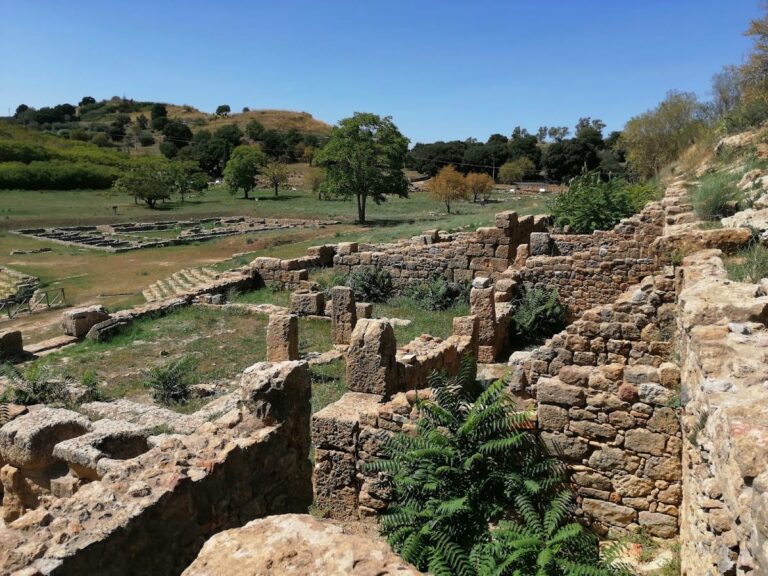
Castello di Pietratagliata occupies a central rocky spur across the Canne, or Gresti, stream, where the ridge forms a natural dam. The ruin’s general form remains legible. Its principal elements are a massive solid tower and rooms cut directly into the sandstone, combined with spaces built in masonry. The structure extends across four levels, reflecting the adaptation of the fortress to the uneven rock.
Rock-cut and built rooms
Lower levels
The first level contains rural dwellings and a large cave opening onto a southern loggia. It also has a window and another loggia on the northern side. The second level marks the beginning of the solid tower and includes a staircase cut into the rock. At this level, an entrance leads to a hall with a window bordered by built-in masonry benches.
Upper rooms and water storage
The third level contains the representative rooms traditionally described as the noble rooms. Four chambers are cut into the rock, while additional rooms were constructed in masonry. The fourth level includes a room with an entrance portal that suggests a chapel, together with a cistern designed to collect rainwater.
Solid tower and access
The high tower is firmly anchored to the rock and can be seen from great distances. Its walls have compact surfaces, with corners strengthened by precisely squared stone blocks. A spiral staircase in the southeast corner has basalt steps and provided access to the tower terrace. The combination of the tower, elevated position, rock-cut rooms, and long-range visibility fits the function of a defensive observation post more closely than that of an aristocratic residence.
Inscription and surrounding evidence
The 1668 inscription belonged to a pointed window and referred to Giacomo Caprini’s successor, the family’s ancient coat of arms, the estate, livestock, and pastures. Its wording is known through a later reading and translation. Nearby Cozzo dei Gresti contains visible pottery fragments associated with a Greco-Roman settlement, while the hill above the castle is linked to the reported discovery of the silver and electrum coins that helped sustain the later treasure tradition.