Escalona Castle-Palace: A Frontier Fortress and Noble Residence in Spain



Site at a Glance
- Rating
- 4.5
- Popularity
- Low
- Country
- Spain
- Primary era
- Medieval
- Eras represented
- Medieval
- Civilizations
- Crown of Castile
- Site type
- Military
- Remains
- Castle
On this page11 sections
History
Escalona Castle-Palace is a fortress and palace in Escalona, Spain, on a site that began as a Roman fortress and was later occupied by Muslim powers. Its medieval development belongs chiefly to the eleventh through fifteenth centuries, when Escalona became a frontier stronghold between Toledo and the territories ruled by the Almoravids and Almohads, successive Muslim dynasties controlling parts of North Africa and al-Andalus. From its elevated position, the fortress helped defend routes linking Toledo and Ávila, the Alberche corridor, Talavera, and Toledo.
Roman and Muslim origins
King Alfonso VI of León took Escalona in the eleventh century, shortly before the fall of Toledo in 1085. Under Christian rule, the town became one of the principal frontier defenses of the region, alongside Maqueda and Santa Olalla. Alfonso VII granted Escalona its fuero in 1130 through the fortress’s tenentes, Diego and Domingo Álvarez. A fuero was a medieval charter that established a town’s rights, obligations, privileges, and legal organization. In Escalona, the grant encouraged settlement on the bank of the Alberche and reinforced the town’s military role.
The defensive works were not complete until the end of the twelfth century. Tasufín ben Alí ben Yúsef attacked Escalona in 1136 or 1137. An Arabic chronicle describes extensive killing, the removal of the town’s bells to Córdoba, and the enslavement of 6,000 captives who were transported to Morocco. Alfonso VII’s chronicle gives the episode little attention, creating a marked difference in the surviving accounts of the assault.
After the Christian defeat at Alarcos in 1195, the Almohads attacked Escalona in 1196. The Almohad caliph Abu Yusuf Ya’qub al-Mansur took the stronghold by force during a campaign launched from Seville. A further attack in 1197 endangered Toledo and the Christian frontier established around settlements that had been devastated during the campaigns.
Lordship of Manuel and Don Juan Manuel
In 1281, Alfonso X granted Escalona and its fortress to his brother Manuel of Castile. The grant compensated Manuel for possessions lost after the peace with Peter III of Aragon. Manuel incorporated Escalona into his frontier lordship, and his son, Don Juan Manuel, was born there. Don Juan Manuel became a powerful Castilian nobleman as well as a writer, and the fortress later stood at the center of his conflict with Alfonso XI.
The dispute began after Alfonso XI repudiated Constanza, Don Juan Manuel’s daughter, following a marriage that had not been consummated. Escalona was crucial to the struggle because it controlled the route between Toledo and Ávila. Royal forces besieged the fortress and remained there until withdrawing on July 20. Papal mediation temporarily settled the conflict in 1330, but fighting resumed between 1335 and 1337. Don Juan Manuel was ultimately defeated, although he retained Escalona.
After Don Juan Manuel’s death, the lordship passed through his family. It returned to the royal patrimony when his daughter Juana Manuel married her relative Enrique of Castile, the future Enrique II. The marriage connected Escalona once again with the Castilian crown and ended the period in which the fortress was held as the central seat of Don Juan Manuel’s family lordship.
Álvaro de Luna and the palace
King Juan II granted Escalona to Álvaro de Luna in 1424. Constable of Castile and the king’s chief favorite, Álvaro made the town the capital of his lordship and built a palace within the castle. He also held major celebrations there in the king’s honor. A royal privilege of 1437 called the palace “the best house found in Spain.” The same privilege required Álvaro to keep the town populated after epidemics had reduced its inhabitants and reserved the king’s right to lodge there.
The palace was built on the former lords’ site and completed in 1438. On August 10 or 11 of that year, lightning struck the keep and caused a major fire. The blaze proved so intense that 800 men, using 2,000 baskets of earth and water skins, could not extinguish it. Reconstruction followed, receiving royal support in 1442. Inhabitants were granted tax exemptions because the town still contained fewer than 400 residents.
Álvaro de Luna was arrested in 1453. His wife, Juana Pimentel, then occupied the fortress with their children, Juan de Luna and María de Luna. Juan II besieged the stronghold, seeking the wealth reputed to have belonged to his former favorite. After an unsuccessful assault, the king negotiated with Juana Pimentel and required her to surrender the fortress and its contents.
The seizure produced a recorded collection of coins rather than the vast treasure alleged by Álvaro’s enemies. The holdings included doblas, old blancas, Florentine and Aragonese florins, alfonsí doblas or nobles, ducats, francs, and other gold coins. One inventory listed approximately 300 alfonsí doblas, 66 nobles, one additional alfonsí dobla, three francs, 136 nobles, and 42 gold coins, including florins from Florence, Genoa, and elsewhere. Juana Pimentel also surrendered two Castilian doblas and one Moorish dobla.
Late medieval conflict and later damage
After Álvaro de Luna’s death, Enrique IV granted Escalona to Juan Pacheco, Marquis of Villena. During the fifteenth century, the town and fortress became important settings for conflicts within the Castilian kingdom. The final conflict helped Isabel of Castile, commonly known as Isabella I, take the throne.
The palace-fortress suffered several fires, including fires during Álvaro de Luna’s period. It was also burned during the Peninsular War, when French troops under Marshal Soult destroyed the complex while the English Lieutenant Colonel Wilson was in the vicinity and Marshal Victor was encamped at Maqueda.
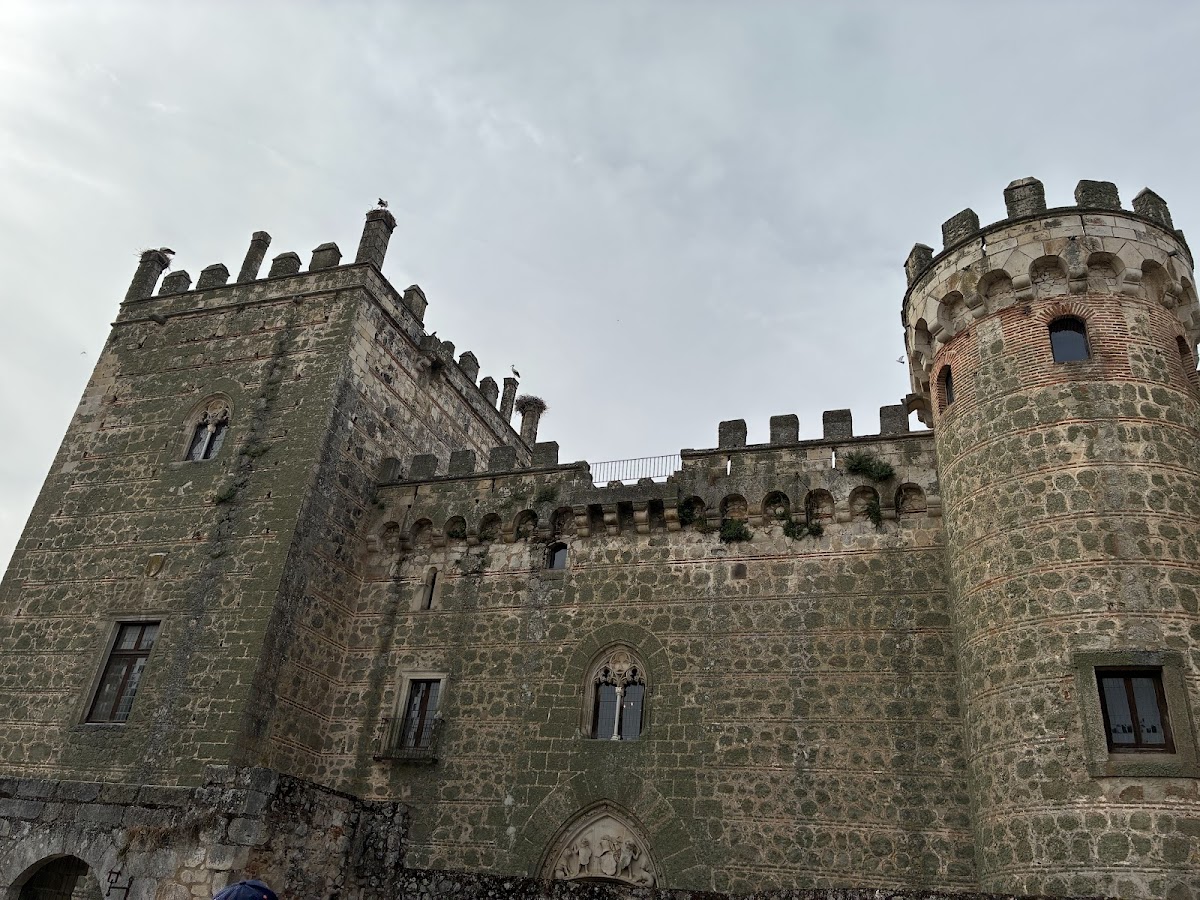
The ruins were declared an Artistic and Architectural Monument on February 2, 1922, a status later corresponding to the category of Property of Cultural Interest. The castle remained privately owned for a long period and was partly restored. Escalona’s municipal government purchased it in August 2024. On March 14, 2026, one of its eight albarrana towers collapsed after heavy rains caused water to accumulate, compounded by the building’s poor state of conservation.
Remains
Defensive enclosure and setting
Albacar and natural defenses
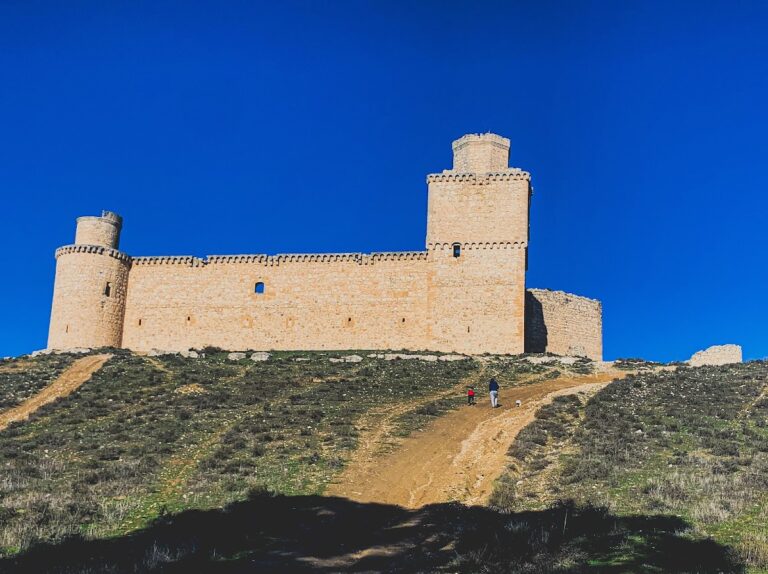
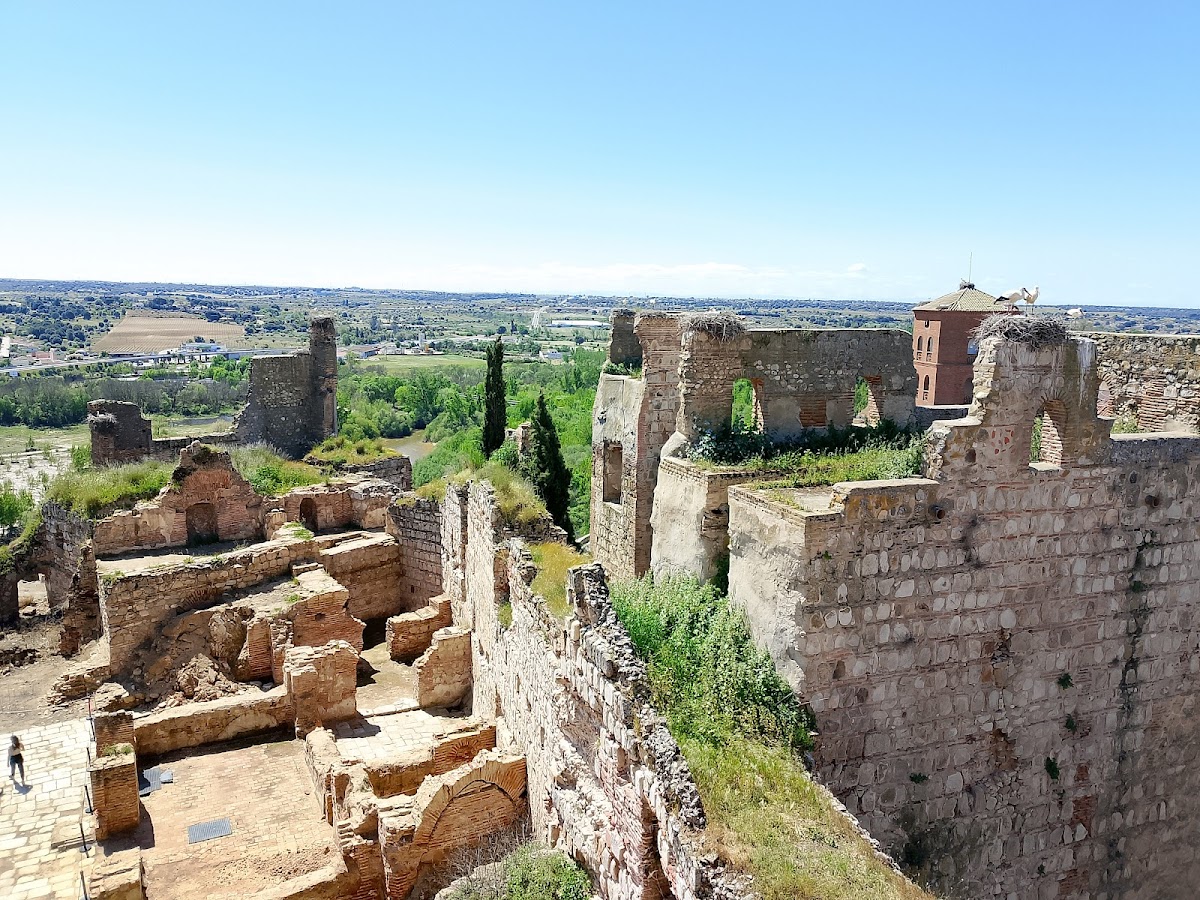
The castle occupies an elevated eastern spur overlooking the Alberche corridor. Its irregular plan reflects the character of Hispano-Muslim fortifications. The defensive complex was divided into a residential section and an albacar, an outer defensive enclosure. Most of the albacar’s perimeter walls survive, together with the projecting towers attached to the defensive system.
The surrounding landscape strengthened the fortress. The Alberche protected the southern side, while ravines formed by the Tordillos and La Parra streams defended the east and west. A moat completed the defenses on the north, where the terrain offered less natural protection. The earliest walls were made from rough concrete rammed into wooden formwork. Their few visible putlog holes, openings used to hold temporary building timbers, suggest hurried construction. Differences between the wall walks and the original town enclosure also point to work by separate construction teams.
Outer defensive towers
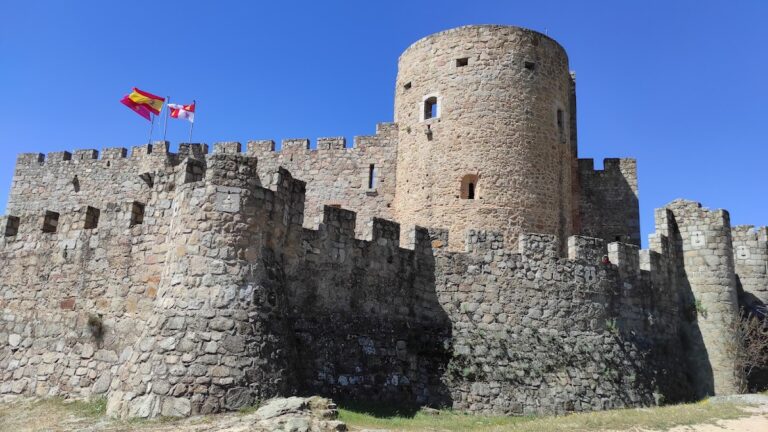
Two square towers belonged to the primitive enclosure and later supported albarrana towers. An albarrana tower is a projecting defensive tower set apart from, or linked narrowly to, a wall so defenders can attack along its outer face. A third tower may also have existed, although it may have been added during a later phase.
A subsequent defensive campaign focused on the north and east walls. Traditionally associated with Juan Manuel, this attribution is now questioned. The work added eight rectangular albarrana towers of different sizes, arranged in a series, together with a bastion, or projecting defensive platform, on the weaker side facing the town. The resulting arrangement created a fan-shaped defense.
Albarrana tower construction
The eight towers belong broadly to one defensive phase but differ in size, materials, and connections to the earlier wall. Two rise from the primitive rectangular towers, while the others project directly from the wall face. Their varied construction preserves evidence of several building methods and later changes to the fortress’s defenses.
The first type uses sections of rammed concrete framed at the corners by brick pilasters or reinforcing strips, resembling the construction of the albacar. The second consists of sections containing single courses of irregular rubble masonry. These have worked outer faces and stretches leveled with small stones or slabs set within horizontal brick bands. This form has been placed between the twelfth and thirteenth centuries. The third uses irregular rubble masonry with worked faces framed by brick. It may date to the eleventh century and was later remodeled between the late twelfth and thirteenth centuries.
Residential and palatial complex
The surviving complex includes the residential-palatial area alongside the defensive enclosure, albacar, and albarrana towers. The palace was completed in 1438 within the castle on the site associated with earlier lords. Fire, later destruction, and partial restoration have left the palace-fortress in a ruined condition, while the surviving defensive elements preserve the relationship between the noble residence and the outer military works.