Castle of Maqueda: A Fortress in Toledo, Spain

Site at a Glance
- Rating
- 3.9
- Popularity
- Low
- Country
- Spain
- Primary era
- Medieval
- External website
- Open
- Eras represented
- Medieval
- Civilizations
- Crown of Castile, Order of Calatrava, Umayyad
- Site type
- Military
- Remains
- Castle
On this page9 sections
History
Castle of Maqueda is a historic fortress in Spain, developed on a hill around 981 by order of Almanzor, the powerful military ruler of the Caliphate of Cordoba. The site formed part of Maqueda’s medieval defenses and later became a stronghold of the Order of Calatrava, before being rebuilt and enlarged by the Cárdenas family.
Early stronghold and Islamic rule
The hill and its surrounding territory were inhabited from ancient times. A Roman watch post or military fortification may have occupied the location, although this possibility remains uncertain. Around 981, Almanzor ordered the architect Fatho ben Ibrahim el Omeya, also known as Aben el Caxeri of Toledo, to build or substantially develop a fortress there. The work incorporated an earlier stronghold. Fatho was also associated with major mosque construction in Toledo and was known for his knowledge of, and travels through, the eastern Islamic world.
A battle traditionally placed near Maqueda in the mid-11th century is connected with a local account whose historical basis is uncertain. According to the legend, Obeydalla challenged the emir of Toledo, who defeated his forces with Christian assistance. Obeydalla and his companions were captured and later executed inside the castle.
Christian conquest and the Order of Calatrava
During the Reconquista, the long expansion of Christian kingdoms into territories ruled by Muslim states in the Iberian Peninsula, the castle passed to Alfonso VI of León and Castile. In 1153, the king granted Maqueda as a privately held lordship to Fernando Yáñez.
After the capture of Cuenca in 1177, Alfonso VIII of Castile granted Maqueda and its territory to the Order of Calatrava. This medieval Catholic military order defended and administered frontier territories in Spain. Maqueda became the seat of a commandery, one of the order’s territorial administrative and financial units, and its commander resided there. The commandery also included the castle and territory of San Silvestre near Toledo.
During the 12th century, the order probably enclosed the settlement, its principal church, and the castle within a larger defensive wall. The fortress resisted Almoravid sieges between 1196 and 1198. The Almoravids were a Berber Muslim dynasty and military power that intervened in Iberian politics during the late 11th and 12th centuries.
Conflict, transfer, and rebuilding
In the mid-14th century, the knights of Calatrava supported Queen Blanche. Peter the Cruel, king of Castile, captured the fortress by assault and ordered the execution of the order’s master. The castle was not confiscated, however, and remained in Calatrava possession for several centuries. Maqueda later declined.
In 1434, Juan II transferred Maqueda and San Silvestre to Álvaro de Luna, a Castilian constable and royal favorite, in exchange for the Calatrava fortresses of Arjona and Arjonilla. After Luna’s arrest and death, his possessions returned to the Crown. During the Farsa of Ávila, a 1465 political ceremony in which opponents of Henry IV symbolically deposed him and proclaimed his half-brother king, Álvar Gómez de Ciudad Real the Elder received Maqueda after supporting Henry IV.
In the mid-15th century, Gómez exchanged Maqueda with Cardinal Mendoza, Pedro González de Mendoza, for estates in Guadalajara. Mendoza soon transferred it to Alonso Carrillo de Acuña, archbishop of Toledo, in exchange for Jadraque and Alcorlo. Carrillo then sold the town and castle to Gutierre de Cárdenas, commander-major of León and royal treasurer.
Gutierre de Cárdenas ordered the earlier structure demolished and the present castle rebuilt and enlarged. The interior was never completed, for reasons that remain unknown. The owners moved to their estates in the municipality of Torrijos, and the unused fortress gradually deteriorated.
Modern institutional use and protection
In the late 19th century, the Spanish government acquired the castle from the heirs of the Cárdenas family and installed barracks for the Spanish Civil Guard. This national security and gendarmerie force combined military organization with civilian policing duties, giving the building a new institutional function.
The castle was declared a Historic-Artistic Monument on 3 June 1931. It is also protected under Spain’s general heritage decree of 1949 and the Spanish Historical Heritage Law of 1985. In 1988, it appeared in Spain’s long-running series of postage stamps devoted to castles. Government attempts to sell the property began through auctions from 2013 onward, and a private hotel company acquired it in 2025.
Remains
Plan and defensive setting
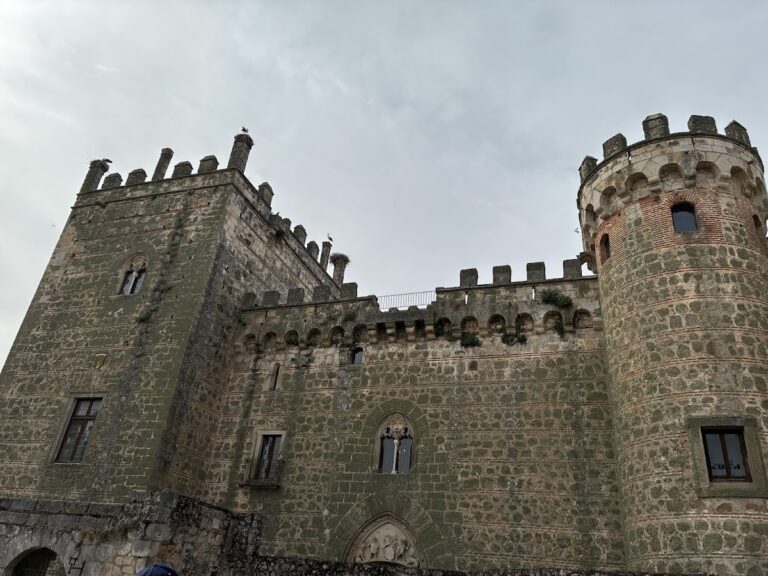
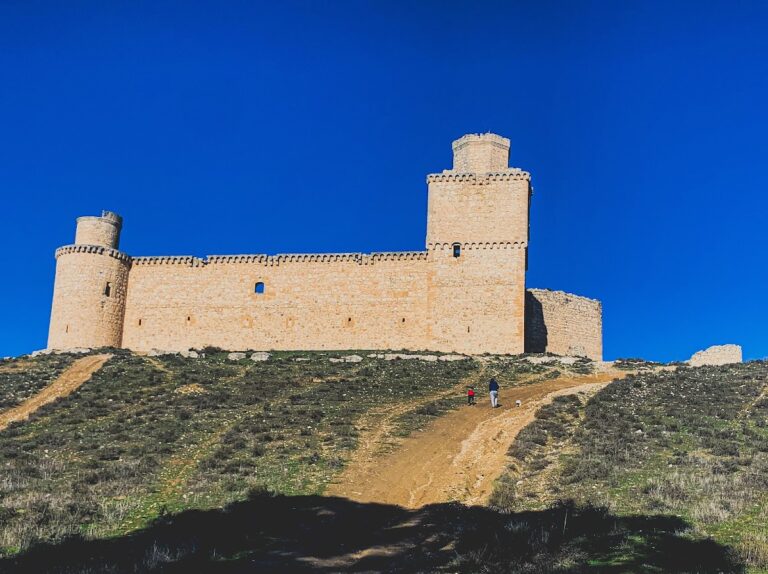
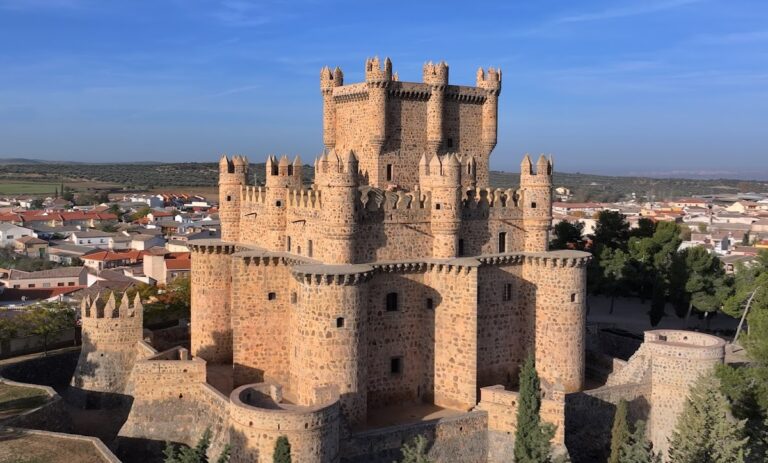
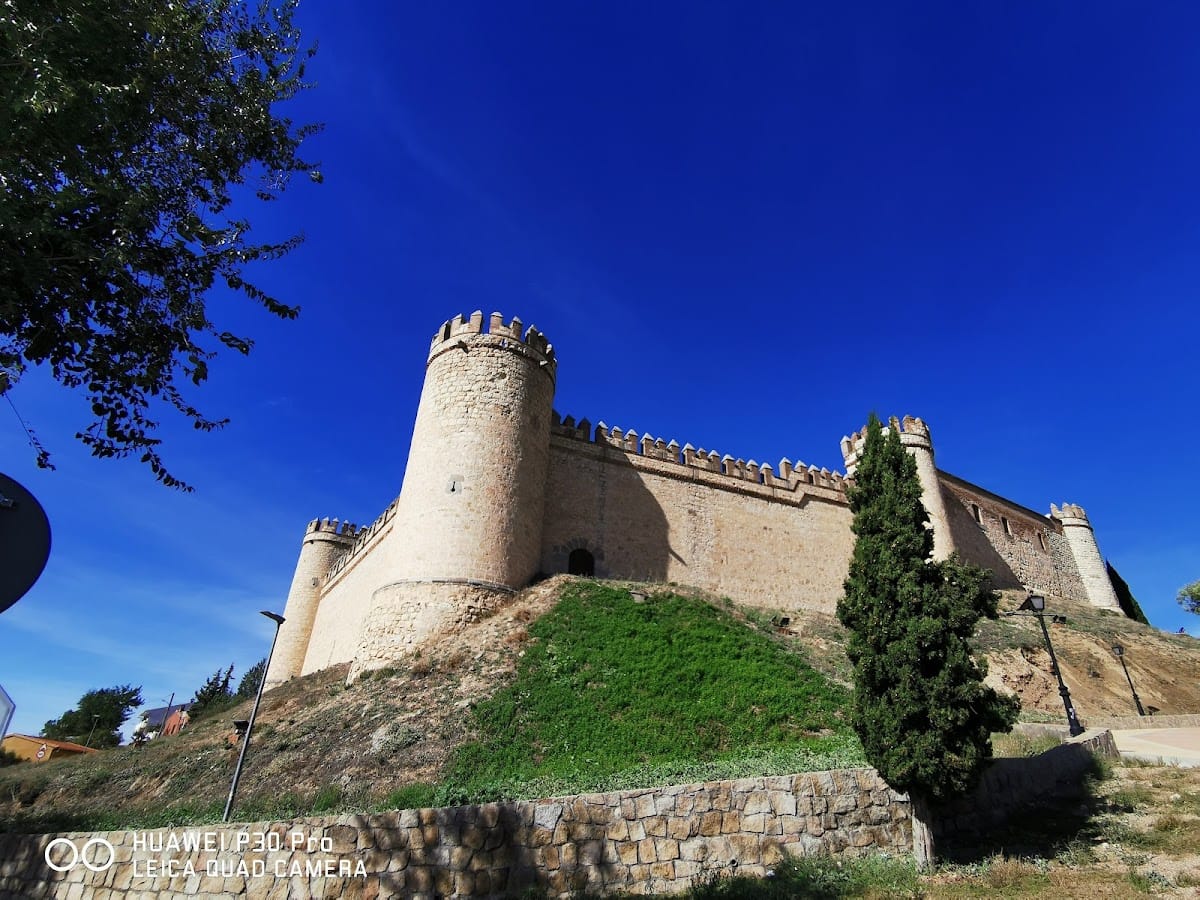
Also known as the Castle of La Vela, the fortress occupies one end of Maqueda’s former walled enclosure. The medieval castle formed part of the defensive wall around the settlement, which later developed into a small town. Its rectangular plan follows the uneven hill, with the building occupying two different ground levels. The walls are approximately 3.5 metres thick, and moats protect two sides. Three round towers stand at the southern corners and at the middle of the eastern wall. A fourth tower was added later, although its date is unknown.
Walls and towers
The battlements resemble those of San Silvestre Castle at Novés, another castle associated with the Cárdenas family. The covered wall walk and upper defensive crown are approximately 2.5 metres high. Narrow arrow slits, openings used to project missiles, occur between pairs of merlons and are arranged in pairs with the parapet. The battlements and parapets are in satisfactory condition, while the castle as a whole is partially restored.
Entrance defenses
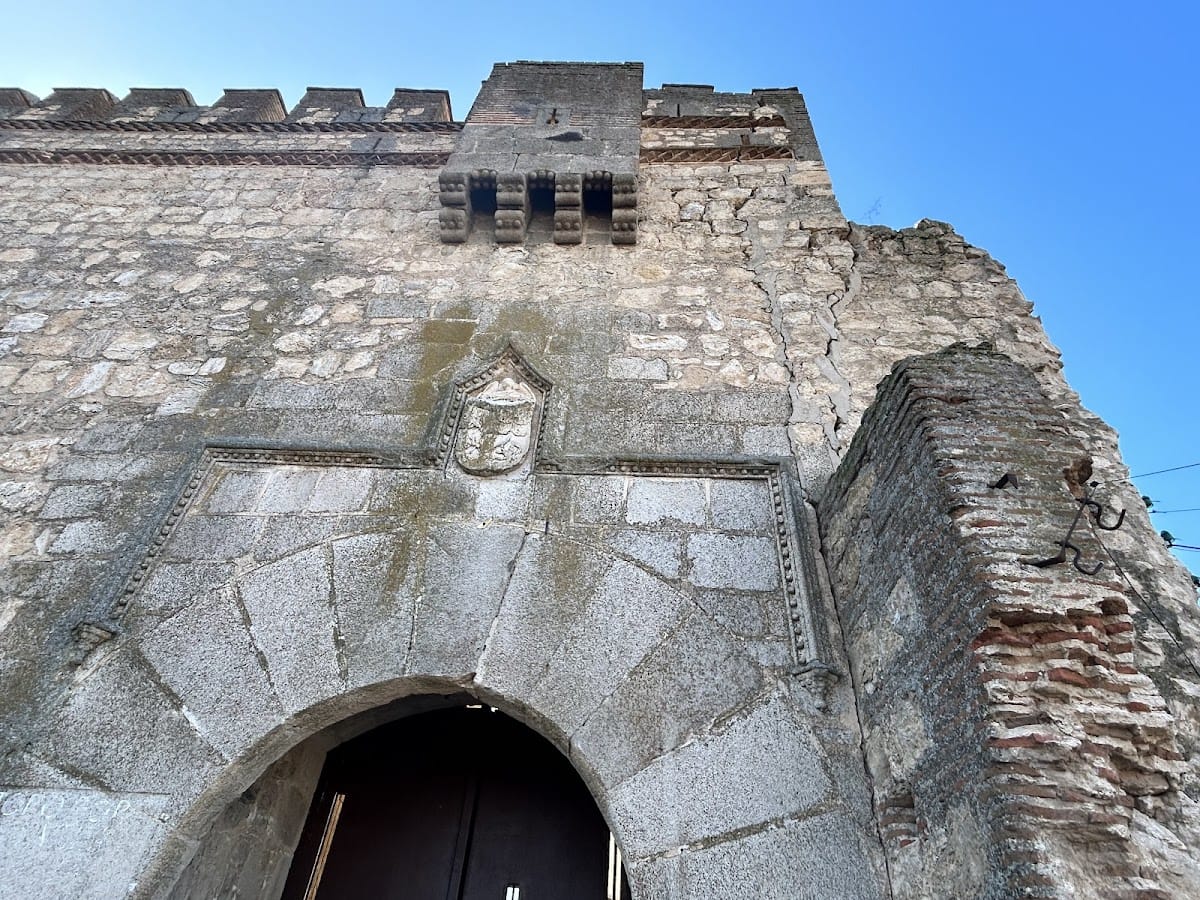
The principal entrance lies in the north facade and bears the coat of arms of the marriage between the Cárdenas and Enríquez families. A substantial machicolation, a projecting defensive structure with openings for attacking enemies below, protects the gateway. It is built of ashlar and brick and incorporates circular and cruciform arrow slits. A strong interlocking wrought-iron grille stood behind the entrance. The interior remains unfinished, preserving the incomplete character created after the rebuilding ordered by Gutierre de Cárdenas.