Piedra Escrita: A Granite Monolith with a Roman Religious Inscription
Site at a Glance
- Popularity
- Medium
- Country
- Spain
- Primary era
- Classical
- Eras represented
- Classical, Medieval
- Civilizations
- Roman
- Site type
- Religious
- Remains
- Sanctuary
On this page8 sections
History
Piedra Escrita is a carved rock monument in Cenicientos, Spain. Its inscription has been identified as Roman, while the monument’s imagery and lettering were later given a medieval Christian interpretation.
Roman religious interpretation
The Roman inscription has been interpreted as a private dedication of thanks to Diana, the Roman goddess associated with hunting and the natural world. It suggests that the monument may have served as a rural place of worship carved into rock.
Medieval reading and modern reinterpretation
A church dating to the thirteenth century stood at the site. In the medieval period, the inscription was retouched and read as “To the Three Marys,” referring to women in New Testament accounts of Jesus. The figures carved on the stone were understood as those women, supporting the interpretation of Piedra Escrita as a medieval monument.
In 1995, Alicia M. Canto, a scholar of inscriptions at the Autonomous University of Madrid, identified the Roman text beneath the medieval alterations. Canto also proposed that the stone might have marked the boundary between Hispania Citerior and Lusitania, two Roman provinces in the Iberian Peninsula. This suggestion rests on its alignment with other ancient markers along a north–south line. Because the provincial boundary across the central plateau was not clearly defined, the proposal would place Ávila in Lusitania, within the territory of the Vettones, an ancient people of western Iberia.
The monument’s form and imagery have been compared with a sanctuary near Segóbriga, also dedicated to Diana and containing similarly carved niches. The proposed bear imagery has been compared with a dedication to Artio, a goddess associated with bears, found at Muri in Switzerland and now held in the Bern Museum. A bear-claw mark has also been proposed as a Roman sign for forest boundaries, including those of sacred woodland.
On 3 August 2021, the Community of Madrid declared Piedra Escrita an Asset of Cultural Interest in the Archaeological Zone category.
Remains
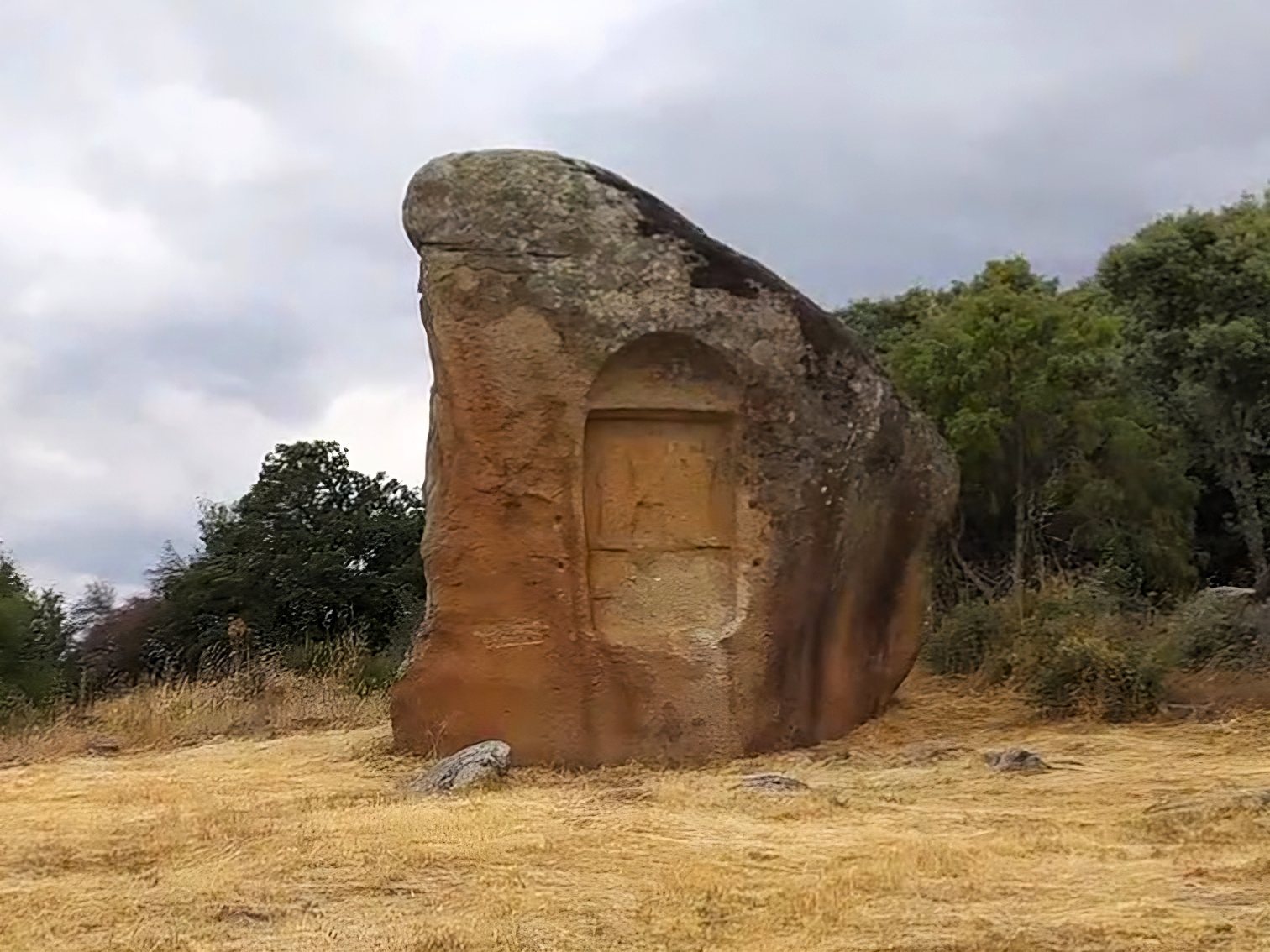
The site centers on a natural granite monolith about 7 metres high and 9 metres in circumference. Its carved features occupy the west-facing side and a natural projection on the rear; graves cut into rock occur in the surrounding area.
Monolith and surrounding features
West-facing niche
A niche with a semicircular top is carved into the monolith’s western face. It contains three human figures: two face a third, and all wear long garments in Roman style. Two indistinct animal forms appear at their feet. They may represent a bovine and a sheep or goat, although a bear has also been suggested.
Inscription and rear carving
The inscription lies to the left of the carved scene. Medieval retouching overlies the Roman text. On the rear, an animal footprint has been retouched on a natural protrusion. The animal is described as one that walked on the soles of its feet.
Nearby graves
Rock-cut graves characteristic of the Early Middle Ages are found in the surrounding area.