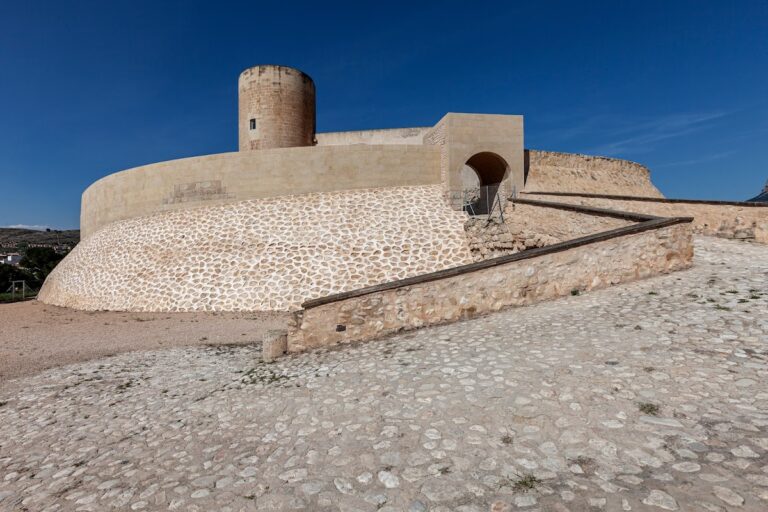
Castillo de Salvatierra: A Medieval Fortress in Spain


Site at a Glance
- Rating
- 4.6
- Popularity
- Very Low
- Country
- Spain
- Primary era
- Medieval
- External website
- Open
- Eras represented
- Medieval
- Civilizations
- Almohad, Umayyad
- Site type
- Military
- Remains
- Castle
On this page7 sections
History
Castillo de Salvatierra, popularly known as El Castillico, is a ruined fortress in Spain above Villena, Alicante. Built during the tenth century under Islamic rule in Iberia, it remained in use until the fourteenth century, when occupation shifted to Castillo de la Atalaya. Its elevated position supported surveillance and control of the Vinalopo route and gave the stronghold a defensible position over the surrounding valleys.
Islamic origins and medieval use
Archaeological soundings carried out in 1951 by José María Soler established the site’s caliphal origin. The Caliphate period here refers to Islamic rule associated with the caliphal state in Iberia. The fortress continued to be used under the Almohads, a later Islamic dynasty that ruled parts of North Africa and the Iberian Peninsula during the twelfth and thirteenth centuries. Finds from prehistoric, ancient, and medieval periods also show that the location was occupied at different times.
After the Christian conquest, people continued to occupy Castillo de Salvatierra. The earliest historical references date from the thirteenth century and relate to the marriage of Don Juan Manuel, Lord of Villena, to Infanta Isabel of Majorca. Her future father-in-law, the king of Aragon, stipulated that Salvatierra should form part of Isabel’s dowry. The fortress probably continued to serve surveillance and territorial-control functions, and it may also have been involved in fighting, until its abandonment in the fourteenth century.
Later military associations and protection
The site was later associated with episodes including the revolt of the Valencian Brotherhoods, battles during the War of the Spanish Succession, and fighting in the Peninsular War, the conflict in which Spain and its allies resisted Napoleonic rule. In 1985, Castillo de Salvatierra was designated a Spanish Asset of Cultural Interest in the monument category, under reference RI-51-0011125.
Remains
Layout and construction
The ruins occupy a fold or slope of the Sierra de la Villa above Villena. The rectangular fortification measures approximately 50 metres long and 5 metres wide. Its walls have two masonry faces, meaning stone-built surfaces joined with mortar, and are about 60 centimetres thick. Medium-sized stones bonded with mortar form the surviving wall fabric. The fortress is divided into an upper alcazaba, or fortified citadel, and a lower albacar, a less-built-up enclosure associated with a fortress and used for additional refuge.
Towers and keep
Three towers occupied the upper part of the structure. The northern tower was initially circular before being altered into its present rectangular shape, while the central tower is also rectangular. The southern tower served as the keep. It is square, with walls reaching up to 3 metres thick, and is divided into four sections. The lower two use Almohad rammed earth, a technique that forms layers of compacted earth within temporary supports, while the upper sections are built in masonry. A Mancala board, a traditional game of pits or hollows played with counters, remains carved into the rock of the keep.
Enclosure and water features
A long, straight masonry curtain wall bounds the eastern side of the albacar. Other surviving elements include a cistern, stairs cut directly into the bedrock, and channels designed to collect water. The fortress now survives only in ruins, with a small part of its original construction preserved.