Castell de Querroig: A Medieval Frontier Fortress in the Pyrenees


Site at a Glance
- Rating
- 4.6
- Popularity
- Very Low
- Country
- France
- Primary era
- Medieval
- Eras represented
- Medieval
- Civilizations
- Kingdom of Majorca
- Site type
- Military
- Remains
- Castle
On this page7 sections
History
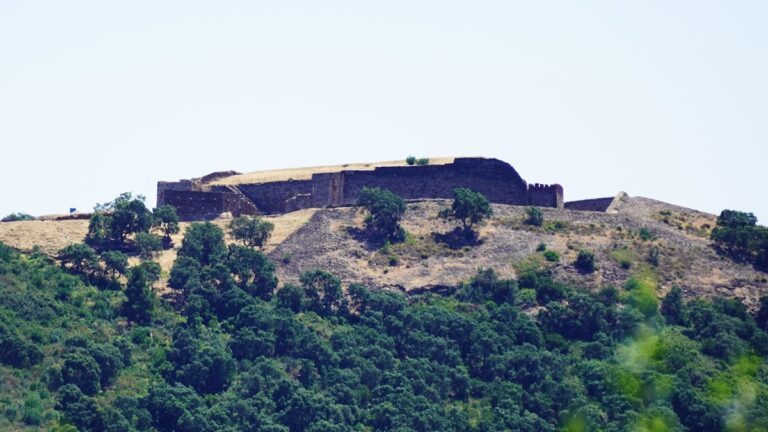
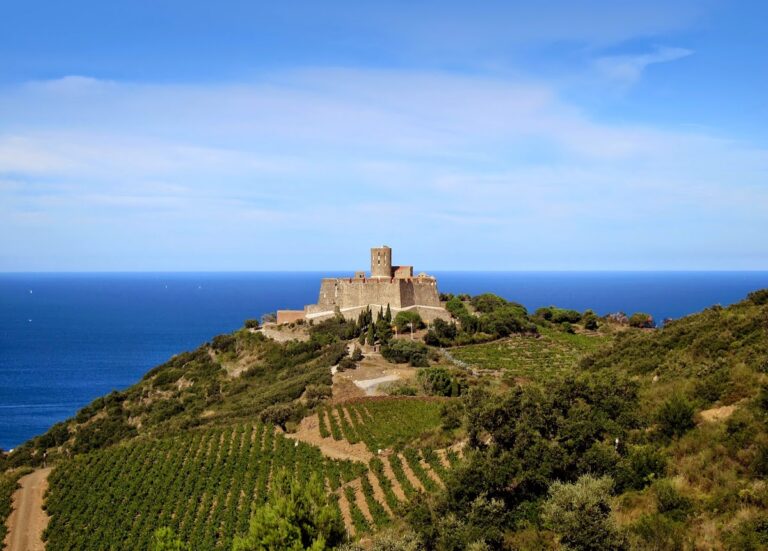
Castell de Querroig is a ruined medieval hilltop fortress in Spain and France, standing on Puig de Querroig where the territories of Portbou, Banyuls-sur-Mer, and Cerbère meet. Built during the tenth or eleventh century, it occupied a frontier position between Alt Empordà and Roussillon and helped observe routes across the eastern Pyrenees.
Early Fortress
Puig de Querroig was recorded in 981 as Podium Cariorubio or Cario rubio. The name marked the boundary of an estate associated with Count Gausfred I, also known as Gaufred of Empúries. The castle itself appears in written records in 1385 as Castrum de Carroig or Castrum de Carroia, although its surviving masonry indicates that the original fortress was considerably earlier.
Frontier Watchtower
After the medieval castle had fallen into ruin, the cylindrical Torre de Querroig was built on the same summit, generally during the fourteenth and fifteenth centuries. It formed part of a frontier network linked to the kings of Majorca. Lookout and signal towers in this system monitored valleys and approaches, and communicated with other defensive positions such as Torre Madeloc.
The fortress and tower controlled or observed strategic routes on both sides of the Pyrenees and contributed to the protection of the Kingdom of Majorca, a medieval polity ruled by the Majorcan branch of the House of Barcelona. The site was abandoned from the sixteenth century onward and gradually deteriorated.
Modern Protection
Castell de Querroig was designated a Cultural Asset of National Interest in Catalonia in 1949. The French portion of the castle and its adjoining ground became a historic monument in 2016, with protection extending to the ruins, soil, and subsoil. Most of the remains lie within Portbou, while the northern end reaches the territories of Banyuls-sur-Mer and Cerbère. The round tower extends onto the Catalan side of the frontier and the complex is jointly associated with the French state, Cerbère, and the Generalitat de Catalunya.
Remains
Castell de Querroig occupies the summit platform of Puig de Querroig, at approximately 670 to 672 metres above sea level. Its enclosing walls follow the summit’s shape and uneven ground in a sinuous plan. The enclosure measured about 44 metres from north to south and 35 metres from east to west. At its centre stood a large, elongated rectangular keep, the principal fortified tower of the medieval castle, measuring approximately 8 by 15 metres.
Castle Enclosure
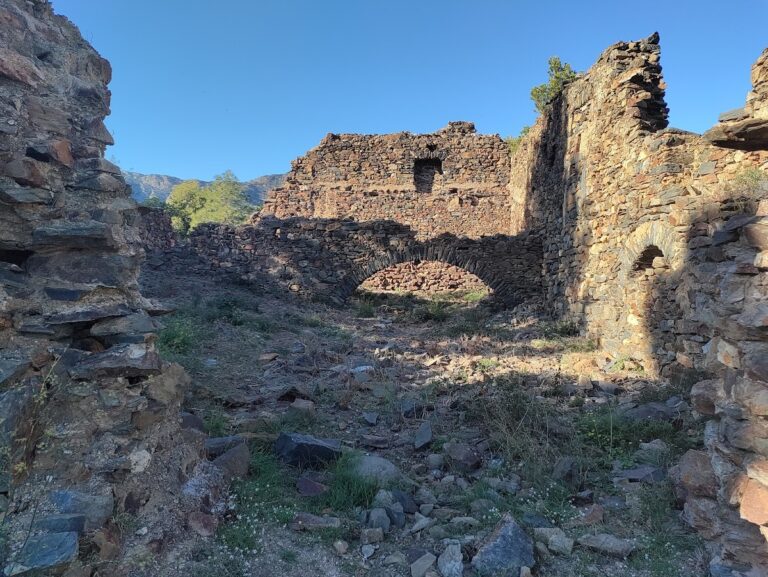
The surviving wall sections vary greatly in height. On the eastern side, masonry reaches approximately 5 metres, while elsewhere the foundations or only traces of the enclosing wall survive. One substantial section contains a row of high, narrow loopholes, openings that allowed defenders to observe or use weapons from behind the wall.
The original walls were built from small, irregular slabs of local schist, a layered stone that naturally splits into slabs. Some of this material came from the chlorite zone of the Albera massif, the easternmost mountain range of the Pyrenees. Corner blocks and the stones around the loopholes were more carefully cut from granite, whose lighter color contrasts with the darker schist walling. The later watchtower was constructed directly over the ruined keep and parts of the castle wall.
Torre de Querroig
The Torre de Querroig stands at the centre of the ruined complex. It is a cylindrical watchtower made from large, roughly dressed stones bonded with mortar. Its walls survive to a maximum height of approximately 7 metres, while the upper floors have disappeared. Inside, a hemispherical or half-dome vault remains.
The tower’s wall is substantial, and small defensive works formerly accompanied it, particularly on the western side. Together, the tower, the earlier keep, and the irregular enclosure preserve the successive defensive uses of the summit. The entire complex is now ruined and heavily deteriorated.
Nearby sites