Taxenbach Castle Ruins: A Former District Court Castle in Austria
Site at a Glance
- Rating
- 3.9
- Popularity
- Very Low
- Country
- Austria
- Primary era
- Medieval
- Eras represented
- Medieval
- Civilizations
- Holy Roman Empire
- Site type
- Military
- Remains
- Castle
On this page11 sections
History
Taxenbach Castle Ruins are the remains of a hilltop castle in Austria, built around 1323 by the archbishops of Salzburg on the Schlossberg above Taxenbach. The castle belonged to the period when the archbishops were both senior Roman Catholic authorities and territorial rulers of the Salzburg domain. It replaced an earlier stronghold and became the administrative headquarters of the Taxenbach district court, combining judicial, administrative, residential, and defensive functions.
From the Edtburg to the Archiepiscopal Castle
The earlier Edtburg probably dated from the twelfth century and stood elsewhere in the Taxenbach area. From the second half of the thirteenth century, it belonged to the Lords of Goldegg, who held it as a fief from the archbishops of Salzburg. The castle housed the Taxenbach district court, a territorial judicial and administrative office governed for the archbishop by a senior official. Otto von Goldegg was named as its owner in 1293.
In 1322, Wulfing von Goldegg rebelled against Archbishop Weikhart during the German succession dispute. The conflict, associated with the Battle of Mühldorf, led to the destruction of the Edtburg. Wulfing then surrendered his feudal rights to the archdiocese. In 1323, Archbishop Friedrich III von Leibnitz acquired the Taxenbach court and exchanged land belonging to the parish priest of Taxenbach for a plot at Dechantshofbühel. A new fortified court seat was established there, forming the basis of the present castle ruins.
From 1325, the new castle served as the seat of the Taxenbach district court. The district administrator, court clerk, and other officials lived and worked there, while a prison formed part of the complex. The castle also helped protect the market town and the crossings over the Ache.
Destruction and Reconstruction
The castle was destroyed during the Peasants’ War of 1525–1526, a major uprising against ecclesiastical and secular lordship in parts of Central Europe. At Taxenbach, the revolt was led by Augustin Kolmbichler against Archbishop Matthäus Lang. After the uprising was suppressed, the defeated peasants were compelled to finance and rebuild the castle through increased forced labor. The reconstruction was completed in 1564.
By the late sixteenth century, the castle’s water supply had fallen into complete disrepair. A description from 1606 portrayed an increasingly dilapidated tower with a small enclosed courtyard and a stable for two horses. Smoke from the smelters at Lend was blamed for poor air, while reports of haunting also discouraged residence. District administrator Christoff von Hirschau therefore moved to Zell am See and travelled to Taxenbach several times each week.
Archbishop Markus Sittikus of Hohenems ordered in 1615 that the district administrator return to the castle to prevent further deterioration. Under his successor, Josef Wilpendorfer, the building again became sufficiently habitable. After the market fire of 1622, the local administrative building was rebuilt, and the court clerk lived there from 1657.
Repairs and Administrative Relocation
Structural cracks appeared in the kitchen, cellar, and vaults during the middle of the seventeenth century. The walls were reinforced, and an archive was installed in 1673. A major earthquake damaged the castle in 1690, after which extensive repairs began. In 1699, the district administrator reported numerous defects, including a faded fresco of Archbishop Paris Lodron above the gate facing the market.
During the final decade of the seventeenth century, the castle’s windows were fitted with rough and bull’s-eye glass panes. Bull’s-eye glass consisted of small panes with a thick central boss created during manufacture. The castle depot stored 100 muskets until 1770, although most of the ammunition was missing; the weapons were then transferred to Salzburg.
The court administration eventually moved to a purpose-built building in the market. The district administrator relocated there in 1768, while the replacement courthouse, known as the Fronveste, remained in use until 2003.
War, Private Ownership, and Destruction
Heavy fighting took place near Taxenbach during the Napoleonic Wars in 1809. Four hundred Pinzgau peasants held up the Bavarian Division Deroy for a day as it advanced toward Tyrol. Taxenbach ultimately became part of Bavaria.
In 1812, Bavarian royal financial authorities auctioned the castle and its surrounding properties. Johann Rathgeb acquired them, but the neglected building progressively deteriorated. By 1872, the property belonged to the master blacksmith Rupert Grabmaier and was occupied by private residents.
In November 1872, a fire caused by negligence almost completely destroyed the castle, and the person responsible was killed. The building was not rebuilt. Stone from the ruins was reused in the expansion of Taxenbach elementary school in 1938. New residential construction was erected on the old foundations in 1962, causing the historic fabric to be almost completely lost.
Protection and Conservation
The market town of Taxenbach acquired the Schlossberg in 1991, and the ruins were recorded as belonging to the market town from 1995. The surviving remains received monument protection from the Republic of Austria in 1993. The remaining walls have since been secured and cleared of vegetation, preserving the visible traces of the former court castle.
Remains
Hilltop Layout
The castle occupied the Schlossberg south of the market, on the orographic left bank of the Salzach. It was probably arranged around a masonry tower enclosed by a ring wall, a defensive enclosure surrounding the principal fortified building. A Meierhof, an estate farm connected with a manorial centre, stood below the castle masonry. The complex therefore combined a fortified upper site with an associated agricultural area.
Ring Wall
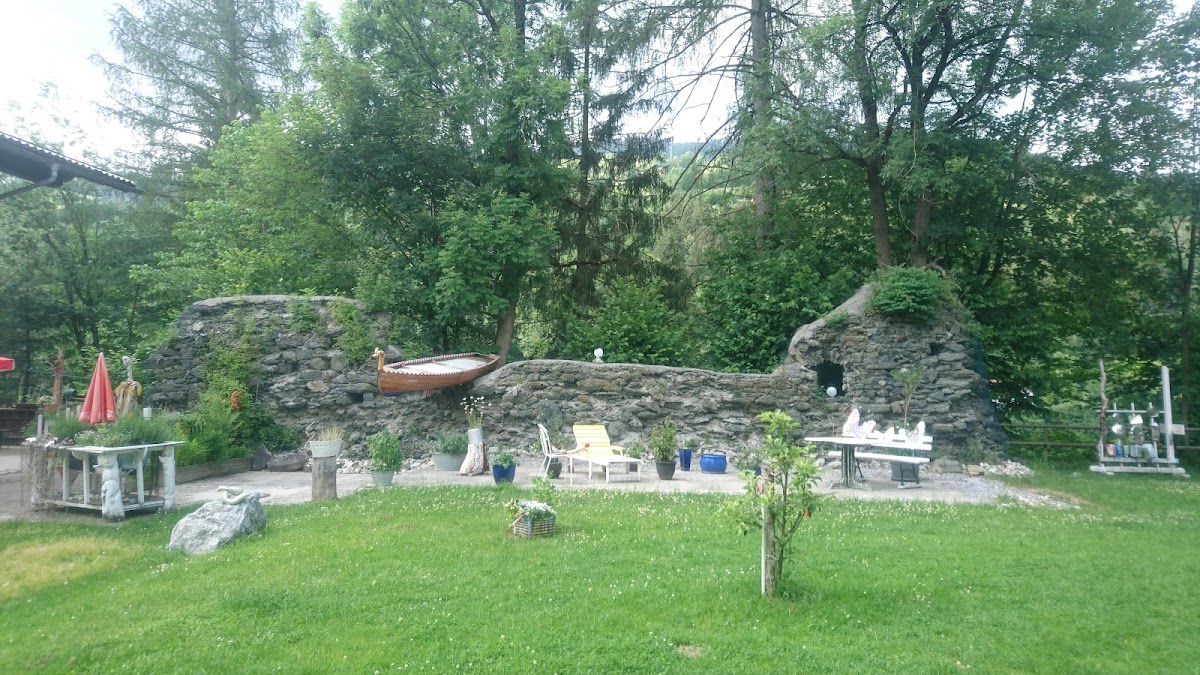
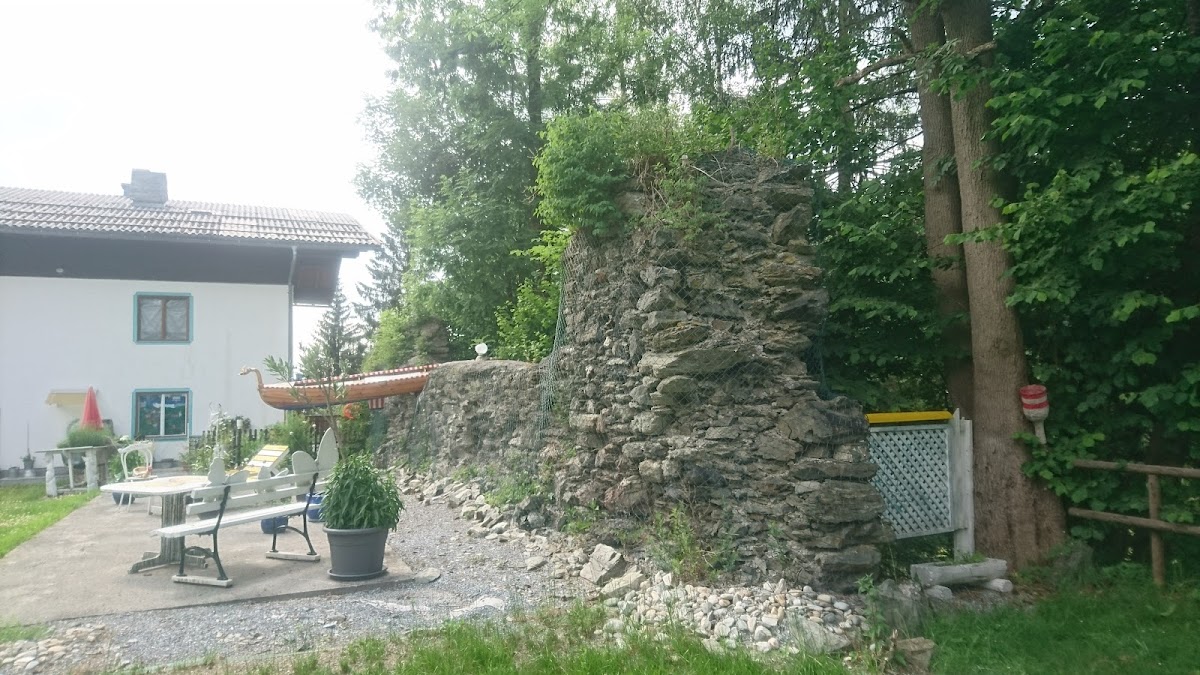
The visible remains consist mainly of sections of the former ring wall. In 1960, foundations and walls survived to heights of up to 5 metres. The east wall, facing the Kitzlochklamm, measured 15 metres in length. The north wall toward the market and the south wall toward the Salzach each measured 46 metres. The west wall toward Dechantbühel had formerly extended for 19 metres. Stone was later removed for the 1938 school extension, and residential buildings were erected over the old foundations in 1962. The surviving masonry has been stabilized and cleared of vegetation.
Water, Access, and Internal Installations
The castle had its own water supply, which was already derelict by the late sixteenth century. Other documented installations included a small courtyard enclosed by the ring wall, a prison, a stable for two horses, and an archive installed in 1673. An emergency exit led toward the Salzach. An underground passage ran through Dechantbühel into the market, and its entrance was still visible inside the ruin in 1930.
Gate and Military Features
A fresco of Archbishop Paris Lodron stood above the gate facing the market. By 1699, the image had faded and was considered in need of renewal. The castle’s windows received rough and bull’s-eye glass panes during the final decade of the seventeenth century. Its depot contained 100 muskets until the weapons were transferred to Salzburg in 1770.