Sisapo: Roman Mining Municipium at La Bienvenida, Spain


Site at a Glance
- Rating
- 4
- Popularity
- Low
- Country
- Spain
- Primary era
- Classical
- Eras represented
- Iron Age, Classical, Medieval
- Civilizations
- Iberian, Roman, Tartessian, Visigothic
- Site type
- City
On this page15 sections
History
Sisapo is a Roman municipium in Spain, located at La Bienvenida near Almodóvar del Campo in Ciudad Real. A municipium was a Roman community incorporated into Rome’s administrative system, with its own civic organization and legal relationship with the Roman state. The settlement originated in the late eighth or early seventh century BC, developed through Tartessian and Iberian phases, and became a Roman urban center whose principal architectural development belongs to the first two centuries AD.
Tartessian and Iberian origins
Sisapo stood in pre-Roman Oretania, the ancient region associated with the Oretani in the central and southeastern Iberian Peninsula. Its early occupation is linked to Tartessian and Iberian culture. Locally made Tartessian pottery, possible Phoenician influence, and imported Greek pottery belong to the period from the seventh to the third century BC, showing the settlement’s participation in wider cultural and commercial connections before Roman control.
Roman administration and mining
Roman occupation began during the first or second century BC. Under Roman control, Sisapo became the principal coordinating center of the surrounding area, bringing together mining, agriculture, and pastoral activity. The mining association known as the Socii Sisaponensis was involved in exploiting the region’s mineral resources. Its name appears in inscriptions from Corduba, Capua, and Rome.
The settlement received renewed development under Emperor Augustus, and its main Roman buildings were constructed or established during the first two centuries AD. Sisapo was renowned for cinnabar, also called minium, a red mercury sulfide ore used as a pigment and as a source of mercury. The nearby mines at Almadén and Almadenejos were associated with the city. Pliny the Elder described Sisaponian cinnabar as coming from veins composed solely of minium earth, without silver, and stated that the unrefined material was sealed and sent to Rome for washing. He gave an annual quantity of about 2,000 Roman pounds, while another figure of 10,000 pounds also circulated.
Ancient writers provide several references to Sisapo and its mineral wealth. Pliny discussed its cinnabar, Cicero mentioned companies exploiting its mines, and Strabo described silver associated with both an old and a new Sisapo. Further references occur in Dioscorides, Solinus, Justin, Vitruvius, and the Book of the Later Han. Strabo’s wording led to the proposed distinction between Sisapo Vetus, or old Sisapo, and Sisapo Nova, or new Sisapo. La Bienvenida has been proposed as the older settlement because of its greater antiquity, while Cerro de las Monas near Almadén has been proposed as the newer site.
Sisapo’s location was once sought at Almadén and other nearby places because ancient writers connected the name with the region’s cinnabar production. Archaeological work at La Bienvenida changed that interpretation. An inscription reading “Sisapon(e)” and further discoveries established the site’s identification with Sisapo. Another group of Roman inscriptions found in 2001 refers to the municipality of the Sisaponenses and may be connected with augustales, members of a civic religious college associated with the imperial cult.
Late Roman and Visigothic transformation
The settlement continued into the late Roman period and the Visigothic era. Numerous fourth-century coins and a Visigothic-period necropolis mark these later phases, while architectural elements from earlier buildings were reused in subsequent construction. From the late Roman or Visigothic period onward, Sisapo declined and was eventually abandoned. Arabic and medieval occupation was limited, and the ruins were progressively quarried or despoiled before becoming buried for more than fifteen centuries.
The ruins were rediscovered in the twentieth century. Archaeological excavation and research have continued at La Bienvenida, revealing successive phases of occupation and clarifying the city’s relationship with the surrounding mining region. The site was designated a Spanish Asset of Cultural Interest in 1992.
Remains
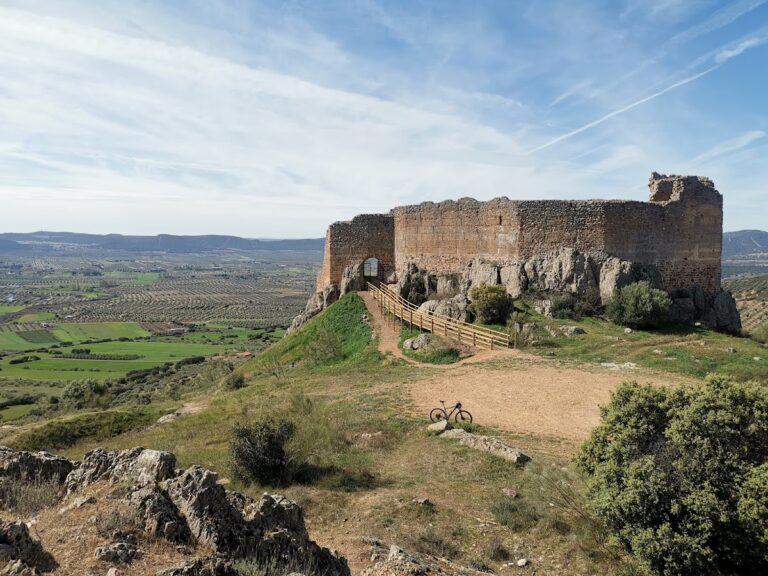
Sisapo survives as an urban archaeological complex enclosed by a circuit of about 1 kilometre and covering approximately 10 hectares. Its remains combine pre-Roman occupation with a Roman city planned around defensive walls, principal streets, residences, industrial buildings, and other structures. Later construction reused elements from earlier phases, preserving evidence of the settlement’s long development.
Fortifications and urban boundary
Walls and bastions
A wall predating the fourth century BC was replaced by a new circuit built under Roman control in the second century BC. At least 19 possible bastions have been identified, although a total of 28 has also been proposed. Two excavated bastions have roughly semicircular plans and diameters of about 8 metres. They belong to the initial construction phase, while a later phase incorporated casemates, enclosed or vaulted spaces built into the fortifications for strength and protected internal support.
Southeastern gate
The city gate has been proposed for the southeastern side of the enclosure, where it aligned with the principal street. This position connects the defensive circuit with the internal urban layout and helps indicate the organization of movement through the Roman settlement.
Residential and public features
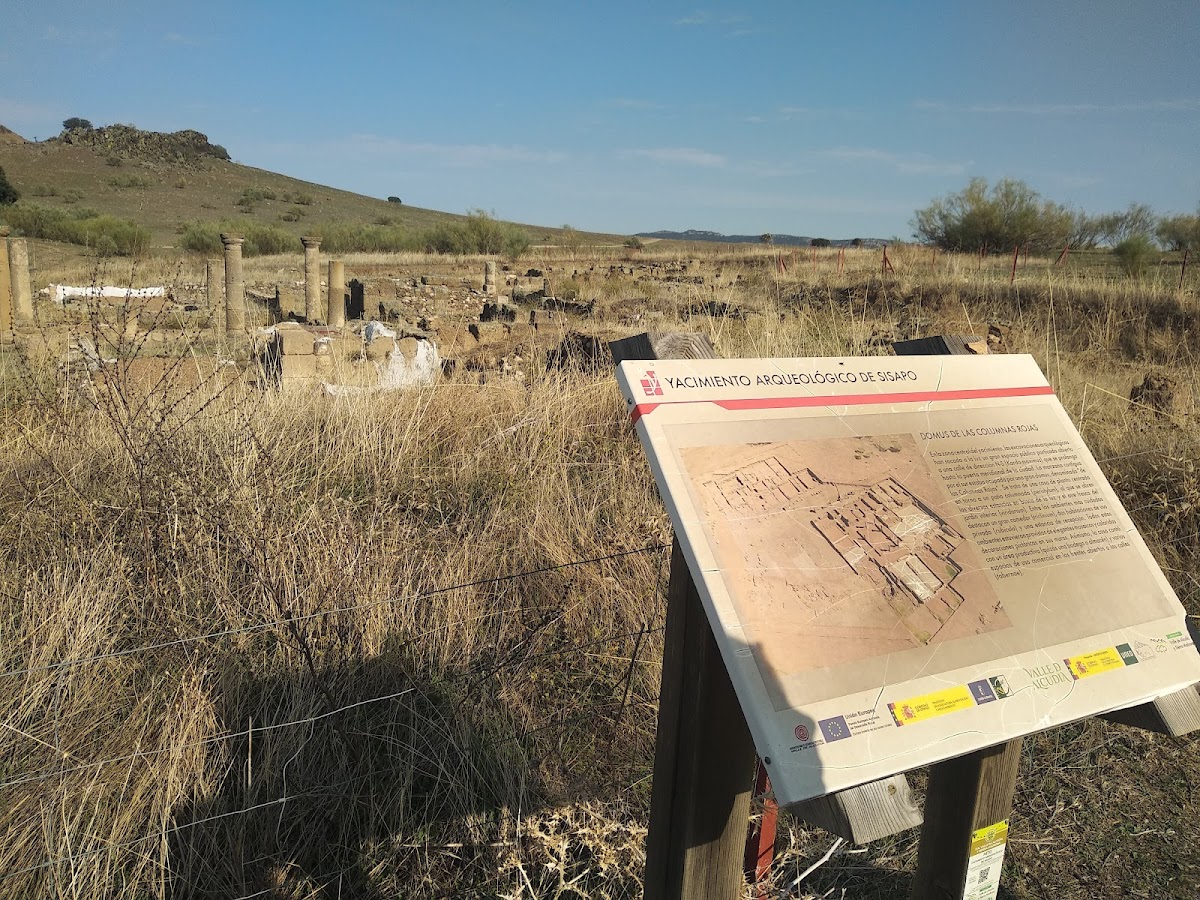
House of the Red Columns
The House of the Red Columns is a large residence associated with an important person. Excavation has exposed approximately 400 square metres of the building, including numerous mosaics and surviving wall paintings. The residence provides evidence of the scale and decoration of an affluent Roman household within Sisapo.
Hoyo Santo
Near the House of the Red Columns lies a circular depression known as Hoyo Santo. It has traditionally been interpreted as the remains of a Roman amphitheater. The interpretation gained support from the discovery of gladiators’ names on walls excavated in the area during recent archaeological campaigns.
Industrial and earlier ritual buildings
Roman smithy
Excavation of a Roman smithy dating to the second century AD began in 2016. The industrial building represents the working side of the urban settlement and belongs to the period when Roman Sisapo was fully developed.
Orientalizing-period building
The smithy overlies a Tartessian building from the Orientalizing period, an early Iron Age phase shaped by the adoption and adaptation of eastern Mediterranean and Near Eastern influences. The lower structure may have been a sanctuary, although that interpretation remains provisional. A Bronze Age warrior stele was later reused in the walls of the House of the Red Columns, linking material from an earlier period with the Roman occupation.
Later archaeological remains
The site has yielded numerous fourth-century coins and includes a necropolis of Visigothic origin. Earlier architectural elements were incorporated into later buildings, preserving physical evidence of the changes that followed the Roman period and the settlement’s eventual decline.