Burg Wildberg: A Medieval Castle and Palace Complex in Austria
Site at a Glance
- Rating
- 4.2
- Popularity
- Low
- Country
- Austria
- Primary era
- Medieval
- External website
- Open
- Eras represented
- Medieval, Early Modern
- Civilizations
- Duchy of Austria, Holy Roman Empire
- Site type
- Military
- Remains
- Castle
On this page12 sections
History
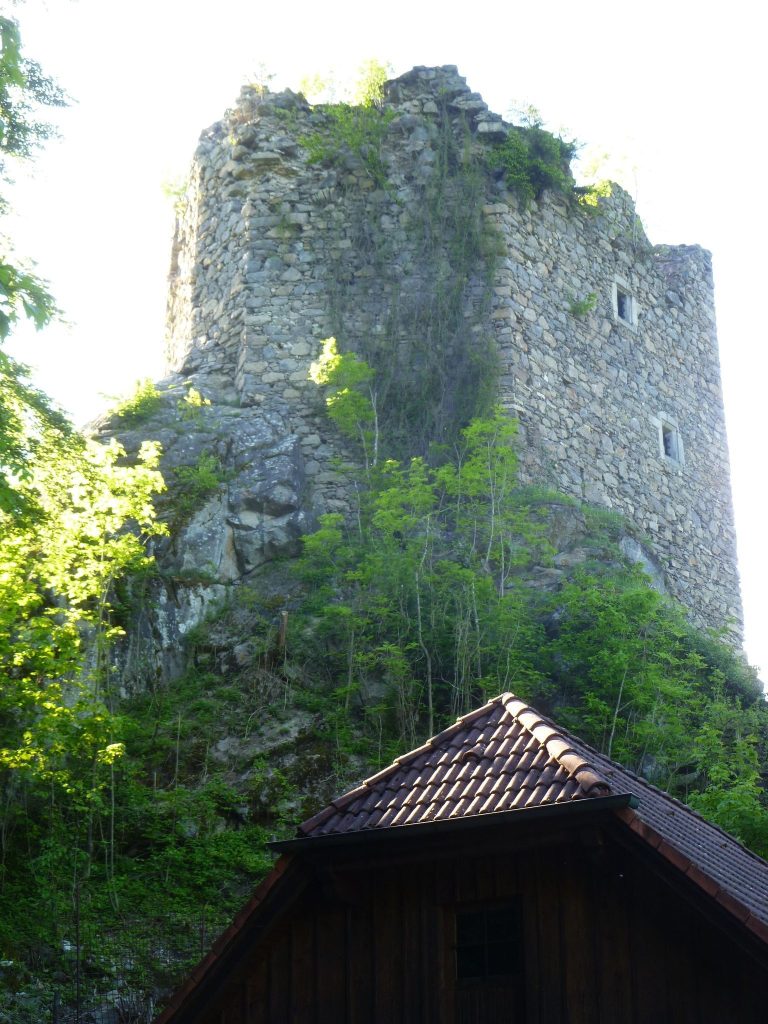
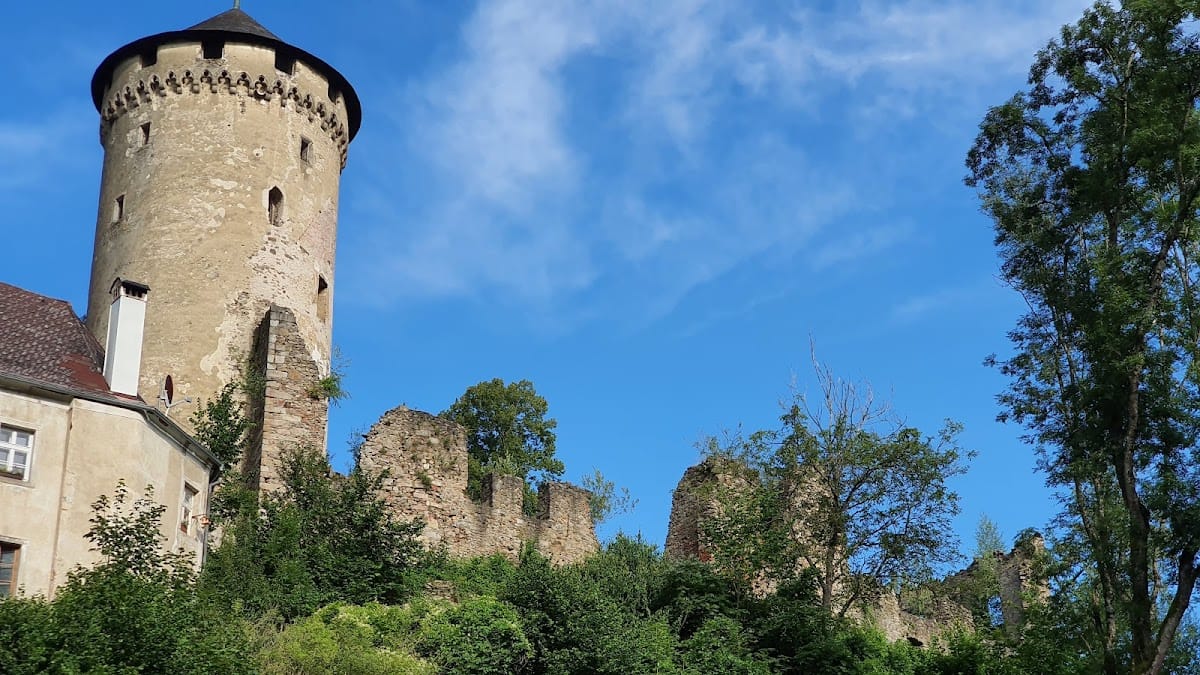
Burg Wildberg is a medieval castle-palace complex in Austria, located in Kirchschlag bei Linz in the Mühlviertel region of Upper Austria. Probably established in the twelfth century by the high-free noble Haunsperger family, it controlled the Haselgraben, part of the Linzer Steig route between Bohemia and the central region of Upper Austria. The complex is described as the oldest castle complex in the Mühlviertel and the largest castle ruin in Upper Austria.
Origins and the Starhemberg connection
Wildberg enters the written record in 1145. Its position above the Haselgraben gave the castle both strategic and economic value, since movement along this route could be overseen from the hilltop. On 30 June 1198, the Wildberg fief, a landed holding granted within a feudal relationship, passed to Gundaker II of Steyr. He was the son of Gundaker I and the son-in-law of Gottschalk of Haunsperg-Wildberg.
Gundaker II is regarded as an ancestor of the later Starhemberg family. The Starhembergs have held Wildberg since the High Middle Ages, making it the oldest seat that remains in the family’s possession. In July 1394, the castle became the temporary prison of Wenceslaus IV, who was King of Bohemia and King of the Romans. Rebellious nobles in Prague had captured him during conflicts within the House of Luxembourg. On 5 July, Kaspar and Gundaker of Starhemberg received the king and confined him in a tower room. Pressure from German princes led to his release on 1 August 1394.
Expansion and transformation
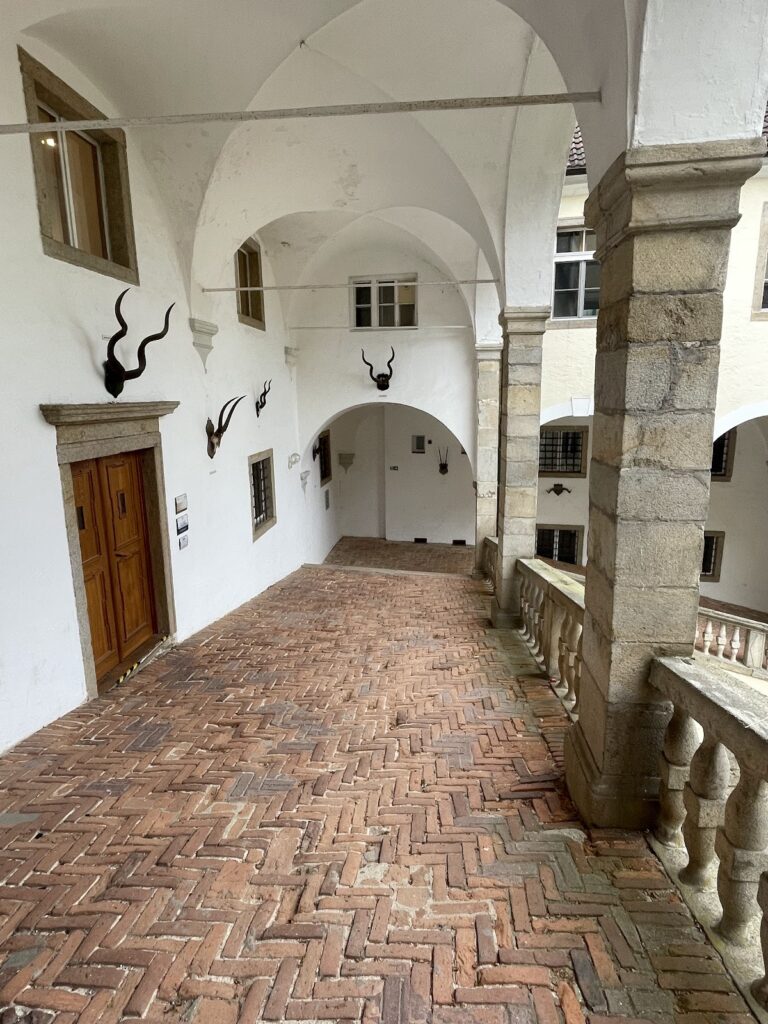
Wildberg developed beyond its medieval defensive core. Around the middle of the sixteenth century, a Renaissance building with an arcaded passage, a gallery formed by a row of arches, was erected between the tower and the Gothic castle. A fire damaged the complex in 1654, but repairs followed soon afterwards. In 1664 and 1665, a palace was built on the site of the former outer bailey, adding a residential and representative component to the older fortress.
By around 1750, the lordship of Wildberg, together with Auerberg and Lobenstein, comprised 703 subjects. The Wildberg branch of the Starhemberg family died out in 1857, and ownership then passed to the Schaunberg-Eferding branch of the same family.
Decay, preservation, and cultural use
At the beginning of the 1920s, the roof of the old palas, the principal residential and representative building of a medieval castle, collapsed. This event marked extensive decay in the northern castle area. In 1965, the Starhemberg forestry and estate administration leased that section to the Urfahr-Umgebung Heritage Association, which has worked since the 1970s to secure and repair the grounds.
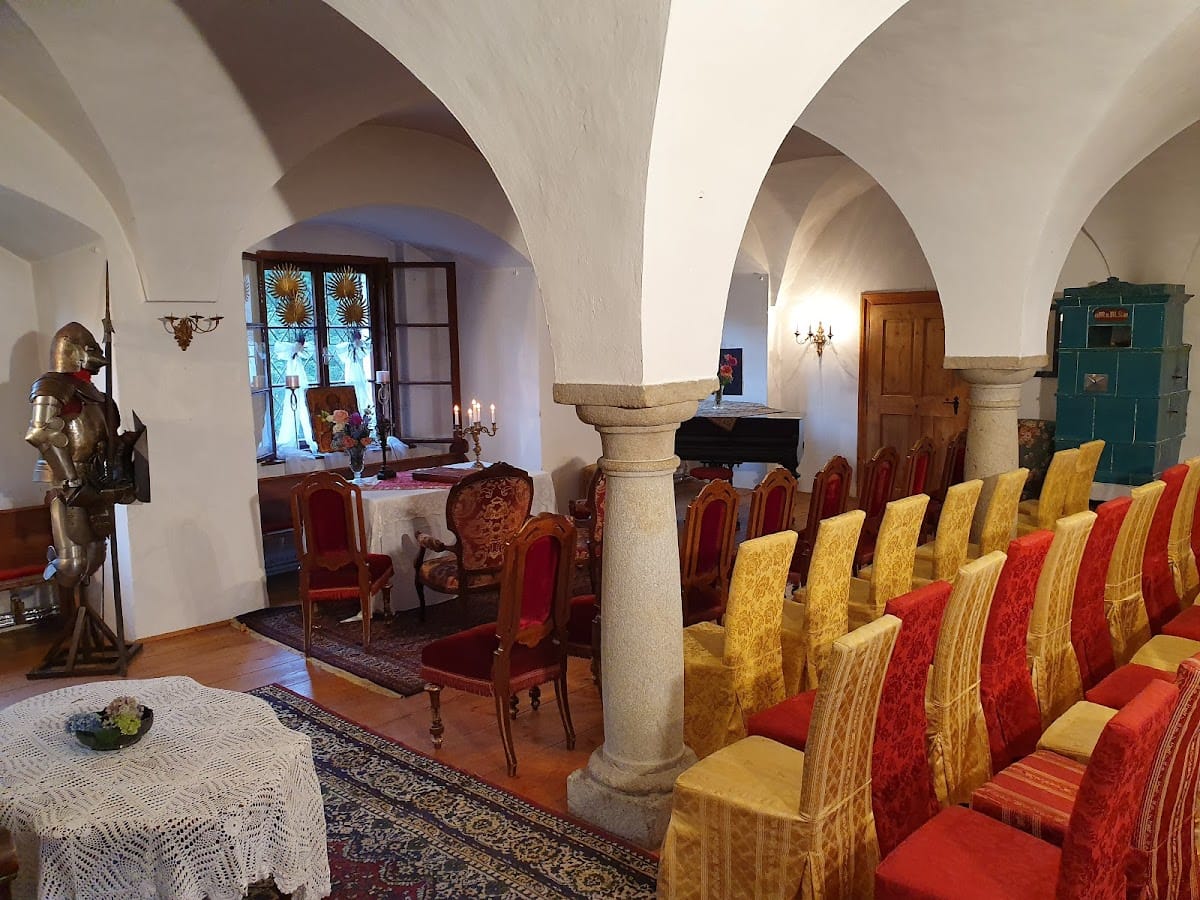
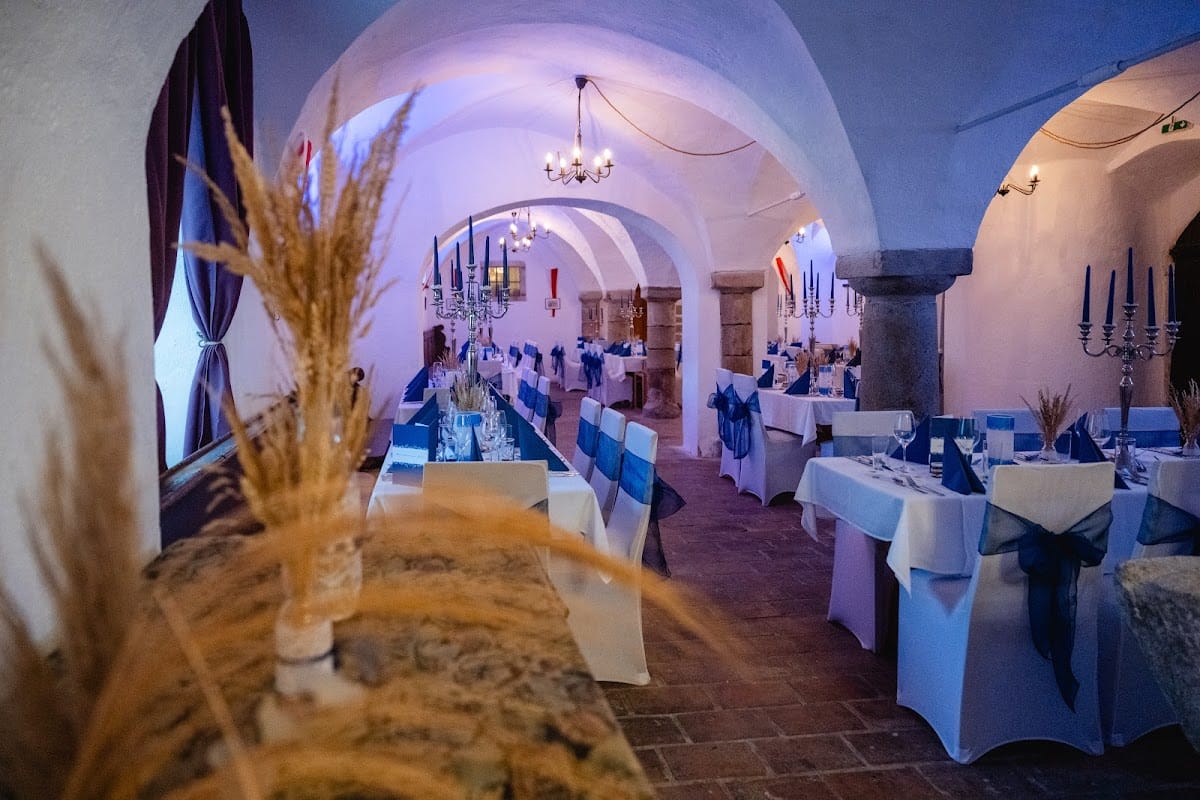
In 1983, owner Heinrich Rüdiger Starhemberg transferred the dilapidated palace building to an association founded by the ORF presenter Helmut Heinz Ecker under a usufruct arrangement. From 1984, the Cultural Association Schloss Wildberg used the palace for artistic purposes. Extensive renovation and preservation work made the building suitable for exhibitions, readings, concerts, opera, drama, and other cultural events. The cultural association and later the Sonare association operated the palace until 2018 under lease or usufruct arrangements. Burg and Schloss Wildberg remain in private Starhemberg ownership.
Wildberg in Austrian literature
The castle also entered the literary landscape of nineteenth-century Austria. Adalbert Stifter made Schloss Wildberg the setting of his unfinished 1830 story Julius. He also referred to the complex in Der Waldgänger, mentioning its old walls, dark round tower, and the imprisonment of the Bohemian king.
Remains
Setting and medieval high castle
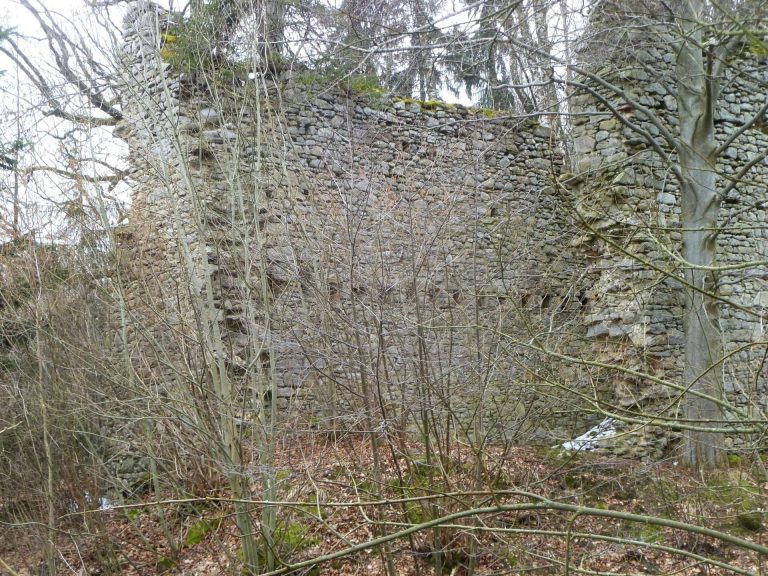
The castle-palace complex extends from south to north along a set-back hilltop on the western slope above the Haselgraben, at an elevation of 598 metres. Its total built area is 4,430 square metres, while the main castle occupies 2,180 square metres. The higher southern section on the summit contains the medieval high castle, which is partly ruined. Sections of the former palas exterior walls survive, together with remnants of the curtain wall, the defensive wall that enclosed or protected the castle.
The round fortified tower
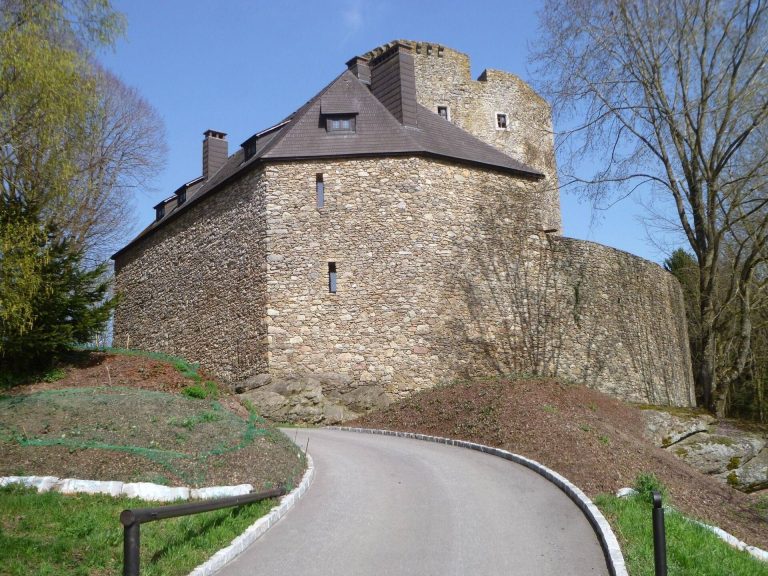
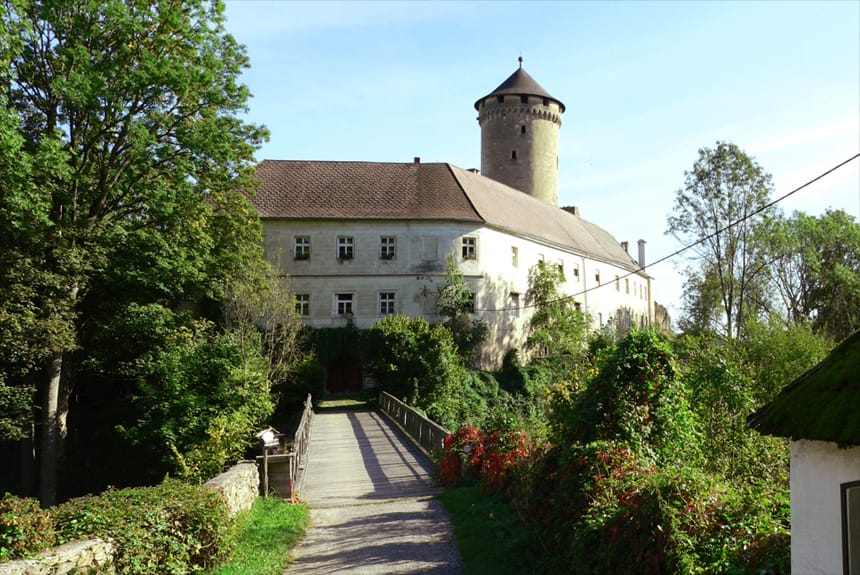
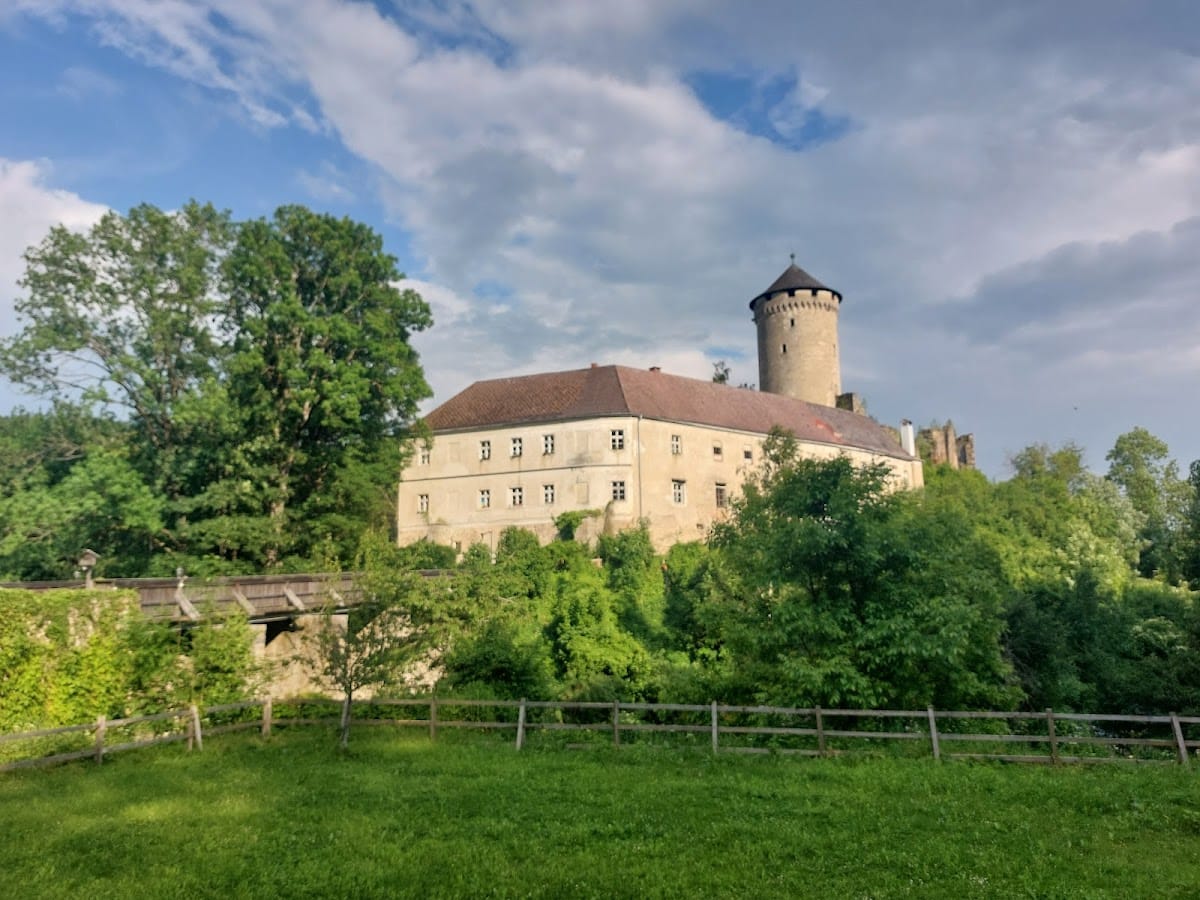
The fourteenth-century bergfried, the principal fortified tower used for defence and refuge, remains in good condition. This round tower rises 27 metres and has a conical roof with battlements. Its walls are 3.45 metres thick at the base. The tower is accessible to visitors and forms one of the most substantial surviving elements of the medieval castle.
The Renaissance passage
Between the tower and the Gothic castle stands the Renaissance building added around the middle of the sixteenth century. Its arcaded passage creates a gallery of repeated arches within the older complex and represents the period when the defensive site was adapted to changing residential and architectural needs.
The northern palace complex
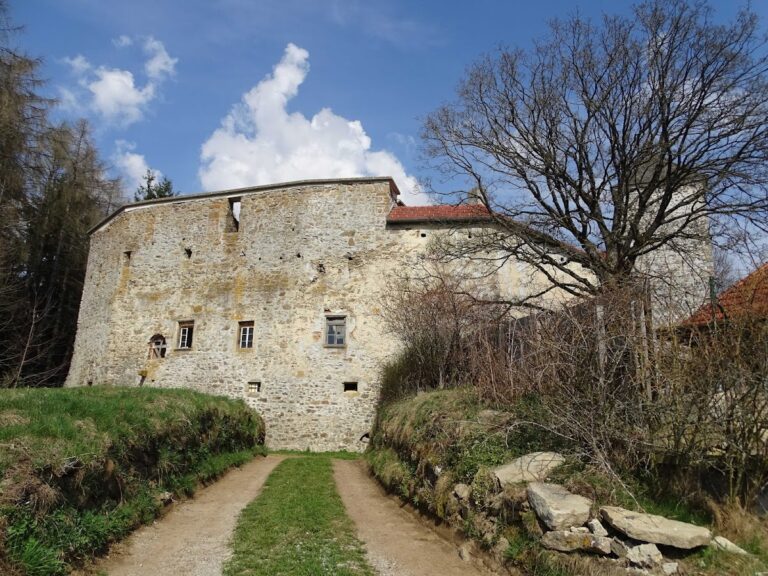
The lower palace occupies the northern part of the site. It is described as a fifteenth-century complex of three wings that incorporates sections of the medieval fabric. The wings enclose a trapezoidal courtyard, giving the northern area a more formal residential arrangement than the elevated high castle.
Gate and bridge
A large Gothic gate closes the courtyard on the north. Beyond it, a bridge crosses the deep neck ditch, a defensive ditch cut across the narrow land connection of a projecting hilltop, and leads out from the palace. The gate, ditch, and bridge form the principal surviving access arrangement of the lower complex.
Palace interiors and condition
The complex remains in structurally poor condition and requires extensive renovation. The northern castle area was especially affected by the collapse of the old palas roof in the early 1920s. The palace rooms have nevertheless been adapted for cultural use, accommodating exhibitions, readings, concerts, opera, drama, and other public events.