Deddington Castle: A Norman Motte-and-Bailey Fortress in England


Site at a Glance
- Rating
- 3.5
- Popularity
- Low
- Country
- United Kingdom
- Primary era
- Medieval
- External website
- Open
- Eras represented
- Medieval
- Civilizations
- Norman
- Site type
- Military
- Remains
- Castle
On this page11 sections
History
Deddington Castle is an extensive Norman motte-and-bailey fortress in the United Kingdom, built at Deddington soon after the Norman Conquest in the 11th century. The castle occupied a wealthy former Anglo-Saxon estate and became an administrative centre and military stronghold associated with Bishop Odo of Bayeux, the powerful half-brother of William the Conqueror.
Foundation under Odo of Bayeux
The site may earlier have served the Anglo-Saxons as an administrative centre for their landed estates. Odo probably established the castle as the caput, or administrative centre, of his Oxfordshire and Buckinghamshire lands. Deddington was one of his richest manors, and the fortress may also have been intended to accommodate a large military force if an Anglo-Saxon revolt threatened Norman rule.
Odo rebelled unsuccessfully against William II in 1088 and lost his lands. His Oxfordshire manors then returned to royal control and were divided among sub-tenants. The first recipient of Deddington Castle is uncertain, although Robert de Beaumont, Earl of Leicester, may have controlled it by 1130.
Expansion and stone rebuilding
Additional earthworks divided the western part of the castle in the early 12th century, creating an outer bailey and a smaller inner bailey. A bailey was an enclosed court within a castle complex. The purpose of this subdivision is uncertain, but it may have strengthened the defences during the threatened invasion of Robert II, Duke of Normandy, in 1101, or during the succession crisis that followed the sinking of the White Ship in 1120.
By 1157, William de Chesney owned Deddington. He was an Anglo-Norman lord who had supported King Stephen during the Anarchy, the civil war and succession crisis between Stephen and Empress Matilda, and later supported Henry II after the conflict ended in 1154. William rebuilt much of the castle in stone, and his descendants continued the work during the following decades.
After William died between 1172 and 1176, Henry II granted the castle to Ralph Murdac, his nephew and a favoured supporter. Disputes between Murdac and William’s relatives, Guy de Dive and Matilda de Chesney, produced litigation over the estate. The surrounding lands went to Guy de Dive and became the Castle Manor, which remained with his family until the middle of the 14th century.
Royal control and medieval decline
King John repeatedly brought Deddington under royal control. The manor was returned to Guy de Dive in 1204, but the castle stayed in the king’s hands until the following year. After Guy died in 1214, John resumed control, which continued until the king’s death in 1216.
Deddington and its castle declined during the 13th century. The settlement had become a borough, a community with formally recognized legal and administrative privileges, and its planned streets extended westward. Nearby Banbury nevertheless overtook Deddington economically. By 1277 the castle was described as old and demolished, while in 1281 Robert of Aston and other men broke through its doors. A report of 1310 called the fortress weak, and no further repairs followed.
In 1312, Piers Gaveston, the prominent favourite of Edward II, may have been held at Deddington after Aymer de Valence, Earl of Pembroke, left him there on 9 June while visiting his wife. Gaveston may instead have stayed in the village rectory. Guy de Beauchamp, Earl of Warwick, seized him the following morning and took him to Warwick Castle, where Gaveston was tried and killed by his enemies.
The castle remained inhabited during the 14th century, although in greatly reduced condition. In 1364, the Dean and Canons of Windsor, the clergy responsible for administering St George’s Chapel and its estates at Windsor, acquired the castle, park, and former fishponds from Thomas de Dive. They leased the farmland but retained its profits and jurisdiction over the castle’s manorial court.
Demolition and later military use
The tower was demolished around this period, possibly in connection with the sale of stone from the castle walls to the Canons of Bicester in 1377. By the 16th century, the antiquarian John Leland recorded only that a castle had once stood at Deddington.
Deddington regained strategic importance during the English Civil War, especially between 1641 and 1645, because the village stood on the route between Oxford and Banbury. The castle served as a temporary fortress for both Royalist and Parliamentary forces. In 1644, Parliamentary troops besieged a Royalist garrison there.
Recreational use and archaeological investigation
During the 17th and 18th centuries, the site was used for grazing animals and producing timber. From the 19th century, local gentry used it as a recreational and sporting ground for cricket and archery. A lodge was built at the entrance, and a pavilion containing a ballroom and cafe stood within the grounds until it was demolished at the beginning of the 20th century. Ownership passed from the Dean and Canons of Windsor to the Ecclesiastical Commissioners of the Church of England in 1886, while stone continued to be removed from the castle remains for local building projects until the 1940s.
The site housed the Deddington and District Rifle and Revolver Club from 1945 to 1981. In 1947, the Ecclesiastical Commissioners sold the castle to Deddington Parish Council. Plans for tennis courts in the inner bailey were abandoned after builders uncovered medieval pottery and roof tiles. An archaeological investigation sponsored by the Ashmolean Museum and directed by Edward Jope and Richard Threlfall continued until 1953. Further investigation was carried out by Queen’s University Belfast under Richard Ivens from 1977 to 1979, after which the site was used as a public park.
Deddington Castle is a scheduled monument, meaning that it is an archaeological or historic site protected under UK law because of its national importance. In the 21st century, Deddington Parish Council manages the western bailey, English Heritage cares for the inner bailey, and the eastern bailey remains under cultivation.
Remains
Earthworks and baileys
Deddington Castle occupies a spur overlooking a nearby stream on the eastern side of the medieval settlement, opposite the village church. It is an unusually extensive motte-and-bailey earthwork, combining a raised defensive mound, or motte, with enclosed courts known as baileys. The original arrangement comprised two baileys of about 3.4 hectares each, with a large motte between them. Its scale and design resembled the initial form of Rochester Castle, another major fortress associated with Odo of Bayeux.
The western bailey measured about 170 by 240 metres. An earth bank approximately 5 metres high rose from a ditch around 15 metres wide, and its summit formed a rampart about 2.5 metres across. Entrances stood on the western side and at the north-eastern corner. In the early 12th century, the western bailey was divided into an outer bailey of approximately 3 hectares and an inner bailey of about 0.4 hectares at its eastern end.
The eastern bailey extended downhill towards the stream and may have contained two fishponds. Another pond, known as the Fishers, lay farther south-east along the stream and was probably associated with the castle. The eastern bailey remains under cultivation, while the western and inner baileys are managed separately.
Early hall and inner defences
An L-shaped stone hall stood near the motte in the western bailey during the castle’s initial phase. The earthworks added in the early 12th century later pressed against the building and partly buried its western wall.
William de Chesney enclosed the inner bailey with a stone curtain wall, a fortified enclosing wall approximately 2 metres thick and constructed from mortared ironstone rubble. The wall cut through the motte, whose central section was removed to accommodate it. The inner bailey was then rebuilt with a chapel, hall, solar, and service buildings. A solar was a private residential room associated with the lord’s household.
Tower, gatehouse, and later alterations
An open-backed square stone tower was built along the curtain wall on top of the motte. It was later rebuilt, probably because pressure from the surrounding earthworks affected it. The summit of the motte was relaid with flagstones to form paths around its top. A stone gatehouse in the western side of the curtain wall provided entry from the outer bailey.
During the later medieval occupation, the upper levels of the tower were abandoned. Wood was burned against the inner faces of its walls in a crude fireplace. The tower was demolished around the 14th century, and stone from the curtain wall was later taken for reuse, including material sold to the Canons of Bicester in 1377.
Later buildings and surviving evidence
The 19th-century lodge stood at the entrance and housed a professional coach. The grounds also contained a pavilion combining a ballroom and cafe until its demolition at the beginning of the 20th century. Medieval pottery and roof tiles found in the inner bailey in 1947 led to the archaeological investigation that continued through the middle of the century.
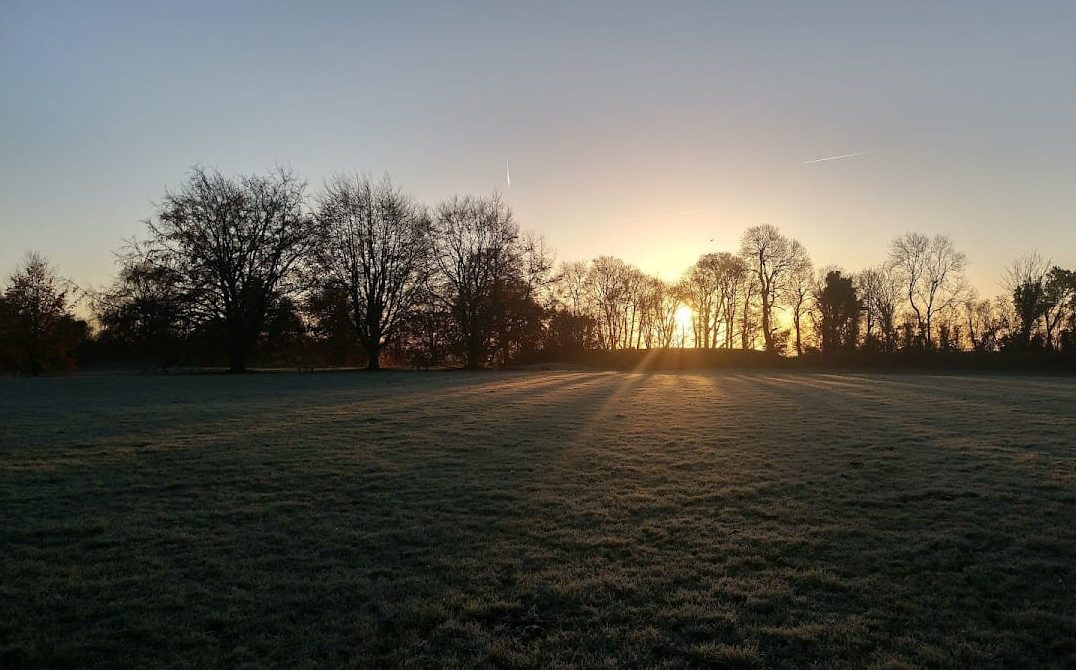
Only the castle’s earthworks remain visibly above ground today. The buried evidence and surviving banks, ditches, baileys, and motte preserve the physical outline of a fortress that developed from an early Norman earthwork into a partly stone-built medieval castle.
Nearby sites