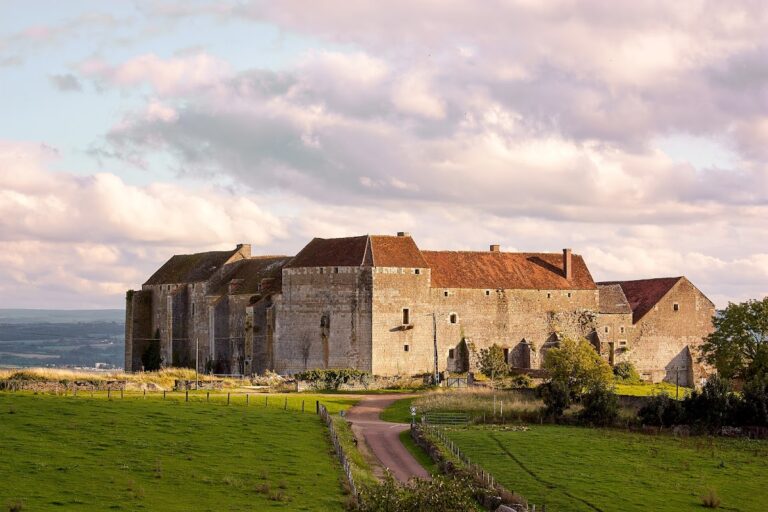
Château de Noyers-sur-Serein: A Medieval Fortress and Lordly Seat in France



Site at a Glance
- Rating
- 4.2
- Popularity
- Low
- Country
- France
- Primary era
- Medieval
- Eras represented
- Medieval
- Civilizations
- Duchy of Burgundy
- Site type
- Military
- Remains
- Castle
On this page16 sections
History
Château de Noyers-sur-Serein is a medieval fortress in France, built by the lords of Noyers before the eleventh century as a military stronghold and the seat of their lordship. By the second half of the eleventh century, the lords controlled eighty fiefs dependent on the castle. The early complex consisted of a large square keep and a chapel, but successive owners expanded it into a major fortified center in northern Burgundy.
From lordly seat to major fortress
During the twelfth century, Clarembaud de Noyers enclosed the keep with a defensive wall. He joined King Philip Augustus on crusade in 1190 and died there. His brother Hugues de Noyers, bishop of Auxerre and guardian of his nephew Miles VI, undertook a much larger building campaign between 1196 and 1206.
Hugues added a lordly residence, a three-part defensive circuit, underground passages, another chapel, and deep ditches cut into the rock. These works followed the principles of French royal military architecture developed under Philip Augustus and his successors, which emphasized strong masonry, planned defensive walls, towers, ditches, and controlled entrances. The expanded castle became one of the finest and wealthiest fortresses in France. Hugues also enclosed the village below the castle with a wall. The settlement had grown within a bend of the Serein.
In 1216, during the War of the Champagne Succession, a struggle over the inheritance of the county of Champagne, Miles VI and his brother-in-law Erard of Brienne took refuge at Noyers with their supporters. They endured a siege lasting several months by Blanche of Navarre and successfully held the fortress.
Burgundian stronghold and noble power
Noyers was initially a noble allod, land held freely without homage to a superior lord. Miles X of Noyers later transferred the superior feudal authority over the castellany, the territory governed from the castle, to Duke Robert II of Burgundy in exchange for 7,000 livres tournois. Noyers thereby became a Burgundian stronghold on the frontier between the duchy and Champagne, which had recently been incorporated into the royal domain.
Miles X became marshal of France under Philip the Fair in 1303. He also governed Artois, advised several French kings, and fought at Courtrai, Mons-en-Pévèle, Cassel, and Crécy. In 1366, Miles XII received Duke Philip of Burgundy at the castle while the duke travelled from Paris to Avignon to meet Pope Urban V. The senior branch of the Noyers family ended with Miles XII’s death in 1370, while a junior branch descended from Jean de Noyers and represented by the counts of Joigny continued into the early fifteenth century.
War, repair, and artillery
During the Hundred Years’ War, the prolonged series of conflicts between the French and English crowns from the fourteenth to the fifteenth century, Edward III of England abandoned plans to besiege Noyers in 1360 because Jean de Noyers was being held prisoner by the English after the Battle of Poitiers. After Edward dismissed his mercenary army following the Treaty of Brétigny, armed bands pillaged Burgundian towns, and Noyers suffered severely.
Margaret of Bavaria, widow of John the Fearless, purchased the castellany in 1419. A survey commissioned by her described deterioration caused by poor maintenance and the disturbances of the Hundred Years’ War. Major repairs continued until 1429, including masonry work, carpentry, and the roofing of towers. The defenses were also adapted for artillery.
Noyers was regarded as one of the keys to Burgundy on the Champagne side during the conflict between Armagnacs and Burgundians. In September 1343, Burgundian forces used the castle as a headquarters for operations against Avallon. The following year, Jacques d’Espailly, known as Fortépice, and his troops failed in an attempt to seize Noyers and Montréal. Royal troops unsuccessfully besieged Noyers in 1463, while reinforcements and artillery were sent there in 1472.
From the Burgundian collapse to the Wars of Religion
After Charles the Bold died at the Battle of Nancy in 1477 and the Burgundian state collapsed, Noyers was granted to Charles d’Amboise de Chaumont, who had helped Louis XI conquer Burgundy. The Treaty of Senlis transferred Noyers to the Austrian house in 1493. A clause in the Treaty of Cambrai in 1508 assigned the castellany to Jeanne de Hochberg, countess of Neuchâtel, as compensation for the loss of Fort Joux.
Francis I appropriated Noyers in 1516 after the death of Jeanne’s husband, Louis d’Orléans-Longueville. Jeanne recovered the inheritance under the Treaty of Nice in 1538. After her death in 1543, her son François d’Orléans-Rothelin succeeded her and died at Noyers Castle in 1548. His widow, Jacqueline de Rohan, administered the estates as guardian of their children.
Françoise d’Orléans-Longueville inherited Noyers and married Louis de Bourbon, Prince of Condé, on 8 November 1565. The land of Noyers was then raised to a county, making Louis de Bourbon its first count. During the French Wars of Religion, the conflicts between Catholics and Protestants that divided France in the sixteenth century, Condé led the Huguenot party. A Huguenot was a French Protestant, especially a Calvinist, and Condé used Noyers as one of his Burgundian residences.
After the second war, Condé took refuge at Noyers with his wife and children and strengthened both the castle and the town. The garrison reached 200 men. In August 1568, Condé and the Coligny family fled Burgundy for La Rochelle after learning of a planned arrest of Protestant leaders. On royal orders, the Count of Tavannes besieged Noyers. His artillery opened three breaches in the medieval walls, and the garrison capitulated on 2 November 1568. The castle was sacked and its furnishings dispersed despite the surrender terms. Protestants briefly recaptured it before surrendering to Marshal de Cossé later that year.
Destruction and later ownership
In 1569, after the Protestant defeat at Jarnac and Condé’s death, the castle was held by a captain and twenty-five men. When plague broke out in the town, the garrison deserted and Huguenots occupied the fortress. Charles IX ordered it dismantled. A royal army captured, pillaged, and ruined the castle, and inhabitants massacred part of the garrison.
During the later civil war between royalists and the Catholic League, a political and military organization opposed to the recognition of Henry IV, royalist forces were expelled from Chablis by Leaguers in 1590. The remaining castle was besieged in 1591 by Charles de Choiseul-Praslin, the king’s lieutenant in Champagne, but Marshal d’Aumont captured Noyers.
In 1592, François de la Magdelaine, seigneur of Ragny and royal governor of the town and castle, was besieged by Jean de Saulx. Antoine Duprat, Baron of Vitteaux, then seized Noyers by surprise with his lieutenant Villeferry, strengthened its defenses, and installed a large garrison. La Magdelaine’s attempt to retake the place failed with heavy losses.
In 1593, inhabitants seized Villeferry while the baron was away and called La Magdelaine and neighboring lords for assistance. Vitteaux retook the castle by treachery, after which a truce separated the League-held castle from the royalist town. On 17 May 1595, soldiers from the castle secretly entered the town, killed the guards at one gate, and opened it to League troops from Avallon and the surrounding area. The town was captured and pillaged.
Marshal Biron’s forces besieged the castle, and Antoine Duprat submitted to Henry IV on 6 July 1595. He agreed to surrender the town and castle to the king within two years in return for a substantial indemnity and permission to remove the castle’s cannon and ammunition. He left Guillaume Drouas de La Plante as commander. Henry IV returned Noyers to the Princess of Condé and her son Charles de Bourbon-Soissons, but an edict of March 1599 ordered the castle razed so that it could not support another revolt against royal authority. The castle of Montréal was destroyed under the same policy in that year.
After the destruction, the county of Noyers chiefly provided income for its powerful owners rather than serving as a residence. A captain of the town and castle was still appointed in 1611, when the office was held by François Estiennot, who later also became governor. The county passed to the house of Luynes in 1710 through the marriage of Louise-Léontine de Bourbon to Charles-Philippe d’Albert, fourth Duke of Luynes.
Despite the order of Henry IV, complete towers and large sections of wall remained visible. Louis-Joseph de Luynes authorized their demolition in 1785 and again in 1788–1789, so that a wall could be built along the Serein and work could be provided for the poorest inhabitants. He sold the county and its dependencies in 1789–1790.
Rediscovery and conservation
After centuries of abandonment, the old castle became a wooded and difficult-to-access site, with masonry stumps largely hidden by vegetation. Ernest Petit’s work in the second half of the nineteenth century improved knowledge of the ruins, although the castle remained little known even among historians.
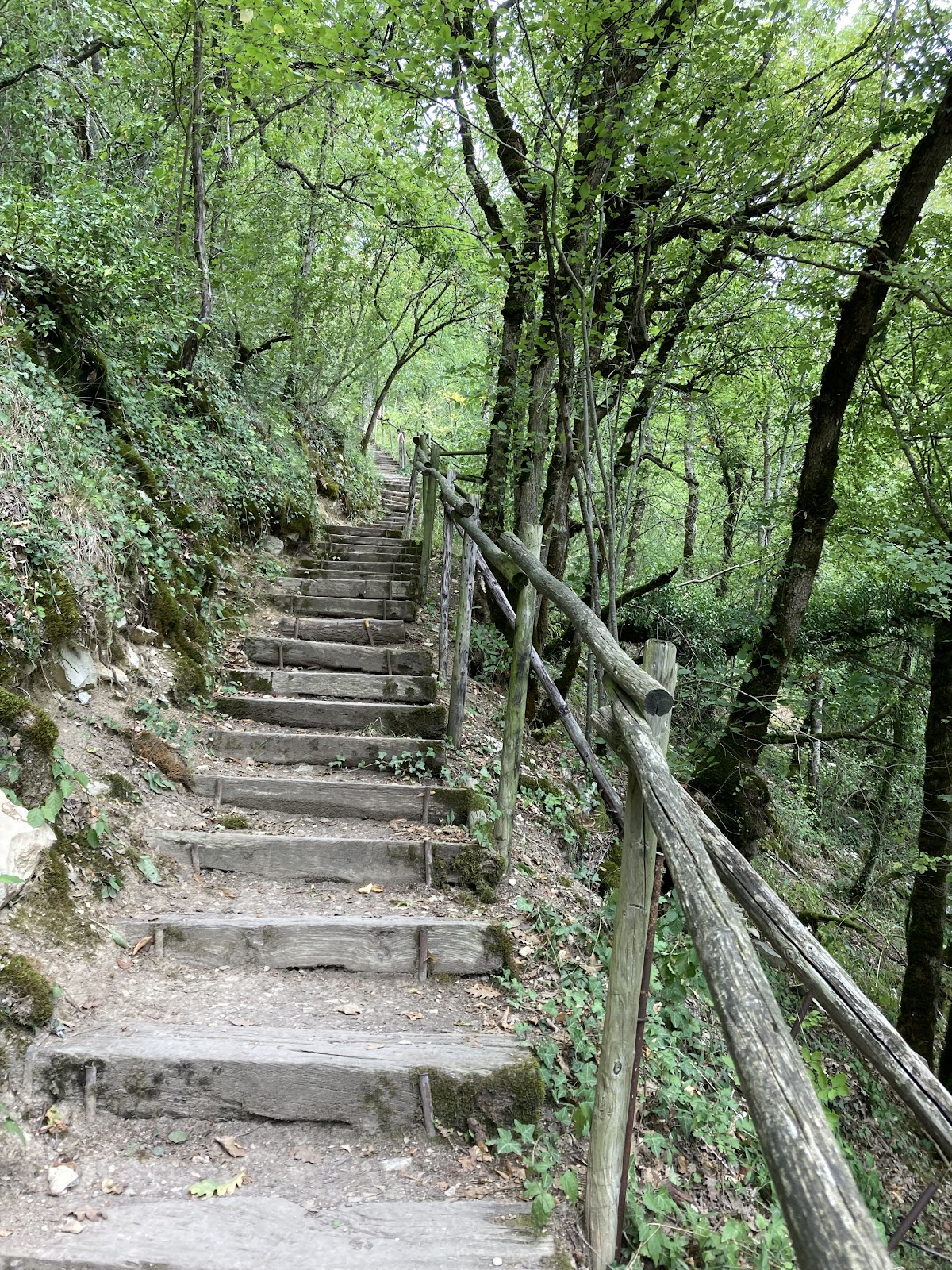
In 1998, enthusiasts founded the association Le patrimoine oublié to rehabilitate and interpret the site. Subsequent work cleared vegetation, excavated the ruins, and restored two towers and a section of curtain wall. Volunteers from Chantiers Histoire et Architecture Médiévales took part in restoration work in 2015 and 2016. Since 2000, archival research has further developed knowledge of the castle’s history, while paths and interpretive signage have made its archaeological layout accessible for interpretation.
Remains
The fortress occupied a triangular plateau, with two sides overlooking the Serein. Its southern point reached the town of Noyers, while the less steep northern side faced the principal approach. The natural position was reinforced by three defensive circuits, broad rock-cut ditches, more than twenty towers, and several fortified gate structures with drawbridges. The surviving ruins consist of broken masonry, two towers undergoing restoration, and part of a curtain wall, the connecting defensive wall between towers.
Approaches and outer defenses
Venoise Gate
At the southern point, the Venoise gate connected the fortress with the town. It was a fortified gate structure equipped with a drawbridge. Entry into the castle required movement through successive defensive works before reaching the inner court.
Grands Vergiers defenses
On the northern side, the outer defensive circuit at Grands Vergiers consisted of ramparts and towers. Beyond it lay a broad ditch cut into the rock, followed by a wall strengthened with five towers. These works protected the side where the natural slope offered the least defense.
Lower bailey
Behind the outer defenses was a lower bailey, or fortified outer courtyard. It contained accommodation for men-at-arms and a chapel. The approach continued across advanced defensive works equipped with drawbridges, through a protected fighting passage between the defensive walls, and toward the honor court of the main castle.
Main castle
Keep and honor court
The main castle stood beyond a double ditch. Its honor court included the large square keep built in the eleventh century, a cistern, a chapel, and the seigneurial residence. The keep and chapel formed the core of the earlier castle before the major expansion between 1196 and 1206.
Seigneurial residence and later works
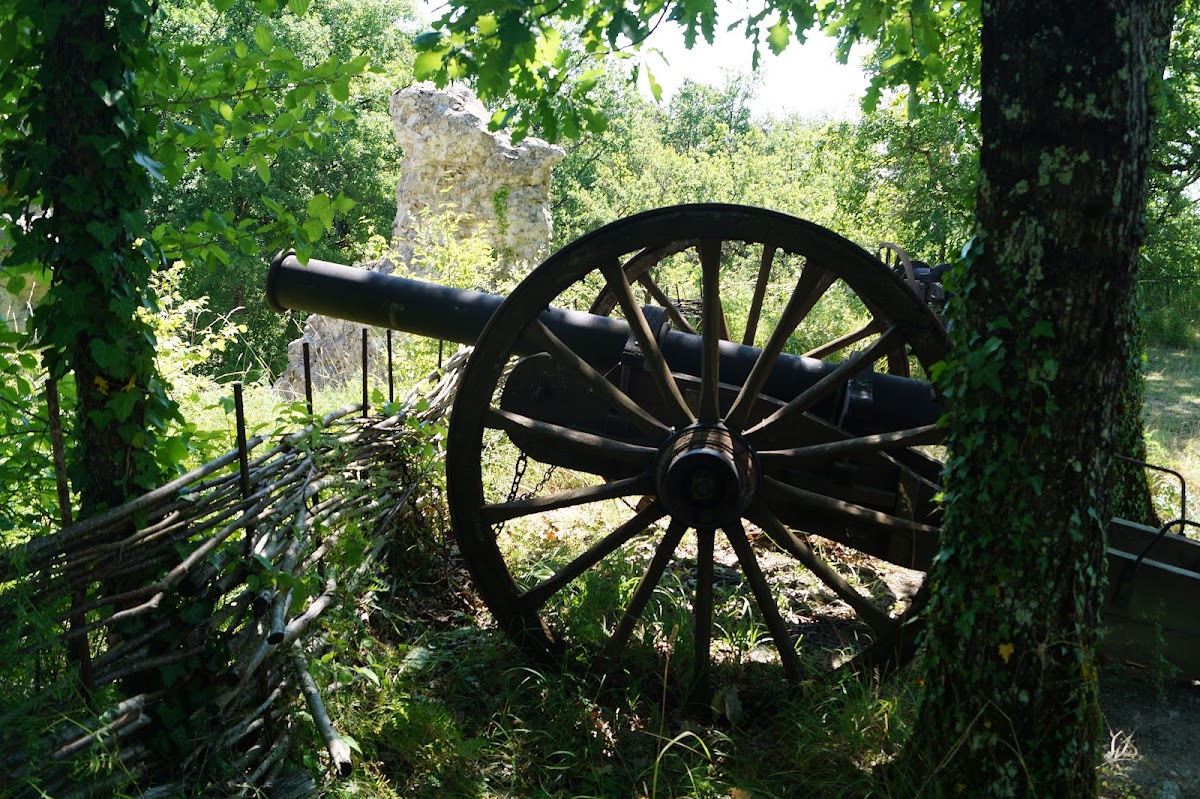
The seigneurial residence belonged to the enlargement carried out under Hugues de Noyers. The same campaign added the triple defensive circuit, underground passages, a further chapel, and deep ditches cut into the rock. Fifteenth-century repairs rebuilt masonry, renewed carpentry, and provided roofs for the towers. The defenses also received three veuglaires, small cannons used for fortress defense, and four cannon, including one of very large caliber.
Surviving ruins
The castle suffered heavy damage during the Wars of Religion and was later dismantled under the order of 1599. Complete towers and large wall sections still survived into the eighteenth century before further demolition in 1785 and 1788–1789. Woodland and vegetation subsequently concealed much of the masonry. Clearing and excavation have since exposed parts of the layout, while restoration has focused on two towers and a section of curtain wall.