Danków Castle: A Bastion Fortress in Poland


Site at a Glance
- Rating
- 4.4
- Popularity
- Low
- Country
- Poland
- Primary era
- Early Modern
- Eras represented
- Early Modern
- Civilizations
- Polish–Lithuanian Commonwealth
- Site type
- Military
- Remains
- Castle
On this page11 sections
History
Danków Castle is a ruined bastion fortress in Poland, developed in the first half of the seventeenth century during the period of the Polish-Lithuanian Commonwealth. It stands beside the Liswarta River at a historic crossing between Lesser Poland, Greater Poland, and Silesia. The settlement’s position on the route between Greater and Lesser Poland made it a meeting place for rulers and a strategically important border location.
Medieval settlement and princely meetings
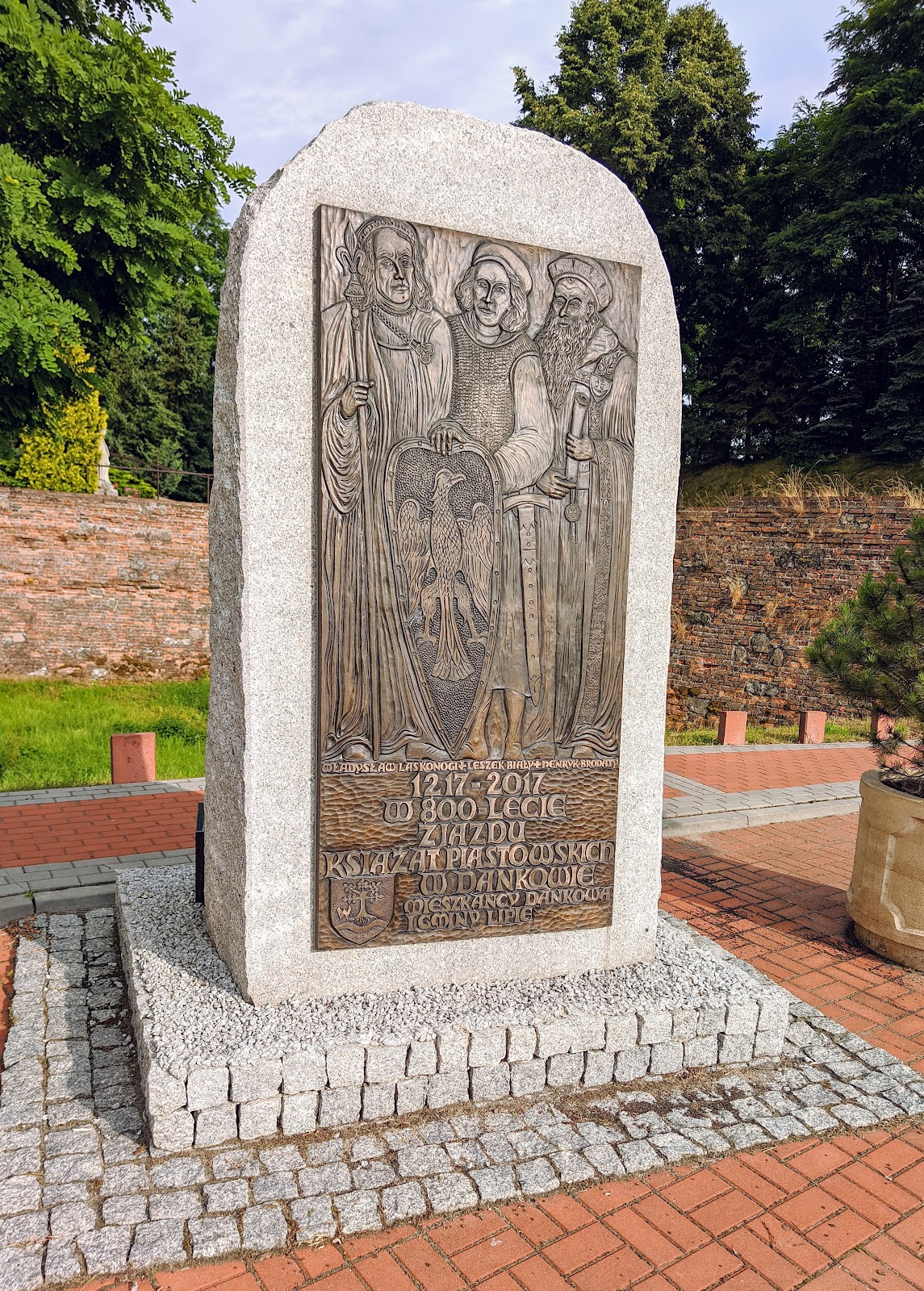
Danków first appears in written records in 1217, when Leszek the White, Duke of Krakow, met Henry the Bearded, Duke of Silesia, and Wladislaus Spindleshanks, Duke of Greater Poland. Henry formed an alliance with Leszek, while Wladislaus concluded a succession agreement with him. Both arrangements opposed Wladislaus Odonic and supported Wladislaus Spindleshanks.
Henry the Bearded returned in 1234 and issued grants to Theodore, the voivode of Krakow. Chronicler Jan Dlugosz placed the betrothals of Henry’s daughters, Constance and Gertrude, to the sons of Conrad of Masovia at Danków on 29 June 1236. Documentary analysis, however, indicates that Dlugosz may have confused this settlement with another village of the same name. A grant issued in 1238 by Casimir, son of Conrad of Masovia, was also once linked to Danków, but it is now more likely to have been issued at the Masovian settlement.
Meetings in the Danków area in 1262 concerned support for Boleslaus the Pious against Casimir of Kuyavia and cooperation with King Ottokar II of Bohemia against Hungary. Boleslaus returned in 1267 and exchanged property with Bishop Thomas of Wroclaw. A provincial synod traditionally dated to Danków on 16 October 1267 brought together Archbishop Janusz of Gniezno and Bishops Paul of Krakow, Wolimir of Kuyavia, and Thomas of Wroclaw. It probably took place at another village with the same name, belonging to the archbishop.
From medieval lordship to private ownership
A document of 1283 listed Danków among towns alongside Wielun and Boleslawiec, although the settlement did not develop into an urban centre, possibly because of warfare. Silesian knights devastated Kłobuck and nearby villages in 1436, followed by further Silesian incursions in 1452 and 1457. During the war with King Matthias Corvinus of Hungary, King Casimir IV Jagiellon camped near Danków for six weeks in 1474.
The settlement probably passed into knightly hands in the early fourteenth century. The owners’ fortified seat was then a conical earthwork at nearby Zbrojewsko. Marcin of Danków is the first recorded private owner, in 1342. The first surviving record connected with the Danków parish dates from 1419, although a church and parish may have existed earlier.
Jan Hincza of Rogów, a trusted knight of King Wladislaus Jagiellon, owned Danków in 1462. After the Hincza family died out, the Kobylański family acquired the estate through marriage connections in 1478. The Renaissance poet Krzysztof Kobylański held the castle from 1540 to 1565. The exact origin of the castle remains uncertain. Medieval use of the location is established, but later claims of a thirteenth-century stronghold granted to Bishop Thomas of Wroclaw are unsupported. A small fortified residence, perhaps a masonry tower or Renaissance house, may have stood there in the fifteenth or sixteenth century.
The Warszycki fortress
Danków passed to the Warszycki family in 1581. Tradition says that Crown Treasurer Stanislaw Warszycki hosted King Sigismund III Vasa and his court there for three months in 1609 during the Zebrzydowski Rebellion, an armed revolt by Polish nobles against the king. This tradition is unconfirmed, and the estate may then have belonged to Stanislaw’s brother Andrzej Warszycki. A Warszycki residence certainly existed by 1614, when Katarzyna Warszycka married Gabriel Tarnowski, the starosta of Krakow, at Danków.
Stanislaw III Warszycki, Andrzej’s son and later castellan of Krakow, is traditionally credited with completing the modern fortifications in 1632. A castellan was a senior official who administered a castle district and often commanded its principal fortress. The fortress followed the Old Dutch and French schools of fortification, including principles associated with the French military engineer Jean Errard. Its earth ramparts, masonry facings, bastions, gates, moat, and artificial lake created a strong early modern defensive system.
Danków was probably not attacked or occupied by Swedish forces in 1655 during the Swedish Deluge, the Swedish invasion and occupation of much of the Polish-Lithuanian Commonwealth during the Second Northern War. Its modern defenses and supplies may have made it difficult for the relatively small Swedish forces in the area to take, although negotiations between Warszycki and the occupiers may also have influenced the outcome.
Royal headquarters and decline
In 1657, Warszycki hosted King John II Casimir, Queen Marie Louise Gonzaga, the commander Stefan Czarniecki, senators, and the royal court. For several months, Danków served as a political and administrative centre of the Polish-Lithuanian Commonwealth. Political negotiations were held there, imperial representatives and foreign embassies were received, military commanders were present, and royal orders and letters were issued.
According to the tradition associated with Jasna Gora, Warszycki also sent twelve heavy guns and cattle from Danków to support the monastery before its famous siege. The castle supplied similar assistance during the Great Northern War, the wider European conflict fought from 1700 to 1721 involving Sweden, Russia, and other powers.
Later owners included Michał Warszycki, the sword-bearer of Leczyca, and Stanislaw IV Warszycki, the Crown sword-bearer. Stanislaw IV’s daughter Emercjanna brought Danków as her dowry to the Lithuanian hetman Ludwik Konstanty Pociej. A hetman was a senior military commander in the Polish-Lithuanian political system. After Pociej’s death in 1730, Emercjanna sold the castle to Antoni Poniński, voivode of Poznan. The Poniński family built a manor at nearby Lipie rather than continuing to live at the castle.
Lightning caused a fire in 1767 that destroyed most of the remaining buildings. An inventory made in 1768 described the castle as abandoned and unused, with the church, kitchen, damaged storage building, and masonry cellars still present. Stanislaw Poniński leased the estate in 1773. The Wessel family later owned it, and the indebted property passed to Joachim Kempner in the nineteenth century. Danków was described as a ruin in 1823.
Archaeology and conservation
Archaeological investigations in 2014 identified traces of activity that predated the bastion fortress. These remains have not established the location or existence of a separate Gothic-Renaissance castle. The site is protected as a registered historic monument under registration number A 361/52. During conservation work in the 1970s, the most damaged brick faces of the bastions were partly refaced. The large artificial lake that had existed at Danków since the fifteenth century was also eliminated during that period.
Remains
Danków Castle occupies approximately 4.5 hectares, with an internal courtyard covering about 2 hectares. The surviving complex combines earth ramparts faced with masonry, ruined and standing gates, remnants of buildings, masonry cellars, and the Church of Saint Stanislaus. The fortress was arranged around a defended interior, with landward defenses, water protection, and controlled entrances forming a unified early modern system.
Bastions, ramparts, and water defenses
The northwestern landward front was protected by a large central bastion, a projecting artillery platform that allowed defenders to fire along the adjacent walls. On the side facing the Liswarta and the former artificial lake, the defenses followed a tenaille-shaped trace, a pincer-like arrangement strengthening the wall line. Two gates occupied the shorter sections of the fortifications and were protected by half-bastions, which projected partly from the main defenses.
A moat approximately 30 metres wide surrounded the fortress on the landward side and included a counterscarp, the outer slope or retaining edge of a ditch. The eastern side was protected by the large artificial lake, which was removed in the 1970s. The bastion faces were formed from earth ramparts with brick or other masonry facings, and the most deteriorated brick elevations were partly refaced during the same conservation period.
Castle gates
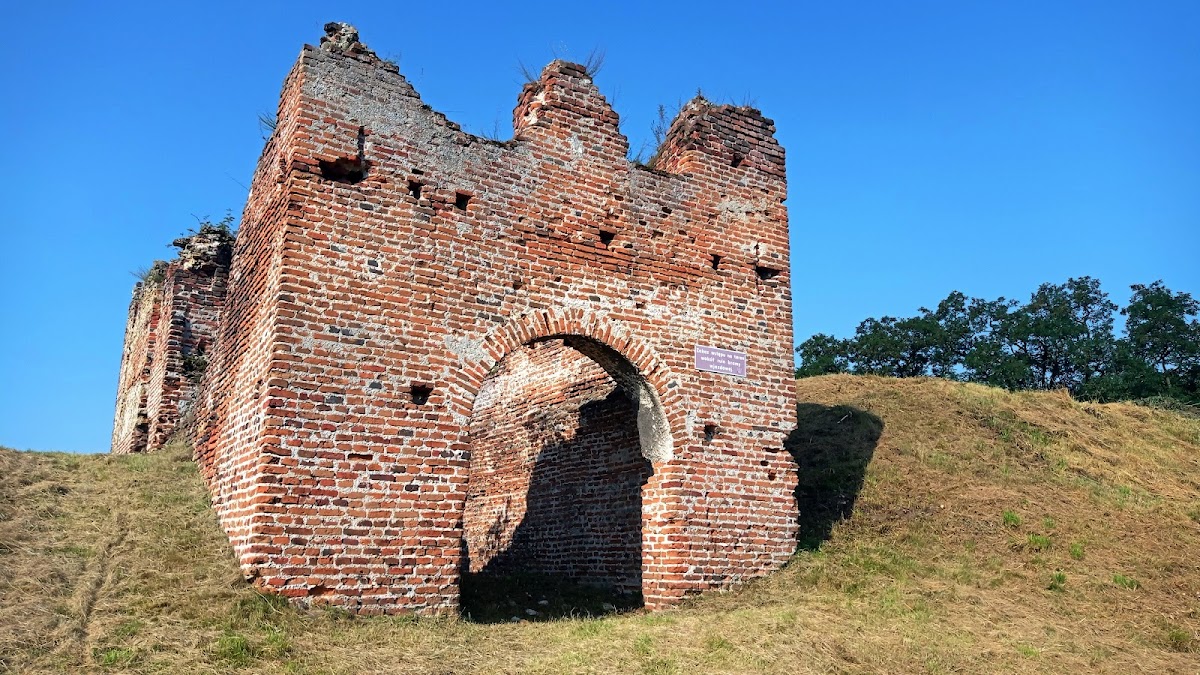
The Krzepicka Gate survives as a ruin and was constructed in two phases. Its original arrangement included a portcullis and a guardroom above the passage. A bridge provided access to the entrance. The northern gate was built as a tunnel running obliquely through the rampart. This protected passage is a potern, a concealed or sheltered gateway through a fortification.
Buildings within the fortress
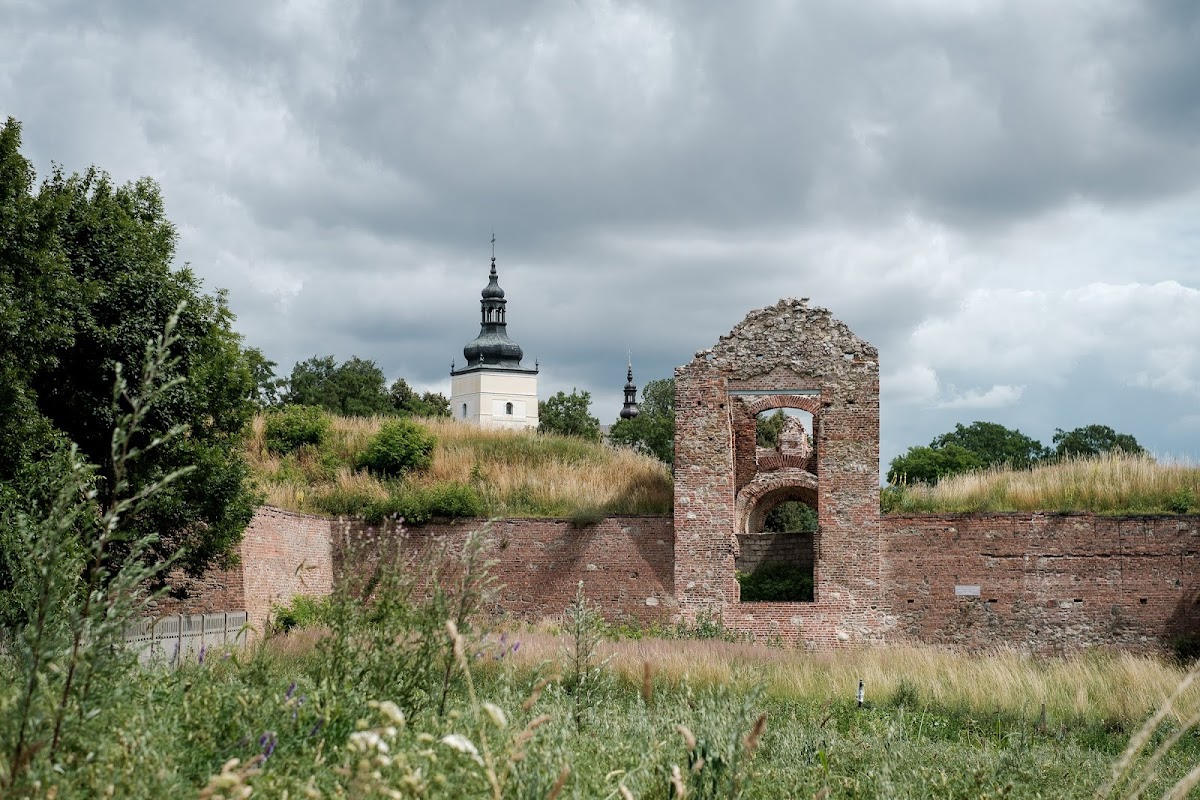
The structure known as the Castellan’s Wife’s House survives as a single stone wall. It was formerly a rectangular masonry storage building, or lamus, measuring 11.5 by 15 metres. The building probably predates the bastion defenses and once had an upper floor. Its lower walls were approximately 1.8 metres thick.
The interior also contained a kitchen, masonry cellars, and a residence probably built of wood before the bastion fortifications. The 1768 inventory listed the kitchen, cellars, and damaged storage building after the lightning-caused fire of 1767. The principal residential building did not survive, while the surviving fragments preserve the arrangement of service and storage structures within the defenses.
Church of Saint Stanislaus
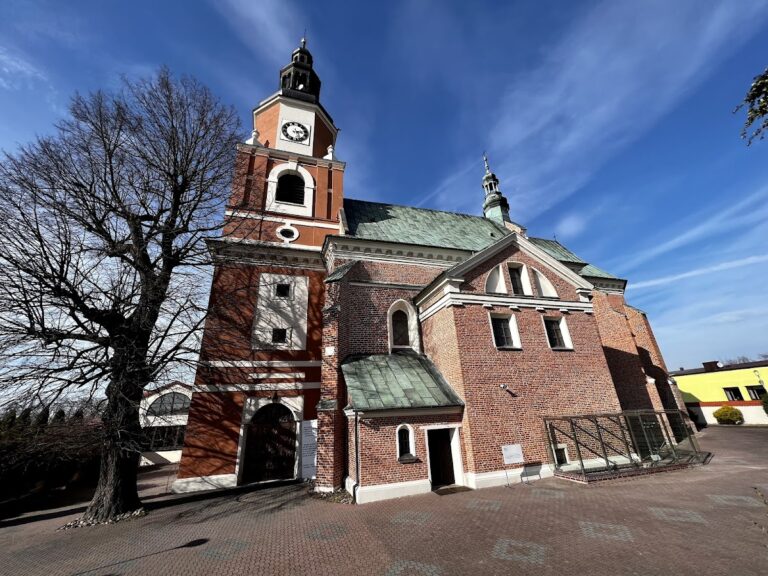
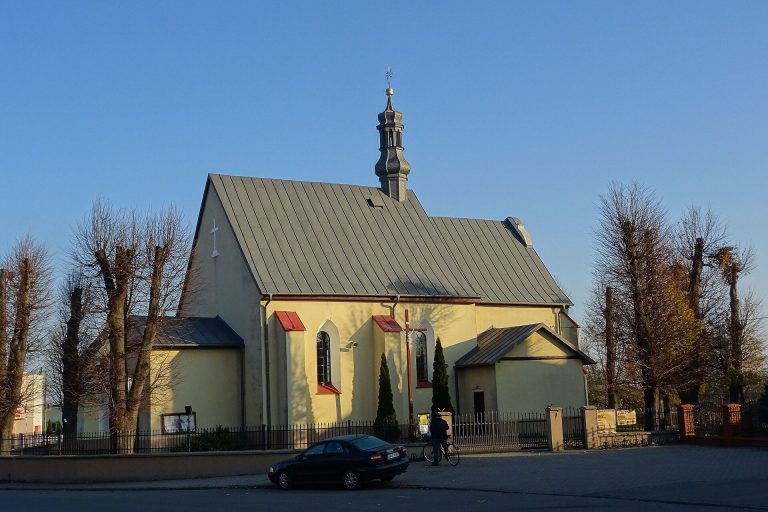
The Church of Saint Stanislaus is a substantial masonry building within the former fortress. It was probably erected in the second third of the seventeenth century by Stanislaw Warszycki, castellan of Krakow. Tradition identifies remnants of a medieval castle in the church walls, but archaeological investigations have not confirmed that interpretation.
Inside the church is an imposing tomb monument to Andrzej Warszycki, who died in 1615 and was the father of the later castle builder Stanislaw Warszycki. The church is also one of the structures listed in the 1768 inventory, linking it directly with the group of buildings that remained after the castle’s decline.