Brekov Castle: A Medieval Hilltop Guard Castle in Slovakia


Site at a Glance
- Rating
- 4.7
- Popularity
- Low
- Country
- Slovakia
- Primary era
- Medieval
- External website
- Open
- Eras represented
- Medieval, Early Modern
- Civilizations
- Hungarian
- Site type
- Military
- Remains
- Castle
On this page10 sections
History
Brekov Castle is a medieval hilltop guard castle in Slovakia, begun in the second half of the thirteenth century as part of the fortification system along the Hungarian–Polish route. It stood within a defensive network that also included Jasenov, Vinné, and Čičva.
Before and during the medieval foundation
The castle hill had already been occupied and fortified before the stone fortress was built. Archaeological work has identified an early-medieval hillfort associated with local Slavic tribes. The later castle was recorded in 1307 as castrum Barko, followed by forms such as possessio Borko cum castro in 1314, castrum Borkó in 1322, and castrum Barkou in 1330. The name Barkó was also used for the castle.
Until 1248, Sobieslav of the Ludaň family controlled extensive estates in central Zemplín, a traditional region of eastern Slovakia corresponding broadly to the former Zemplén area of the Kingdom of Hungary. Brekov, together with Jasenov and Vinné, belonged to this wider estate complex. The castle is first documented as the property of Peter Peteň in 1307.
The Druget and Zápolya periods
In 1317, Charles Robert of Anjou, king of Hungary from 1308 to 1342, granted Brekov and other estates in eastern Slovakia to Philip Druget as a reward for loyal service. The powerful Druget family retained the castle until 1486, although military control later shifted between the Drugets and other occupants.
The Zápolya family controlled Brekov between 1484 and 1488 and expanded and strengthened its defenses. In 1472, Matthias Corvinus, king of Hungary and Croatia, appointed Stephen Zápolya hereditary count of Spiš and military captain responsible for protecting the northeastern parts of Hungary. Stephen is recorded in 1488 as the castle’s castellan, or appointed commander. Brekov also became involved in internal political conflict. In 1466, troops supporting Matthias Corvinus and those of his opponent, Casimir IV, king of Poland and grand duke of Lithuania, fought beneath the castle walls.
Destruction and later decline
During the mid-sixteenth century, the owner Francis Kendy joined the noble opposition to Ferdinand of Habsburg, whose reign was shaped by the succession struggles that divided the Kingdom of Hungary. After the royal army captured Brekov in 1558, it demolished the castle.
Mikulas Druget repaired and restored the fortress in 1575. Rebel forces led by George Rákóczi attacked it in 1644 and largely destroyed it. Partial repairs to the residential buildings allowed brief renewed use, but the castle’s function ended during the anti-Habsburg uprisings of the late seventeenth century. Imre Thököly ordered its demolition in 1684, after which the ruins progressively deteriorated.
Archaeology and conservation
Brekov Castle was declared a cultural monument in 1963 and is listed as a National Cultural Heritage site by the Monuments Board of the Slovak Republic. Archaeological research and systematic conservation of the ruins resumed in the second half of the 2000s, following occasional small masonry repairs during the twentieth century. Research and conservation have continued since 2007, while reconstruction and rescue work by the Association for the Salvaging of Brekov Castle has been underway since 2009. The Municipality of Brekov owns the site, and the association has administered it since 2008 and cared for it since 2009 in cooperation with the municipality and the regional Monuments Board. Its work brings together archaeologists, historians, architects, masonry specialists, and local and regional volunteers.
Remains
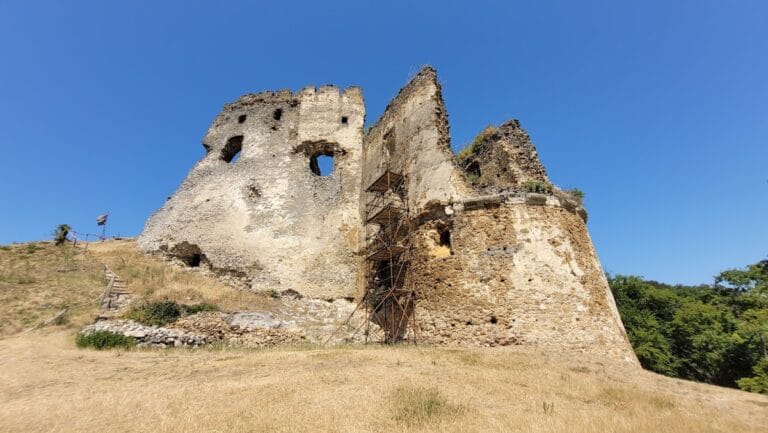
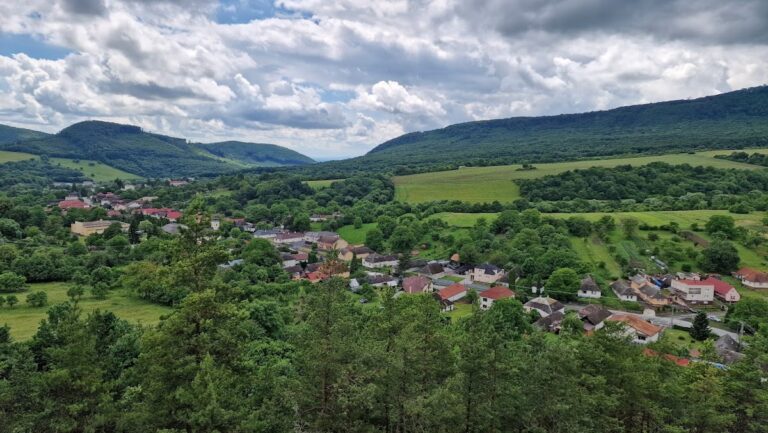
The ruins occupy a cone-shaped limestone hill approximately 280 metres above sea level, above the village of Brekov and the Laborec valley, about 4 kilometres southwest of Humenné. The hill lies on the western projection of the Vihorlat Mountains. The earliest stone core has an oval plan and sits on the highest part of the limestone rock, while later buildings and defensive circuits extend around it.
Early core and tower
The first castle core dates from the turn of the thirteenth and fourteenth centuries. A tower was attached to its southwestern side, forming part of the earliest stone defensive arrangement. Finds from the hill also include pottery and iron arrowheads associated with the earlier Slavic hillfort, connecting the medieval ruins with the site’s pre-castle occupation.
Palaces and outer defenses
During a later building phase associated with the Druget family, a two-part palace was constructed against the tower and a small outer bailey, a defensive enclosure outside the principal stronghold, was added to the north. Under Stephen Zápolya, the outer bailey was expanded eastward. Its earlier defensive wall was replaced with new masonry along the edge of the rocky plateau. A Late Gothic bastion, a projecting structure used to strengthen adjoining defenses, was later built beside the entrance gate, and a polygonal building was added on the western side of the original core.
Entrances and domestic spaces
Walls survive to heights of up to three storeys, allowing the former arrangement and height of the buildings to be traced. The remains include gates and a passage leading toward the Upper Castle, probably equipped with a drawbridge. Some cellars retain vaulted ceilings. In the western section, the castle kitchen preserves an open hearth, a sink, and a large smoke flue, while fireplace beams remain embedded in the wall at floor level.
Conserved fabric and archaeological finds
Conservation has included removing excessive vegetation from the castle hill, investigating the ruins archaeologically, and stabilizing the northern walls and the former courtyard gate of the Upper Castle. The sixteenth-century entrance gate of the Lower Castle has also undergone conservation. Excavations recovered a substantial collection of Late Renaissance stove tiles, along with pottery and iron arrowheads linked to the earlier hillfort. Some of these finds are displayed seasonally in a castle museum below the ruins.