Qasr Shabeeb: A Roman Frontier Fortress in Jordan


Site at a Glance
- Rating
- 3.9
- Popularity
- Low
- Country
- Jordan
- Primary era
- Classical
- Eras represented
- Classical
- Civilizations
- Roman
- Site type
- Military
- Remains
- Castle
On this page11 sections
History
Qasr Shabeeb is an archaeological castle in western Zarqa, Jordan, traditionally associated with the ancient Roman period and dated to around 46 BC. Built as a defensive center on Rome’s eastern frontier, it later served travelers, Islamic rulers, Ottoman troops, and the local population. The building was formerly known as Zarqa Hall or Zarqa Fortress.
Roman Frontier Stronghold
Qasr Shabeeb is believed to have been built over the remains of an earlier Roman fortress. During the Roman period, the site served a military purpose, including during the years associated here with Aurelius, dated to 253–268. A Latin inscription above the entrance states that a unit of the Roman army camped at the castle, while pottery found at the site dates to the second century AD.
Later Islamic and Ottoman Use
During the early Islamic conquests, particularly in the seventh century, the fortress lost its earlier military importance. In peacetime it became a station for travelers, and the building was later reused during the Ayyubid and Mamluk periods. These were successive Islamic dynasties that ruled parts of the Middle East during the medieval era.
In the Ottoman period, the castle housed a Turkish garrison responsible for guarding pilgrims who passed through or stayed in Zarqa. During the Hashemite period, the building was generally closed and saw little use.
The Tradition of Shabib
The castle’s traditional association is with an emir named Shabib al-Mahdawi al-Judhami, although his identity remains uncertain. He may have been an emir serving Kafur al-Ikhshidi, the ruler of Egypt during the late Ikhshidid period before Fatimid rule, whose influence extended into eastern Jordan. Another possibility identifies him with an emir of the Fatimid period, from 969 to 1171, whose authority reached from southern Ma’an to Mount Sheikh.
Other traditions connect Shabib with an Ottoman-period emir whose influence extended from Hawara to the Hijaz, the region of western Arabia that includes Mecca and Medina. He is also described as an emir of Zarqa and its surroundings, within the Mahdawi emirate of the Balqa, a historical region of central Jordan. In that interpretation, the castle served as his fortress.
Remains
Castle Layout and Construction
Square Fortress
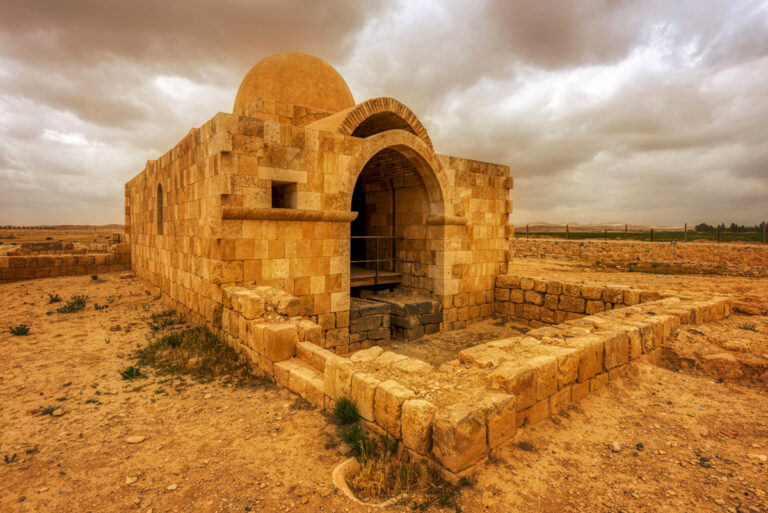
Qasr Shabeeb is a square building measuring 13.75 metres on each side. Its entrance is on the eastern wall, while windows are set into the other walls. Each facade contains an archer’s window, reflecting the building’s defensive character. A tower stands on the eastern side.
Roofed Hall and Upper Rooms
The entrance opens into a roofed hall covered by two types of vaulting. One is a square vault whose sides converge toward the center, while the other is a barrel vault, a continuous curved roof formed by extending an arch along a length. An internal staircase leads to the roof, where the remains of rooms were found. Those rooms had collapsed, and their stones had fallen.
Inscription and Water Feature
Doorway Inscription
A Latin inscription is placed above the arch surrounding the doorway. It records the presence of a Roman army unit that camped at the castle. An Arabic line was added later, referring to the death of a ruler and asking for mercy for him.
Well and River Setting
A well stands in front of the entrance. It is traditionally believed to have been linked by underground passages to the Zarqa River, although that connection has not been confirmed. The castle occupies an elevation that historically overlooked the river, placing the building above the surrounding landscape and its watercourse.