Castle of Ermenonville: An Eighteenth-Century Estate in France
Site at a Glance
- Rating
- 4.1
- Popularity
- Medium
- Country
- France
- Primary era
- Early Modern
- External website
- Open
- Eras represented
- Medieval, Early Modern
- Civilizations
- French
- Site type
- Domestic
- Remains
- Castle
On this page15 sections
History
Castle of Ermenonville is an eighteenth-century classical château in Ermenonville, France, remodeled from a medieval fortified residence and set within a former princely estate. Its origins reach back to the ninth century, when a religious establishment associated with the priest Irminon stood on the site. A first castle was built there in 987, during the reign of Hugh Capet, founder of the Capetian dynasty and king of France from that year.
Medieval Fortress and Royal Connections
During the Middle Ages, Ermenonville belonged to feudal lords, including the Lorris family. The residence later acquired associations with the French monarchy. Joan of Arc visited Ermenonville in the early fifteenth century, and Louis XI stayed there several times toward the end of that century.
On 11 December 1600, Henri IV, the first Bourbon king of France, arranged for the castle to be purchased by Dominique de Vic, a loyal cavalryman and royal servant. Henri IV frequently rested at Ermenonville and sometimes met Gabrielle d’Estrées there. The castle retained the appearance of a medieval fortress during this period, with austere facades, six small towers, and a large keep on the southern side facing what is now the main courtyard.
The Lombard Remodeling
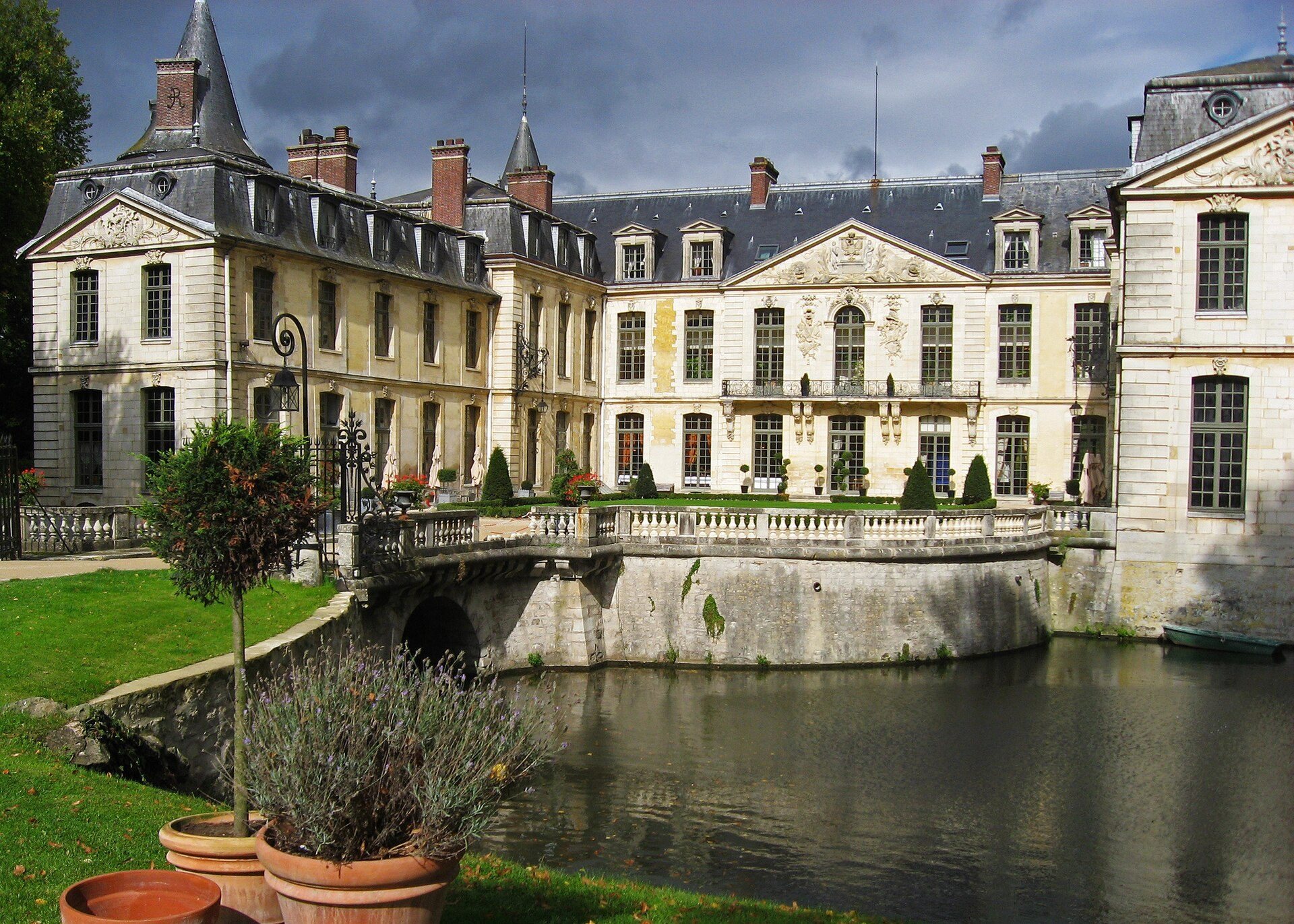
In 1725, Claude-Louis Lombard undertook an extensive remodeling intended to bring the residence into line with the architectural taste of the Enlightenment. He demolished the medieval keep, extended the lateral wings southward, enlarged and multiplied the windows, added a projecting central body, and redecorated the facades. Lombard also added heraldic decoration honoring Dominique de Vic. The Radziwiłł arms were installed only after 1880.
After Lombard died in 1732, the castle remained with his family. Another Claude Lombard sold it in 1754, together with the lordship and viscountcy, to René Hatte. Hatte was a royal tax collector under Louis XV and one of France’s wealthiest fermiers généraux, private tax collectors who leased the right to collect certain royal taxes. His death in 1759 left a complicated succession.
René-Louis de Girardin, Hatte’s grandson, became the sole owner and lord of Ermenonville in 1763 after purchasing the other heirs’ shares. He considered rebuilding the castle completely, but instead modernized its interior and furnishings, removed buildings that obstructed the courtyard, and opened the southern view toward the park.
Girardin, Rousseau, and the Landscape Garden
Girardin planned the surrounding grounds as an English-style landscape garden, a deliberately irregular design using naturalistic planting, water, and constructed viewpoints rather than rigid geometric axes. The work was influenced by Jean-Jacques Rousseau’s ideas, especially those expressed in Julie, or the New Heloise. Girardin worked with Jean-Marie Morel and Hubert Robert, and the park attracted visitors from across Europe.
The relationship between the estate and Rousseau became direct in 1778, when the philosopher and writer stayed with the Girardin family for six weeks. Rousseau died at Ermenonville on 2 July after a walk, and Girardin buried him on Poplar Island in the southern park. The burial brought visitors including Marie Antoinette, Gustav III of Sweden, Benjamin Franklin, Robespierre, Mirabeau, Danton, Saint-Just, and Camille Desmoulins.
In 1776, the castle’s northwest tower, which contained the chapel, collapsed unexpectedly. Girardin commissioned a replacement chapel beneath the ceremonial staircase, between the ground floor and basement. The northwest tower was rebuilt only in the nineteenth century.
Revolutionary and Nineteenth-Century Changes
During the French Revolution, Ermenonville was temporarily renamed in Rousseau’s honor. A decree of 1794 ordered the transfer of Rousseau’s remains to the Panthéon in Paris. His former burial place at Ermenonville consequently became a memorial site. Napoleon Bonaparte visited the estate in 1800 and hunted rabbits in the park and surrounding forest.
After René-Louis de Girardin died, his son Stanislas and his brother Alexandre-Louis managed the property. Their limited resources prevented adequate maintenance, so they granted Louis VI Henri de Bourbon-Condé, the last Prince of Condé, usufruct of the 950-hectare estate. This arrangement ended with the prince’s death in 1830, when the domain returned to the Girardin family.
The estate was then divided among the Girardins. After Stanislas-Xavier died in 1832 and his shares passed to Ernest in 1833, a partition assigned the lands and forests to Alexandre-Louis and the castle and park to Ernest. Alexandre-Louis’s death in 1855 made Ernest the sole owner. Ernest carried out restoration work between 1864 and 1867, including repairs to the castle and work on the archery ground in the southern park.
Dispersal, Protection, and the Bugatti Period
Ernest de Girardin died in 1874, leaving the estate heavily burdened by debt. Two attempts to sell it as a whole failed, and the domain was divided into nine lots auctioned in November of that year. Gustave-Adolphe-Edgard de Girardin acquired several lots, Alexandre de Girardin acquired another, and Rosa-Augusta Hainguerlot, widow of Alphée de Vatry and owner of Chaalis, bought the lots corresponding to the Désert and the present Mer de Sable.
Gustave-Edgard hoped to live at the castle and restore the park, but lacked the necessary funds. The remaining 253 hectares were sold at auction on 8 October 1878 to Marie-Charlotte Hensel, widow of the businessman François Blanc. She acquired them as a dowry for her daughter Louise, who had married Prince Constantin Radziwiłł.
Constantin Radziwiłł and his son Léon undertook major restoration work. The Radziwiłł family remained at Ermenonville until Léon’s death in 1927, after which the estate passed to his nephews Sosthènes and Armand de La Rochefoucauld-Doudeauville. The castle, Poplar Island, the Temple of Modern Philosophy, and several other structures in the Grand Park were entered on the supplementary inventory of historic monuments by an order of 11 June 1930. The protected elements other than the castle were formally classified on 6 July 1939.
In 1932, Ettore Bugatti, an Italian-born industrialist and automobile designer who founded the Bugatti company, acquired the castle and park through a real-estate company. The furniture, collections, and inventory were sold separately in 1933, dispersing objects associated with Rousseau and René-Louis de Girardin. Bugatti also sold land around the Petit Park and transferred the Grand Park in 1938 to the Touring Club of France, which sought to preserve it and open it to the public as the Jean-Jacques Rousseau Park.
War Damage and Modern Uses
German forces occupied the castle and Petit Park from 1941 during the Second World War. Near the end of the war, Bugatti mortgaged the estate to finance mechanical research. After his death in 1947, his daughter Lidia Bugatti occupied the castle. Following the acquisition of the Bugatti marque by Hispano-Suiza in 1963, the property passed to that company.
Henri Montarnal acquired the estate in 1964, when it was in very poor condition. He converted the castle first into a hotel and restaurant and later into a retirement home. The retirement home closed in 1978 because maintenance and heating costs were too high and occupancy was low outside the summer season.
From 1981 to 1987, Montarnal’s daughter leased the estate to the International Society for Krishna Consciousness, a modern Hindu religious movement founded in 1966 by A. C. Bhaktivedanta Swami Prabhupada. The organization used the property as a Hindu temple and ashram in France, calling it Krishnaville. It restored 80 rooms while retaining the traditional French decoration, but the lease provoked local opposition and investigations into its commercial activities.
The occupation ended with a major fire on 14 November 1987 that seriously damaged the building. Repairs allowed a retirement home to reopen on 1 July 1988, but the owner later lost the property to lending banks after failing to repay the repair loans. Les Hôtels Particuliers acquired the castle on 31 May 1991 and converted it into a luxury hotel and restaurant. Antoine Haswani acquired it in June 2018, and the castle continues to be used as a hotel.
Remains
The Castle and Its Water Setting
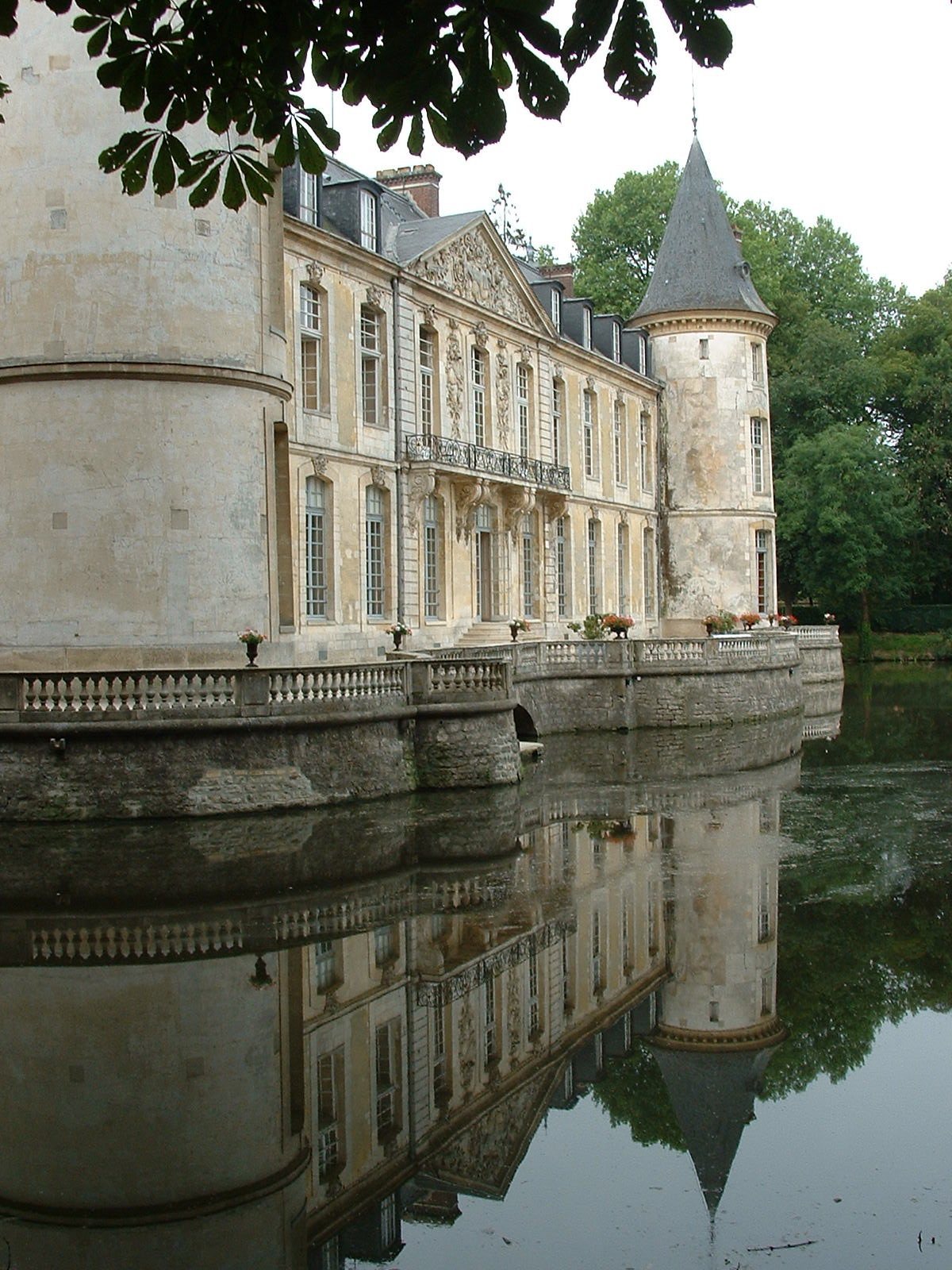
Classical Main Building
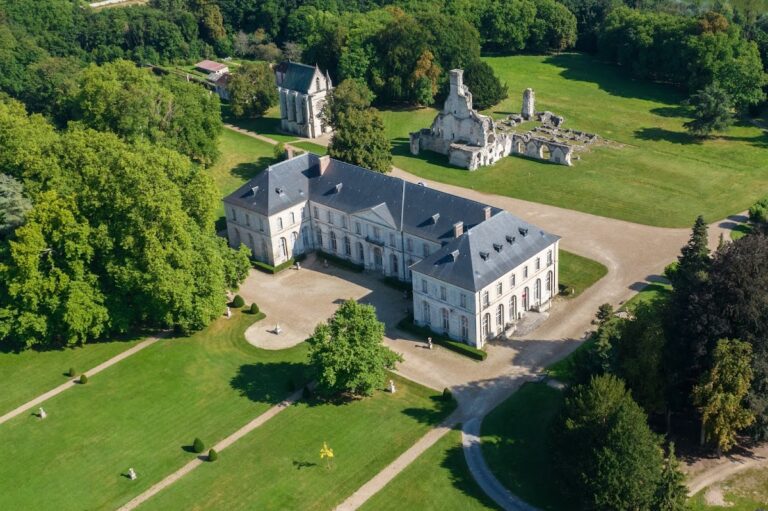
The present castle is a classical eighteenth-century building surrounded by a moat supplied by the Launette River. It developed from a fortified residence whose southern side faced the main courtyard. A 1724 engraving shows the southern keep before Lombard’s remodeling, when four of the original six small towers remained and the projecting ends of the lateral wings had not yet been built.
Lombard’s alterations gave the building its present architectural character. The lateral wings were lengthened southward, while the main building received a projecting central body with lowered pediments on both the courtyard and park sides. Heraldic decoration, wrought-iron balconies at first-floor level, and bas-reliefs on the wall piers between the windows complete the remodeled facades. The heraldic scheme honoring Dominique de Vic belongs to Lombard’s work, while the Radziwiłł arms were added after 1880.
Chapel and Northwest Tower
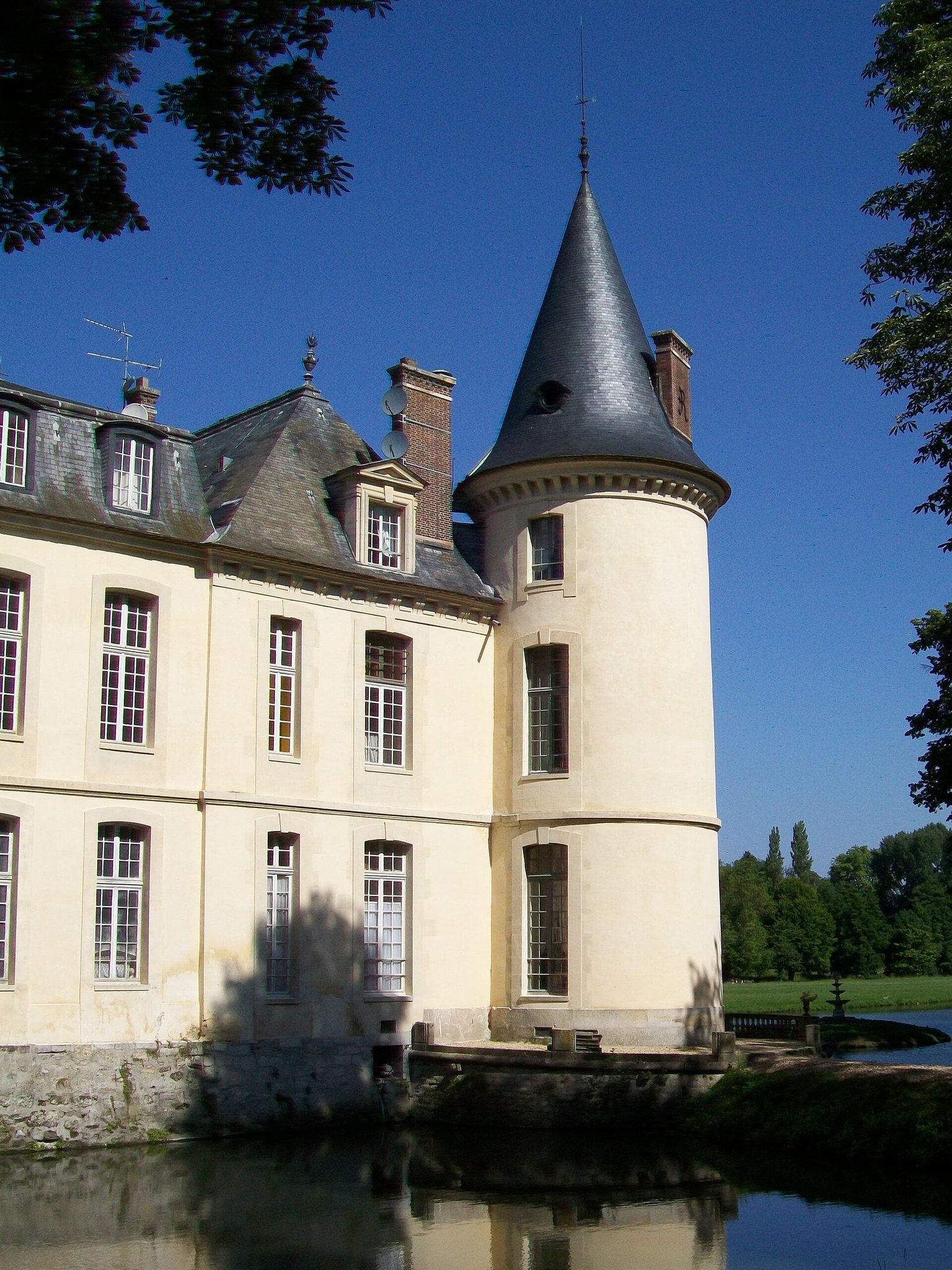
The northwest tower once contained the castle chapel and collapsed in 1776. A replacement chapel was built beneath the ceremonial staircase, between the ground floor and basement. The northwest tower itself was reconstructed during the nineteenth century, leaving the castle with a physical record of both the eighteenth-century collapse and the later rebuilding.
Park Features and Landscape Structures
Petit Park, Grand Park, and the Désert
The historic estate was divided into the Petit Park north of the castle, the Grand Park to the south, and the western area known as the Désert. Only part of the former park now forms the Jean-Jacques Rousseau Park. The northern Petit Park was partly subdivided during the first quarter of the twentieth century, and Bugatti later sold land on its western and eastern sides. The Désert had been enclosed by a wall in 1856.
The landscape was arranged with irregular, non-geometric planning. Its artificial lake, ponds, and watercourses formed part of a design intended to create natural transitions, changing views, and unexpected encounters with landscape structures. Among the surviving features are Poplar Island, the Temple of Modern Philosophy, the Philosopher’s Cabin in the Désert, the Naiad grotto, a cascade, and the Altar of Reverie.
Poplar Island
Poplar Island lies in the park’s artificial lake, which covers about six hectares. Girardin originally buried Rousseau there in 1778. After Rousseau’s remains were transferred to the Panthéon in Paris in 1794, the island’s burial place became a cenotaph, preserving the memory of the philosopher’s first interment at Ermenonville.
Later Uses of the Estate
The physical history of the estate also includes adaptations made during the twentieth century. During the Bugatti period, several automobiles, including a Bugatti Royale, and an aircraft designed by Ettore Bugatti were kept at Ermenonville. The separate 1933 sale dispersed the furniture, collections, and other inventory.
During the occupation by the International Society for Krishna Consciousness, one hall contained an altar with statues of Chaitanya and Nityananda, sixteenth-century Bengali Vaishnava religious figures associated with devotion to Krishna. The estate also contained a museum of traditional Indian art, a vegetarian restaurant, and a radio station. The 14 November 1987 fire substantially damaged the castle, after which repairs preceded its use first as a retirement home and later as a hotel and restaurant.