Kajaani Castle: A Swedish Fortress and Administrative Center in Finland
Site at a Glance
- Rating
- 4.2
- Popularity
- Medium
- Country
- Finland
- Primary era
- Early Modern
- External website
- Open
- Eras represented
- Early Modern
- Civilizations
- Swedish
- Site type
- Military
- Remains
- Castle
On this page13 sections
History
Foundation and early Swedish rule
Kajaani Castle is a ruined Swedish fortress in Kajaani, Finland, founded in the early seventeenth century as a military and administrative center in Kainuu. Sweden acquired the region through the Treaty of Teusina, a 1595 peace settlement with Russia, and sought to protect its inhabitants and settlers from Russian raids while strengthening its authority along the frontier. Foundation work began in 1604, followed by the main construction in 1605 on the orders of King Charles IX of Sweden.
Clemens Eriksson initiated the project, and in 1606 Charles IX ordered Admiral and governor Isak Behm to surround the castle with a ring wall. Behm was detained in 1610 after refusing an order to attack the Russian border post at Soma. Master builder Isak Rasmusson and two journeymen were sent to direct the works. Rasmusson resigned in 1615 after becoming blind, although his journeyman Lars Thomasson had overseen the masonry from 1613. Erich Persson Hare replaced Behm as commander, while shortages of labor and building materials repeatedly slowed construction. Local peasants were required to provide six workdays each year.
The Treaty of Stolbovo in 1617 altered the Swedish-Russian frontier and reduced the region’s strategic importance. In 1619, King Gustav II Adolf ordered construction to stop. The unfinished fortress nevertheless served as an administrative center, prison, place of exile, and military strongpoint. Its remote position made it suitable for holding political and religious offenders. Johannes Messenius, a Swedish historian and professor at Uppsala University, was imprisoned there from 1616 to 1635 because of his contacts with Jesuits and the pope. During his confinement he wrote the fifteen-part Scandinavian history Scondia Illustrata. He was transferred to Oulu in 1636. The writer and adventurer Lars Wivallius was held at Kajaani from 1634 to 1641.
Erik Pedersson commanded the castle from 1623 until 1641, when Per Jakobsson Tysk of Colonel Bielke’s regiment succeeded him. Tysk was later ordered into field service, and construction did not resume during his command. Other commanders included Christopher Wernstedt, Johan Ulfsparre, Nils Olofsson, Nils Andersson Björn, Nils Silfverbagge, and Johan Zattler.
The Kajaani fief and aristocratic residence
Count Per Brahe the Younger received the Kajaani fief in 1650 and founded the town beside the castle in 1651. He ordered major alterations between 1661 and 1666, transforming the fortress into an aristocratic residence and administrative seat. Builder Olof Mårtensson worked on its enlargement and reinforcement from 1660, while Major Samuel Mårtensson Lång oversaw its completion. Samuel Lång completed the main wall works in 1665. This phase became the castle’s period of greatest prominence and produced the last Swedish example of a building that combined a noble residence with a fortress.
A chapel was first mentioned in 1648, probably outside the walls, and was later moved inside them. The castle remained the headquarters of the Kajaani fief until the Great Reduction, King Charles XI’s recovery of aristocratic fiefs and property for the Crown, abolished the fief in 1681. Kajaani then returned to its role as a crown administrative and defensive center under a local bailiff, a royal official responsible for administration.
War, destruction, and later military decline
During the Great Northern War, the conflict from 1700 to 1721 between Sweden and a coalition including Russia, Russian forces burned Kajaani and nearby villages in 1712. Lieutenant Colonel Johan von Meurman then strengthened the castle’s defenses. After Olavinlinna fell in 1714, Kajaani became Sweden’s last defensive position in Finland.
Russian forces first demanded the castle’s surrender in March 1715 but remained outside it for more than six months. They returned in December under General Fyodor Chekin with approximately 3,000 to 4,000 men. The garrison numbered about 50. After a five-week siege, Commander Johan Henrik Fieandt surrendered on 24 February 1716 because food, firewood, and ammunition had run short. Russian promises of safe conduct and protection of property were not honored. Soldiers and civilians were deported as prisoners, the castle was stripped of its possessions, and Chekin ordered it blown up in March 1716.
The Treaty of Nystad, concluded in 1721, returned the Kajaani region to Swedish control. A small garrison remained on the island until the late eighteenth century, and the ruins were partly used as a prison in the 1740s. The walls deteriorated as stones were taken for house foundations, while proposals to rebuild the castle were not carried out. Finland’s transfer to the Russian Empire in 1809 ended its military importance, although the island continued to serve as an important crossing point on the Kajaaninjoki.
Restoration, interpretation, and cultural memory
A wooden bridge built across the ruins in 1845 caused further damage. A steel-reinforced-concrete bridge begun in 1936 led to archaeological discoveries and renewed calls for restoration. The first major restoration took place in 1890-1892 under plans by Johan Jacob Ahrenberg. Collapsed sections were patched with brick and parts of the ruins were lowered, work later judged poor. Further repairs followed in 1910-1911. Excavation and restoration began again in July 1937 after objects were found during bridge construction, with funding from the Parliament of Finland.
A restoration and research project carried out by the City of Kajaani from 2001 to 2008 repaired the walls and examined the castle’s construction history. The city also built a pedestrian bridge to the island. In 2014, responsibility for the site passed to the Nature Services of Metsähallitus along with 28 other valuable cultural-heritage sites.
The idea that an earlier castle stood on the island before Kajaani Castle remains unsupported by archaeological evidence. Researcher Heikki Rytkölä considered the proposal too speculative. A story by Ior Bock likewise described an earlier castle and a well containing treasure from the period of the Crusades, but archaeological investigation found no such well.
Kajaani Castle became an enduring subject in Finnish literary and cultural memory. Zachris Topelius included the castle, Messenius, Fieandt, and the siege in his historical novel The Surgeon’s Stories. Eino Leino described the siege and the suffering of women and children in his 1890 poem Kajaani Castle. Ilmari Calamnius, Jussi Kukkonen, Lars Huldén, and Juha Seppälä also treated the castle, its prisoners, commanders, siege, and destruction in poetry, fiction, and drama. In 1951, Finland issued a 20-markka stamp commemorating Kajaani’s 300th anniversary, showing the castle ruins and other Kajaani landmarks.
Remains
Island setting and fortress layout
Walls and towers
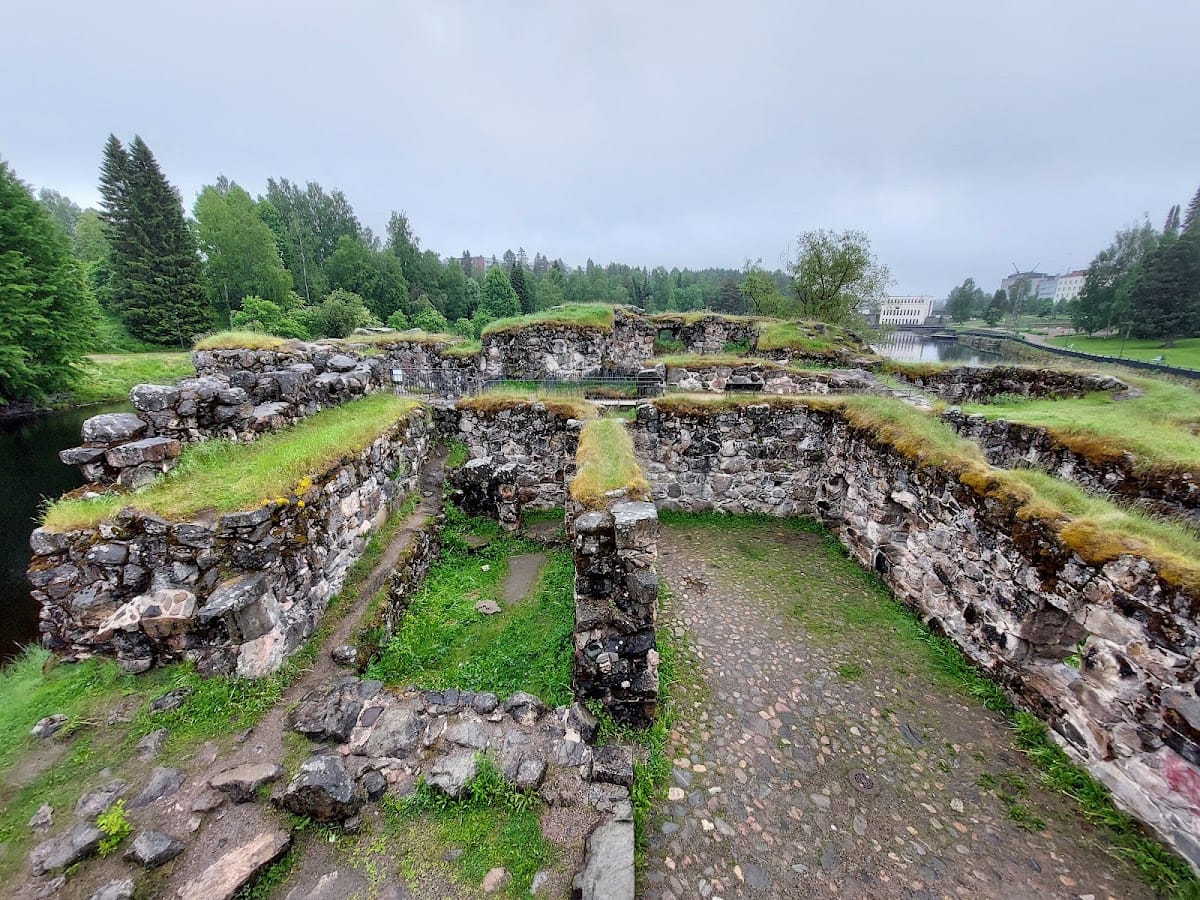
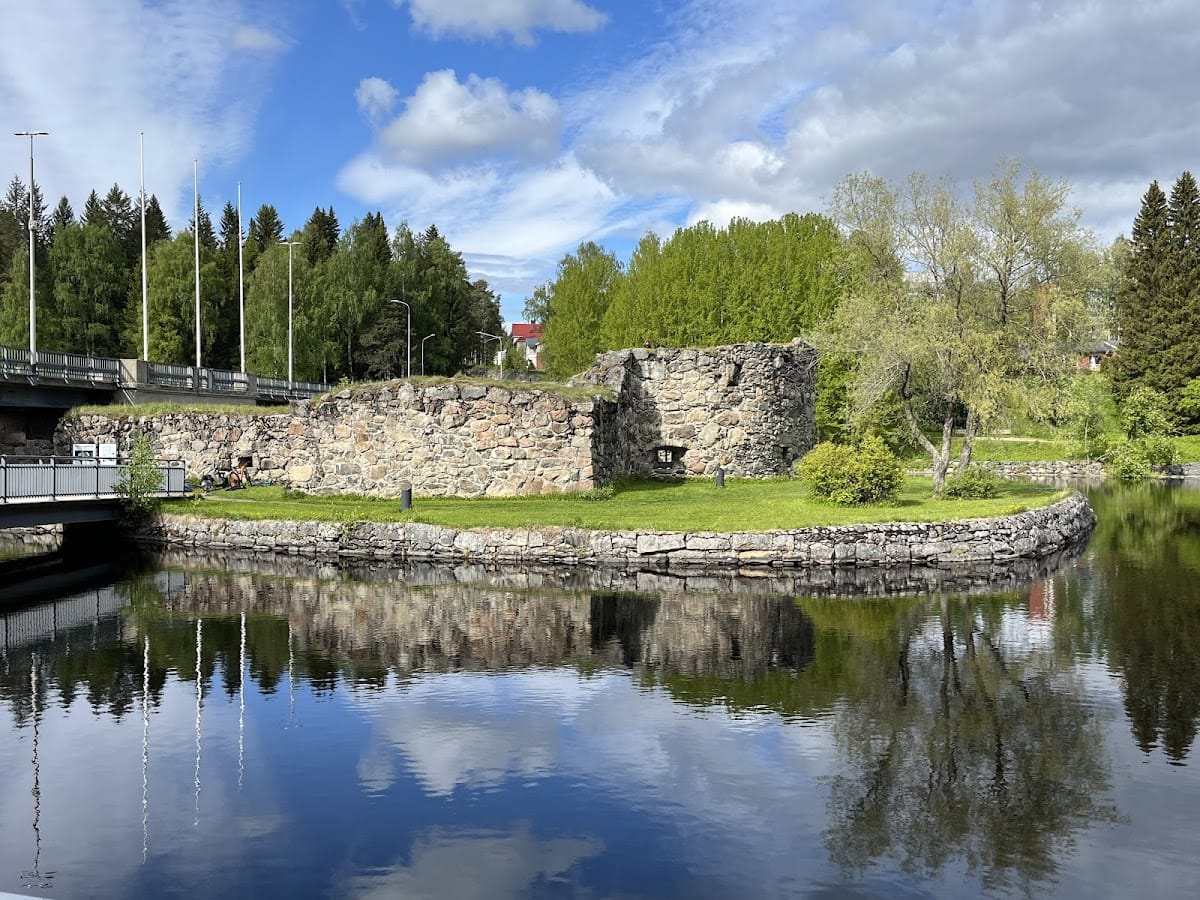
The roofless ruins stand on Linnasaari, a small island in the Kajaaninjoki between the Ämmäkoski and Koivukoski rapids, east of Lake Oulujärvi. The fortress occupied a natural junction of several routes, with its original walls rising directly from the rapids. Because the island was too small for the planned complex, it was enlarged with piled earth and embankments. Natural stone quarried or collected nearby formed the castle, and the varying wall stones reflect the use of several kinds of rock. Limestone for the mortar probably came from Melalahti in Paltamo.
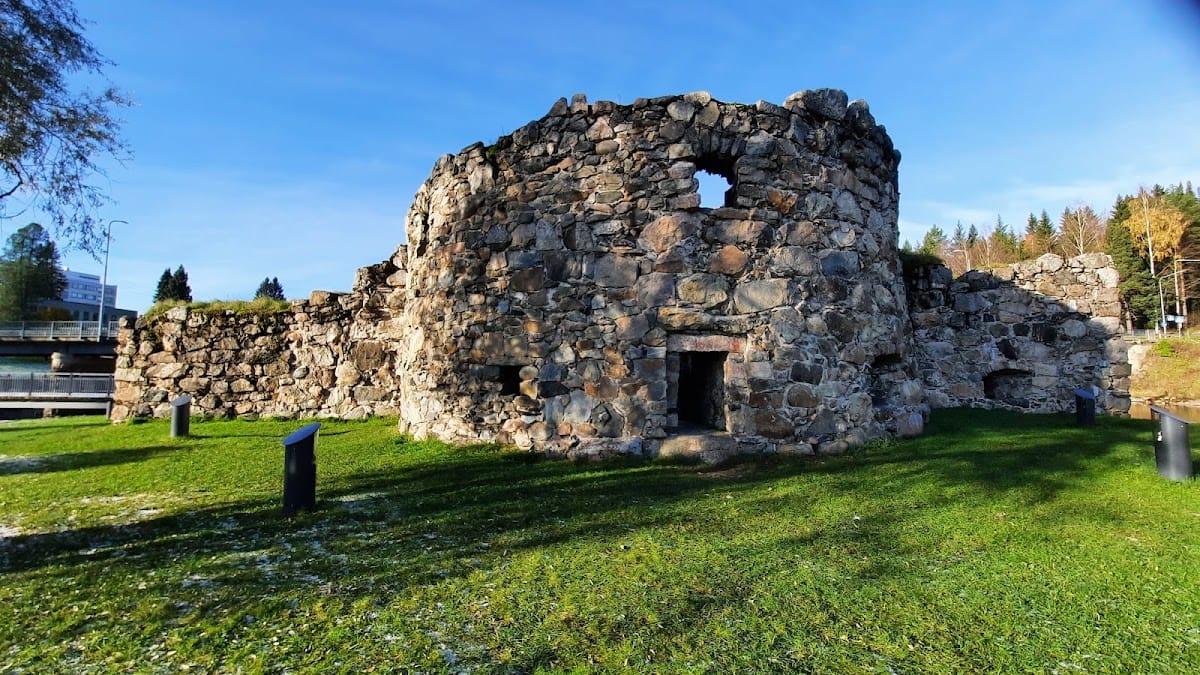
The first construction phase, completed in 1619, created a rectangular granite fortress with a half-rounded artillery tower at each end. A one-story outer wall, two rectangular batteries, and a gate tower at the northern entrance formed the principal defenses. The outer wall was approximately 39 meters long, 9.6 meters high, and 3.6 meters thick. The walls were probably covered with a thin lime-mortar coating. Traces of white lime remain, while the window openings were red. Gates were treated as defensive weak points and were protected by arrow or gun openings directed toward them. Drawbridges stood before the gates.
Interior buildings
The first interior buildings were wooden. During the later enlargement, stone houses attached to the outer wall replaced them. Vaulted roofs were planned, so each house retained four walls even where it joined the perimeter. The buildings followed a paired-house arrangement, with a central porch giving access to two rooms. The chancellery had two stories and a wooden intermediate floor, with exterior stairs leading to the upper levels. Its stone walls were whitewashed with limestone. The commander’s room had a brick floor, while the other rooms probably had plank floors.
Four rooms, a gunpowder chamber, a living room, a porch, and a kitchen with a cellar beneath it stood against the northern outer wall. From 1669, the second floor of the eastern tower contained a great hall, also called the great night chamber. The western round tower was raised in 1666, the gates were renewed in 1667, and the eastern round tower was reinforced in 1669. The great hall was completed in 1672.
Bridges and approaches
Bridges connected Linnasaari with the mainland from both north and south. The northern bridge was approximately 50 meters long, while the southern bridge measured approximately 91 meters. In 1845, a wooden bridge was built through the ruins. Its foundations required the central part of the remains to be lowered and some stones to be removed, adding to the physical damage caused after the castle’s destruction.
Excavation and surviving fabric
Restored masonry
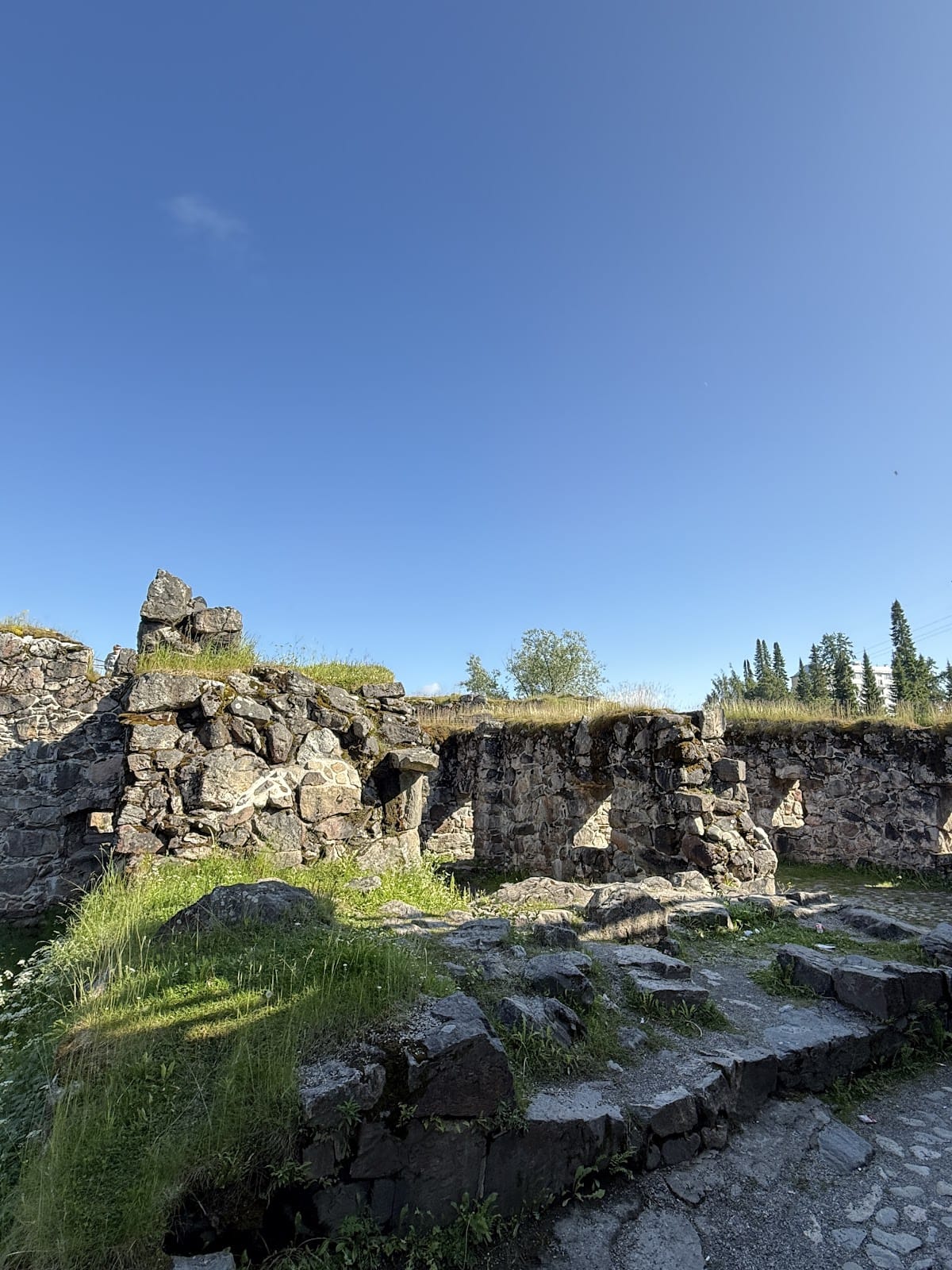
Before the nineteenth- and twentieth-century restoration campaigns, several meters of soil and stone covered the ruins. In 1937, this material was cleared away, the walls were repaired and raised, and earlier brick patches were replaced with granite. The 2001-2008 project repaired the masonry and covered the courtyard with cobblestones. The castle now survives as roofless ruins.
Archaeological finds
Approximately 1,800 archaeological finds were recovered during the excavations and restoration associated with the 1937 work. In 2006, archaeologist Kari Uotila investigated a radar anomaly and found an electrical cable at a depth of 40 centimeters. The cable probably explained the supposed large metal object detected at approximately 2.5 meters. Later radar scanning found no further evidence of such an object.
When completed, Kajaani Castle was described as the northernmost stone castle in Europe and the last medieval-style stone castle built in Sweden. The surviving ruin is also described as the world’s northernmost castle ruin.