Neuleiningen Castle: A Medieval Quadrangular Fortress in Germany


Site at a Glance
- Rating
- 4.6
- Popularity
- Medium
- Country
- Germany
- Primary era
- Medieval
- Eras represented
- Medieval, Early Modern
- Civilizations
- Holy Roman Empire
- Site type
- Military
- Remains
- Castle
On this page11 sections
History
Neuleiningen Castle is a medieval hilltop fortress in Germany, built by Count Frederick III of Leiningen-Dagsburg between 1238 and 1241, or around 1240. It formed part of the early history of the Frankish Leiningen dynasty, whose territories included the Leiningerland, and helped control the entrance to the Eckbach valley from the Rhine Plain.
Leiningen Foundation and Early Ownership
The castle’s name comes from the Counts of Leiningen. After an inheritance division within the family, Frederick III established the fortress on a high spur above the Eckbach valley. Together with Battenberg Castle, about 1,400 metres to the south, it controlled access between the valley and the Rhine Plain. Neuleiningen remained the exclusive property of different Leiningen branches for more than two centuries.
Palatine Intervention and Shared Rule
In 1468, Frederick the Victorious, the Elector Palatine and ruler of the Electoral Palatinate, intervened in disputes over the Leiningen inheritance and took the castle by force. Ownership passed through several interim arrangements before an agreement in 1508 divided it between the Bishopric of Worms, an ecclesiastical principality governed by the bishop of Worms, and the Counts of Leiningen-Westerburg.
The castle was drawn into the Peasants’ War of 1525, a widespread uprising involving rural communities and other groups in the German lands. It was opened to the rebels without a fight. Countess Eva received and entertained them generously, and they left without causing major damage. The local poet Paul Münch later commemorated the episode in the Palatine-dialect poem Die Gräfin Eva vun Neileininge.
Destruction and Later Ownership
Neuleiningen suffered minor damage during the Thirty Years’ War, the series of conflicts that devastated much of central Europe between 1618 and 1648. In 1690, French troops burned and razed the complex during the War of the Palatine Succession, a late-seventeenth-century conflict in which France fought a coalition over claims connected with the Palatinate.
The two owners then disagreed over reconstruction. Leiningen-Westerburg supported rebuilding, while the Bishopric of Worms opposed it. Karl von Leiningen-Westerburg sold the Leiningen share to the bishopric in 1767. After the French Revolution, the ruins underwent secularization, meaning that ecclesiastical property was transferred to secular authorities. The municipality acquired them in 1804 and sold them in 1808.
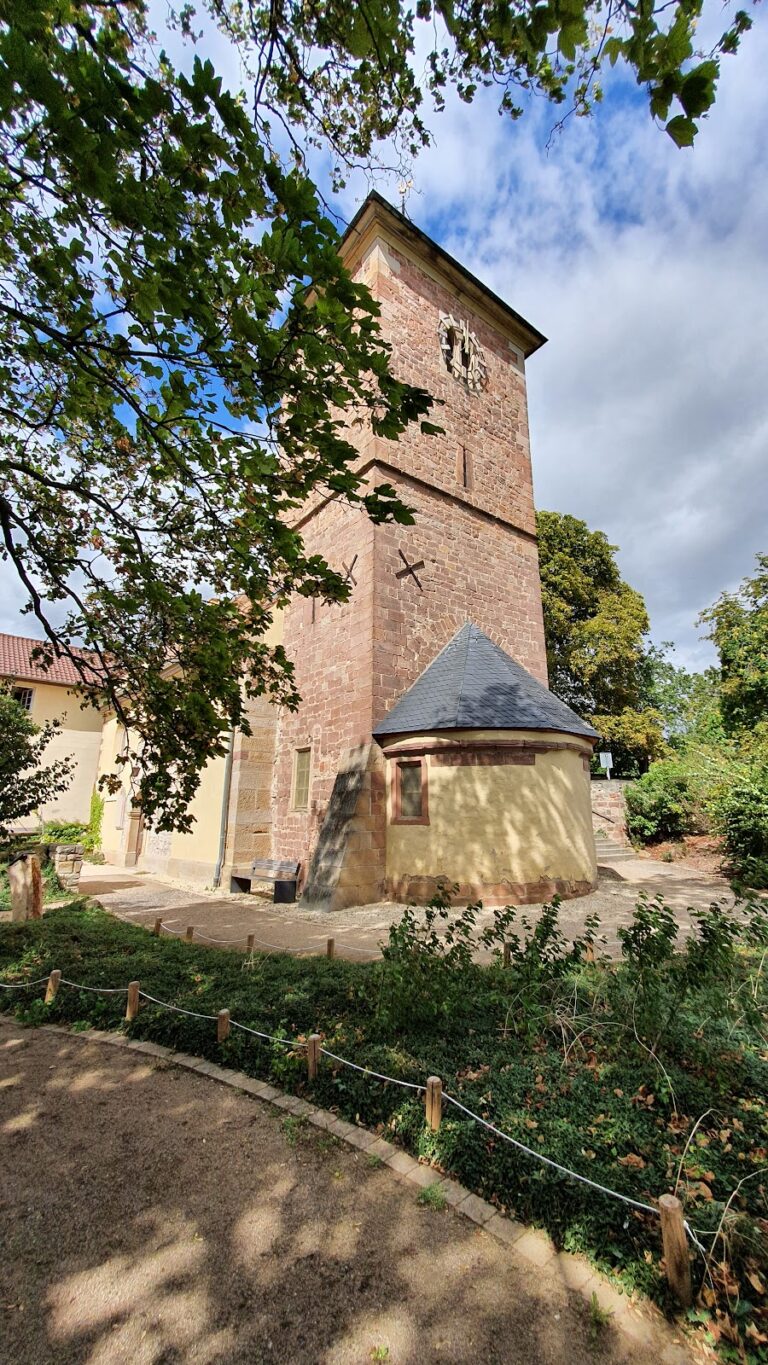
In 1874, Count Karl Emich of Leiningen-Westerburg-Neuleiningen bought the castle back for the Leiningen family. From that year, he had the southeast tower rebuilt and adapted for residential use. He regularly stayed there during holidays, later becoming an honorary citizen of Neuleiningen. The tower now serves as a publicly accessible observation tower. Neuleiningen Castle is a protected cultural monument, and a castle and local-history museum managed by the Stiftung Historisches Neuleiningen opened in 2005. The surrounding thirteenth-century village fortifications remain closely connected with the castle and are unusually coherent and well preserved for the region.
Remains
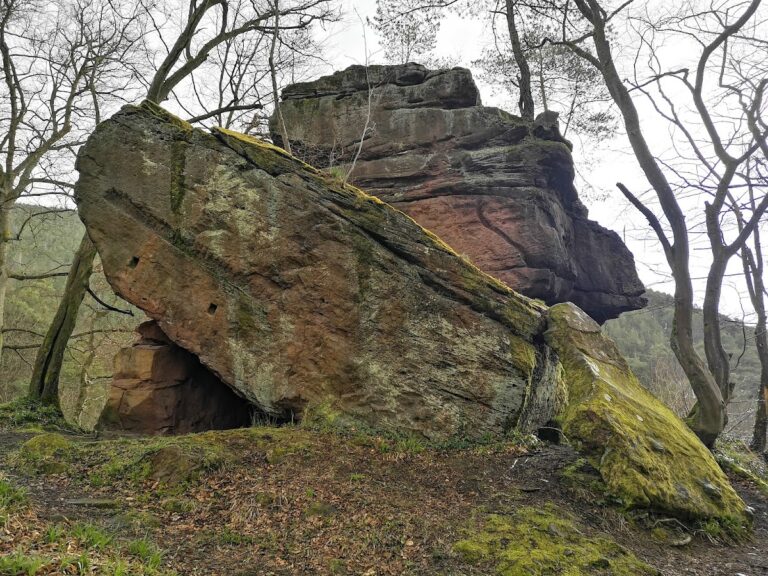
Neuleiningen Castle stands at 269.8 metres above sea level on the Schlossberg, the southern spur of the Grünstadter Berg. It occupies the geological boundary between the Leiningen Sporn of the northeastern Palatinate Forest and the Tertiary Alzey Hills. The steep southern slopes descend about 180 metres to the Eckbach valley through Palatinate Forest Buntsandstein, a regional Triassic sandstone formation, while the A6 motorway to the north lies on Tertiary rock.
Quadrangular Fortress Plan
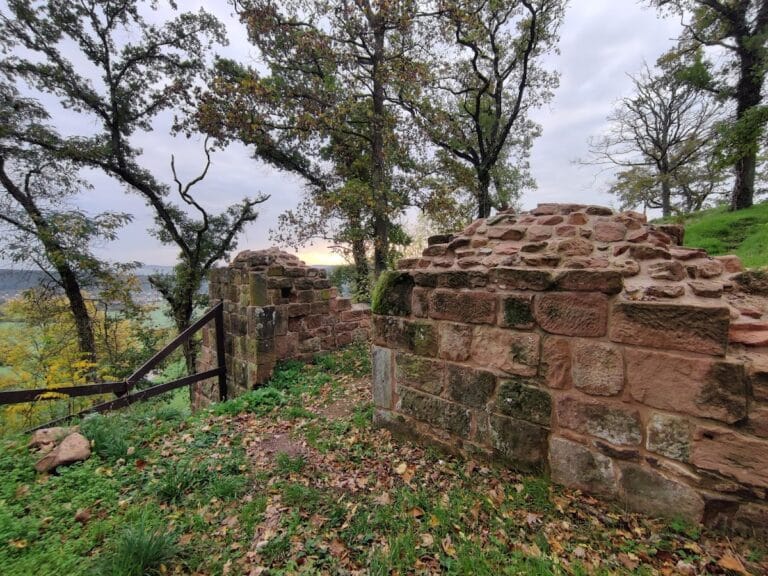
The castle follows the quadrangular, or castellum, type, a regular rectangular enclosure reinforced by towers projecting beyond its curtain walls. Its design combines building traditions associated with early thirteenth-century castles in the Île-de-France with local construction methods, rather than reproducing a single French model. Four round towers define the plan, while numerous narrow arrow slits were designed for bows and crossbows. These openings are among the earliest examples of their type on German soil, and Neuleiningen is regarded as Germany’s earliest quadrangular castle apart from the rudimentarily preserved castle at Lahr.
Excavations have identified small traces of the buildings belonging to the first construction phase. The architectural remains visible today date from the fourteenth century to the beginning of the seventeenth century, showing how the enclosure continued to develop after its thirteenth-century foundation.
Residential and Museum Buildings
North-Side Palas
The north side contains the palas, the principal residential and great-hall building of a medieval castle. Its prominent stepped gable, whose sloping edges rise in a series of steps, is associated with Landgrave Hesso of Leiningen-Dagsburg.
Leiningen-Westerburg Residence
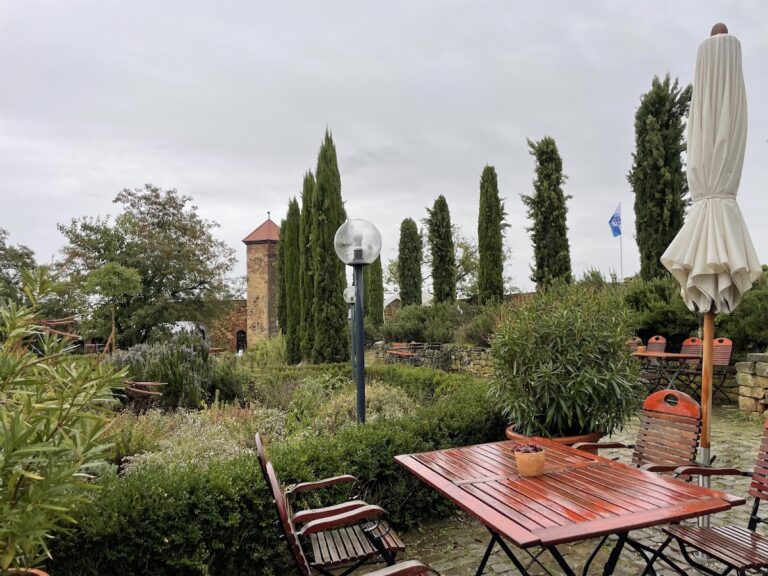
In the southeast corner, the cellar of the Leiningen-Westerburg residence survives from around 1508. A castle tavern was established in this part of the complex during the second half of the twentieth century.
Rebuilt Southeast Tower
The rebuilt southeast tower is made of sandstone and rises 15 metres high. Its observation platform is 14 metres above the ground. The two upper storeys contain a small local-history museum with stoneware from a former local factory that closed in 1932, along with other craft exhibits.
Landscape Setting
The elevated castle site overlooks the Upper Rhine Plain to the east and the Palatinate Forest to the south and west. The Donnersberg massif lies to the northwest. The surrounding settlements include Neuleiningen-Tal, Grünstadt-Sausenheim, and Kleinkarlbach. On clear days, the view extends as far as Ludwigshafen, Mannheim, the Odenwald, Heidelberg Castle, Worms Cathedral, Speyer Cathedral, and aircraft taking off from Frankfurt Airport.