Castle Khust: A Medieval Hungarian Royal Fortress in Ukraine


Site at a Glance
- Rating
- 4.6
- Popularity
- Medium
- Country
- Ukraine
- Primary era
- Medieval
- External website
- Open
- Eras represented
- Medieval, Early Modern
- Civilizations
- Habsburg, Hungarian, Principality of Transylvania
- Site type
- Military
- Remains
- Castle
On this page11 sections
History
Castle Khust is a medieval fortress in Ukraine, in the city of Khust, built under the Hungarian crown during the fourteenth century. It occupied a strategic position above the routes leading from the Solotvyno salt mines and the Máramaros salt road, and it helped control the Khust Gate and the approaches through the Toronyai and Tatar passes. The fortress also defended the crown towns of Khust, Visk, Técső, Hosszúmező, and Máramarossziget, together with five associated villages.
Fourteenth-century foundation and royal control
The castle’s foundation date remains uncertain. A later tradition placed its construction between 1090 and 1191, during the reigns of Saint Ladislaus I and Béla III, but surviving evidence does not support that chronology. Archaeological and written evidence places the emergence of the fortress no earlier than the first half of the fourteenth century. Excavations in 2019 particularly support a fourteenth-century origin.
Construction probably began around 1349, early in the reign of King Louis I of Hungary, and the first core may have been completed within four or five years. The earliest written reference dates from 1353. Further references appear in 1387 and 1447. The first known castellan, Domonkos Macska, was ordered by the king to return tax that he had improperly collected from the village of Rakasz. A castellan was the official responsible for administering and defending a castle.
Castle Khust initially belonged directly to the Hungarian crown. In 1393 King Sigismund of Luxembourg granted it to the Drágffy family, but it had returned to royal ownership by 1405, when the Perényi family leased it. The fortress later passed to John Hunyadi and then to King Matthias Corvinus, who gave it to his wife, Queen Beatrice of Aragon, in the 1480s. After a Moldavian attack in 1472, it again became direct royal property late in the fifteenth century. In 1498 King Vladislaus II transferred it to Gábor Perényi, and the Perényis held it again in 1511.
Habsburg and Transylvanian struggles
After the Battle of Mohács in 1526, which opened a prolonged contest for control of much of the former Hungarian kingdom, Castle Khust repeatedly changed allegiance between Habsburg and Transylvanian forces. Ferdinand I’s troops captured it in 1541. Between 1550 and 1552, Italian military engineers modernized the defenses to meet the threat posed by gunpowder artillery. The fortress returned to the Transylvanian side in 1557. Under the 1570 Treaty of Speyer it became part of the Principality of Transylvania, an autonomous Hungarian-ruled polity that frequently opposed or negotiated with the Habsburg monarchy. Imperial forces briefly occupied it and transferred it back in 1572.
Gáspár Kornis, a Transylvanian military commander and castellan, led the fortress from 1574 to 1594. During his tenure, the defenses were substantially expanded and strengthened. In 1594 he prevented the Crimean Khan Gazi II Giray from besieging or attacking the castle by offering gifts. The fortress came under Emperor Rudolf II in 1599, then endured a siege by Bocskai’s forces in 1605. The Peace of Vienna in 1606 returned it to Transylvania, but imperial troops recaptured it in 1613. Prince Gábor Bethlen regained the castle in 1615 and gave it to his brother István Bethlen.
István Bethlen transformed the principal palace in the upper castle into a more elaborate residence. He also reinforced the masonry walls and added palisades, defensive barriers made from closely set stakes, where the walls met earthen ground. After his death in 1648, the fortress passed to Ferenc Rhédey through his marriage to Bethlen’s daughter, Druzsina. The Rhédey period, from 1648 to 1667, became a high point in the castle’s history. A school operating within the fortress educated noble children from across Hungary.
Sieges and regional conflict
Several military campaigns tested Castle Khust without bringing its immediate fall. Prince George I Rákóczi, a Transylvanian ruler, besieged it in 1636 and attempted to tunnel beneath the defenses, but he failed to capture the fortress. Polish forces commanded by Jerzy Lubomirski abandoned another siege in 1657. Ottoman and Tatar forces operated in the surrounding region between 1660 and 1662. In 1661 the Ottoman traveler Evliya Çelebi visited the castle while accompanying an Ottoman-Tatar delegation that sought the release of the imprisoned Transylvanian nobleman Miklós Zólyomi.
Storms damaged the fortress in 1671, 1706, and 1748. Its roofs, which were covered mainly with wooden shingles, required continual maintenance and were vulnerable to fire. A powder explosion in 1692 destroyed roofing over the officers’ quarters and reduced the rainwater that could be collected in the citadel’s cistern, a reservoir for stored water. Maria Theresa ordered restoration after the storm of 1748, but the project was abandoned because of the fortress’s poor condition. In 1750 most of its weapons were removed and taken to Košice and Nagyvárad.
The Rákóczi uprising and imperial abandonment
Castle Khust became one of the centers of the Rákóczi uprising, an anti-Habsburg revolt led by Francis II Rákóczi from 1703 to 1711. In 1703 Imre Ilosvay, a Kuruc officer, entered the fortress in disguise and encouraged its unpaid German garrison to mutiny. The kurucs were anti-Habsburg soldiers and insurgents active mainly in the late seventeenth and early eighteenth centuries. During the takeover, the garrison killed its commander, Franz Gottfried von Eythner, on 17 August, and transferred the castle to Rákóczi’s control.
The fortress remained in Rákóczi’s hands until the end of the uprising. Assemblies met in the Rákóczi House below the hill in 1706 and at the castle in 1709. The 1706 assembly declared the deposition of the Habsburgs from the Hungarian throne. After the revolt was defeated in 1711, the castle surrendered to imperial troops. Baron Acton entered with those forces on 12 May 1711, after which the fortress served as an imperial garrison.
In 1717 the garrison joined local forces under Zsigmond Sztojka against a returning Crimean Tatar army. The fighting took place near Visk and at the Borsai Pass. Accounts give approximately 6,000 to 8,000 Tatars killed and more than 6,000 to 7,000 captives freed. The event was the last major military episode associated with the fortress.
Lightning struck Castle Khust in three places on 3 July 1766, including the powder tower. Fire destroyed the roofs and badly damaged or burned the commandant’s quarters, inn, clock tower, and many other buildings. Two soldiers died. The fortress was not rebuilt. Joseph, later Emperor Joseph II, inspected it in 1773 and rejected reconstruction. In 1776 the garrison and military stores moved to Mukachevo, while the castle was assigned to treasury use.
The decline continued after abandonment. The gates were blocked, remaining military equipment was removed, and the last surviving tower collapsed during a storm in 1798. In 1799 the treasury authorized the removal of stone from the eastern side for the Roman Catholic church and other state buildings in Khust. The western side retained more substantial walls, while the eastern side was progressively dismantled.
Memory, archaeology, and protection
The ruins gained a wider cultural meaning during the Romantic period. The Hungarian poet Ferenc Kölcsey visited Castle Khust and wrote the poem Khust, first drafted in 1825 and published in its well-known form in 1831. The poem turned the ruined fortress into a major symbol of Hungarian patriotic Romanticism. A memorial plaque recalling this connection was installed below the Summer Bastion in 2016. The castle has also appeared in historical literature, painting, physical models, and three-dimensional reconstructions, including virtual reconstructions produced in 2014, 2018, and 2022.
In 1941, during commemorations of the second anniversary of Carpathian Ukraine’s declaration of independence, members of the Revolutionary Organization of Ukrainian Nationalists led by Ivan Romanets removed the Hungarian flag and raised a blue-and-yellow Ukrainian flag over the ruins. Hungarian police subsequently arrested the participants, and military trials took place in Mukachevo in 1942.
Archaeological research remained limited until the twenty-first century. Vegetation clearance in 2017 exposed more surviving wall fabric but also accelerated its deterioration. A research and conservation plan followed in 2018. Clearing and cleaning took place in 2019, when the University of Uzhhorod opened two excavation trenches. The results indicated a fourteenth-century origin, major rebuilding during the fifteenth and sixteenth centuries, and the end of residential use in the eighteenth century. Further excavation was interrupted by the COVID-19 pandemic and the Russo-Ukrainian War.
From 2019 to 2022, the approach road and its surroundings were renovated. Castle Khust has been a nationally significant monument of Ukraine since 1963 and remains in the national heritage register. Since 2021, it has been communally owned by the Khust municipal community. In 2026, a protection agreement was concluded between the municipal council and the Transcarpathian regional administration.
Remains
Setting and defensive layout
The fortress stood on a separate volcanic hill at the confluence of the Tisza and Rika in the western Máramaros Basin. The conical rock rose approximately 145 to 150 metres above its surroundings and reached about 333 metres above sea level. The city of Khust now surrounds the hill. Castle Khust extended roughly from north to south, or northeast to southwest in another plan, and its irregular outline followed the shape of the terrain. The complex measured about 160 metres in length and 70 metres in width. Stone walls rose from foundations cut into the rock. Where they met soil, rows of piles supported the walls, while sloping earth between the timber and masonry reduced erosion and made attack more difficult.
The fortress developed as separate lower and upper defensive systems, with the lower area divided into two parts. Descriptions of its mature form identify a lower castle, middle castle, and upper castle or citadel. Earlier plans and inventories identify seven bastions, projecting fortifications that allowed defenders to fire along adjoining walls, while by the mid-eighteenth century the complex had four towers and six bastions. A serpentine road approached from the west and south. A watchhouse stood partway up the southern slope, and tradition held that a subterranean corridor connected it with the fortress. The lower approach passed through a three-part main gate protected by a gate bastion. The upper entrance lay beyond a ditch about 8 metres deep and approximately 8.5 metres wide, crossed by a drawbridge.
Lower and middle castle
The lower castle contained the main gate, the two-storey Bubnói or Drum Bastion, the Small Guard Bastion, the three-storey Ferdinand Bastion, and the Summer Bastion. A small square held a Reformed chapel. Beside the main gate, a single-storey stone house accommodated hajdús, armed soldiers and retainers, together with a lieutenant. Other buildings served domestic and economic purposes. The Ferdinand Bastion was built during the sixteenth-century Habsburg modernization and named after Ferdinand I. Its upper level served as an arsenal, its middle level as a chapel, and its lower level as a powder store. The Drum Bastion likewise contained a powder store, a chapel hall, and weapons storage.
The middle castle was protected by the Man’s-Head Bastion, Wooden Bastion, and Great Guard Bastion. It held the gunpowder mill and wooden houses for the deputy commandant and jailer. Gun platforms were arranged along the inner-castle walls. Other installations included brick-vaulted buildings with narrow windows that served as cattle sheds and stables, a kitchen, rooms near the Drum Bastion, a barracks, a smithy, and a bakery near the deep ditch. A stream beside the bakery supplied fresh water. The steep slopes prevented an assault from all sides at the same time.
Upper castle and water supply
The upper castle contained the largest building, the palace or domus regalis, together with the grain store, garrison barracks, and powder tower. Winter rooms for the owners and commandant occupied the second floor near the watchtower. Summer rooms on the southern side had large windows overlooking the Tisza and the road below. István Bethlen’s alterations made this principal palace a more elaborate residence and form part of the building’s later historical development.
A deep well stood in the northern third of the citadel beside a rainwater cistern. One detailed description gives the well’s depth as 74 metres, while other descriptions give approximately 150 to 160 metres. It supplied the garrison during sieges. When the well could not be used, water had to be brought from Khust and Visk. The 1692 powder explosion reduced the rainwater available to the cistern, while the fire of 1766 left many buildings roofless and their internal partitions and walls blackened.
Plans, surviving fabric, and archaeological finds
The first known depiction of Castle Khust was drawn in February 1600 by the Italian military engineer Cesare Porta on the orders of General Giorgio Basta. The drawing identifies the lower, middle, and upper gates, the Summer, Small Guard, Man’s-Head, Wooden, Great Guard, Drum, and Ferdinand bastions, as well as the palace. It provides a plan of the fortress before the later destruction of its roofs and buildings.
The clock tower, formerly the highest tower, was destroyed by a storm in 1797 or 1798. Its bell survived the 1766 fire and is used by the Roman Catholic Church of Saint Anne in Khust. The castle clock also survives in the church tower, attached to another bell. A large Crown of Saint Stephen formed from pine trees was once visible on the hillside from the Tisza, but it and the forest around the former Rákóczi House were removed during the Czechoslovak period.
The 2019 excavations opened a trench measuring 3.70 by 6.0 metres in the commandant’s palace area and another measuring 4.0 by 14.0 metres in the upper-castle courtyard between the Drum and Summer Bastions. Cultural deposits reached 5 metres in the palace trench and 1.2 to 1.6 metres in the courtyard trench. Finds included pottery and stove-tile fragments, coins of Matthias Corvinus and Vladislaus II, and a pierced copper poltura from 1707, the period of the Rákóczi uprising. The excavators also recovered copper blanks associated with the counterfeiting of Ferdinand I’s denarii, along with lead bullets, crossbow bolts, and pipe bowls.
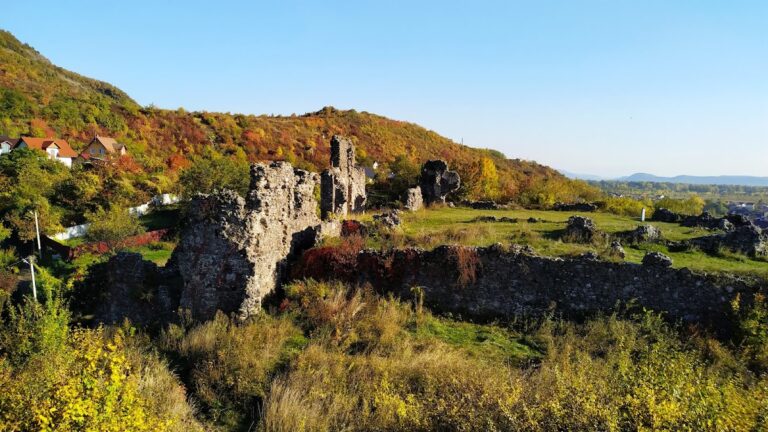
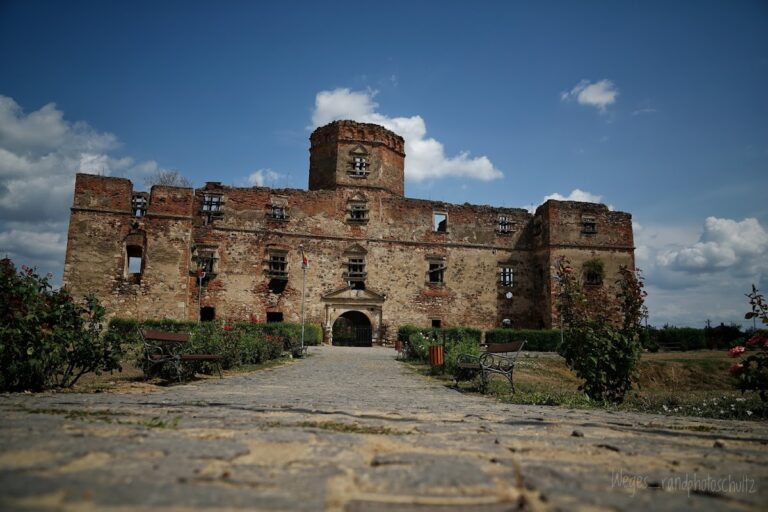
The 1766 fire and subsequent dismantling left the fortress as a ruin, with only portions of its former buildings and walls surviving. The western side retains the most substantial masonry, while the eastern side reflects the stone removal authorized in 1799. A forged-iron gate now marks the beginning of the road to Castle Hill, and a bronze model of the fortress stands in the entrance square with an inscription reproducing Evliya Çelebi’s description. A small statue titled Salt Merchant was placed there in 2020. In 2023, an approximately 1:20 model showing the fortress as it appeared in 1763 was completed, and a steel statue of Domonkos Macska was installed 300 to 400 metres from the entrance. The statue bears a cat’s head, a fourteenth-century helmet, and a stainless-steel sword hilt.