Kilkea Castle: A Medieval Fitzgerald Stronghold in Ireland
Site at a Glance
- Rating
- 4.6
- Popularity
- Medium
- Country
- Ireland
- Primary era
- Medieval
- External website
- Open
- Eras represented
- Medieval
- Civilizations
- English, Norman
- Site type
- Military
- Remains
- Castle
On this page6 sections
History
Kilkea Castle is a medieval stronghold in Ireland, established by the Anglo-Norman Sir Walter de Riddlesford in 1180 near Kilkea in County Kildare. It became associated with the Fitzgerald family, the Anglo-Norman Geraldines who developed into a major political and landholding force in medieval and early-modern Ireland, and remained connected with the earls of Kildare for more than 700 years.
Anglo-Norman foundation and Fitzgerald rule
Sir Walter de Riddlesford founded a motte-and-bailey at Kilkea after the Anglo-Norman conquest of Ireland. His granddaughter later married Maurice Fitzgerald, 3rd Baron Offaly, bringing the Manor of Kilkea into Fitzgerald ownership. The castle consequently formed part of the Fitzgeralds’ territorial and political presence in the region.
Sir Thomas de Rokeby, Justiciar of Ireland from 1349 to 1356, used Kilkea as both his residence and military base. The Justiciar was the English Crown’s principal royal representative and senior judicial and administrative official in medieval Ireland. Rokeby died at Kilkea in 1356.
Military activity continued around the castle during the fifteenth century. Forces campaigning against the O’Mores and O’Dempseys defeated them at Kilkea in 1414. In 1426, John Fitzgerald, 6th Earl of Kildare, was reputed to have added so many new works that he had almost rebuilt the castle.
The Wizard Earl and religious occupation
Kilkea became especially associated with Gerald Fitzgerald, 11th Earl of Kildare, who was known as the “Wizard Earl.” After his half brother, Thomas Fitzgerald, 10th Earl of Kildare, and five uncles were executed at Tyburn in 1537, Gerald became the senior male representative of the Geraldines. He was sent to the continent for education, later returned to Kildare, and was restored to his titles. His association with alchemy and reputed magical powers helped shape the traditions surrounding his name. He died in 1585.
A legend says that the Wizard Earl returns to Kilkea every seventh year on a white horse with silver-shod hooves. According to the story, he wanders through the castle searching for something.
In 1634, Elizabeth Fitzgerald, widow of Gerald Fitzgerald, 14th Earl of Kildare, leased the castle to the Jesuit Order, a Catholic religious order formally known as the Society of Jesus. The Jesuits remained at Kilkea until 1646. That year, during the Irish Confederate Wars, the castle hosted Archbishop Rinuccini, the papal nuncio to the Confederation of Kilkenny. A papal nuncio was the pope’s diplomatic representative to a political authority, while the Confederation of Kilkenny was a Catholic-led Irish government formed during the seventeenth-century Confederate period.
Tenancy, rebellion, and nineteenth-century repair
In the early eighteenth century, the 19th Earl of Kildare made Carton House the family seat. Kilkea Castle was then leased to successive tenants. One of them was Thomas Reynolds, a Dublin silk merchant who became an informer during the 1798 rebellion. Through his connection with Lord Edward Fitzgerald, Reynolds joined the United Irishmen, an Irish republican organization whose rebellion sought to end British rule in Ireland. He later supplied information to the English army, and the military sacked Kilkea Castle during the rebellion.
The castle had been renovated before the 1798 rebellion and was damaged by fire in 1849. Lord Walter, 3rd Duke of Leinster, repaired it and lived there. He founded the Kildare Archaeological Society in 1891, became known as a bookseller and authority on Irish antiquities, and edited the Journal of the Association for the Preservation of the Memorials of the Dead in Ireland from 1904 until his death in 1923.
Modern ownership and reuse
After Carton House was sold in 1949, Kilkea Castle became the residence of the 8th Duke of Leinster. The Fitzgerald family sold the castle and estate in 1960. Restoration followed, and in 1966 the building was developed as a hotel under the direction of architect Niall Montgomery.
The hotel entered examinership in 2009 during the Irish financial crisis. This Irish legal procedure gives a financially distressed company protection while a survival plan is considered. The hotel closed and was offered for sale in 2010. American businessman Jay Cashman later bought the property, invested in renovations, and reopened it as a resort.
Kilkea also has an association with the polar explorer Sir Ernest Shackleton, who was born in 1874 at Kilkea House near the castle. His Quaker family had been millers in the vicinity of Kilkea Castle for more than a century. Quakers are members of the Religious Society of Friends, a Christian movement emphasizing direct religious experience and rejecting a formal priesthood.
Remains
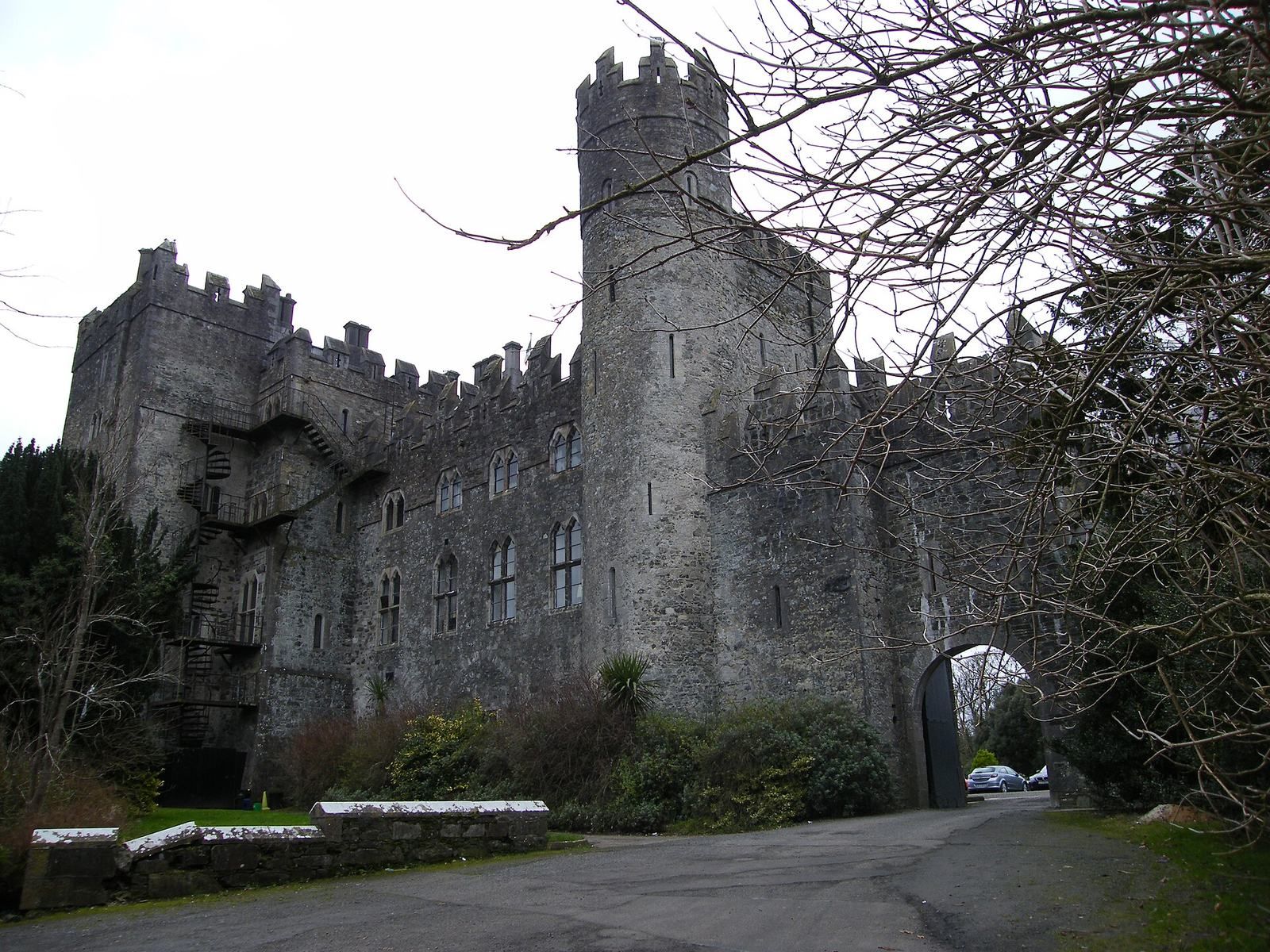
Kilkea Castle developed from a motte-and-bailey, a medieval fortification composed of a defended artificial mound and an adjoining enclosed stronghold or settlement. The site later became a fortified medieval residence of the Fitzgerald earls of Kildare. Its defensive works were substantially expanded in 1426, when John Fitzgerald, 6th Earl of Kildare, was reputed to have undertaken such extensive construction that the castle was nearly rebuilt. The structure was later renovated before the 1798 rebellion, repaired after the 1849 fire, restored in 1966, and adapted first as a hotel and subsequently as a resort.