Ballyadams Castle: A Fifteenth-Century Tower Castle in Ireland


Site at a Glance
- Rating
- 4.1
- Popularity
- Very Low
- Country
- Ireland
- Primary era
- Medieval
- Eras represented
- Medieval, Early Modern
- Civilizations
- Irish
- Site type
- Military
- Remains
- Castle
On this page11 sections
History
Ballyadams Castle is a fifteenth-century tower castle in Ireland, located at Ballyadams in County Laois near Ballinan. It was built by the O’More clan, who held power in the surrounding territory. The castle stands near the barony of Stradbally, a historical territorial subdivision used for administration and geography in Ireland.
O’More origins and Geraldine attacks
One tradition attributes the castle’s construction to Adam O’More, on the site of an earlier Norman castle. The name Ballyadams is understood as meaning “Adam’s town” in Irish. The castle later became involved in the conflicts that accompanied the decline of Gaelic power and the struggles of Anglo-Norman noble families in Ireland.
In 1534, the Geraldines captured Ballyadams Castle by assault during the rebellion of Thomas FitzGerald, the tenth Earl of Kildare, who was known as Silken Thomas. The Geraldines were a powerful Anglo-Norman and later Irish noble dynasty, including the FitzGerald earls of Kildare and Desmond, whose branches played major political and military roles in medieval and early-modern Ireland.
In 1546, the Lord Deputy of Ireland and the Earl of Desmond led a large army into County Laois and seized the castle. The action was presented as retaliation for the rebellion led by Gillapatrick O’More, chief of Leix. During that rising, the O’More and O’Connor clans had captured the town and monastery of Aghaboe.
Bowen ownership and seventeenth-century conflict
John Thomas Bowen, also known as John Pike because he habitually carried a pike, took possession of Ballyadams Castle in 1551. His son Robert inherited it in 1569. A church was built beside the castle in 1631 in Robert Bowen’s memory, and it contains a tomb-slab sculpture commemorating him.
The castle was drawn into the 1641 Irish Rebellion, a major uprising against English and Protestant settler rule that formed part of the wider conflicts of seventeenth-century Ireland. Ballyadams was besieged during the rising and became a site of fighting.
Decline, repair, and abandonment
Catherine Bowen, who married Piers Butler of Tipperary, acquired the castle in 1700. By 1782, Austin Cooper described it as already derelict and at risk of collapse. The Butlers stopped living there after rebels attacked the castle during the 1798 Irish uprising.
During the nineteenth century, Robert MacLean of Scotland leased Ballyadams. His daughter Ellen MacLean was born there in 1841. The Cammish family also lived in the castle and later sought to purchase it. The MacLeans undertook partial repairs, including the installation of a new roof, but the castle was sold without their knowledge in 1896 and was subsequently leased to various tenants.
Ellen Rothwell, née Shore, lived in Ballyadams Castle during the twentieth century. The castle was later abandoned and is now a ruin. David Butler, its current owner, is a direct descendant of Piers Butler.
Remains
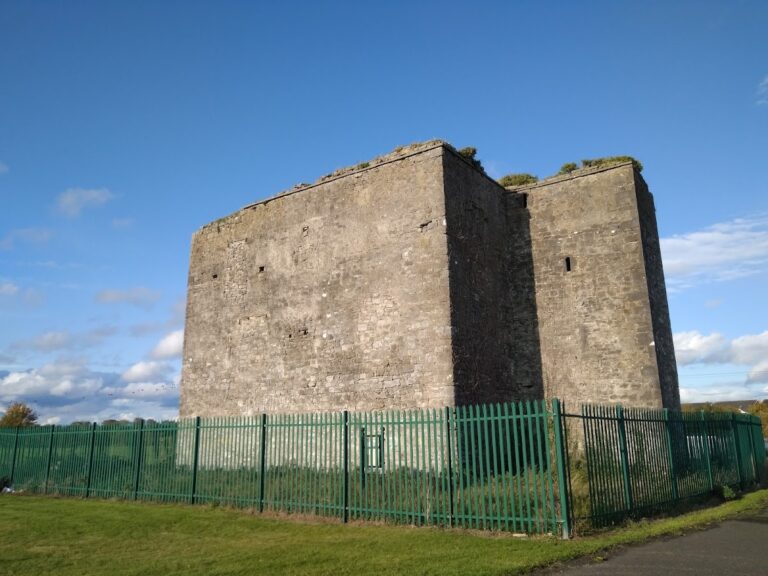
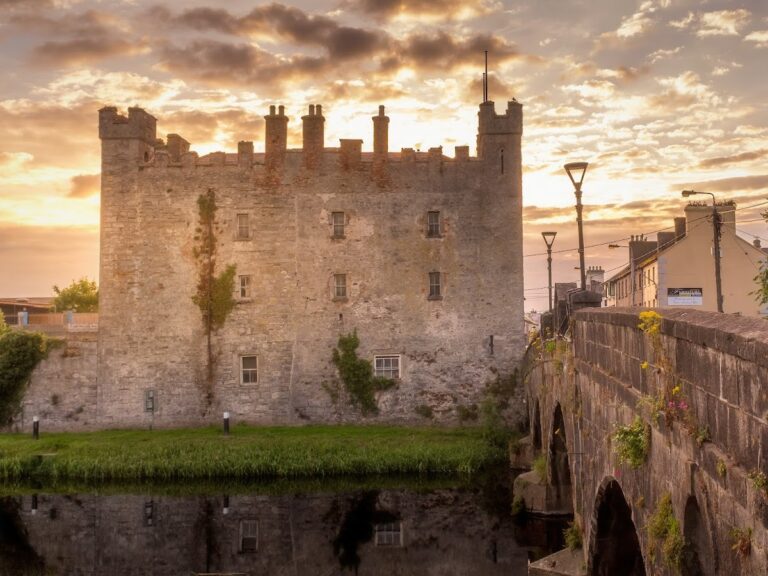
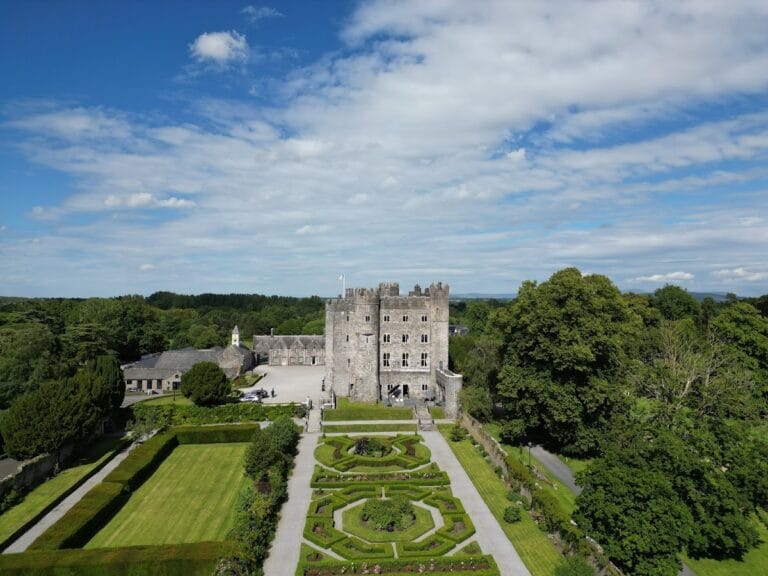
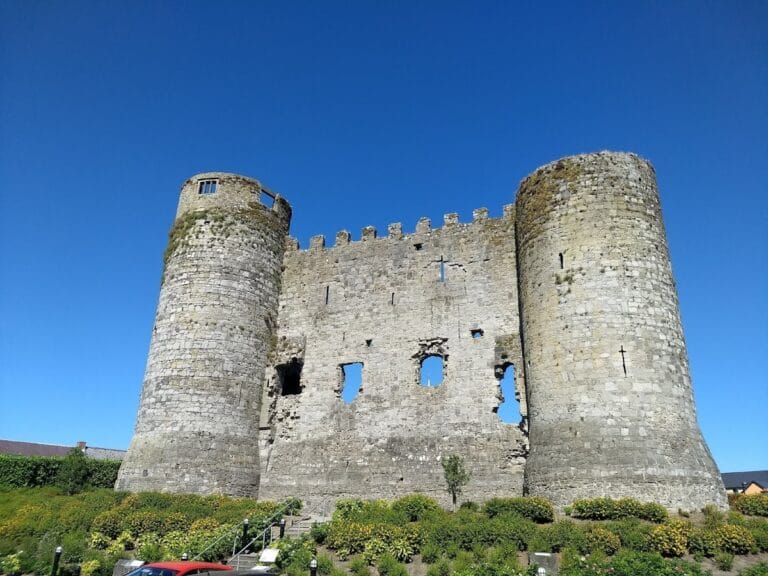
Ballyadams is organized around a principal six-storey tower, with smaller round towers attached to it and a residential building extending from the rear. The surviving elements form a castle complex shaped by both medieval defensive needs and later domestic use.
Castle buildings and defensive features
Principal tower
The main tower is a six-floor structure of tower-castle form. Its entrance is formed by a series of arches, while stone spiral stairs survive within the building and lead to the upper floors. Round towers are attached to the main tower, and the northwestern tower is the tallest of these attached towers.
Rear residential building
A residential building is attached to the rear of the castle. It is described as a typical fortified house of the late seventeenth century. A fortified house was a residence designed with defensive features, combining domestic accommodation with the ability to withstand local attack. This later building reflects the complex’s continued residential use after the construction of the medieval tower.
Church and memorial
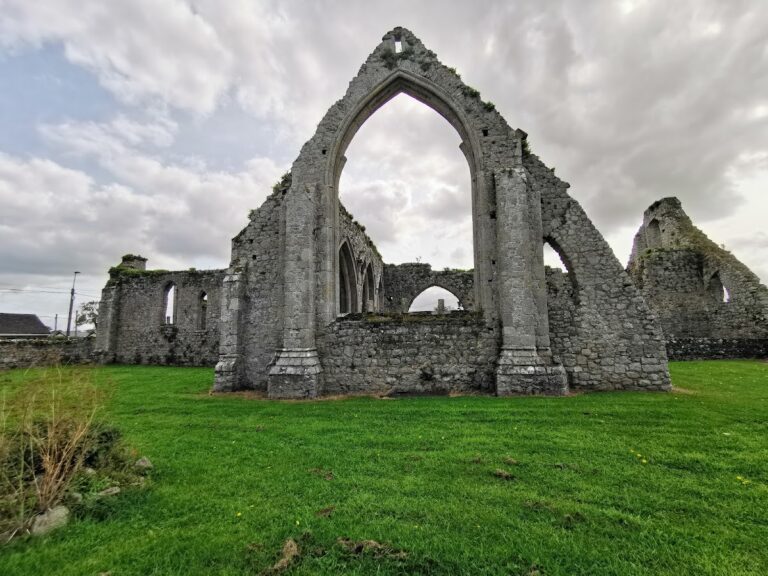
A church was built beside the castle in 1631 in memory of Robert Bowen. Within it, a tomb-slab sculpture commemorates him, linking the surviving religious building with the Bowen family’s ownership of Ballyadams.
Wells and surrounding land
Limestone wells
Two wells beside the castle were cut into limestone. Their water was believed to possess healing properties and was known as St Patrick’s spring. Saint Patrick is Ireland’s patron saint and is traditionally associated with the Christianization of Ireland.
The castle now stands as a ruin, while the surrounding land is used by local farmers as pasture. The danger of collapse has prevented entry into the building, leaving its surviving tower, attached structures, residential range, and associated features as evidence of its long history of occupation, conflict, repair, and decline.
Nearby sites