Castle of Santa Severina: A Norman Fortress in Italy



Site at a Glance
- Rating
- 4.7
- Popularity
- Medium
- Country
- Italy
- Primary era
- Medieval
- External website
- Open
- Eras represented
- Medieval, Early Modern
- Civilizations
- Byzantine, Kingdom of Naples, Norman, Spanish
- Site type
- Military
- Remains
- Castle
On this page17 sections
History
Castle of Santa Severina is a Norman fortress in Italy, built in 1076 on the summit of the rocky stronghold above the ancient settlement of Siberene. Its origins lie in a site occupied from the Bronze Age and Iron Age, and its later history reflects Byzantine, Arab, Norman, Angevin, Aragonese, and aristocratic rule. The castle and surrounding settlement formed part of a strategically important centre overlooking the Neto valley and the hills of the Marquisate of Crotone.
From Siberene to the Byzantine kastron
The settlement was first occupied by an indigenous population probably associated with the Oenotrians. Greek-Italic, Brettian, Roman, Byzantine-Greek, and Arab communities followed. Arab control lasted from about 840 until 885 or 886, when the settlement became a kastron, a Byzantine fortified complex combining military and religious buildings. By the end of the ninth century, it had become the second metropolitan seat of Calabria.
The ancient name Siberene later changed to Santa Severina, although the reason remains uncertain. It may have developed from a Byzantine Latinization as Severiana or Severina, with “Santa” added after the Byzantine reconquest in 886. Another possibility is that the Byzantines dedicated the settlement to a Santa Severina who was already venerated. The site remained Byzantine until 1076, when Robert Guiscard, the Norman duke of Apulia and Calabria, obtained the duchy and its territories.
Norman and Angevin transformation
Robert Guiscard ordered the construction of the castle on the summit and a wall around the settlement. He also commissioned a donjon, the principal fortified tower of a medieval castle. Its remains were identified only during recent investigations. The Norman stronghold was built directly above the acropolis of ancient Siberene.
Because the population had been Greek for almost two centuries, civil, military, and ecclesiastical institutions changed gradually under Norman rule, while Greek religious rites continued for a long period. After the Battle of Benevento in 1266, Charles I of Anjou conquered the Kingdom of Sicily. He incorporated Santa Severina and its dependent settlements into the royal domain, although he granted the fief to Pessino di Villery. Resistance from the citizens prevented Pessino from taking possession, and he transferred his authority to Pietro Ruffo, Count of Catanzaro, for 1,200 gold ounces. Ruffo also failed to establish control.
Angevin rule brought major changes to the fortress. The cylindrical towers and the four curtain walls surrounding the donjon are attributed to this period. These works reshaped the Norman stronghold into a more substantial fortified complex.
Aragonese rule and the Carafa seizure
The Aragonese dynasty came to power in Santa Severina in 1444. Alfonso V of Aragon granted the town numerous privileges. The inhabitants later requested exemption from certain taxes and asked either for the castle to be demolished, because it was considered dilapidated and costly to maintain, or for it to be repaired. Alfonso chose preservation and ordered substantial restoration. His successor, Ferrante of Aragon, confirmed the town’s independence and its organization through effective magistracies.
Andrea Carafa, a nobleman descended from the Caraccioli family, advanced through important offices in the Kingdom of Naples and through service to Ferrante II Gonzaga, Alfonso II of Aragon, and Frederick of Aragon. Charles V appointed him lieutenant of the kingdom in 1525. Carafa had paid 9,000 ducats to secure the fief of Santa Severina, although a 1496 decree assigned it legally to Frederick of Aragon.
The citizens resisted Carafa by invoking their Angevin and Aragonese privileges. He besieged the town for several months before entering the castle through a concealed lane with help from the mastrogiurato, a local official. Santa Severina came under his feudal control in October 1506. Carafa confiscated the property of wealthy inhabitants accused of felony, imprisoned opponents, and had some killed by throwing them through trapdoors into the castle dungeons.
Andrea Carafa died without descendants in 1526, and his nephew Galeotto Carafa succeeded him. Galeotto’s rule produced a more favourable political climate and a revival of cultural activity, although he also accumulated heavy debts. After his death in 1556, his eldest son Andrea inherited the town and its people, but the county was seized and auctioned before he could be formally installed. The Carafa family made later efforts to recover the fief. One such attempt was made by Geronima Carafa, Galeotto’s wife, who acquired it for 54,800 ducats through further borrowing and transferred it to her son Vespasiano Carafa after Galeotto’s death in 1569. Vespasiano left no successor, ending the family’s possession of the county.
Later feudal rule and changing uses
After the Carafa period, the fief passed to the royal court and was transferred to Vincenzo Ruffo in 1608. Carlo Sculco purchased it in 1650 for 71,000 ducats and received the ducal title of Santa Severina from Philip II of Habsburg. The associated ducal bull was issued in Madrid on 15 November 1660.
Domenico Sculco died without heirs in 1687, ending the family’s succession rights. The castle was auctioned in 1691 to Cecilia Carrara, who transferred it to her son Antonio Greuther. The Greuthers were a merchant family from Westphalia that had arrived in Italy around the middle of the seventeenth century. Gennaro Greuther became the last feudal lord of Santa Severina.
During the eighteenth century, the absence of major military threats allowed the Greuthers to turn the fortress into an aristocratic residence. Joseph Bonaparte, who ruled the Kingdom of Naples, abolished feudalism there on 2 April 1806. Gennaro retained only his princely title, while the castle and much of Santa Severina came under Church jurisdiction until the establishment of the Kingdom of Italy in 1860.
Excavation, restoration, and institutional use
From the early 1930s, the castle housed a grammar-school boarding institution, whose administrators helped prevent prolonged deterioration. In the 1970s it served as a municipal boys’ boarding school for about 80 students of the Diodato Borrelli grammar school. After declining enrolment led to its closure, the municipal administration considered creating a major picture gallery and organizing nationally important painting exhibitions.
A programme of restoration and archaeological investigation took place between 1994 and 1998, following seven years of specialist work by archaeological and cultural-heritage authorities. The project revealed evidence for the site’s development from antiquity onwards and was completed with a ceremony on 23 May 1998. Two volumes recorded the results in the archaeological and cultural-heritage fields. The restored complex now houses the Museum of Santa Severina, the Centre for Documentation and Study of Calabrian Castles and Fortifications, and the MACSS Museum of Contemporary Art of Santa Severina.
Remains
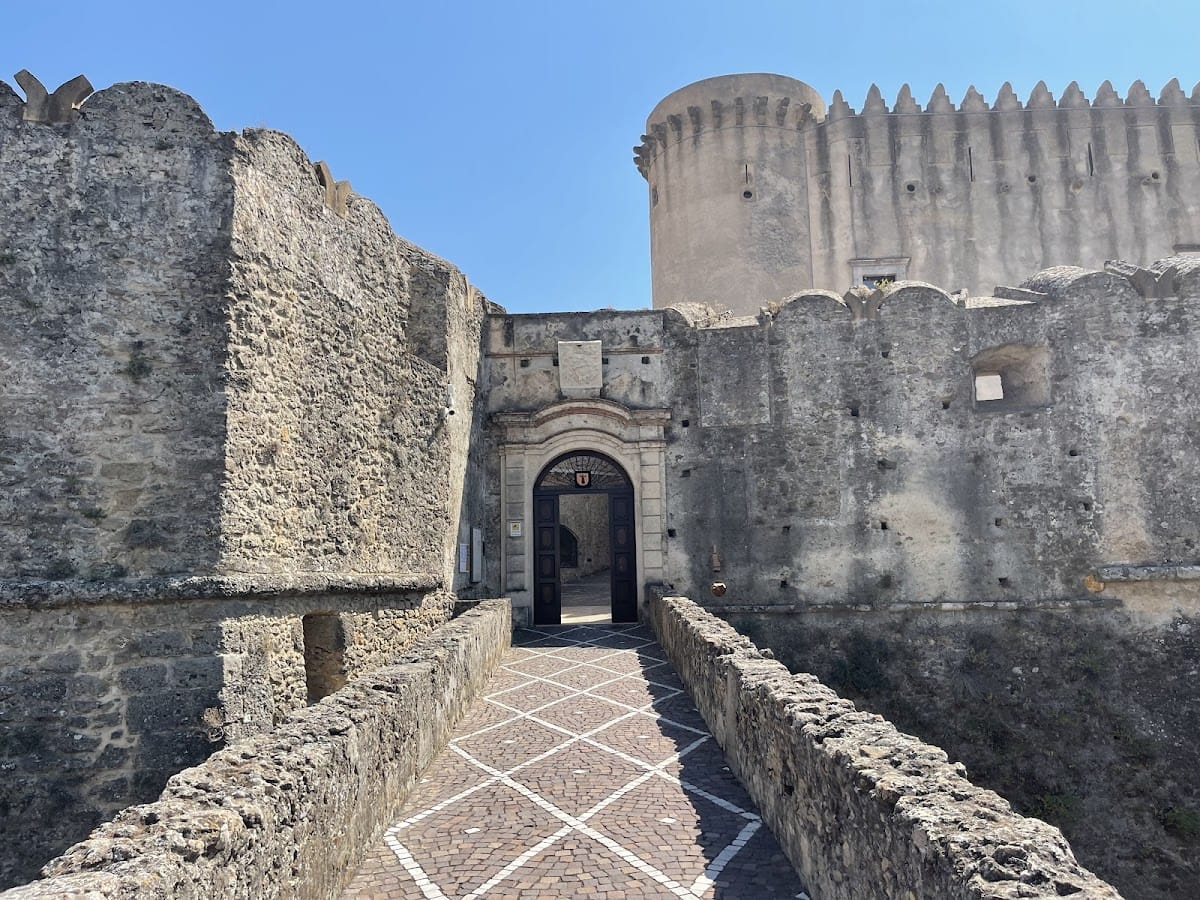
The castle occupies approximately 10,000 square metres on the elevated rocky stronghold of Santa Severina. It overlooks the broad Neto valley and the hills of the Marquisate of Crotone, near Crotone. Built in irregular stone masonry, the fortress follows an uneven perimeter adapted to the highest part of the stronghold. Its defensive fabric was repeatedly demolished, altered, raised, and supplemented as military requirements changed.
Fortifications and central stronghold
Donjon and corner towers
The principal core is a square donjon with four cylindrical battered towers, whose walls slope inward towards the top. A powerful surrounding curtain wall joins the central stronghold to the outer defenses. Four projecting bastions correspond to the towers, while the bastioned fronts have differing geometries in sections dating from the sixteenth century.
Carafa defenses and gates
The Carafa works added fortified walls around the Angevin stronghold and created the Belvedere bastion. Crenellations remain visible along the wall. A passage is associated with Galeotto Carafa, while his son Andrea is credited with minor completion work on the crenellated wall. Vespasiano Carafa completed the section beside the new gate.
Archaeological investigations also identified remains probably belonging to the Swabian period, the era of the Hohenstaufen rulers in southern Italy. These include features associated with an old round tower, a truncated tower, the round tower of the former spiral stair, and quadrangular battlements. The surviving evidence for this phase is limited.
Archaeological evidence within the castle
Byzantine necropolis
The castle area contains a Byzantine necropolis, showing that burial activity formed part of the site’s long development before and during its later fortification. One tomb contained a body with a coin from the third century BC placed on its jaw, linking the archaeological record to the earlier history of Siberene.
Ecclesiastical complex
Investigations revealed an articulated Byzantine ecclesiastical complex within the castle grounds. Its presence reflects the period when Santa Severina functioned as a kastron, combining military installations with religious buildings.
Cistern
A large empty cistern with a barrel-vaulted roof was also discovered inside the complex. Its form and position belong to the castle’s water-management infrastructure and provide evidence of the practical arrangements required within the fortified enclosure.
Residential interiors and museum collections
Eighteenth-century residence
The eighteenth-century conversion to an aristocratic residence altered the interior organization. First-floor rooms with vaulted ceilings were transformed and combined, a large hall was created beside the spiral staircase, and the rooms were decorated. Around 1750, the central hall of the donjon was decorated by the painter Francesco Jordano.
Archaeological collections
The Museum of Santa Severina displays finds recovered during excavations in the castle. Its collections also include archaeological materials from the surrounding territory, among them prehistoric bronzes dated from the fifteenth to the eighth centuries BC. The complex additionally contains the Centre for Documentation and Study of Calabrian Castles and Fortifications and the MACSS Museum of Contemporary Art of Santa Severina.