Palazzo Barracco: An Eighteenth-Century Palace in Crotone
Site at a Glance
- Rating
- 4.3
- Popularity
- Very Low
- Country
- Italy
- Primary era
- Early Modern
- External website
- Open
- Eras represented
- Early Modern
- Civilizations
- Kingdom of Naples
- Site type
- Domestic
- Remains
- Palace
On this page6 sections
History
Palazzo Barracco is an eighteenth-century palace in Crotone, Italy, built for the Barracco family in 1738 by Domenico Aiello Farina. It stands within the city’s historic centre and later became associated with the family’s commercial activity, royal connections, and changing residences during the nineteenth century.
The Barracco Family in Crotone
Baron Alfonso Barracco was living in Crotone by the end of the eighteenth century. On 23 January 1800, he entered an agreement with the De Riso brothers and the Bianco family of Catanzaro to supply 1,700 tomoli of grain from the 1799 harvest. A tomolo was a historical Italian measure of capacity used especially for grain, although its precise value differed between regions. Antonio Casaburi, who lived in Crotone and served as royal auditor, political and military assessor, and administrator of Alfonso Barracco’s property for the royal treasury, was responsible for the delivery.
The palace later passed to Alfonso’s son Luigi. In 1828, Luigi arranged an exchange involving a house in the parish of San Salvatore. The deed was notarized in 1839 as part of his plan to reconstruct and enlarge Palazzo Barracco. In November 1828, he also received authorization for a private oratory, a small chapel intended for private or limited religious use by members of the family.
Earthquake, Royal Visit, and Family Relocation
The earthquake of 8 March 1832 was followed by a royal decree dated 12 March 1833 ordering the demolition of the Church of San Salvatore. Bishop Leonardo Todisco Grande strongly opposed the decision, but the church was demolished on 8 August 1834. Around 1833, Luigi Barracco hosted Ferdinand II, the new king of the Two Sicilies, at the palace during the monarch’s tour of the kingdom’s provinces.
In 1834, Luigi’s firstborn son, Alfonso Barracco, married Emilia Carafa. Alfonso later succeeded his father, who died in 1849. The family subsequently moved to a new residence on Via Monte di Dio in Naples. After Italian Unification, the nineteenth-century process that brought the Italian states together into the Kingdom of Italy, Alfonso supported Giuseppe Garibaldi’s campaign with a contribution of 10,000 ducats. The Barracco family then moved to Rome.
Decline and Institutional Use
As the family’s presence in Crotone became increasingly infrequent, the palace entered a prolonged period of decline. In 1919, Baron Enrico Barracco, Alfonso’s son and heir, lived there with his wife Maria Doria, together with the heirs of Roberto Barracco.
From 1995 to 2009, Palazzo Barracco housed the offices of the Chamber of Commerce of Crotone and the Museum of Contemporary Art of Crotone, commonly known as MACK. The palace remains in use.
Remains
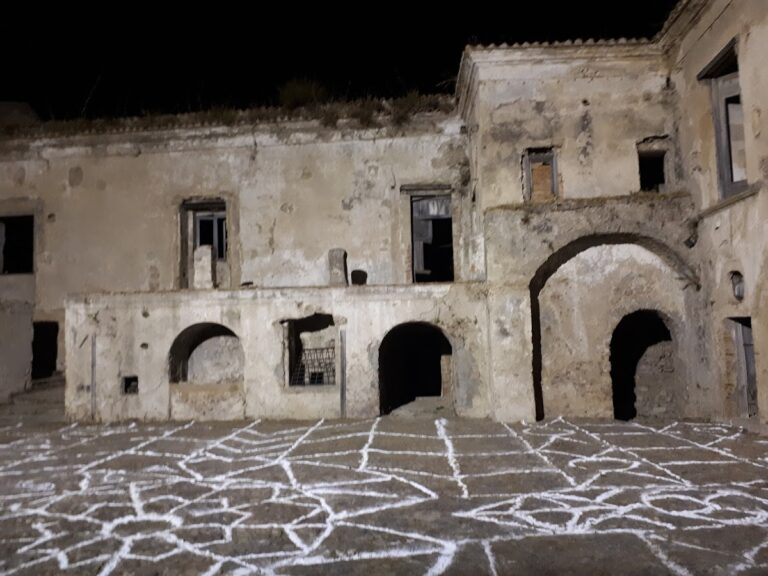
Palazzo Barracco occupies a prominent position on Piazza Castello in Crotone’s historic centre. Its elevated setting overlooks the city, the sea, the surrounding countryside, and the mountains, while numerous roads connect it with the urban area. The palace is organized around an enclosed courtyard with a gallery, an elevated passage or balcony that provides circulation around the courtyard.
Courtyard and Gallery
The enclosed courtyard forms a defined internal space within the palace, and the gallery provides movement around it. These elements express the building’s arrangement as a substantial urban residence rather than a single outward-facing block. The palace is currently in use, preserving its role as an occupied building within Crotone’s historic centre.
Nearby sites