Migdal Afek: A Historic Fortress and National Park in Israel



Site at a Glance
- Rating
- 4.4
- Popularity
- Medium
- Country
- Israel
- Primary era
- Medieval
- External website
- Open
- Eras represented
- Classical, Medieval, Early Modern, Modern
- Civilizations
- Crusader, Kingdom of Jerusalem, Ottoman
- Site type
- Military
- Remains
- Castle
On this page12 sections
History
Migdal Afek is a historic fortress and national park in Israel, on the southeastern edge of Rosh HaAyin. Its hilltop castle was built by the Franks in the early twelfth century during the Crusader period, above earlier Roman and Byzantine remains, beside the Aphek Pass. The pass formed part of the Via Maris, or Way of the Sea, an ancient route linking Egypt with the Levant and lands farther east.
The Hasmonean settlement and later antiquity
A fortified Jewish settlement called Migdal Aphek or Afek stood here by the second century BCE, during the Hasmonean period. The Hasmoneans were a Jewish ruling dynasty that governed Judea during the second and first centuries BCE. The settlement was destroyed by Roman forces in 67 CE during the First Jewish-Roman War, the revolt against Roman rule that began in 66 CE.
The site continued to be occupied or used during the Roman and Byzantine periods. Reused decorated stones, a Greek inscription, and a small quantity of pottery point to these later phases. A Byzantine church or shrine once stood at the site.
Mirabel under the Kingdom of Jerusalem
In the early twelfth century, the Ibelin family established the castle of Mirabel at ancient Migdal Afek. The Ibelins were a prominent Frankish noble family in the Crusader states. In 1134, King Fulk of Jerusalem made Mirabel an independent lordship within the County of Jaffa and granted it as a fief to Barisan of Ibelin, who built the hilltop castle over the earlier Roman and Byzantine remains.
After Barisan died, Manasses of Hierges became lord of Mirabel in 1150 through his marriage to Barisan’s widow, Helvis of Ramla. Manasses, a cousin of Queen Melisende and constable of the Kingdom of Jerusalem from 1140, supported her in her struggle with her son Baldwin III. Baldwin besieged Manasses at Mirabel in 1152. Manasses surrendered and was exiled.
Barisan’s son Hugh of Ibelin inherited Mirabel, and after Hugh died without children, his brother Baldwin of Ibelin inherited the lordship in 1170. A Frankish settlement grew on the hills around the castle. Saladin’s advance forces burned it in 1177, and Baldwin of Ibelin later served as a commander at the Battle of Montgisard.
Following the Battle of Hattin, Mirabel was captured by al-Adil, Saladin’s brother, in July 1187. The castle remained in Ayyubid hands, under the dynasty founded by Saladin, in 1191 and 1192. It was abandoned during the thirteenth century.
Ottoman village and fortified manor
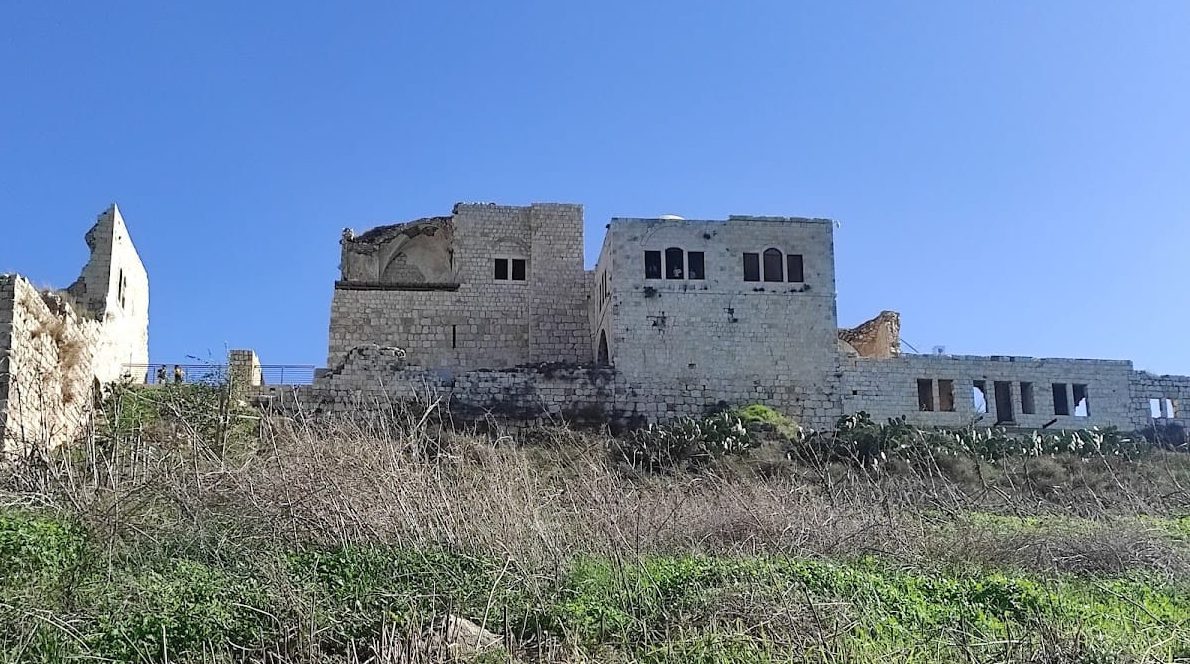
From the sixteenth century, a village called Majdal Yaba occupied the site. During the seventeenth century, the Rayyan family, who had come from Transjordan, took control of the village and built a two-story manor house. The site was also reused as a fortress under Ottoman rule in the seventeenth and eighteenth centuries.
During the nineteenth century, Sheikh Sadek took control of the area and built a castle over the ruins of the earlier fortress. He used it as a center of authority and to collect unlawful taxes from travelers until the Ottoman authorities exiled him. The village consequently became known as Majdal Sadiq as well, although Majdal Yaba remained the more common name on maps and in other records.
War, displacement, and preservation
The site was involved in fighting during World War I between Ottoman, German, and Austro-Hungarian forces and the British-led Egyptian Expeditionary Force. In the 1940s, the Solel Boneh quarry at Migdal Tsedek was used by Ta’as, the underground Jewish weapons-manufacturing organization, to test its first weapons.
In July 1948, during the Nakba, the Arab village was depopulated by the Israel Defense Forces. The Nakba refers to the mass displacement and dispossession of Palestinians during the 1948 war and its aftermath. After the war, new immigrants lived at the site, while the former village lands became part of Rosh HaAyin, Einat, and Givat HaShlosha. A memorial near the road junction and the entrance to the ruined village commemorates fighters who died during the capture of the village in the 1948 war.
Migdal Afek was declared a national park in 1994, initially covering about 30 dunams around the fortress. In 2005, a further 1,671 dunams were incorporated after the municipality of Rosh HaAyin withdrew its objection. Vandalism led to the park’s closure in 2013. Restoration and reconstruction began in 2016, and the site reopened in March 2021 as part of a larger park developed around the fortress and village ruins.
Remains
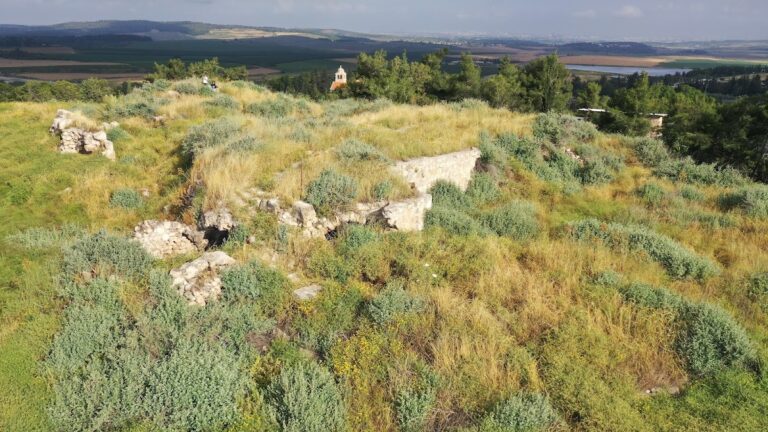
The surviving complex occupies a hill about 120 metres above sea level, approximately 17 kilometres east of Jaffa, overlooking the narrow Aphek Pass. The pass allowed the ancient route to cross the coastal plain between Tel Afek and Migdal Afek, bypassing the Yarkon River and its wetlands to the east and the foothills, rocky ground, and east-west river valleys of Samaria to the west. The ruins combine a Crusader hilltop castle, later Ottoman construction, and a fortified nineteenth-century manor house, with the remains of Majdal Yaba or Majdal Sadiq surrounding the fortress.
Fortress and manor
Crusader castle
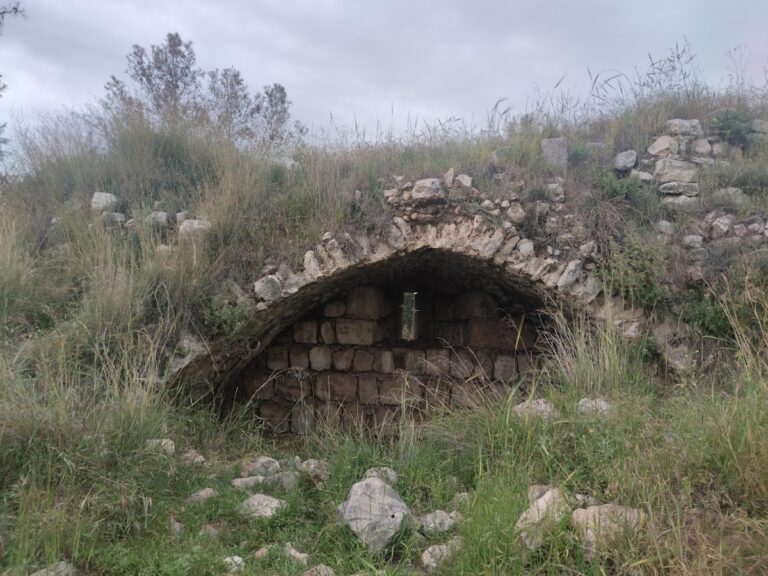
The Crusader castle forms the core of the hilltop complex. Its walls are about two metres thick, and the central donjon, the main fortified tower of a medieval castle, together with the enceinte, its enclosing defensive circuit, preserves the basic arrangement of the fortress. Crusader construction is especially clear in the western tower.
Ottoman additions and manor house
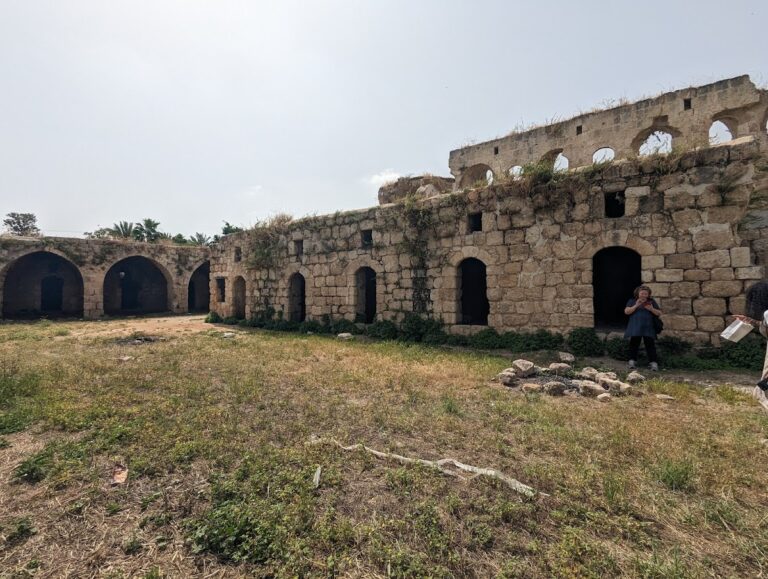
Ottoman construction partly overbuilt the Crusader castle. The later manor house had two stories and incorporated or occupied the earlier fortified complex. The nineteenth-century fortified building therefore survives as part of the same layered structure rather than as an entirely separate monument.
Earlier remains and the Greek inscription
Jewish settlement and burial caves
The earlier Jewish settlement is represented mainly by elaborate burial caves in a Jerusalem-style tradition. Sparse remains from the Bronze Age and Iron Age also occur at the site. These earlier traces form part of the archaeological sequence beneath and around the later fortress.
Saint Kyrikos inscription
A lintel above a stone-built doorway carries the Greek words “Martyrion of Saint Kyrikos.” The stone was probably brought from elsewhere and reused in the fortress. The inscription dates from the fourth or fifth century CE and refers to a martyrion, a Christian shrine or memorial associated with a martyr.
The inscription is associated with Saint Kyrikos, traditionally described as a three-year-old Christian child killed for his faith during the reign of the Roman emperor Diocletian in the late third century. The room behind the inscribed doorway was later used by the al-Rayyan sheikh as a stable and for storing fodder. Reused decorated stones and a small quantity of Roman and Byzantine pottery further reflect the site’s later occupation.
The nearby junction of Routes 444 and 471 is called Migdal Afek Junction after the national park.