Opočno Castle: A Renaissance Residence and Historic Estate in Czechia


Site at a Glance
- Rating
- 4.7
- Popularity
- Medium
- Country
- Czechia
- Primary era
- Early Modern
- External website
- Open
- Eras represented
- Stone Age, Bronze Age, Medieval, Early Modern, Modern
- Civilizations
- Austrian Empire, Duchy of Bohemia, Habsburg, Holy Roman Empire, Kingdom of Bohemia
- Site type
- Domestic
- Remains
- Castle
On this page23 sections
History
Opočno Castle is a Renaissance castle complex in Opočno, Czechia, developed from an early medieval fortified settlement on a promontory in the foothills of the Orlické Mountains. The site was occupied by the end of the Stone Age and during the Bronze Age, while its medieval fortification was mentioned in the eleventh and twelfth centuries. A Gothic castle followed around 1330, and the Trčka family transformed it into an Italian Renaissance residence in the sixteenth century. Later Baroque rebuilding, aristocratic ownership, wartime confiscations, and state administration shaped the castle’s present history.
Early settlement and the medieval castle
Archaeological research has placed the earliest settlement at Opočno at the end of the Stone Age and in the Bronze Age, including the period of the Urnfield cultures. In the early Middle Ages, a fortified settlement called Opočen stood on the promontory. Cosmas of Prague mentioned it in connection with events of 1068, and a charter issued by Duke Soběslav I in 1130 granted revenue from Opočno to the Vyšehrad Chapter.
The early stronghold probably protected the Kladská Road, also called the Polish Road, against Polish princes. It was the last fortification on the Bohemian side of this route. A major fire in the early twelfth century destroyed its rampart and brought its defensive role to an end.
A stone Gothic castle was probably built on the site around 1330 by the Drslavici family. Čeněk of Potštejn was its first known holder in 1341. The first documented owner was Mutina of Dobruška, later of Opočno, who held the castle from 1359. He probably received it from Charles IV, first as a pledge and later as hereditary property, and began further construction before his death in 1361.
After Mutina’s death, the castle and estate passed to his son Sezema of Dobruška, who died in 1373. Sezema’s sons Štěpán and Jan divided the estate in 1376, assigning Opočno to Štěpán. He sold it to Půta I of Častolovice in 1390. Půta held it until 1397, and his son Půta the Younger retained it until 1403. Jan Krušina IV of Lichtenburk, the high burgrave, acquired Opočno in 1406. From 1407 or 1408 to 1413, his sons Hynek, Alexandr, and Jan held it jointly.
Opočno during the Hussite Wars
During the Hussite Wars, a fifteenth-century conflict involving religious and political reformers in Bohemia, Opočno was generally held by Jan Městecký of Dobruška and Opočno. He probably acquired it between 1416 and 1419, although the surviving evidence does not establish the transfer conclusively. He first supported the Hussites and later joined their opponents.
Jan Žižka unsuccessfully tried to capture Opočno in 1421. Hussite forces commanded by Sigismund Korybutovič besieged it again on 10 August 1422, but withdrew on 21 August without taking the castle. On 12 August 1425, the Orphans, a Hussite faction, captured and ravaged Opočno in retaliation for the dispatch of an assassin against Žižka.
Jan Městecký died in 1431, ending the Dobruška-Opočno line. Ownership remained uncertain until 1455. Possible holders included Jiří of Dubá and Vízmburk, Petr Svojše of Zahrádka, and Mikuláš Suchan of Libáň. In 1451 Opočno passed as an escheated estate to Ladislaus the Posthumous. From 29 July 1453 it was held by George of Poděbrady and Kunštát. Another tradition connects George’s acquisition with a punitive expedition against Petr Svojše in 1451 and regards the 1455 transfer from Ladislaus as a legal confirmation.
In 1455, George of Poděbrady’s supporter Václav of Valečov and Kněžmost became lord of Opočno. His son Viktorín succeeded him, followed by Viktorín’s uncle Samuel of Hrádek and Valečov. From 1487, Jan of Janovice and Pressburg acquired Opočno by purchase.
The Trčka transformation
Between 1493 and 1495, the Trčka of Lípa family acquired Opočno Castle and later the entire estate, including Dobruška, for 20,000 Hungarian gold florins. Mikuláš the Younger Trčka of Lípa lived at Opočno until his death without heirs in 1516 and greatly enlarged the estate. It then passed to his aunt Johanka Kroměšínová of Březovice, who transferred it to her sons Jan, Vilém, Zdeněk, Jindřich, and Mikuláš before her death later that year.
The brothers held the property jointly until 1521. After further deaths, Zdeněk and Mikuláš remained as holders, with Zdeněk taking over administration in 1527. He expanded the estate and began the first major transformation of the castle. Following a redistribution of family property in 1533, his son Jan the Younger Trčka inherited the Opočno branch. Jan had no male heirs and transferred the estate to Vilém Trčka of Lípa in 1549 or 1550.
Vilém continued earlier work and converted the Gothic castle into a Renaissance residence in the Italian manner between 1560 and 1567. After his death in 1569, disputes between the Trčka and Žerotín families were settled by the marriage of Jaroslav Trčka and Johanka of Žerotín around 1581. Jaroslav later transferred the estate to his sons Vilém, Kryštof Jaroslav, and Jan Karel, excluding his eldest son Jindřich, born from his first marriage.
Jan Karel died in 1588 and Vilém in 1596. Kryštof Jaroslav then held Opočno alone until his death in 1601. Since he had no male heir, he designated his cousin Jan Rudolf Trčka of Lípa as successor.
Confiscation and the Colloredo inheritance
During the Bohemian Estates’ Revolt, an uprising against Habsburg rule, Jan Rudolf supported the rebels. After their defeat, his wife Marie Magdalena Trčková of Lípa, née Lobkowicz, preserved his life and property through appeals and bribes. He served his punishment under house arrest and was later permitted to take part in post-White Mountain confiscations after lending money to the emperor.
Marie Magdalena nevertheless maintained contacts with anti-Habsburg rebels and linked the prospects of her son Adam Erdmann Trčka with Albrecht of Wallenstein, a major Bohemian commander and imperial general in the Thirty Years’ War. Wallenstein was assassinated at Cheb in 1634, and Adam Erdmann was killed there with him. Jan Rudolf tried to transfer Opočno and other properties to his daughters and granddaughter, but his estates were confiscated.
Emperor Ferdinand held Opočno from 1634 to 1635. On 28 December 1635, Rudolf and Vilém Colloredo-Walsee received it as a pledge for their service in suppressing the Estates’ Revolt. It became hereditary property on 30 August 1636 for 51,456 Rhenish florins, and Rudolf Colloredo, an Imperial general, became sole owner in 1638.
Opočno formed part of the Colloredo family’s indivisible property. After Rudolf’s death in 1657, it passed through several Colloredo branches, from Ludvík to Kamilo, then to Karel Ludvík and finally to Jeroným IV Colloredo. A major fire at the end of the seventeenth century destroyed the upper floors and roof, prompting extensive Baroque rebuilding. Jeroným initiated the work, while Giovanni Battista Alliprandi led its later phase. Nicola Rossi may also have contributed during the early eighteenth century.
After Jeroným’s death in 1726, Opočno passed to his eldest son Rudolf Josef I. Emperor Francis Stephen of Lorraine visited the castle during his rule. In 1775, the castle and estate came to Prince Rudolf Josef of Colloredo. František de Paula Colloredo of Waldsee inherited Opočno in 1788. His marriage to Maria Isabella of Mansfeld united the two families, which thereafter used the name Colloredo-Mansfeld.
The nineteenth and early twentieth centuries
After František’s death in 1807, his son Rudolf Josef continued alterations to the castle, particularly in the park. Opočno became a political meeting place during negotiations for the anti-Napoleonic coalition in June 1813. Tsar Alexander I of Russia, Prussian King Frederick William III, Austrian Chancellor Metternich, and Prussian Chancellor Hardenberg took part in the discussions, which helped bring Austria into the alliance against Napoleon.
Rudolf Josef II died in 1843 and was succeeded by his nephew František de Paula Gundakar II of Colloredo-Mansfeld. His death in 1852 left only a daughter, Vilemina, so his cousin Josef I assumed the estate. Josef had to confront heavy debts and the economic difficulties that followed the abolition of robot, the compulsory labor owed by dependent peasants to an estate.
After Josef I died in 1895, his grandson Josef II became lord of Opočno. He carried out further building work between 1903 and 1912 and allowed limited public access from 1922. Having no children, he adopted four nephews and transferred the family property to them. Josef III Leopold Colloredo-Mansfeld acquired Opočno in 1925.
War, state ownership, and restitution
After the occupation of Bohemia and Moravia, Josef Leopold and other family members declared Czech nationality. Nazi authorities placed the castle under forced administration and confiscated it in 1942. After the Second World War, the property was confiscated again under the Beneš Decrees, postwar Czechoslovak measures that provided, among other things, a legal basis for confiscating property associated with Germans, Hungarians, alleged traitors, and collaborators. The castle passed to the Czechoslovak state in 1945.
The Colloredo-Mansfeld family did not recover Opočno because Josef Leopold was not issued a certificate of national reliability. The family did recover Zbiroh under an exception. From 1948, Opočno formed part of the state system of castles and chateaux and was fully opened to the public. Administration passed to the State Heritage Institute in 1967. Ownership subsequently rested with Czechoslovakia, the Czech and Slovak Federal Republic, and the Czech Republic. Since 2007, the castle has remained state property under the administration of the National Heritage Institute, the Czech state institution responsible for many publicly owned historic monuments.
Restitution proceedings began in 1991, when Kristina Colloredo-Mansfeldová and her cousin Jeroným sought the return of Opočno. A 2002 district-court decision led to the castle’s return to the family in 2003, but that decision was overturned and the property returned to the state in 2007. The land remained with Kristina after the reversal.
The litigation continued through renewed proceedings, appeals, and constitutional complaints. In 2018, the European Court of Human Rights found that Kristina Colloredo-Mansfeldová’s case was not manifestly unfounded. It criticized the inability to respond to a key 1947 Ministry of Agriculture document, while expressly declining to decide whether the castle should be returned. In 2020, the Czech Constitutional Court rejected the claim that the Nazi confiscation had been proven to have a racial motive.
Separate proceedings concerned movable contents. In 2010, Jeroným removed more than 20 paintings previously awarded to him, and in 2013 Kristina removed another 34 paintings awarded to her. In 2022, an appellate court recognized claims to part of the furnishings formerly belonging to Josef II but rejected claims concerning furnishings associated with Josef III. In 2023, it recognized additional claims by Kristina and Jeroným to items including weapons, paintings, hunting trophies, tableware, and a carriage.
Remains
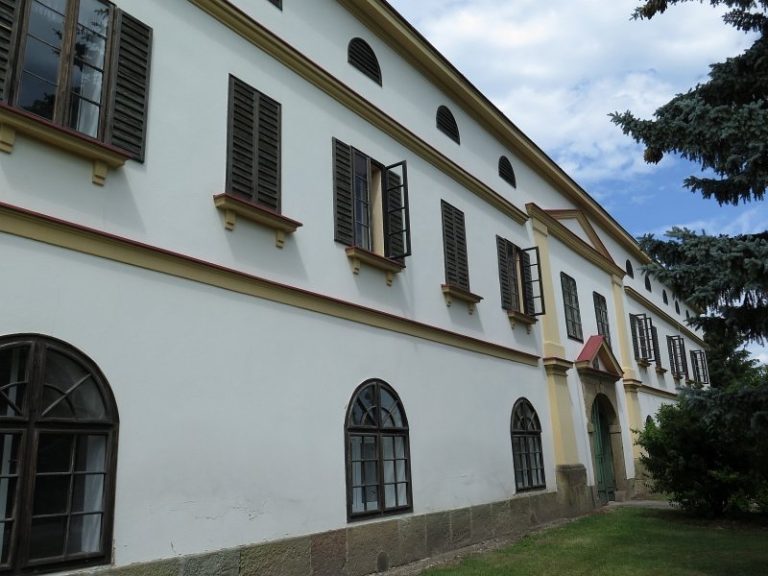
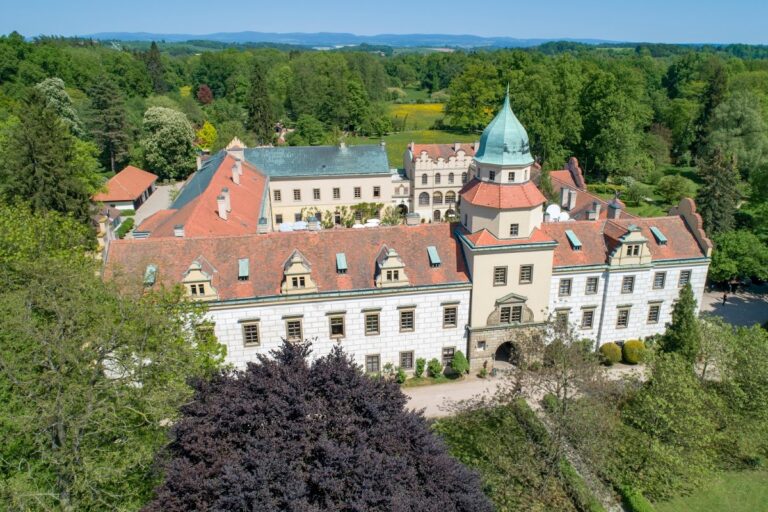
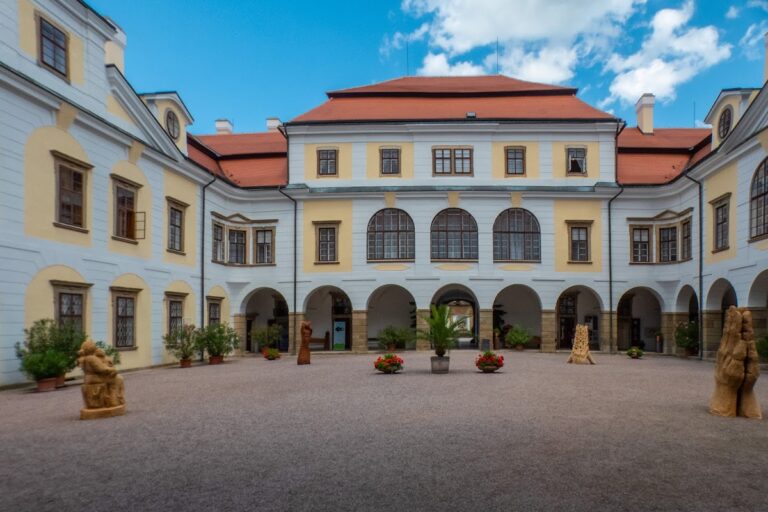
Opočno’s present complex occupies a promontory in the foothills of the Orlické Mountains. The Renaissance residence consists of three wings around an inner courtyard, while a terrace replaces the fourth side and overlooks the English-style park and the Orlické Mountains. The surviving complex combines medieval fabric with Renaissance, Baroque, Classical, and later alterations.
Early fortification and medieval remains
Early fortified settlement
The early medieval settlement occupied the promontory before the present castle was built. Excavations in the area in front of the present riding school revealed a stone facing from its rampart, remains of log or plank buildings, small ovens, fragments of clay vessels, and iron tools. These remains provide evidence of the settlement’s construction and domestic activity.
Gothic castle
The Gothic castle stood in the southeastern part of the promontory. Its complete original plan is unknown, but it probably ended on the south at a defensive ditch, traces of which remain visible in Hradební Street. A castle gate provided entry, and the approach ran beside residential and service buildings before reaching the inner courtyard.
The medieval castle included a chapel dedicated to Saint Andrew. Vilém Trčka later transformed it into the Church of the Holy Trinity, incorporating a Renaissance tomb for the Trčka family. The round Well Tower, set into the eastern slope and fitted with an oriel, is the only surviving part explicitly identified as belonging to the original medieval castle. It was heavily altered during the Renaissance. Its first function and date remain uncertain, since it may have supplied water or served a defensive purpose.
Renaissance residence
Courtyard wings and arcades
Mikuláš the Younger Trčka demolished and rebuilt the rear part of the castle while developing Opočno as a representative and administrative center for the expanding estate. Zdeněk Trčka made additional changes in a Gothic-Renaissance style between 1517 and 1573. Vilém Trčka’s rebuilding between 1560 and 1567 created the Renaissance chateau, adding the entrance wing and part of the west wing with arcades, a series of arches supported by columns or piers.
New rooms were attached to the former castle buildings on the north and west. Monumental arcades followed Italian Renaissance models, while the facades received sgraffito, a decoration made by scratching through one surface layer to expose a contrasting layer beneath it. The Trčka building program also produced religious and service buildings around the residence, including the Church of the Holy Trinity, built in 1567.
Garden and summer pavilion
Jan Rudolf Trčka created a rectangular Renaissance garden in 1602 and began constructing a summer pavilion. The pavilion overlooks the valley of the Zlatý Potok. In 1635, a ball-game hall was added across the town ditch.
Baroque and later alterations
Baroque rebuilding
The fire at the end of the seventeenth century destroyed the upper floors and roof. The first Baroque rebuilding phase added the south wing, installed a new roof, and altered the facades to their present appearance. The residence became a two-storey, three-winged building organized around arcades while retaining the core of the Renaissance castle.
The second phase completed the main building in the High Baroque style. Giovanni Battista Alliprandi designed and directed work in 1709, 1710, and 1712. The Chapel of Saint Anne in the southeastern wing is attributed to this phase. Jan Blažej Santini-Aichel, an architect known for combining Baroque design with Gothic forms, was documented at Opočno in 1718, although the purpose of his stay is unknown.
Officials’ Building and Well Bastion
From 1716 to 1720, the Officials’ Building was constructed at the northwestern corner of the complex for the administration of the estate. Its arcades were later reconstructed, and the Well Bastion was also altered.
Park and nineteenth-century work
Nineteenth-century work introduced major Classical-style changes in the lower parts of the park. The upper Renaissance section received greenhouses and an orangery, while a Colloredo family tomb was built below the Church of the Virgin Mary in 1810. In 1878 and 1879, the arcades underwent extensive reconstruction, dormer windows were replaced, and gargoyles, projecting water spouts often carved decoratively, were repaired.
The rooms on the second floor of the west wing received stucco ceiling decoration. In the eastern section, removing a five-metre wall created a viewing terrace connected by stairs to the castle park. The English-style part of the park includes rare trees, ponds, and waterfalls and covers approximately 22 hectares.
Interiors and collections
Rooms and galleries
The castle contains historical interiors, including a representative salon with Baroque and Rococo stucco decoration. It also has large and small picture galleries. The interiors were altered between 1905 and 1925, and the galleries were reinstalled in 2010 to correspond as closely as possible to photographs from the First Republic period.
The collections include paintings by Czech, Italian, Dutch, and Neapolitan-school artists transferred from Prague. Other holdings include an ethnographic collection from Africa and the Americas, a hunting-trophy museum, and an extensive weapons collection displayed in two halls. The weapons include arms from the sixteenth to the nineteenth centuries as well as Oriental weapons.
Libraries and the Kolowrat-Colloredo Gallery
A French library transferred from Paris contains approximately 12,000 volumes, including valuable works relating to Bohemia. The castle also has another valuable library and a hall displaying armor and historical weapons.
The Kolowrat-Colloredo Gallery originated with the Kolowrat family. Its holdings include a late Gothic portrait dating from around 1500, dozens of Renaissance and Baroque paintings, and the Žerotín Epitaph of 1575.
Painting research and carriage collection
In 1993, restorers proposed that a painting at Opočno might be Hieronymus Bosch’s lost work The Twelve-Year-Old Jesus in the Temple. Reflectography, an imaging method that can reveal underdrawing and alterations beneath a visible surface, showed an overpainted figure. Analysis of the pigments, art-historical examination, and dendrochronology, which dates wood by comparing annual growth rings, rejected Bosch’s authorship, although the painting may be a copy of the lost original.
A carriage of considerable artistic value forms part of the collections. Some furnishings, including weapons, paintings, hunting trophies, tableware, and the carriage, have been involved in restitution claims and judicial decisions.
Conservation and presentation
Between 1960 and 1990, the facades were renewed and the castle collections were restored and reinstalled. An Oriental Armoury was created in the 1980s. From 1993 to 2000, the arcades were restored and the castle roofs repaired. These interventions helped preserve the layered medieval, Renaissance, Baroque, and later character of the complex.