Rychnov Castle: A Baroque Residence in Czechia


Site at a Glance
- Rating
- 4.8
- Popularity
- Low
- Country
- Czechia
- Primary era
- Early Modern
- External website
- Open
- Eras represented
- Early Modern
- Civilizations
- Habsburg, Holy Roman Empire, Kingdom of Bohemia
- Site type
- Domestic
- Remains
- Castle
On this page12 sections
History
Rychnov Castle is a Baroque aristocratic residence in Rychnov nad Kněžnou, Czechia, built between 1676 and 1690 in the seventeenth-century architectural style known for formal symmetry, monumental compositions, and elaborate decoration. The estate was acquired by Albrecht Libštejnský von Kolowrat in 1640, during the Thirty Years’ War, a European conflict that also brought religious persecution to the town and forced some inhabitants to emigrate.
Foundation of the new residence
Albrecht’s son, Karl Libštejnský von Kolowrat, regarded the family’s older castle in the Burjanen valley as unsuitable for representation. He therefore commissioned a new residence on a gentle slope below the Church of the Holy Trinity. Preparatory work began in 1670, and construction followed from 1676 to 1690.
Kolowrat ownership and eighteenth-century changes
When the Libštejn branch of the Kolowrat family died out, the Kolowrats of Krakovec inherited the Rychnov estate. During the eighteenth century, the castle underwent major alterations attributed to Jan Blažej Santini-Aichel, an architect whose work combined Baroque design with forms derived from earlier architectural traditions. The changes included an additional floor for the castle and the construction of new stables. A large picture gallery was established after this work, displaying family portraits and European paintings from the seventeenth and eighteenth centuries, and it was later opened to the public.
State ownership and return
The castle, park, and adjoining grounds remained with the Kolowrats until the Second World War, when the German occupying authorities placed the property under forced administration. After 1945, the Czechoslovak state nationalized the castle, and Count Otmar Kolowrat was expropriated in 1948. The property was returned in 1992 to Count Kryštof Jaroslav Kolowrat Krakowský, and the castle reopened in 2008. The castle complex, park, and Church of the Holy Trinity are protected together as a Czech national cultural monument.
Remains
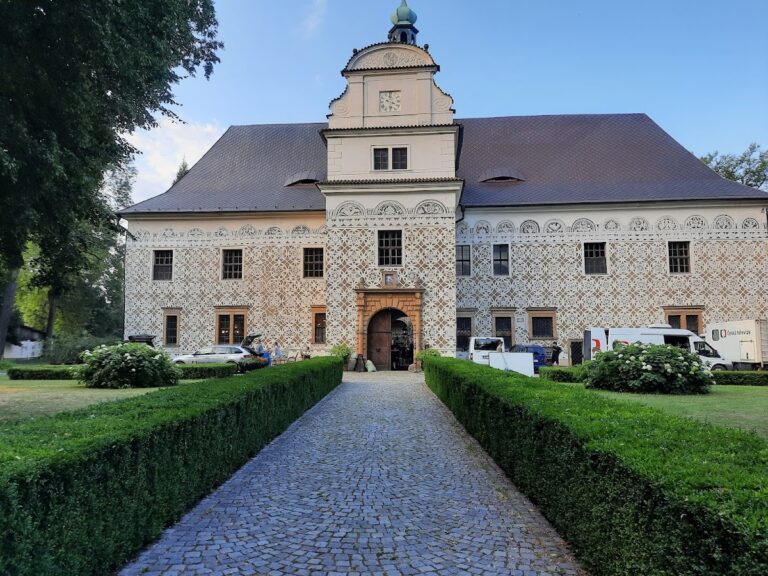
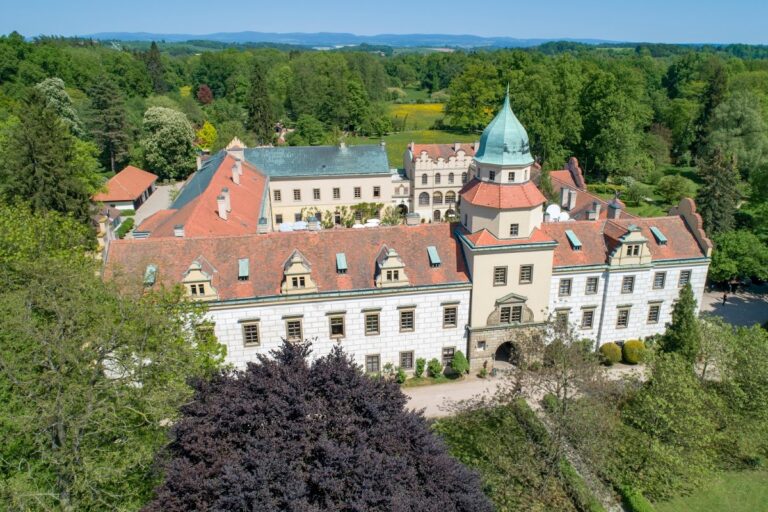
Rychnov Castle forms a large Baroque complex in the northern part of Rychnov nad Kněžnou’s historic urban core. The site includes the residence, park, stables, riding arena, Church of the Holy Trinity, and an enclosure wall with entrance gates. Positioned on a gentle slope, the complex visually dominates the Kněžná valley.
Castle and courtyards
Residence and inner courtyard
The residence was planned as four wings arranged around an arcaded inner courtyard. Its main axis continues toward a second courtyard laid out with full symmetry and containing a fountain. Together, the buildings around these two courtyards form the central core of the complex. The eighteenth-century work attributed to Jan Blažej Santini-Aichel added another storey to the castle.
Stables and riding arena
The later stables belong to the eighteenth-century enlargement of the complex and include a riding arena. They stand among the adjoining buildings that extend the castle beyond its central residential core.
Church and grounds
Church of the Holy Trinity
The Church of the Holy Trinity forms part of the castle complex. Its substantial bell tower contains a bell weighing seven tons, described as the third-largest bell in the Czech Republic.
Park and Marian column
The castle grounds include the park and a historic Marian column decorated with statues of saints. The surrounding enclosure wall has entrance gates that define the complex’s outer boundary.
Interiors and collections
The interiors retain Baroque furnishings. The eighteenth-century picture gallery, a display space devoted chiefly to paintings, contains portraits of Kolowrat family members and works from European schools of the seventeenth and eighteenth centuries. Other preserved collections include porcelain, weapons, glass, and a library containing manuscripts.
Nearby sites