Church of Our Lady of the Snows in Petrovaradin: A Marian Shrine in Serbia
Site at a Glance
- Rating
- 4.7
- Popularity
- Medium
- Country
- Serbia
- Primary era
- Modern
- Eras represented
- Early Modern, Modern
- Civilizations
- Austria-Hungary, Habsburg, Hungarian, Ottoman
- Site type
- Religious
- Remains
- Church
On this page18 sections
History
The Church of Our Lady of the Snows in Petrovaradin is a Roman Catholic sanctuary in Serbia and the country’s largest shrine devoted to the Virgin Mary. Tradition places a small church on the site between the 13th and 16th centuries and attributes it to Cistercian monks, members of a Catholic monastic order. They had come to the area at the invitation of Bela IV, king of Hungary and Croatia, on 24 June 1237. The present church was rebuilt in 1881 with Neo-Gothic and Byzantine forms.
Ottoman rule and the Jesuit chapel
Ottoman forces captured Petrovaradin Fortress on 28 July 1526. The town became a seat of Ottoman grandees, and the medieval church was destroyed. Two dervishes, members of Muslim religious orders, put up a wooden shelter on the site; the Ottomans later built a small mosque there.
The Ottoman forces left the fortress in October 1687 after their defeat at Harsány, and the mosque was abandoned. Jesuits, members of the Catholic Society of Jesus, arrived in Petrovaradin in 1693. With no church of their own in the town, they obtained permission from Cardinal Kolonić to use the mosque and turned it into a chapel dedicated to the Immaculate Conception of Mary, the Catholic teaching that she was preserved from original sin from the moment of her conception. The Jesuits worshipped there until St George’s Church was built at the foot of the fortress.
The shrine and pilgrimage traditions
During the Battle of Petrovaradin on 5 August 1716, the Ottoman army under Grand Vizier Damat Ali Pasha, the empire’s chief minister, had besieged the fortress from 3 August. The Austrian army, commanded by Prince Eugene of Savoy, a Habsburg commander, sallied out on 5 August and defeated the Ottoman forces near the chapel. In thanksgiving, Eugene gave the chapel an image of the Virgin Mary. The shrine’s dedication became associated with Our Lady of the Snows, a Catholic feast linked to a tradition that snow fell in Rome in 358 and that a basilica was founded where it remained.
The chapel was enlarged with support from the family of Austrian deputy field marshal Count Wenzel Siegfried Breuner. The older chapel became a sacristy, a room for preparing and storing items for worship, and the front was extended by 3.8 metres. The Jesuits enlarged and refashioned the building again in 1745. On 26 July, the revered image known as miraculous was solemnly brought into the church. The date became known as Little Tekije, while the 5 August feast was called Great Tekije.
Jesuits led an annual procession from St George’s Church in the fortress to the chapel for the August feast. Girls dressed in white carried a special statue, military musicians accompanied them, and Franciscans led the procession with a cross. On 10 August 1730, Pope Clement XII granted a plenary indulgence, a remission of the temporal consequences of sin under prescribed religious conditions, to pilgrims visiting for the feast. The chapel drew pilgrims from across Srem and from beyond the Danube, and Orthodox Christians also venerated the shrine.
The image followed a separate seasonal custom. Kept at St George’s Church through winter, it was carried to the shrine on Easter Monday and returned to the fortress church for the October feast of the Rosary. In 1881, priest and writer Ilija Okrugić wrote and composed a song for the transfer, which pilgrims continued to sing. By 1760, funds from pious legacies had enabled the chapel to be enlarged and rebuilt in solid masonry as a small church. That year, Bishop of Srem Nikola Đivović described it as standing outside Petrovaradin’s suburb and under Jesuit care.
Rebuilding and changing administration
When Bishop Josip Juraj Strossmayer visited in 1878, he found the church dilapidated. Parish priest Ilija Okrugić sought his advice about restoration, and Strossmayer directed him to architect Hermann Bollé. Okrugić led the rebuilding using a design selected with the bishop’s approval; the work was completed in 1881. The rebuilt church was blessed during that year’s feast of Our Lady of the Snows, after a large procession, and the image was brought into the building on 4 August. Around 15,000 people attended the occasion, about 2,000 received Communion, and more than 600 pilgrims came from Temerin.
Organs were purchased in 1893. Interior repairs in 1927 included work on the organs, new pews and a canopy beside the entrance. On 5 August 1933, Bishop Antun Akšamović celebrated a pontifical Mass, a service led by a bishop, for the 1,900th anniversary of the Redemption. Several thousand pilgrims from Srem, Bačka and Banat attended, along with about 40 priests.
Conventual Franciscans, a branch of the Franciscan order, took over the parish of St George in Petrovaradin in 1941. Ambroz Vlahov became administrator of the shrine in 1955, although it remained territorially and legally within the parish of Saint Roch. On 9 May 1960, the shrine was formally placed under Conventual Franciscan administration. In 1973, Stjepan Miler became administrator of St George’s parish and rector of the shrine, assisted by Stjepan Sokolović and Mirko Štrok. The shrine then returned to diocesan clergy.
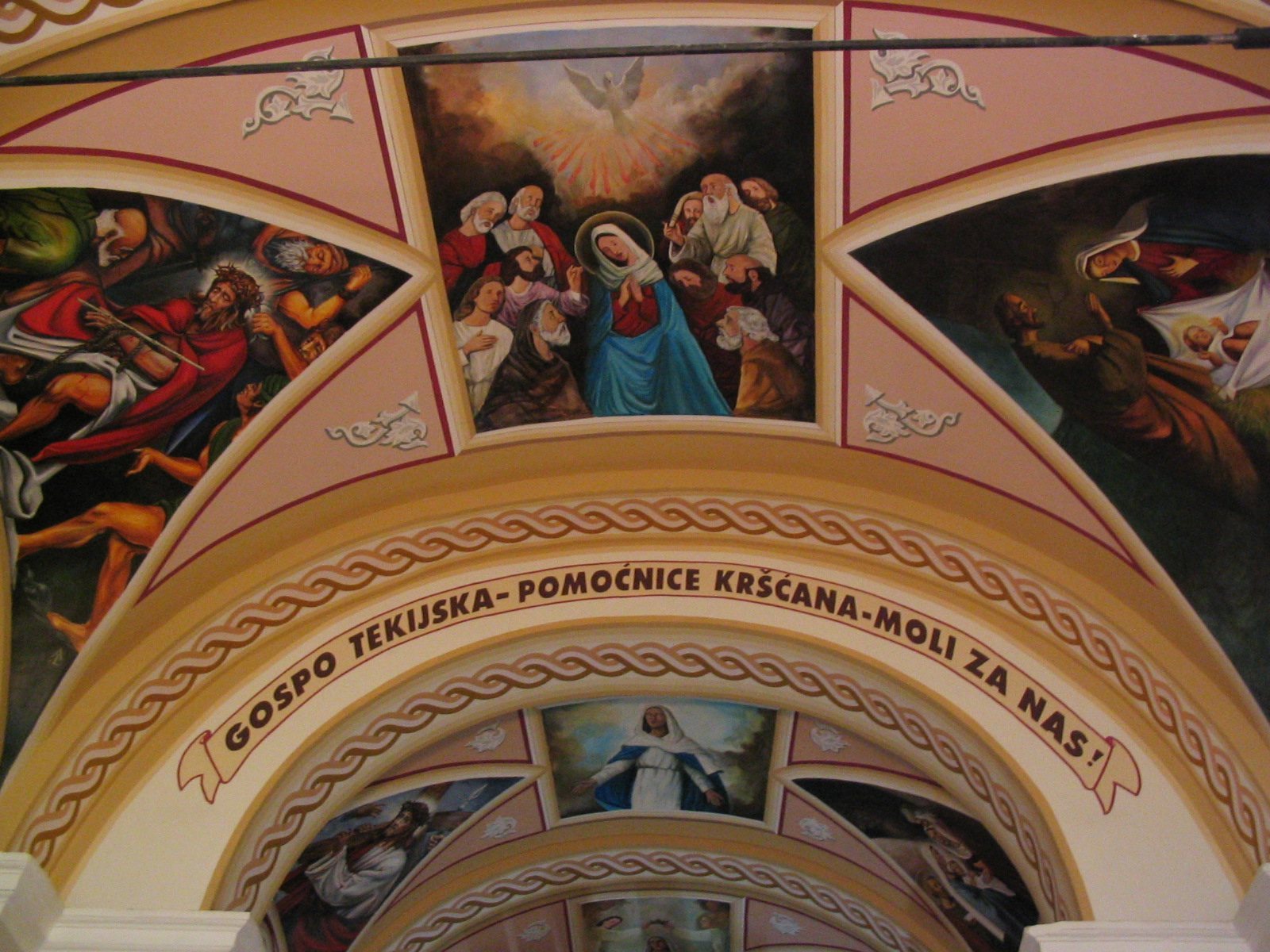
In 1976, the church was restored externally and its interior rearranged in response to liturgical changes from the Second Vatican Council, the Catholic Church council held from 1962 to 1965. Bishop Ćiril Kos blessed the renewed church and consecrated its altar on 31 May 1977. The towers were clad in copper in 1981. A Stations of the Cross path and a grotto dedicated to Our Lady of Lourdes were created in 2002 and 2003, and scenes of the four mysteries of the Rosary were painted on the church vaults in 2004.
Remains
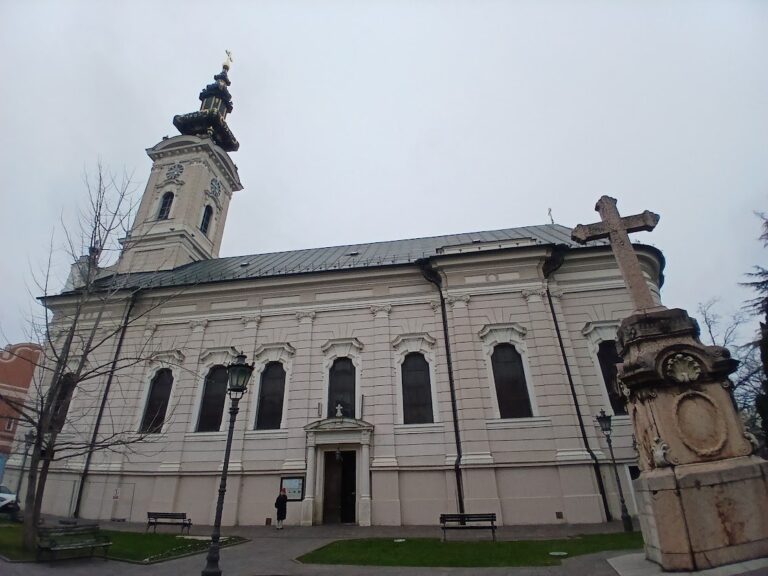
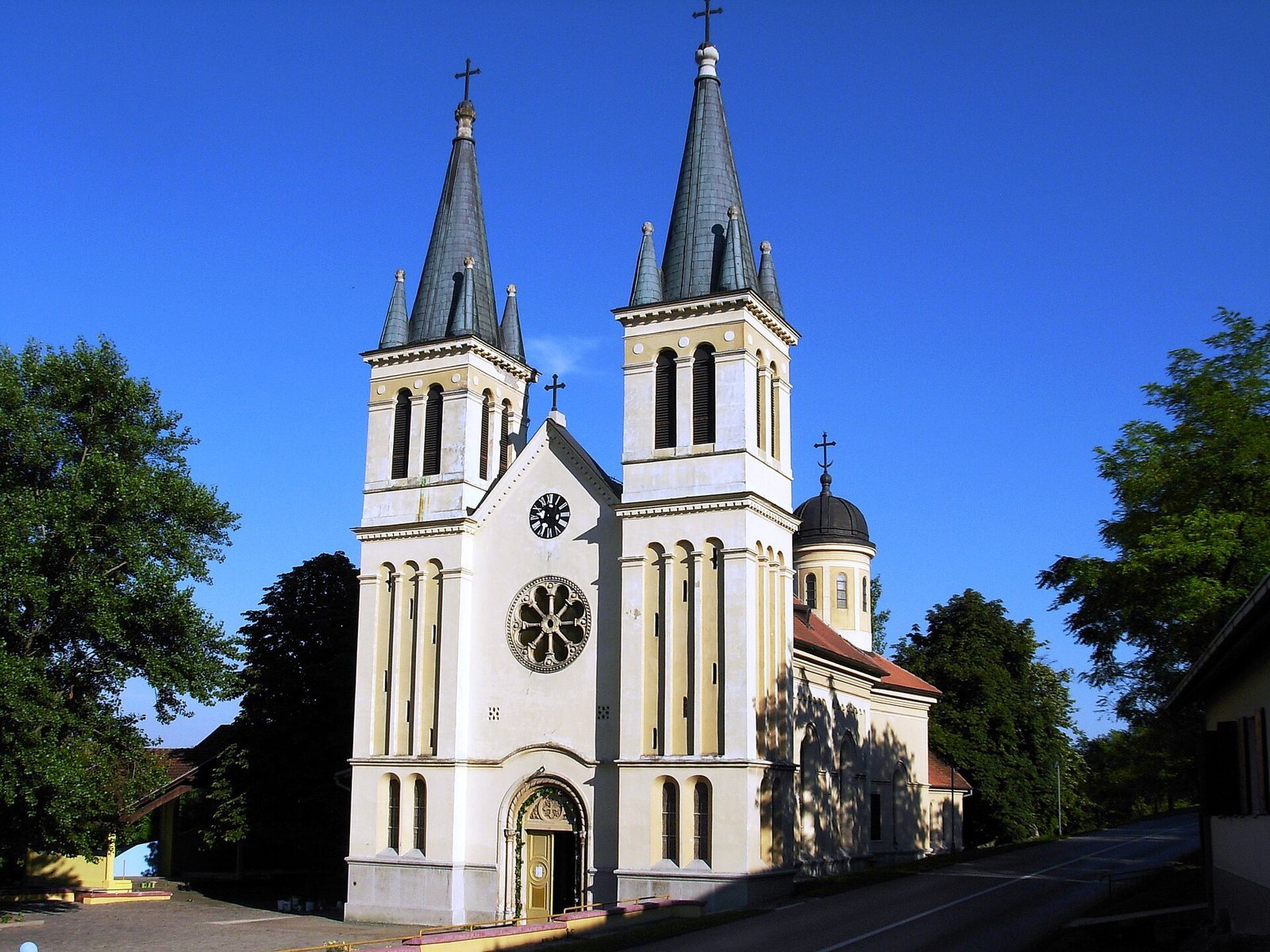
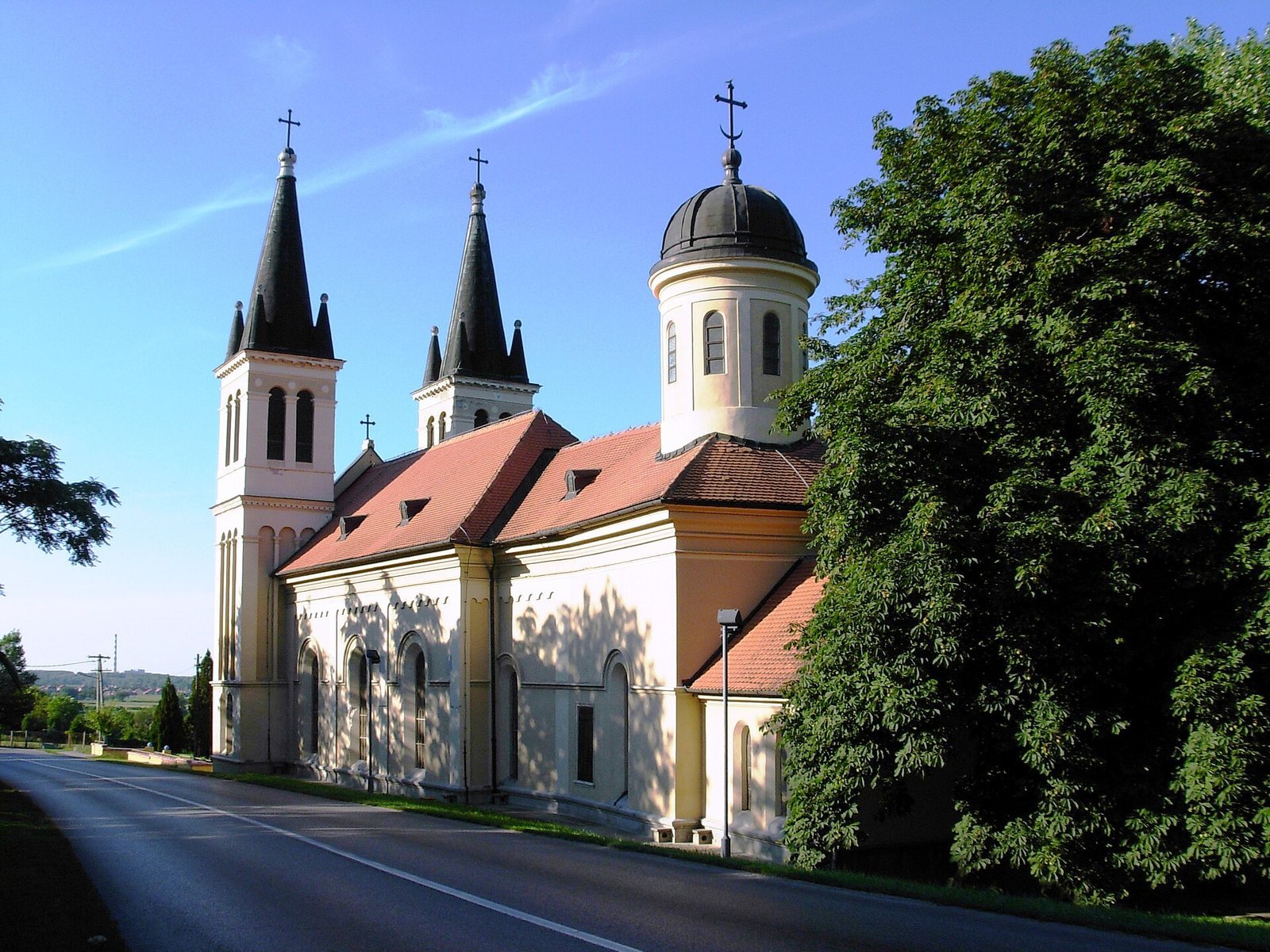
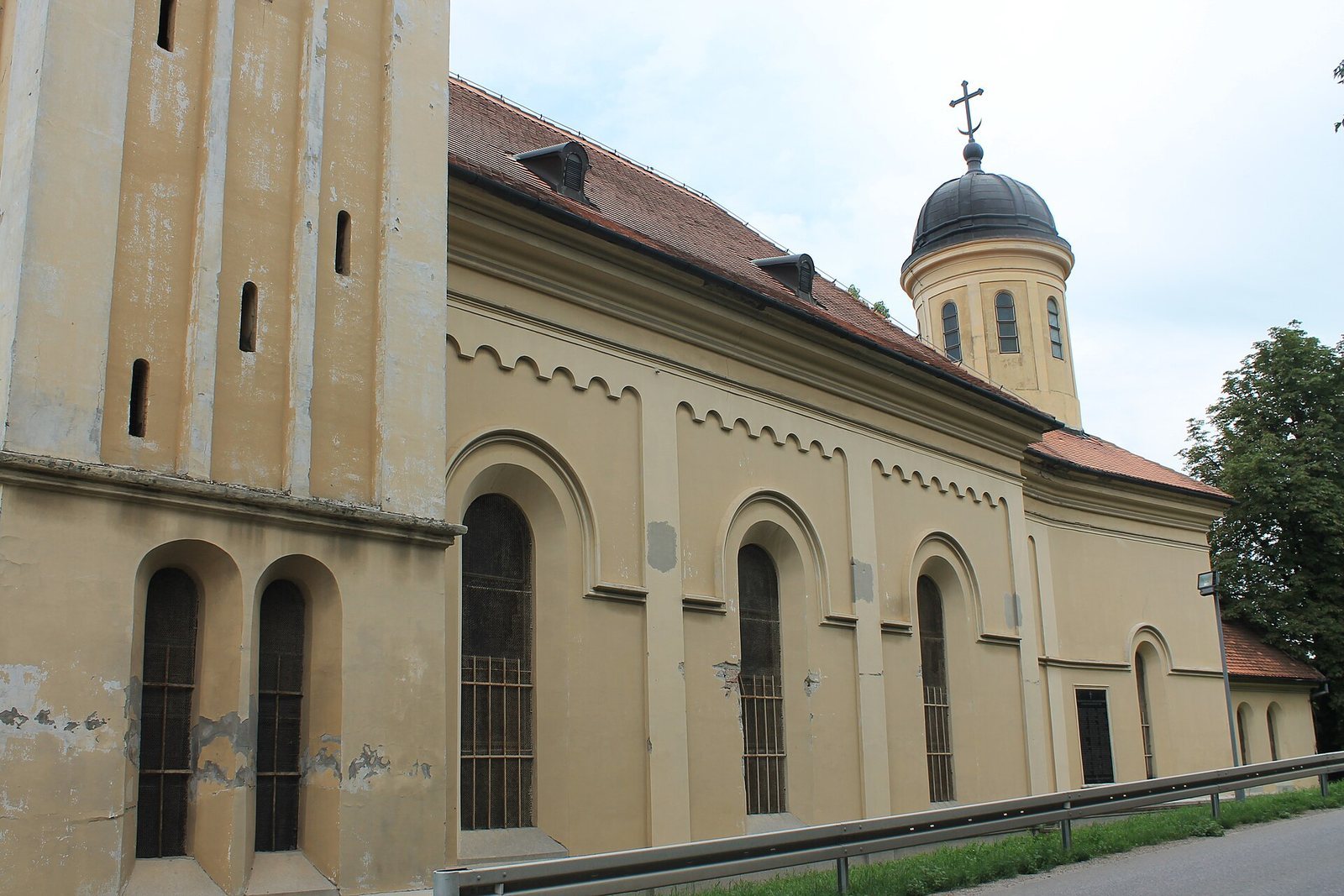
The present church is a single-nave building, with one principal lengthwise space for worship, measuring 35.8 metres long and 13.2 metres wide. Its front is Neo-Gothic and its rear uses Byzantine forms. A raised gallery, or choir, sits above the entrance, while a sacristy occupies the rear of the building.
Setting and earlier buildings
Location and springs
The church stands at the outskirts of Petrovaradin toward Sremski Karlovci, beside the Novi Sad–Belgrade road. Two springs were associated with the site during the Ottoman period, including one in the valley 150 metres below the church.
Earlier forms of the shrine
The medieval church gave way to a wooden shelter and then a small mosque with a minaret. An early chapel formed on the site was described as resembling a funerary monument. By the chapel’s first centenary, it had the modest form of a church, with a red-painted wooden bell tower and a clergy residence to the right of its entrance. A vineyard-covered slope bordered it on the right, while a deep ravine descended to the left toward marshland by the Danube.
A bell was noted at the chapel in 1735. It bore an image of a saint holding a chalice, possibly St Ignatius, and an inscription naming its maker, Johan Dival, and Vienna. The inscription gave the date 1719.
Exterior architecture
Plan and main structure
The church’s simple, lengthwise plan leads from the entrance to the altar at the rear. The sacristy is attached at the back, and the gallery above the entrance forms the raised choir. Together, these features organize the single main space beneath the building’s vaulted interior.
Towers and domes
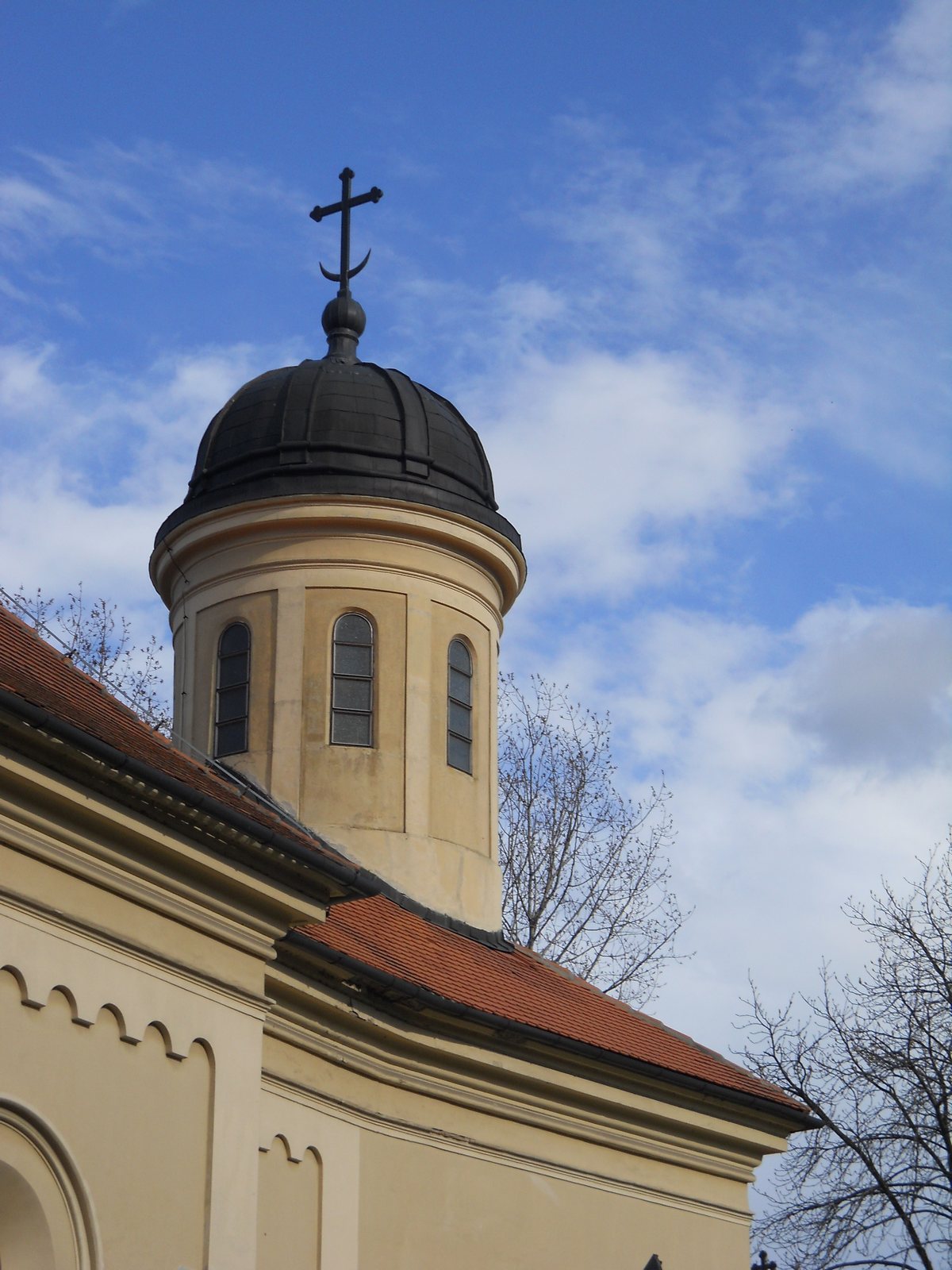
Two square bell towers frame the front. From the main entrance threshold to their tops, they measure 27.6 metres. Each side of each tower has two round-headed windows, and four small masonry domes with spheres mark the corners. A larger brick dome rises at the centre, topped by a sphere and gilded cross. One tower contains three bells. Above the altar, a separate dome, three metres in diameter, rests on a circular brick wall. A gilded crescent beneath a gilded cross on this dome commemorates the 1716 victory over the Ottomans.
Interior, altar and furnishings
Altars and sculpture
The Neo-Gothic main altar was made in 1881 by Ferdinand Stuflesser’s workshop in St Ulrich, South Tyrol. It incorporates a statue of Mary, while the miraculous image is placed on the altar. In 1882, the same workshop produced relief scenes for the Stations of the Cross, a devotional sequence recalling Jesus’s Passion, and statues of Saints Cyril and Methodius and Saints Peter and Paul. The side altars dedicated to Saints Anne and Joseph were made there in 1884.
Painted decoration and inscriptions
The interior’s watercolour decoration includes a star on the dome vault. Text around it calls Mary “Mother of Grace and Mercy” and addresses her as “morning star,” “rose without thorn,” and “hope, consolation, remedy.” An inscription on the middle arch names Mary of the Snows and Jesus and recalls Prince Eugene’s defeat of the Ottoman army there; Roman numerals in its lettering encode 1716. Another inscription commemorates the defeat, while inscriptions also encode the church’s rebuilding in 1881. The main arch carries a greeting asking Mary to pray for sinners. A marble tablet below the left choir window records the donors’ rebuilding of the church with two towers, a dome, an altar and a sacristy.
Sanctuary arrangement
The reorganization of 1976 placed the altar between four white-marble pillars joined at the top by reinforced-concrete crosspieces. Two marble-clad arches span the pillars to form a crown-like frame. When the image is brought from St George’s Church, it is placed in the centre of this frame, beneath a statue of the Immaculate Conception. Behind the altar, an oak crucifix hangs above the sacristy doorway. Two tabernacles, sacred receptacles, flank the door: the right one is for the Eucharist and the left for the Bible.
Saints Peter and Paul stand on brackets to the left of the altar, and Saints Cyril and Methodius to the right. A dark-grey diabase cross, made from fine-grained igneous rock, is set into the wall behind the altar and bordered with white marble. Two reliefs from the former side altars now hang on the right-hand wall. One shows Saints Anne and Joachim with the child Mary; the other depicts Joseph’s death in the presence of Mary and Jesus. Statues of Anne and Joachim stand at the ends of the paired reliefs.
Windows and devotional image
The stained-glass windows depict saints and identify their donors. Milan Stanišić’s workshop in Sombor made them in 1980. Eight small coloured-glass windows light the dome above the altar. A niche to the left of the entrance holds a picture of Our Lady of Sorrows, showing Mary in her suffering. Jakob Šili donated it after recovering from a serious illness. Its reddish-brown glazed wooden frame is reinforced with zinc sheet and set within a white-marble surround.
Features of the grounds
Stations of the Cross and grotto
The grounds include a concrete path measuring 2.20 by 300 metres, created in 2002 and 2003 for the Stations of the Cross. They also contain a grotto dedicated to Our Lady of Lourdes. In 2004, the vault walls inside the church were painted with scenes of the joyful, sorrowful, luminous and glorious mysteries of the Rosary, a Catholic prayer that meditates on events in the lives of Jesus and Mary.