Grgeteg Monastery: A Serbian Orthodox Monastic Complex in Serbia


Site at a Glance
- Rating
- 4.9
- Popularity
- Medium
- Country
- Serbia
- Primary era
- Early Modern
- Eras represented
- Early Modern, Modern
- Civilizations
- Habsburg, Serbian
- Site type
- Religious
- Remains
- Monastery
On this page12 sections
History
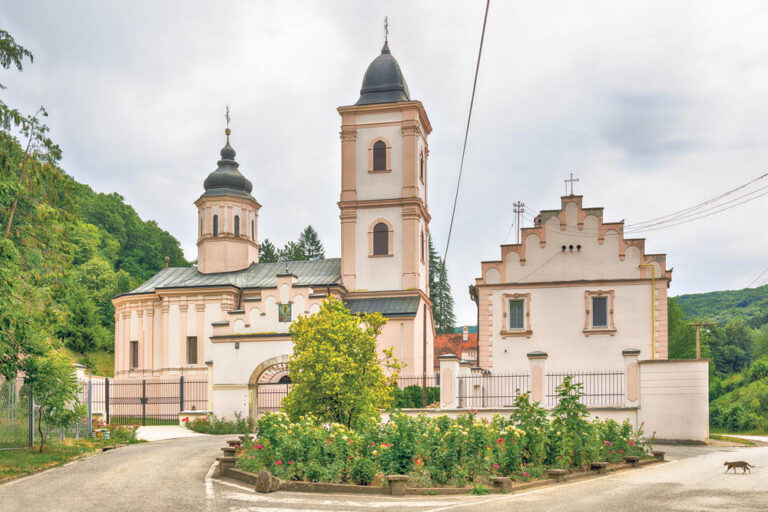
Grgeteg Monastery is a Serbian Orthodox monastery in Serbia, located on the southern slope of Fruška Gora near the village of Grgeteg. Tradition attributes its foundation in 1471 to Despot Vuk, also known as Zmaj Ognjeni Vuk, a fifteenth-century Serbian nobleman and military leader who established it in memory of his father, Grgur. The church is dedicated to the Translation of the Relics of Saint Nicholas. The surviving church belongs to the Baroque period, the seventeenth- and eighteenth-century European style known for elaborate decoration and complex forms.
Foundation and early records
The village of Grgeteg was formerly the monastery’s prnjavor, a settlement economically dependent on a monastery. The earliest reliable reference to Grgeteg appears in a Turkish register from 1546, while a written church record dates from 1611. The monastery was a men’s institution during its earlier history and is now a women’s monastery.
By the late seventeenth century, Grgeteg had been abandoned and fallen into ruin. In 1691, Emperor Leopold I granted the ruined monastery, together with Neradin and Bankovci, as a feudal estate to Bishop Isaija Đaković, who was then attached to the Arad-Jenopole see. After he became Serbian archbishop and metropolitan, Đaković secured the estate’s transfer to the Serbian Metropolitanate. He restored Grgeteg in 1708 and established monastic cells. The monastery was known as a metropolitan monastery until 1749, and its development was associated with Đaković and Metropolitan Vincencije Popović. Imperial privileges issued by Leopold I and Joseph I were preserved by the monastery.
Eighteenth-century rebuilding
Monks from Slanci Monastery near Belgrade moved to Grgeteg in 1739 while fleeing Ottoman forces. A visitation on 21 July 1753 recorded a brotherhood of 15 monks, several monastic buildings, sacred relics, liturgical furnishings, and a library of 65 books, including eight old Serbian books.
Metropolitan Pavle Nenadović began a new building campaign in 1750. The principal work was completed in 1763, while cells, two kitchens, a large refectory, and other buildings were erected in 1751 and 1752. During the 1740s to 1760s, monastic quarters were arranged around the church on all four sides, and a high bell tower was built. An earlier stone church was subsequently replaced by the present Baroque church, constructed between 1767 and 1771.
In 1777, an imperial decision ordered Grgeteg’s suppression as part of a reduction of Orthodox monasteries and assigned its property to Metropolitan Vićentije Jovanović. The monks departed, and the monastery stood empty for a year. Local Orthodox communities protested, and Maria Theresa eventually revoked the decision. The monks formally returned on 10 June 1778.
Monastic administration and economic life
Grgeteg later functioned as an archimandry, a monastery headed by an archimandrite, a senior Orthodox monastic title. In 1865, the Remeta branch was placed under its authority. A monastery school operated at Grgeteg in 1859.
The monastery’s estate included two watermills, a farm near Šatrinci, the Bankovci wasteland, rights over Neradin, livestock, an apiary, arable land, vineyards, and orchards. The Neradin property contained a lime quarry and an inn. The brotherhood sold “Neradin lime” and leased the inn annually. In 1902, the estate was listed as containing 2,830 jutar and 482 square fathoms of land, with the property and its revenues valued at 802,814 crowns and 7 heller.
Monastic production also included plum brandy known as Grgeteg monastery slivovitz, which was exported to Austria and Bohemia. A spring called Kalinova Voda lay near the monastery. In 1893, Grgeteg and Beočin monasteries acquired the Serbian Monastic Printing House in Novi Sad. The press remained in that city but thereafter operated for church-related purposes. A printing press also worked at Grgeteg during the 1920s to 1940s, when Russian clergy who had left Russia lived at the monastery.
Scholars, artists, and modern restoration
Archimandrite Ilarion Ruvarac administered Grgeteg from 1874 to 1905. During his 31 years there, he researched Serbian and church history, directed major repairs, and supervised the decoration of the iconostasis. Other important superiors included Isaija Đaković, Pavle Nenadović, Kiril Živković, Petar Jovanović Vidak, German Anđelić, and Visarion Stakić, who served from 1933 to 1941. The bishop and poet Lukijan Mušicki became a monk at Grgeteg in 1802.
The entire complex was restored in 1899 to 1901 according to designs by Hermann Bollé. During the Second World War, an explosion on 22 September 1943 destroyed the bell tower and one monastic building. The church was looted and partly damaged. Restoration began in 1953. Grgeteg was re-established as a women’s monastery, the church was fully reconstructed by 1987, and the residential quarters were repaired by 1994.
A chapel dedicated to Saint Seraphim of Sarov was consecrated in the residential quarters in 1999. Four bells cast in Voronezh were installed on the bell tower by Easter 2001. On 24 July 2002, the monastery received a copy of the miracle-working Three-Handed Icon of the Mother of God, painted at Hilandar, the Serbian Orthodox monastic foundation on Mount Athos. Grgeteg is protected as an immovable cultural property and as a cultural monument of exceptional importance in Serbia. The complex also includes a museum dedicated to Ilarion Ruvarac and an exhibition of surviving objects from the treasuries of Fruška Gora monasteries.
Remains
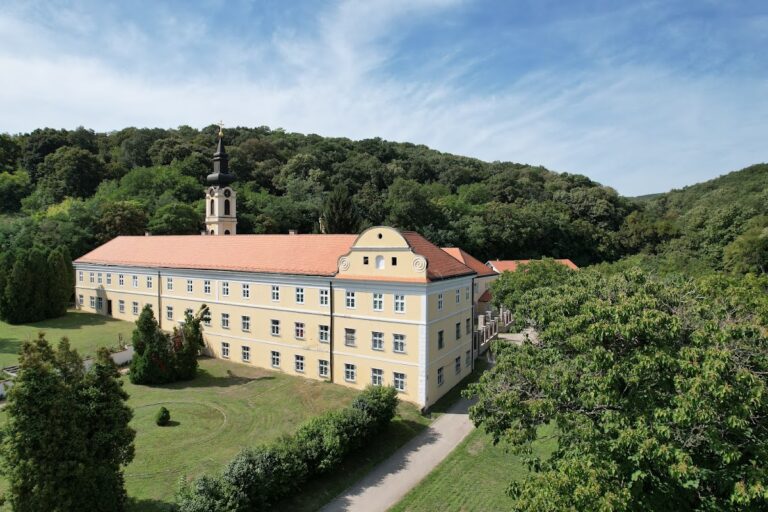
Grgeteg’s surviving complex is organized around a church with monastic residential quarters on all four sides, together with economic buildings. The quarters were constructed during the second half of the eighteenth century, and the church and bell tower belong to the rebuilding campaign of 1767 to 1771. The buildings were restored in 1901, while the bell tower and a residential structure destroyed during the Second World War were later reconstructed.
Church and monastic buildings
Baroque church
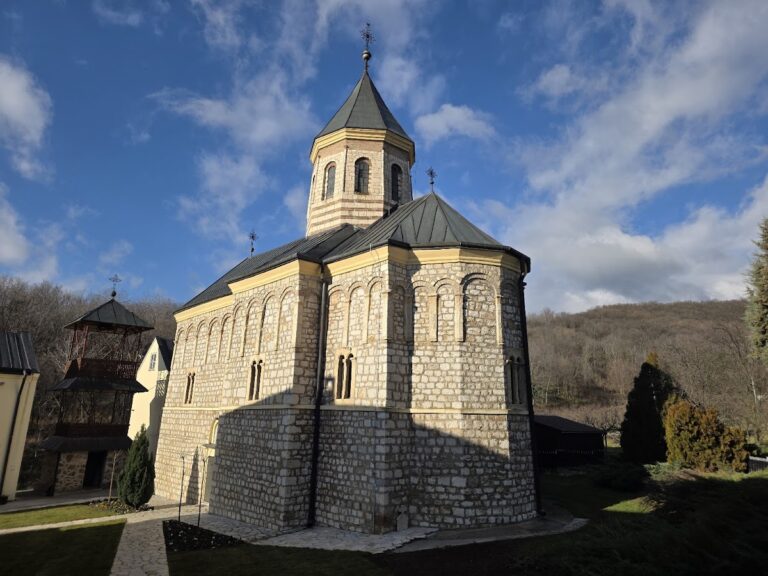
The church is a Baroque building constructed between 1767 and 1771 on the site of an earlier stone church. Its interior preserves two successive iconostases, the screen of icons separating the sanctuary from the main body of an Orthodox church. The first was a masonry iconostasis painted by Jakov Orfelin in 1774 and 1775. It remained in place until the restoration of 1901. The present iconostasis was painted by Uroš Predić in 1901 and 1902, as part of work on the church and chapel that continued from 1900 to 1902.
The church contains the Three-Handed Icon of the Mother of God, an Orthodox image of the Virgin Mary with the Christ Child and a third hand. An earlier icon known as the Shiklosh Mother of God was regarded as a sixteenth-century work associated with the period of Serbian Despot Stefan Štiljanović, a sixteenth-century Serbian despot and venerated Orthodox Christian figure.
Residential quarters and bell tower
The residential quarters enclose the church on four sides and incorporate the monastic cells, two kitchens, a large refectory, and other service buildings established during the eighteenth-century expansion. The quarters were repaired after wartime destruction, and a chapel dedicated to Saint Seraphim of Sarov was consecrated within them in 1999. The reconstructed bell tower received four replacement bells cast in Voronezh in 2001.
Sacred objects and collections
Relics and liturgical furnishings
A visitation in 1753 recorded an antimension, a consecrated cloth placed on the holy table for the Eucharist. It had been consecrated at Hopovo in 1722. The same record described a templon, an earlier form of the icon screen, made by Serbian craftsmen. A wooden reliquary, a container for sacred relics, in the left choir held a foot of Saint Thecla and part of the skull of the protomartyr Archdeacon Stephen. Another wooden box held a bone of Saint George and a relic associated with the Serbian saint Jovan, who was martyred in Belgrade.
The monastery also possessed an old epitrachelion, the distinctive stole worn by an Orthodox priest or bishop during worship, embroidered with the year 1553. Liturgical vessels and utensils transferred from Slanci Monastery in 1739 formed part of the treasury, along with several icons removed from the Belgrade court chapel during the same year.
Library and museum material
The library listed in 1753 contained 65 books, including eight old Serbian books. Some manuscripts originating from Grgeteg are now held by the Museum of the Serbian Orthodox Church and the Cyril and Methodius National Library in Sofia. Treasury valuables removed during the Second World War were likewise transferred after the war to the Museum of the Serbian Orthodox Church. The monastery museum dedicated to Ilarion Ruvarac and its exhibition of objects from Fruška Gora monastic treasuries preserve this wider historical and artistic association.
Nearby sites