Bogovađa Monastery: A Serbian Orthodox Women’s Monastery
Site at a Glance
- Rating
- 4.8
- Popularity
- Medium
- Country
- Serbia
- Primary era
- Modern
- Eras represented
- Modern
- Civilizations
- Ottoman
- Site type
- Religious
- Remains
- Monastery
On this page15 sections
History
Bogovađa Monastery is a Serbian Orthodox women’s monastery in Bogovađa, Serbia, in Lajkovac municipality southwest of Lazarevac. Dedicated to Saint George, it belongs to the Valjevo Diocese. The community was active in the first half of the fifteenth century, but its precise foundation date and original patron are unknown.
Medieval beginnings and refoundation
Tradition associates a small church and several other buildings at the site with the time of Stefan Lazarević, a Serbian ruler who received the Kolubara valley from King Sigismund of Hungary. The first monastery was destroyed after the fall of the Serbian Despotate, the medieval Serbian polity ruled by despots.
In 1545, the hieromonk Mardarije, a monk who was also an ordained priest, established a new monastery on the earlier remains. A foundation record in Dabi’s Gospel, a Gospel manuscript, names Prince Pavle and Jovan Velimirović, along with other Orthodox Christians, as patrons. The foundation has also been attributed to Prince Petar Velimirović. A tradition places Grgur Branković’s death and burial at Bogovađa, while another places his monastic life and burial on Mount Athos.
Rebuilding and Hadži-Ruvim
The monastery was burned and destroyed in 1788 during Koča’s Frontier uprising, an eighteenth-century revolt against Ottoman rule. Hadži-Ruvim, Hadži-Đera, and Vasilije Petrović, then the abbot, led its rebuilding from 1791 to 1794. Hadži-Ruvim had entered monastic life at Bogovađa in 1784 and became abbot on 7 November 1795.
The years from the rebuilding to the First Serbian Uprising were especially active for Hadži-Ruvim. He expanded the library, lent books to laypeople, established an art school for woodcarving, painting, and other arts, and sold carved crosses to support the monastery and its books. His notes described wartime events and their effects in the Belgrade and Valjevo districts, including churches and monasteries burned or looted in the Valjevo district. A dependent religious establishment linked to Hilandar, the Serbian Orthodox monastery on Mount Athos, was set up at Bogovađa around 1797, but lasted only briefly. The monastery’s name is thought to derive from a local expression meaning “God’s water,” associated with a healing spring near the church.
Resistance and destruction in the early nineteenth century
In late 1803, local princes and other prominent people met at Bogovađa and resolved to rebel against Ottoman rule. Hadži-Ruvim also helped organize resistance; Ottoman authorities arrested and executed him in 1804. In 1805, after moving from Voljavča Monastery, the Serbian Governing Council, the uprising’s executive body, met for two months in a monastery lodging building. Ottoman forces failed to capture Karađorđe and retaliated by burning and destroying the monastery.
Nineteenth-century rebuilding
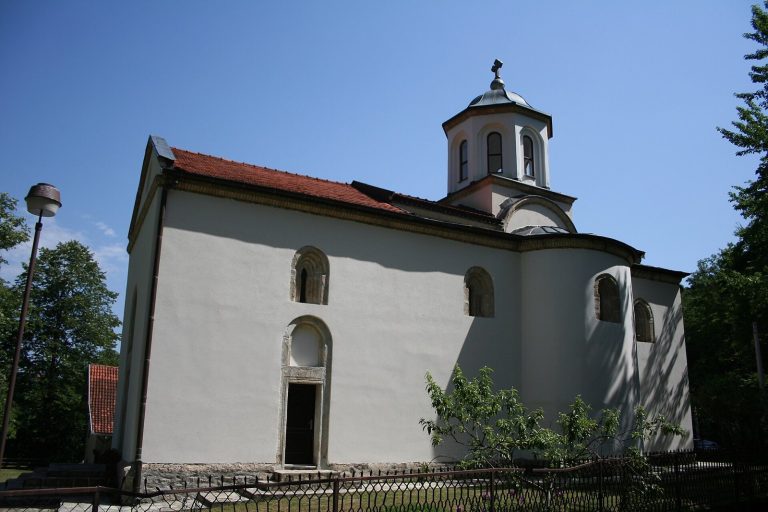
The monastery was rebuilt from 1816 to 1818. Prince Miloš Obrenović later supported construction of the present church, built between 1849 and 1852 under Bosnian master builder Milutin Gođevac. Its current appearance dates to 1852. A separate lodging building was added in 1858 under Prince Aleksandar.
War and preservation
Fighting took place around Bogovađa during the Battle of Kolubara in 1914, and the lodging buildings served as a hospital for wounded soldiers. As the Austrian army retreated, it looted the monastery, took its bells, destroyed its livestock, and cut down its forests. Hadži-Ruvim’s library was lost. The monastery has been protected since 1949 and was registered as a Cultural Monument of Great Importance in 1982. Conservation work on the church took place in 1998 and 1999, and a monastery lodging building was reconstructed in 2005.
Remains
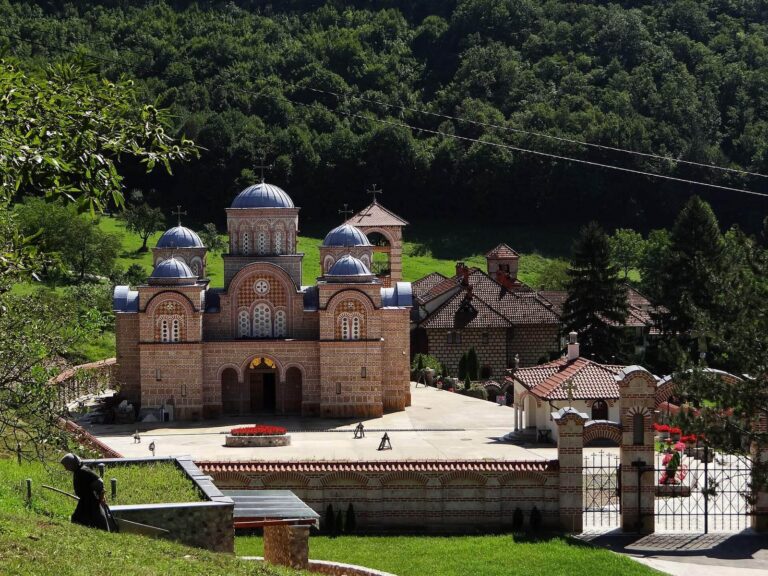
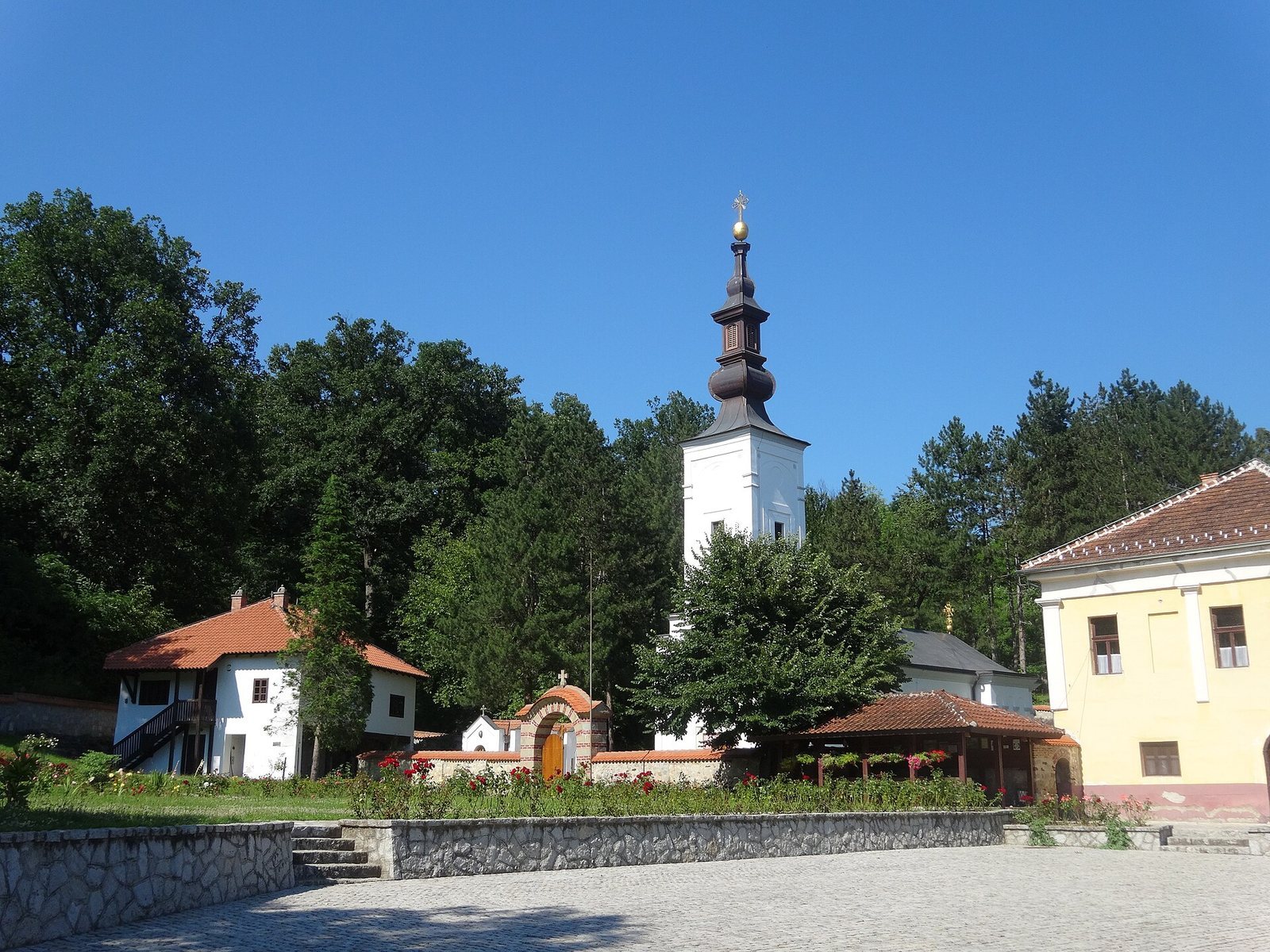
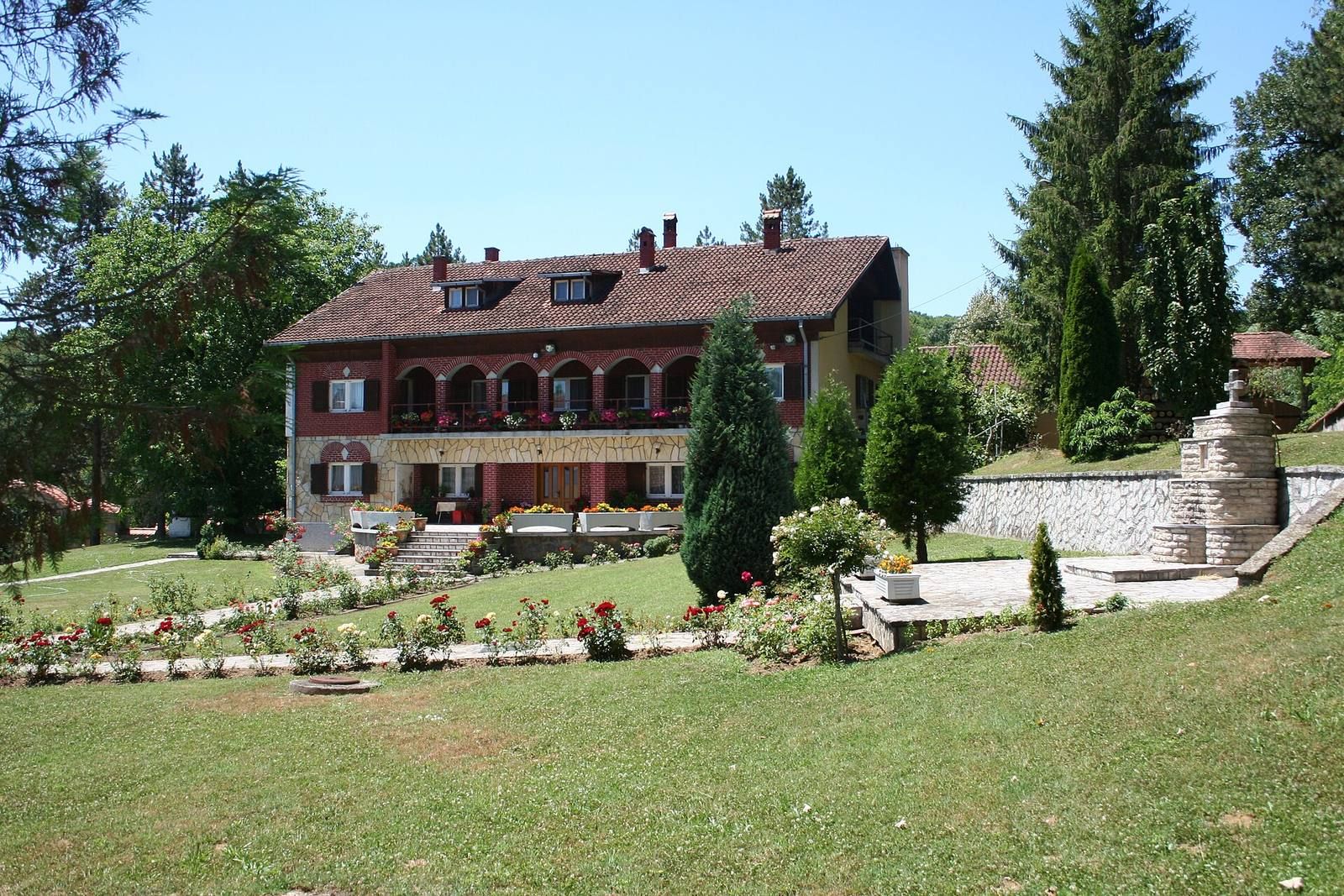
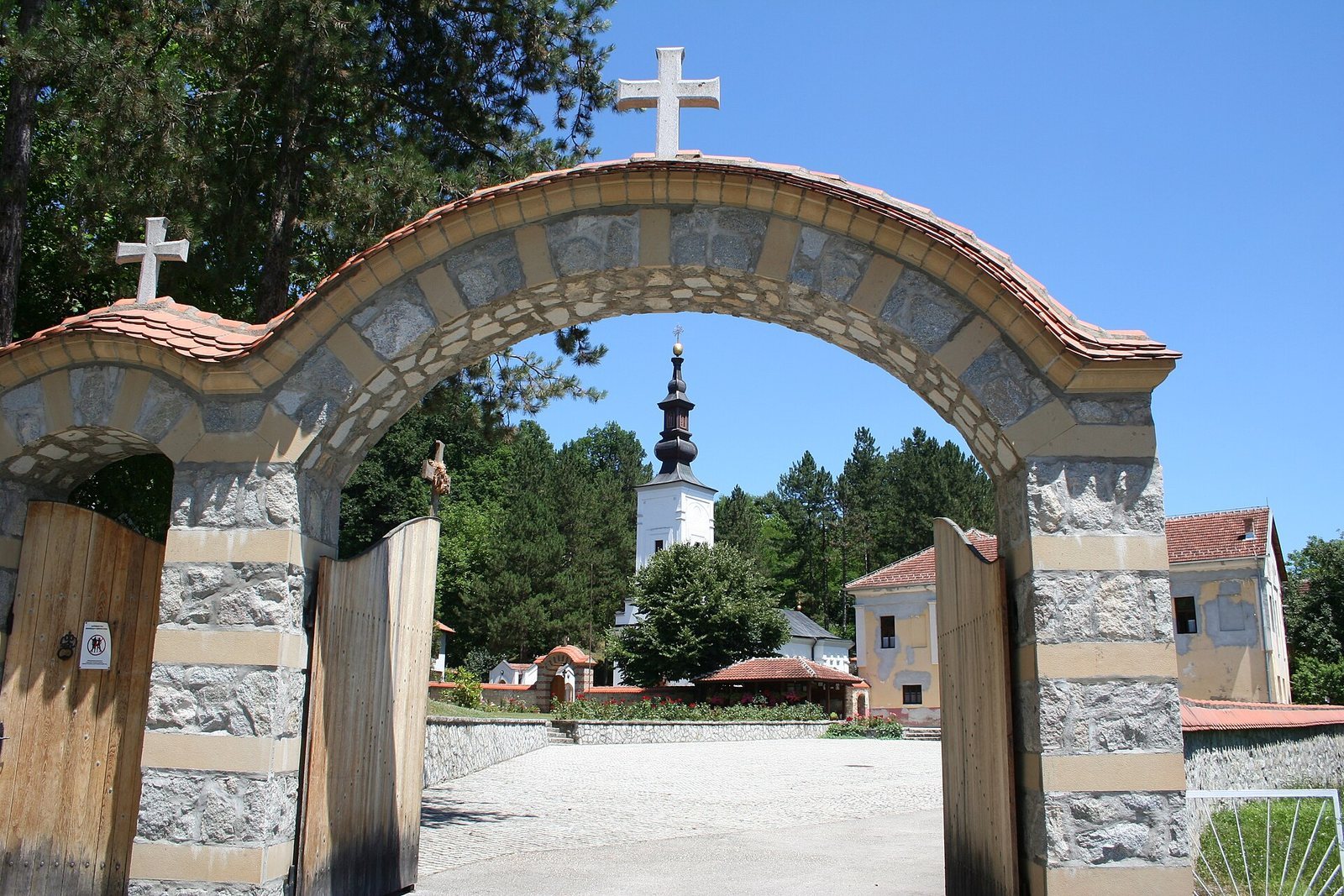
The monastery grounds include the church of Saint George, two separate lodging buildings, a spring and fountain, and commemorative monuments. The church’s elongated plan and ornamented facades form the principal architectural feature, while the lodging buildings preserve distinct elements of the monastery’s rebuilding phases.
Church of Saint George
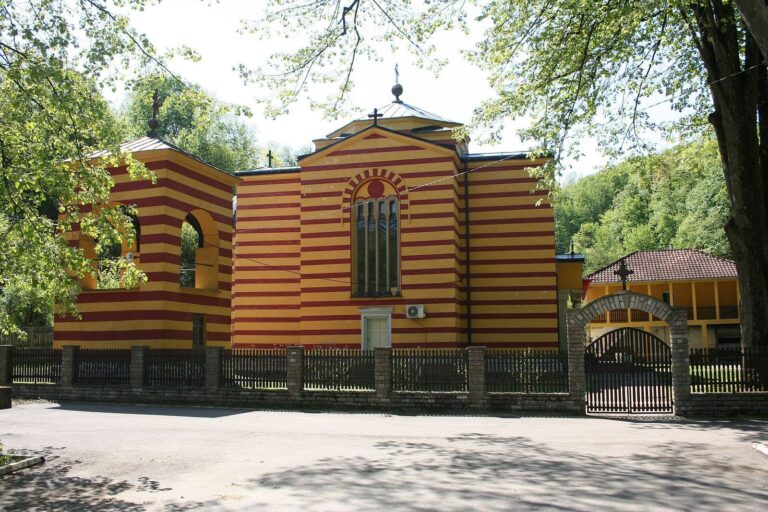
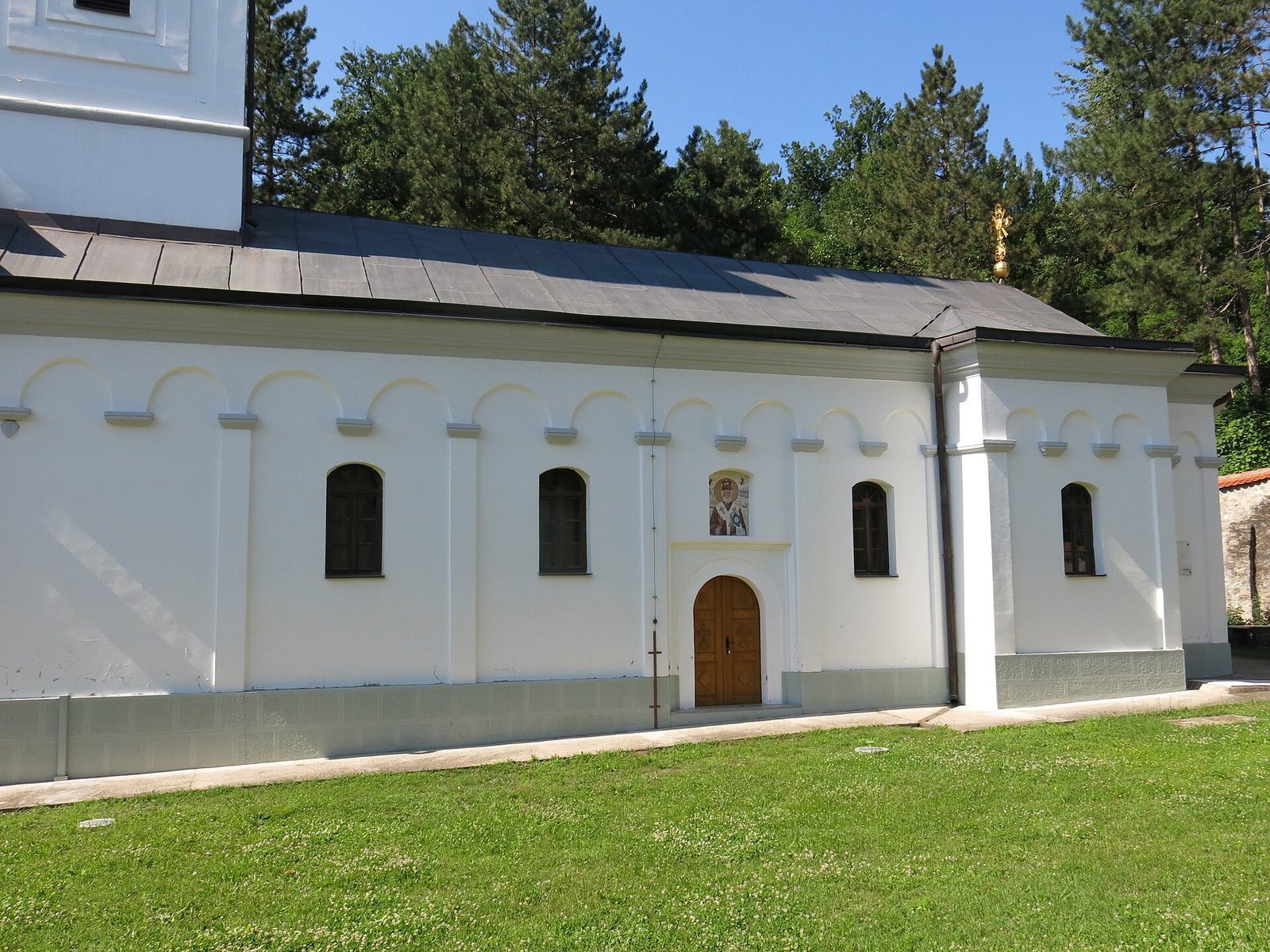
The church has one long main interior space, a rounded altar end, and rectangular choir spaces that project from either side of the altar. A multi-storey Baroque bell tower rises above the western facade; its upper part is covered in metal. The stone entrance portal bears intertwined vine decoration. A cornice and decorative arcades supported by short projecting stone supports ornament the facades. Inside, the icon screen was painted in 1858 by Milija Marković with his sons Radovan and Nikola. The entrance hall contains the burials of Mardarije, the monk German, and Grgur Branković.
Monastic lodging buildings
Older lodging building
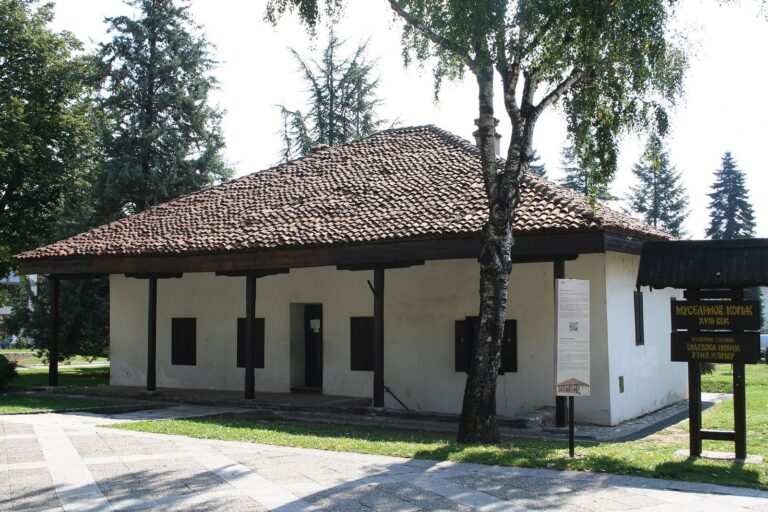
The older lodging building stands northwest of the church. Its substantial lower level is a semi-basement or raised ground floor, and its stone cellar predates the rest of the structure. An underground exit leads toward the forest for emergency use. Six small rooms or cells occupy the upper floor beneath a hipped, tile-covered roof. The building houses a museum devoted to the First and Second Serbian Uprisings.
1858 lodging building
The separate lodging building erected in 1858 has an inscription above its north door. It names Prince Aleksandar, Bishop Mihailo of Šabac, senior monastic cleric Archimandrite Grigorije, and the monastery brotherhood in connection with its construction.
Spring and fountain
A spring near the church was reputed to help with various ailments, especially eye complaints. Pipes carried its water to a fountain below the monastery, now within the grounds of a nearby military barracks. The fountain, built in 1796, has been repaired several times.
Commemorative remains
Memorial plaque
A stone plaque on the church’s western interior wall lists 320 Serbian soldiers from surrounding settlements who died between 1912 and 1918.
Memorials in the grounds
One roadside memorial commemorates brothers Svetozar, Mijat, Mikailo, Miloje, and Lazar Mijatović of Vrančevići, who died in war on 19 December 1918; their mother, Milenija, erected it in 1921. Other memorials honor Mihailo Đokić, aged 27, who fell near Pirot, and Andrej Arsenijević of Pepeljevac, who died in 1915 at age 38. Andrej’s memorial was erected by his brother Savo, uncle Đorđe, and sons Milijan and Obrad. A monument to Velimir Vukašinović of Pepeljevac records that he died aged 36 at Đakovica on 25 November 1912 while fighting for the liberation of Old Serbia and Macedonia; his brothers, sons, and wife Julka erected it in 1921. The grounds also include memorials to Milan Mirković and to Vojislav T. “Voja” Protić, son of Leposava and the priest Todor Protić, who was born on 1 May 1904 and died on 7 October 1906.