All Saints, Camden Town: An Anglican Church and Greek Orthodox Cathedral
Site at a Glance
- Rating
- 4.6
- Popularity
- Medium
- Country
- United Kingdom
- Primary era
- Modern
- Eras represented
- Modern
- Civilizations
- British
- Site type
- Religious
- Remains
- Cathedral
On this page6 sections
History
All Saints, Camden Town, is a church in the United Kingdom that has served as a Greek Orthodox cathedral since 1991. Built between 1822 and 1824 for the Church of England, England’s Anglican church, it answered the needs of a growing district and drew on ancient Greek architectural forms.
Camden Town and the new church
Camden Town began developing in the 1790s, when the surrounding parish was still largely rural. From the fourteenth century, the old parish church had lost importance as people moved north towards Kentish Town and Camden Town. The Church Building Act of 1818 encouraged new churches for London’s growing districts. St Pancras New Church, consecrated in 1822 in the parish’s southern part, was intended mainly to serve its immediate neighbourhood.
Initially called Camden Chapel and informally known as St Stephen’s, All Saints was built to serve Camden Town. It became an independent parish church in 1852. Its congregation was large: an 1854 survey counted 1,650 worshippers on Sunday mornings, 630 in the afternoons and 1,430 in the evenings.
Changing congregations and cathedral status
Anglican attendance declined during the twentieth century, a change linked to the opening of St Michael’s in Camden Road in 1881. All Saints received its dedication to All Saints in 1920. In 1948 it passed to the Greek Orthodox community, part of the Eastern Orthodox Christian tradition, reflecting the area’s substantial Greek-speaking population, especially people from Cyprus. St Michael’s then became Camden Town’s main Anglican church.
In 1991 All Saints became a cathedral. It belongs to the Archdiocese of Thyateira and Great Britain, a major church jurisdiction serving Greek Orthodox communities in Britain, within the Orthodox Church of Constantinople, a senior Eastern Orthodox patriarchate. Its congregation continues to include worshippers from London’s outer suburbs.
All Saints is a Grade I listed building, the highest listed-building category in England, for buildings of exceptional interest. It has undergone several renovations, including work begun in January 2009 under the supervision of English Heritage.
Remains
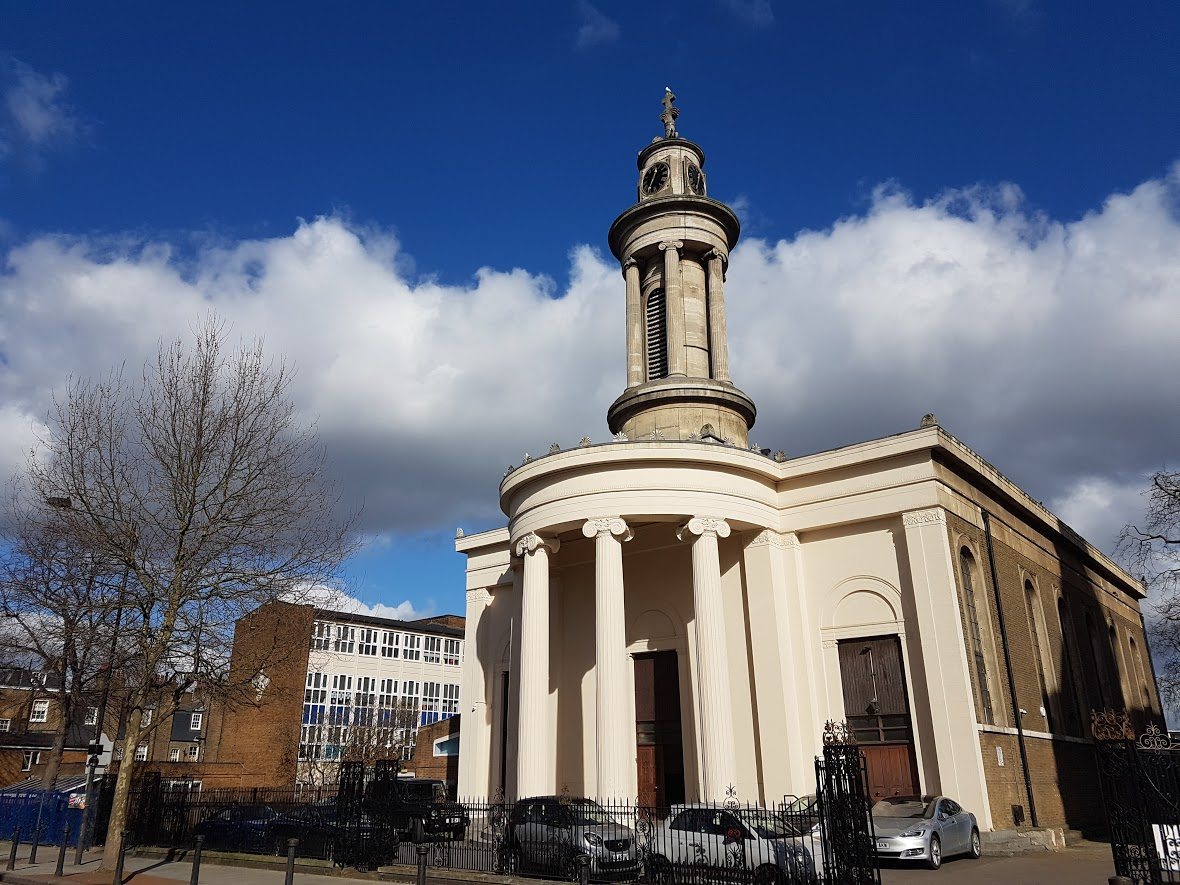
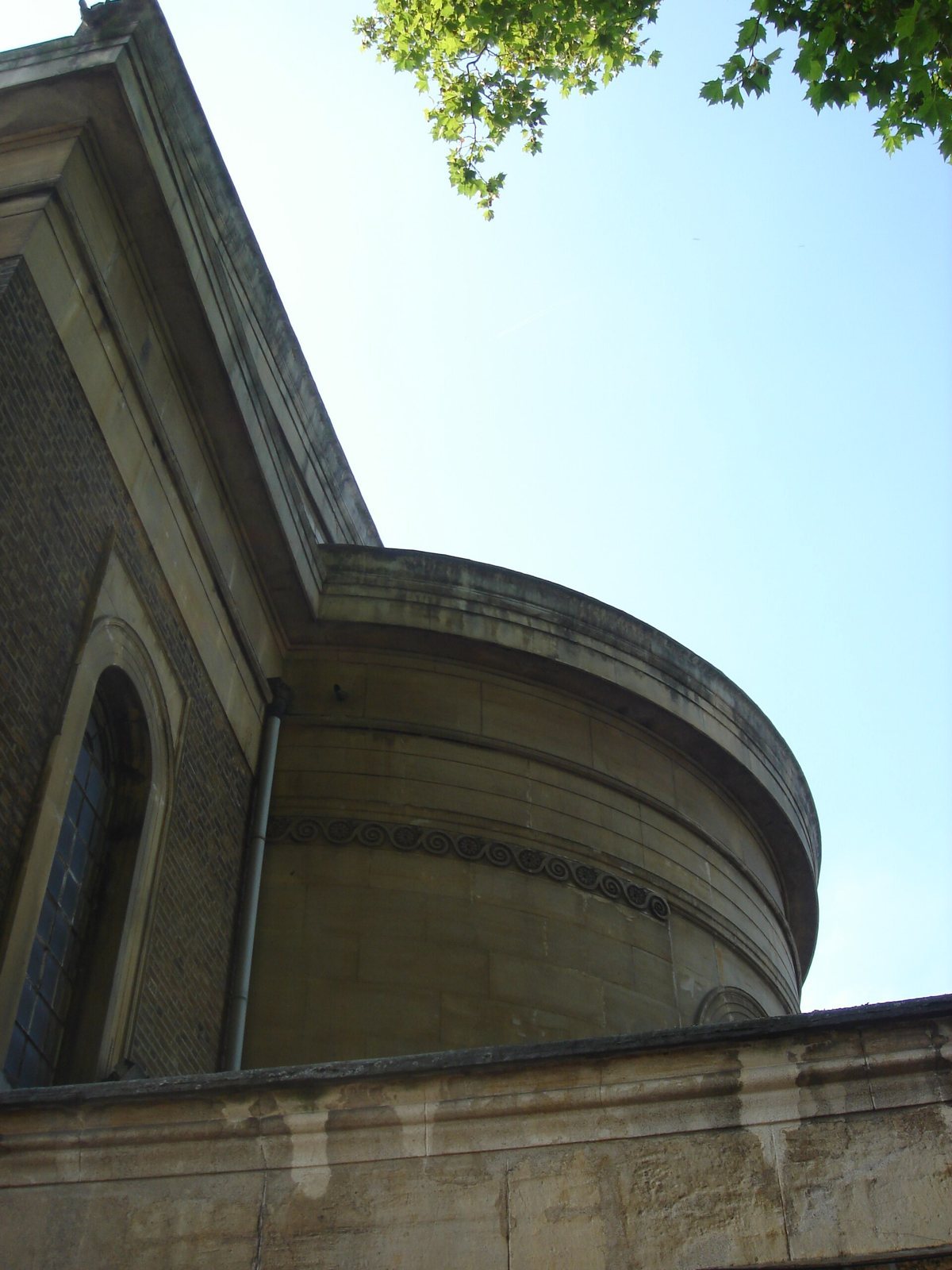
The church has a basically rectangular plan, with an apse, a recessed rounded end, to the east. Yellow stock brick forms most of the building, while Portland stone faces its eastern and western ends.
Exterior
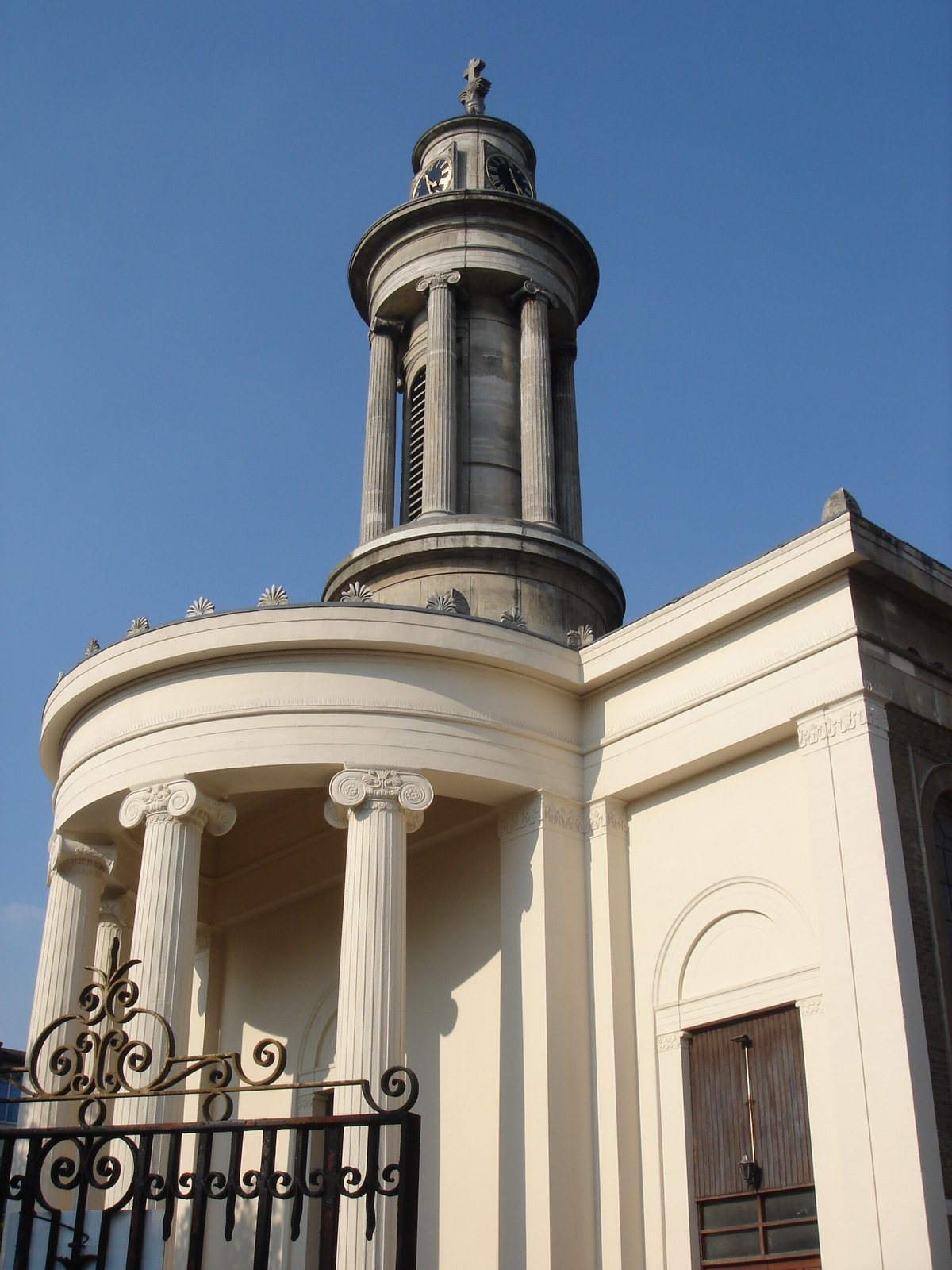
The west entrance is framed by a large colonnade of fluted columns in the Ionic order, a classical Greek style known for scroll-shaped capitals. The columns stand between projecting side walls to form a semicircular porch. Behind it rises a cylindrical stone tower encircled by a smaller colonnade. Its design follows the Choragic Monument of Lysicrates in Athens, a circular memorial to Lysicrates’ victory as sponsor of a dramatic chorus. Copies of Greek architectural elements and fragments recovered during excavations in Greece informed the church’s Ionic design; the fragments are now in the British Museum. Although the building was generally praised, some contemporary writers and later critics, including Sir John Summerson, considered the tower too slender in proportion to the church.
Interior
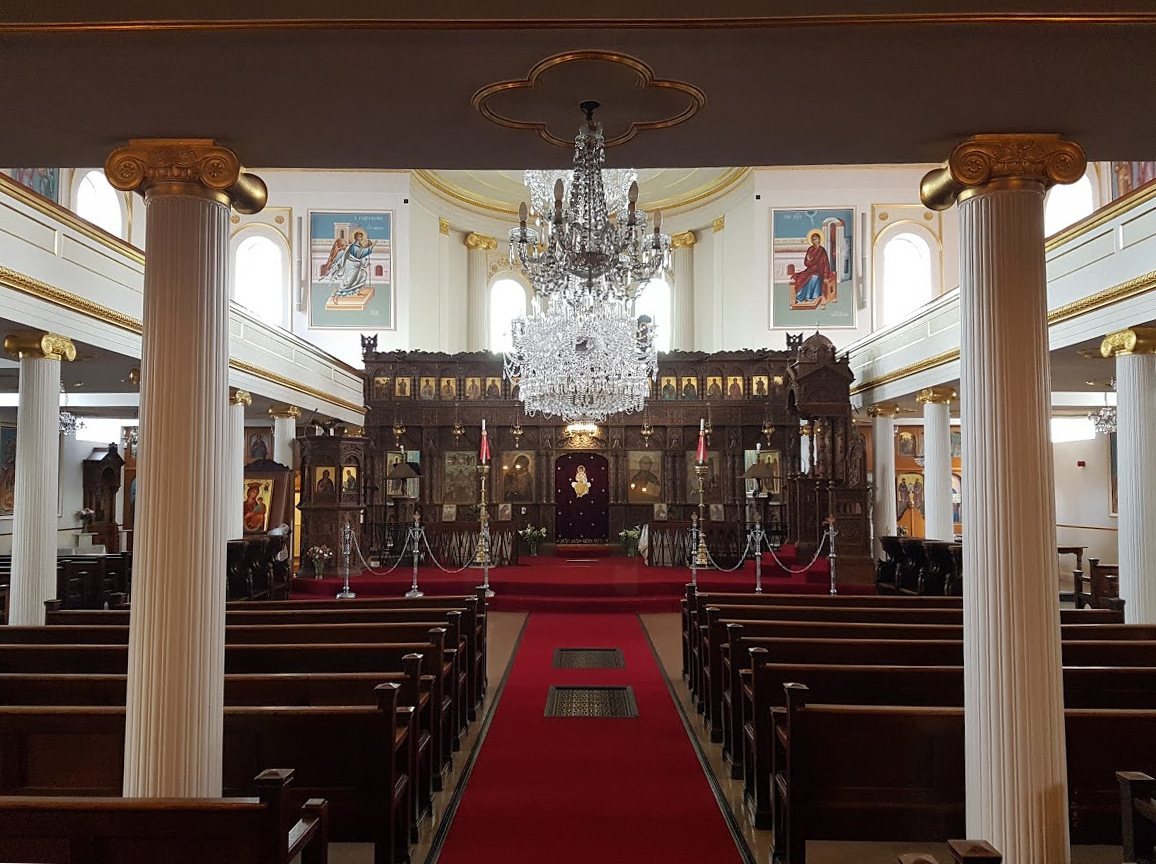
The interior has a flat ceiling and Ionic columns. Galleries run along three sides of the church, supported by further Ionic columns.