Tomb of Mentuemhat (TT34): A 26th-Dynasty Theban Tomb in Egypt
Site at a Glance
- Popularity
- Medium
- Country
- Egypt
- Primary era
- Iron Age
- Eras represented
- Iron Age
- Civilizations
- Egyptian
- Site type
- Burial
- Remains
- Tomb
On this page17 sections
History
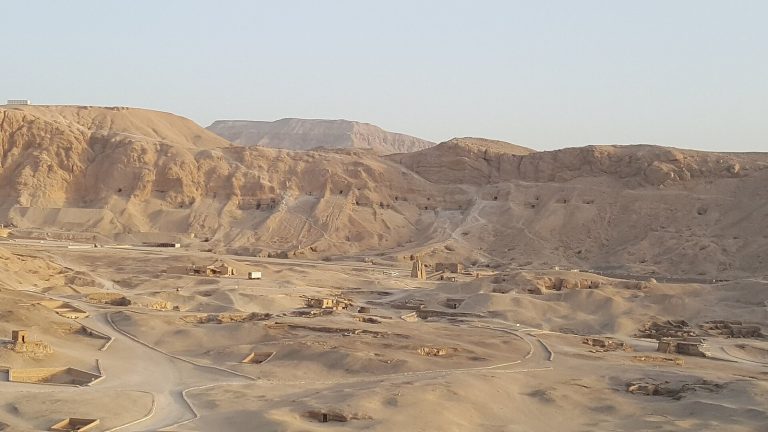
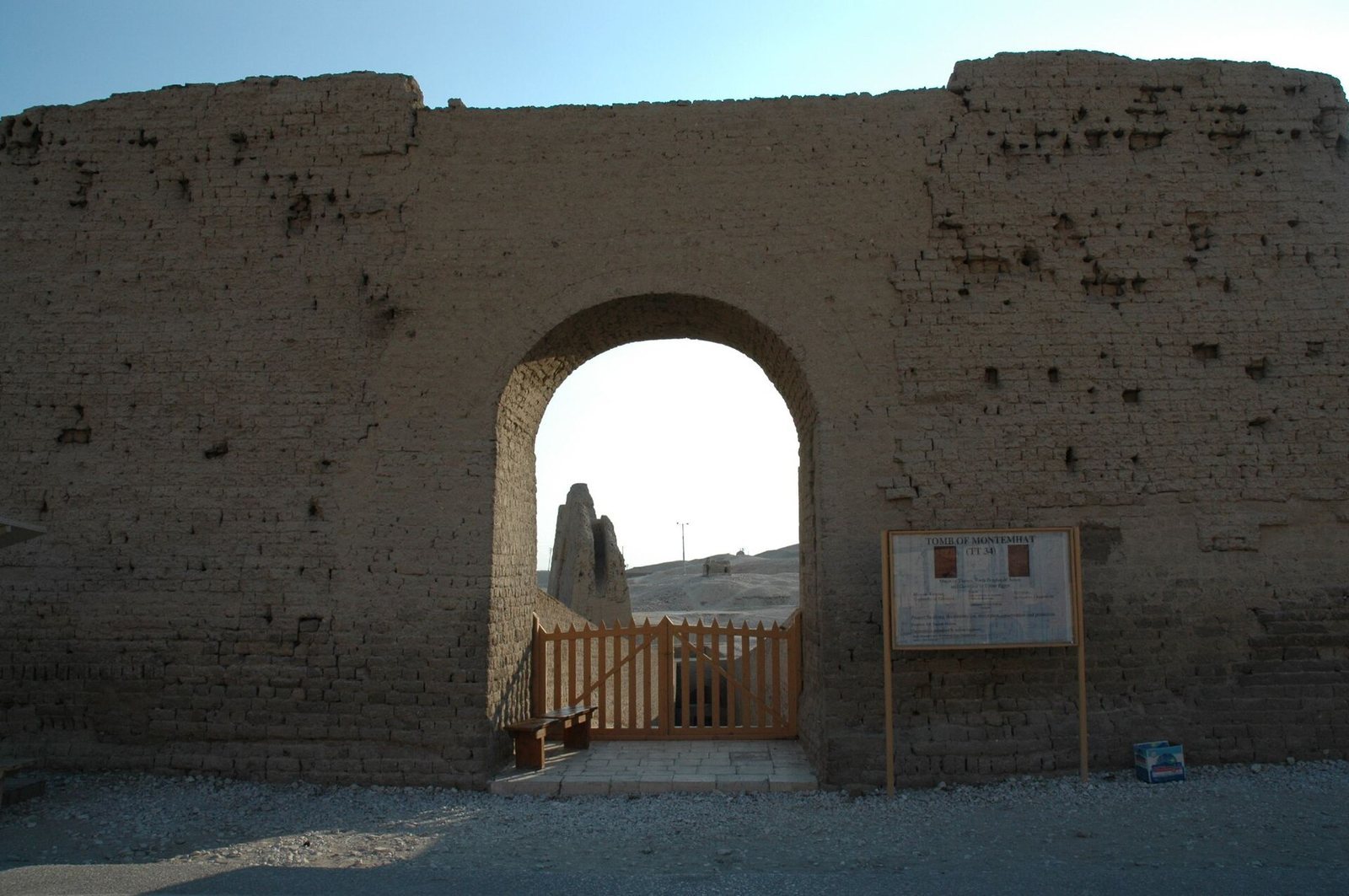
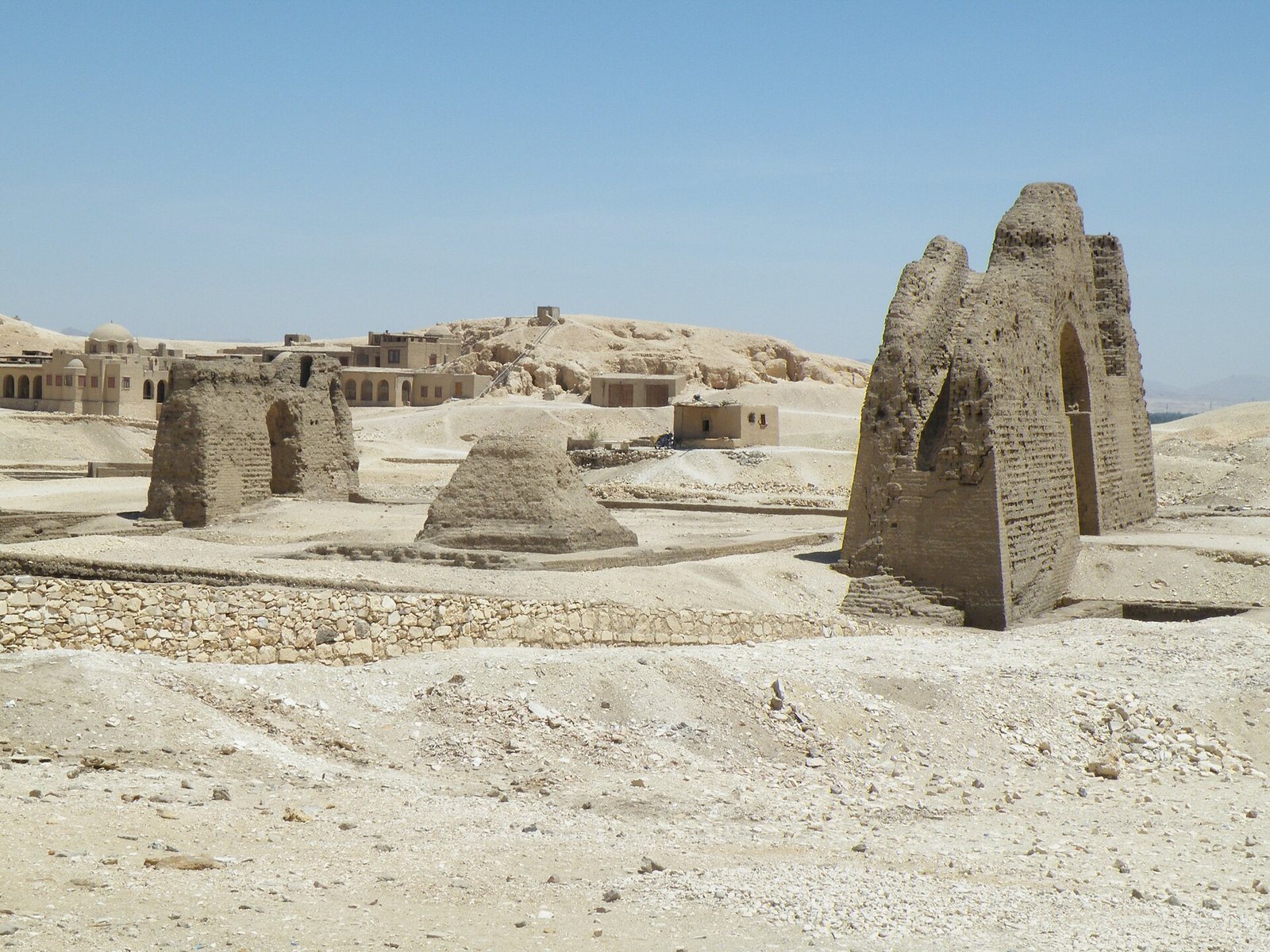
The Tomb of Mentuemhat (TT34) is an ancient Egyptian tomb at el-Assasif in the Theban Necropolis, on the west bank of the Nile opposite Luxor, Egypt. Built during the 26th Dynasty, Egypt’s Saite dynasty, it was made for Mentuemhat, a leading official of Thebes. TT is the standard abbreviation for a Theban tomb.
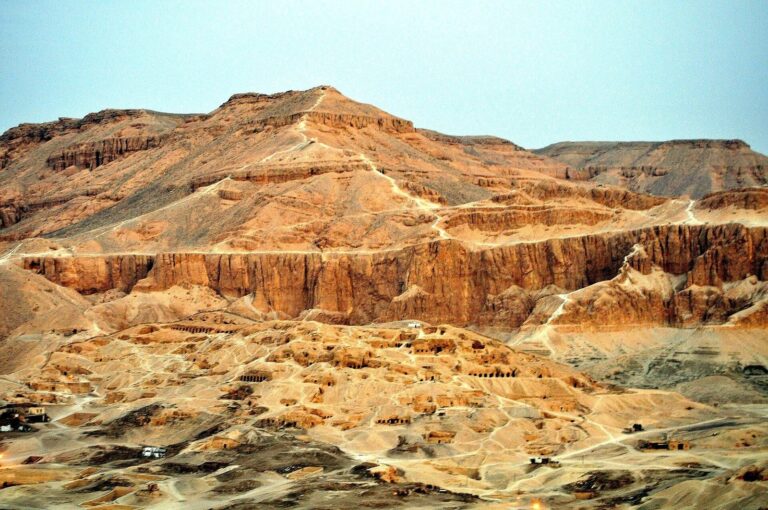
The Theban cemetery
The wider Theban cemetery served nobles and officials connected with Egypt’s ruling houses, especially during the New Kingdom. Its use extended from the Old Kingdom through the Saite period and into the Ptolemaic period, when Egypt was ruled by the Ptolemaic dynasty, a Macedonian Greek royal house.
Mentuemhat’s career and family
Mentuemhat held the offices of Fourth Prophet of Amun, a rank in the priesthood of the major god Amun, Mayor of Thebes, and Governor of Upper Egypt. He served under Taharqa and Tanutamani, kings of the 25th Dynasty, and Psamtik I, a king of the 26th Dynasty. The 25th Dynasty was Kushite, preceding the Saite 26th Dynasty.
His father, Nesptah, was also a Prophet of Amun and Mayor of Thebes, and his mother was Esenkhebi. Mentuemhat’s named wives included Wadjerenes, daughter of Har and granddaughter of King Piye, as well as Eskhons and Shepetenmut.
Archaeological work
Work at TT34 began in 1941 under the archaeologist Zakaria Ghoneim. In 1988, a team led by Farouk Gomaa made substantial progress in the tomb and discovered the coffin of Mentuemhat’s young son.
Remains
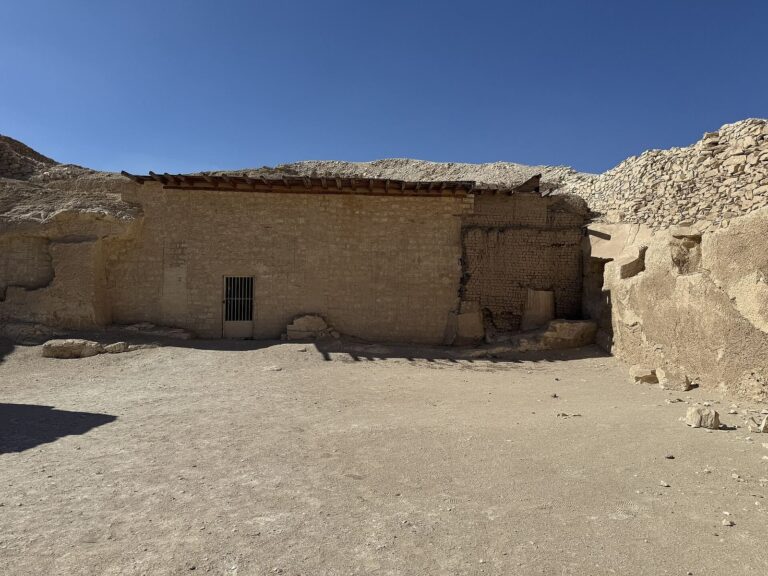
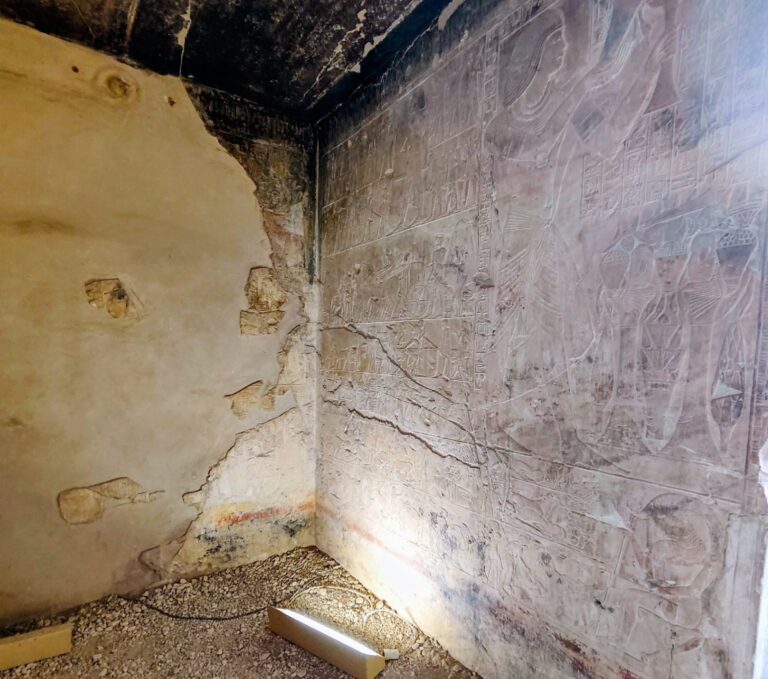
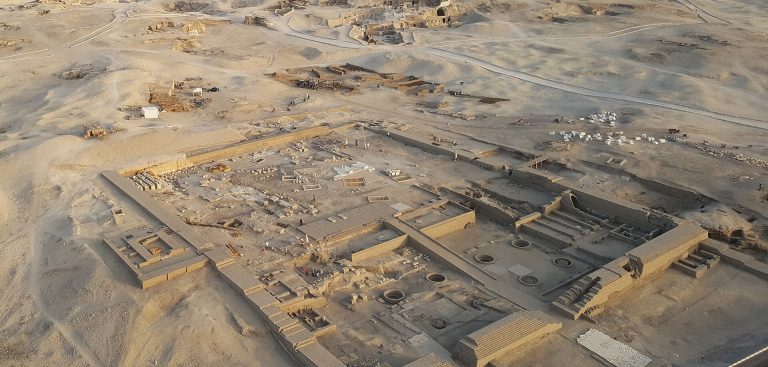
TT34 is described as the second-largest tomb at el-Assasif. It is open above and has limestone walls with colored surfaces and finely worked decoration. Its corridors extend for more than 300 metres, linking courts, chapels, rooms, stairways, and an underground burial area.
Entrance and first court
Approach and court
The entrance passage leads to a columned antechamber, then continues through a short corridor to the first court. Niches on the two sides of the court once held statues of Mentuemhat and his mother. Only the lower part of the statue in one niche survives.
Side chapels
A corridor running around the first court provides access to ten side chapels, labelled A to J. Chapel A is unfinished, though its walls show priests presenting offerings to the deceased. Chapel B contains hymns and an image of Mentuemhat worshipping. One wall carries litany texts and the 72 names of Osiris, a god associated with the dead and the afterlife; the opposite wall combines texts and prayers with a scene of Mentuemhat presenting offerings to 74 demons.
Chapel C contains sacred texts. In Chapel D, three rows show women pouring libations for the deceased, accompanied by offering lists. Chapel E depicts Mentuemhat with crown prince Akiu and a chancellor described by the title “only beloved friend, great in knowledge.” Chapel F shows Irephiaut, chief of the cavalry archers and chief of the stables of the Lord of the Two Lands, a royal title for Egypt’s Upper and Lower regions. Chapels G to J remain unfinished.
Decorated areas beyond the first court
Portico and funerary scenes
A western portico extends from the first court, with offering-bearers shown on its walls. Decoration beyond it includes a funeral procession with mourners and funerary equipment, among it chariots, as well as scenes of pilgrimage to Abydos.
False door and underground chapel
A false door, a carved feature resembling a doorway and used in funerary settings, shows Mentuemhat at its centre. A bull and seven cows appear on one side, while sacred oars and demons are shown on the other. A staircase descends to an underground chapel decorated with texts and animal images.
Inner courts and burial chambers
Passage, rooms, and decorated stairways
A short passage decorated with Mentuemhat worshipping leads to a second court and then to rooms I to V. The sequence of decorated stairs begins at room VI. Texts on walls VII concern Mentuemhat, his parents, and his wife Seshepmut. At landing VIII, his titles accompany a scene of Anubis, associated with funerary rites, and Ma’at, associated with truth and cosmic order, guiding him toward the mountain. Walls IX repeat the titles of Mentuemhat and his parents.
Chamber X and the sarcophagus chamber
In chamber X, a niche holds a statue of Mentuemhat’s father, while a statue of Osiris stands on a raised platform. A short staircase leads to chamber XI, the sarcophagus chamber, whose ceiling carries astronomical decoration. Pyramid Texts and Coffin Texts, collections of funerary spells intended to aid the dead in the afterlife, were inscribed on the tomb walls.
Reliefs and sculpture attributed to TT34
Reliefs in museum collections
Reliefs associated with TT34 are now held in collections in several countries. The Museum of Fine Arts in Boston holds a scene of men in canoes gathering papyrus, although its origin in TT34 is uncertain. The Fitzwilliam Museum in Cambridge has a relief of a woman making an offering. The Oriental Institute in Chicago holds canoe scenes and blocks with drawing sketches of fishing and women presenting offerings. The Cleveland Museum of Art has 14 reliefs, while the Egyptian collection of Florence’s Archaeological Museum includes bird-catching and agricultural scenes.
Other pieces include Mentuemhat with a servant at the Nelson-Atkins Museum of Art in Kansas City and eight reliefs at the Brooklyn Museum. Three Brooklyn pieces probably came from one wall: a girl removing a thorn from her foot, a woman with a child, and a harpist with a singer. The de Young Museum in San Francisco holds a scene of a man cleaning fish with two offering-bearers and texts referring to the Fourth Prophet of Amun. At the Seattle Art Museum, a woman making an offering appears with texts referring to the Mayor of Thebes, alongside the upper part of a pair of figures. The Toledo Museum of Art holds a man’s head. Marsh scenes with birds and genets at the Vatican Museums may also have come from TT34.
Statues and guardian figures
A group described as nine statues dedicated to Mentuemhat has been attributed to TT34, though the pieces may instead have come from chapels at Medinet Habu. The listed objects include two black-granite guardian statues at the Egyptian Museum in Cairo and two canopic-jar lids at the University of California Museum of Anthropology in Berkeley. Canopic jars held organs removed during mummification; the Berkeley lids represent Imsety and Hapy, two protective deities associated with those organs.
The Natural History Museum of Athens holds a black-granite guardian wearing a cloak that conceals a knife, with a lion shown in relief at its side. Three baboon guardians, two seated and one standing, are now in Berlin. Related black-granite bases include supports for two guardian statues at the Antiquities House at Medinet Habu and bases for three deities at the Museum of Archaeology and Fine Arts in Besançon.