Links of Noltland: A Prehistoric Settlement on Westray
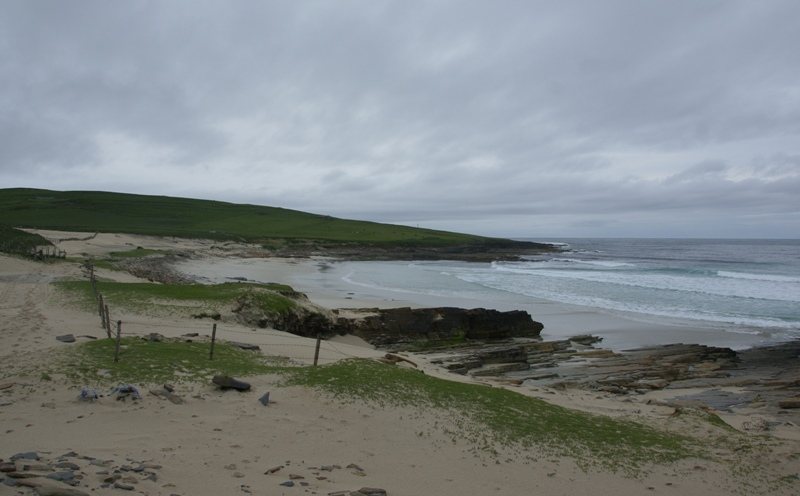
Site at a Glance
- Rating
- 3.9
- Popularity
- Low
- Country
- United Kingdom
- Primary era
- Bronze Age
- Eras represented
- Stone Age, Bronze Age
- Civilizations
- Unclassified
- Site type
- Settlement
- Remains
- Village
On this page14 sections
History
Prehistoric occupation
Links of Noltland is a prehistoric settlement among the sand dunes on the north coast of Westray in the United Kingdom. It was occupied from around 3300 BC until about 800 BC, spanning the late Neolithic, the later Stone Age, and the Bronze Age, the period that followed and is named for the use of bronze. Its earliest buildings were in use at the same time as Knap of Howar on neighboring Papa Westray. Evidence from the settlement indicates that its inhabitants grew barley and kept livestock.
Archaeological investigation
Work in the late 1970s and early 1980s brought the settlement remains to light, followed by excavations from 1978 to 1981. Archaeological investigation resumed in 2007, combining excavation with geophysical surveys, which use physical measurements to detect buried features, and topographical surveys that map the land’s shape and elevation. In 1993, Links of Noltland was designated a scheduled monument, a legally protected site of national archaeological or historic importance.
Remains
Settlement layout and buildings
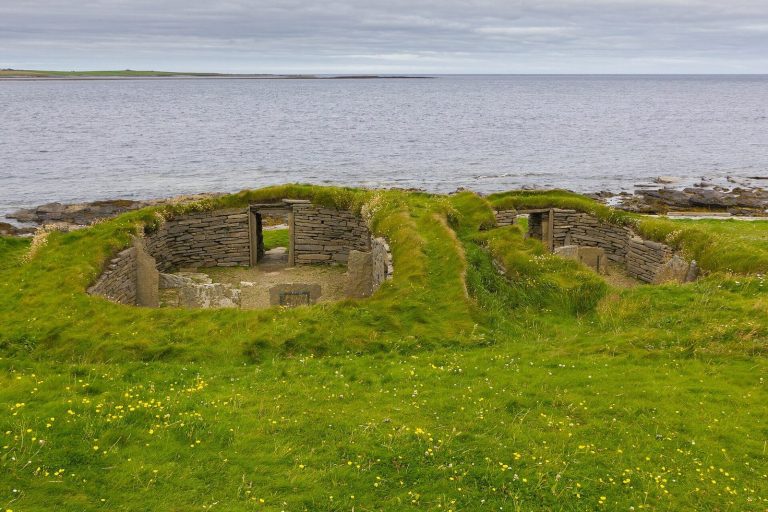
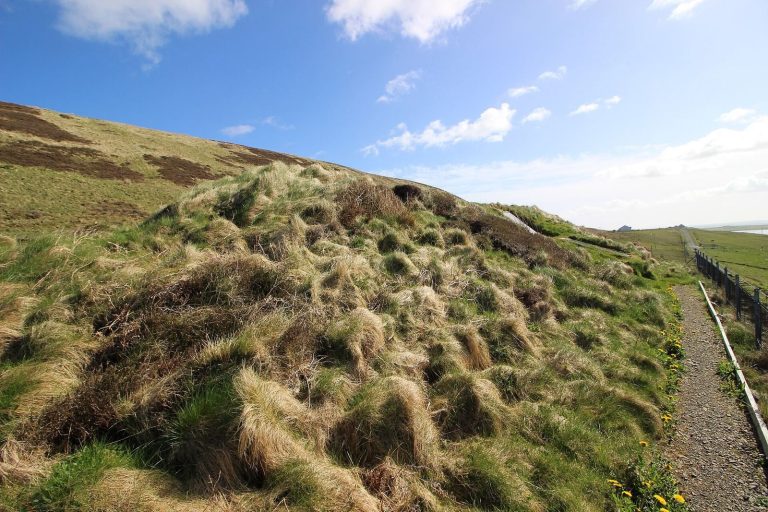
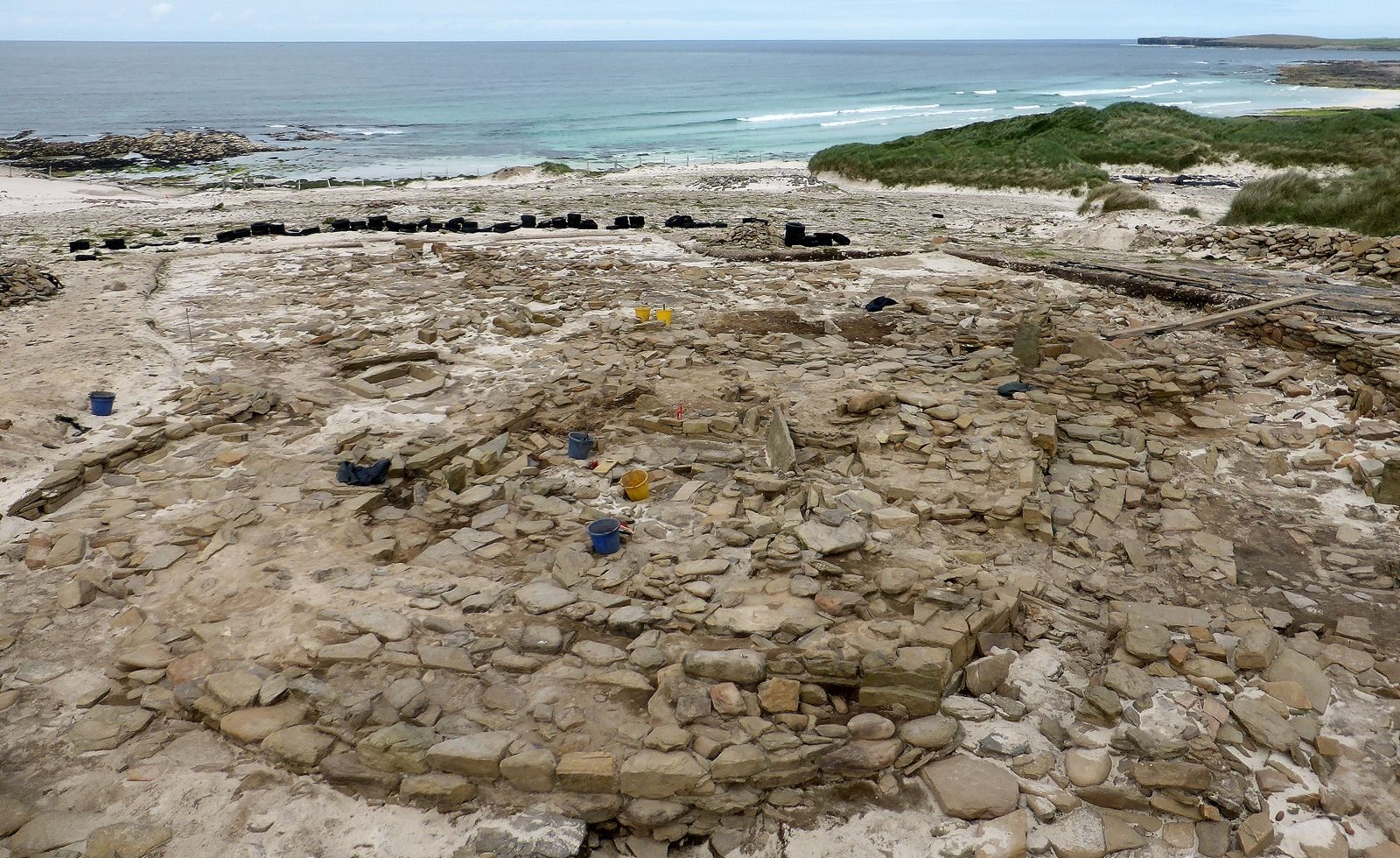
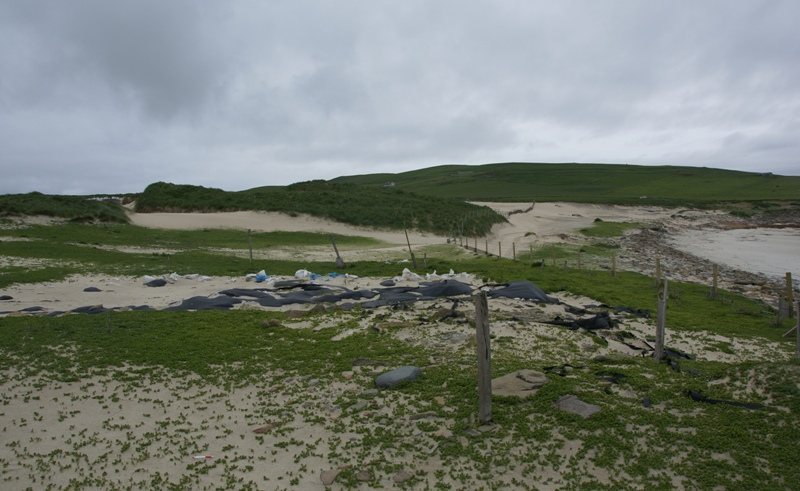
The settlement’s buried buildings lie among dunes on Westray’s north coast, south of Grobust Bay. Excavations uncovered more than 30 buildings from the late Neolithic and Bronze Age; later excavation and surveys identified further structural remains, including six probable Neolithic buildings and eight Bronze Age buildings. The site is vulnerable to coastal erosion.
Fields and refuse deposits
Excavations between 1978 and 1981 revealed large midden deposits, accumulations of refuse that can include food remains, as well as buildings and field walls. The walls mark cultivated land and field boundaries. A hearth and several red deer skeletons were found in the western area.
Eastern building
A large building in the eastern part of the settlement survived to roof height. It contained several rooms and compartments joined by passages.
Structure 8
Excavated in 2009, Structure 8 is a rectangular building about 22 metres long and 20 metres wide, with walls around 3 metres thick. It stands on raised ground, somewhat apart from the main settlement, and overlooks it. Described as a “village hall,” it may instead have been a separate farmstead. The Westray Wife figurine was found inside.
Structure 9
At least ten cattle skulls are built into the walls of Structure 9. They were placed upside down, with their horns driven into the ground; some horns interlock. This arrangement appears to have had ritual meaning.
Bronze Age well-house
In 2015, a nearly complete underground well-house was uncovered in an eroding mound at the settlement’s edge, about 5 metres from the coast. A stairway descends to a cistern, or water-storage tank, about 2.5 metres deep that was originally roofed. The building also has a narrow entrance and closely packed cells. The mound initially resembled a burnt mound, a heap of fire-cracked stones often associated with heating water. The building has been interpreted as a sweat-house, a heated structure that produces heat and steam. Its narrow access and cells have also prompted the suggestion that it served as a specialized meeting place for a select group.
Finds and figurines
Tools and pottery
Finds from the settlement include polished stone axes, worked-bone objects, polished bone beads, and tools. Pottery includes grooved ware, decorated with incised lines.
Westray Wife
The Westray Wife, also called the Orkney Venus, is a sandstone figurine about 4 centimetres long with a lozenge-shaped body. Found in Structure 8 in 2009, it has dot-like eyes, heavy brows, and an elongated nose. Crosshatching on its body may represent clothing. The figurine probably dates to around 3000–2500 BC. It is believed to be the earliest depiction of a human face found in Scotland and the oldest human carving found in the British Isles.
Other figurines
A second figurine, found in July 2010, is made of clay and has no head. Finds in 2012 brought the total number of figurines recovered at Links of Noltland to four.
Excavated areas have been covered with sand to protect them from winter storms and coastal erosion. Protection from rabbit digging is also a concern.