Thierlstein: A Medieval Castle and Ancestral Seat in Germany
Site at a Glance
- Rating
- 4.3
- Popularity
- Very Low
- Country
- Germany
- Primary era
- Medieval
- Eras represented
- Medieval, Early Modern, Modern
- Civilizations
- Duchy of Bavaria, Electorate of Bavaria, German, Holy Roman Empire, Kingdom of Bavaria
- Site type
- Military
- Remains
- Castle
On this page11 sections
History
Thierlstein is a medieval castle in Germany whose principal defensive tower, or keep, and adjoining residence were built around 1360. The castle later served as the ancestral seat of the Thierlinger family.
The Thierlingers and their seat
The Thierlingers, a hereditary local elite who served a ruler in return for land or office, first appear in records in 1125. They were probably vassals of the Diepoldingers, a noble family associated with Bavaria and the Upper Palatinate. Thierlstein’s history was connected with Traubenbach, now Untertraubenbach, a district of Cham. Around 1180, Mengotus de Trübinbach relinquished to Reichenbach Monastery property that his brother Gozpert had donated there. Andre der Draubnaher last appears in records in 1377. The Thierlingers and Trübenbachs seem to have been related, and the Thierlingers probably inherited from them.
Stephanus de Türlstein appears as a knight in a papal document of 1365. Ebo and Erasmus are named as owners in 1374 and 1384. A 1428 reference to Stefan der Türlinger zum Türlstein identifies Thierlstein as the family’s ancestral seat. In 1441, Stephan Thierlinger styled himself after Traubenbach. A record from 1411 associates the family with regional administration, identifying either Stefan II as an official at Cham or Ulrich II as one at Neunburg.
The Hofmark and changing ownership
In 1488, Thierlstein belonged to the Thierlingers, while Traubenbach was held by the Murachers. Hans II Thierlinger joined the Löwler uprising, a revolt by Bavarian nobles against Duke Albrecht IV of Bavaria-Munich. As punishment, Hans was compelled to transfer Thierlstein to his son. The castle became a Bavarian Hofmark, a landed estate with local manorial rights, and declined in importance. Although both estates were listed as Thierlinger possessions in 1503, Traubenbach remained associated with the Murachers. By the late sixteenth century, a daughter of Georg von Murach had brought Traubenbach into her marriage to Georg Thierlinger, and the two estates were thereafter held together.
The Thierlingers adopted Protestantism during the sixteenth century. Georg Bernhardt Thierlinger, the family’s last representative, died in 1620 at the Battle of White Mountain, a major battle in the Thirty Years’ War, the European conflict fought from 1618 to 1648. Thierlinger creditors’ two estates were acquired by Jakob Pollinger in 1622. He sold them in 1625 to the lord of Huzlrechter, whose widow sold Thierlstein in 1630 to Wilhelm von Köckh zu Mauerstetten. His family held the castle until 1768.
Barons von Pfetten owned Thierlstein in the late eighteenth century, and Count Max Josef von Taufkirchen followed in 1785. In 1811, the marriage of his daughter Maria Josepha to Karl Maria Freiherr von Schacky auf Schönfeld brought the property to the Schacky family. In 1820, the Interior Ministry authorized the Counts of Taufkirchen to establish a class I patrimonial court there, a court exercising jurisdiction through a landowning family.
Later owners and preservation
Karl Franz Xaver Freiherr von Schacky’s widow sold the estate in 1884, and Arnold Ritter acquired it in 1895. The Barons von Lichtenstern held the castle until 1984, when Siegmund Gottfried Freiherr von Schacky auf Schönfeld bought it back. The castle largely escaped destruction in wars and fires. Changes in the fifteenth century may have repaired partial damage caused by the Hussites. The Schacky family undertook an extensive renovation in 1988–89, regarded as a model of Bavarian monument preservation. Thierlstein is protected as both a built monument and an archaeological monument, the latter reflecting evidence in the castle area for an earlier medieval castle.
The estate’s farm buildings gave rise to the Schlossbrauerei Thierlstein. By the late nineteenth century they had passed into private ownership; in 1899, Josef Sauer acquired the inn, brewery, farm buildings, and agricultural land. The Sauer family has retained the farmyard and brewery. From 2006 to 2008, Marie-Theres Fischer, née Sauer, renovated the buildings.
Remains
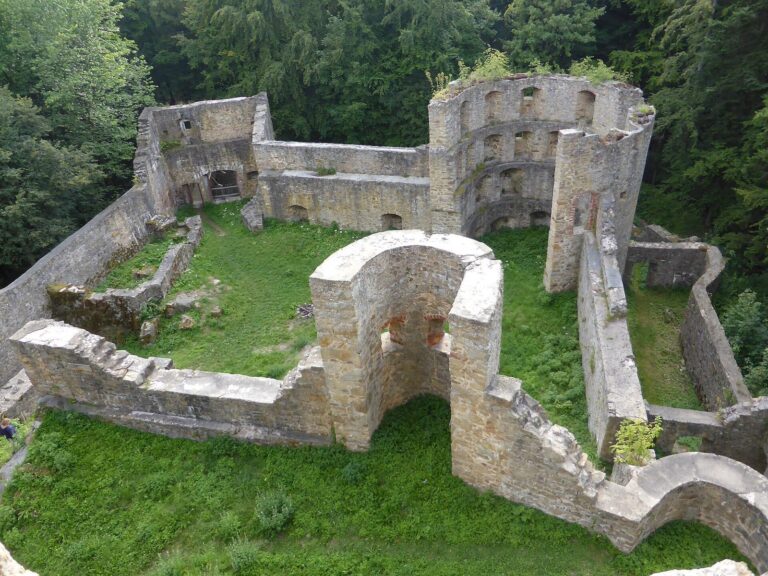
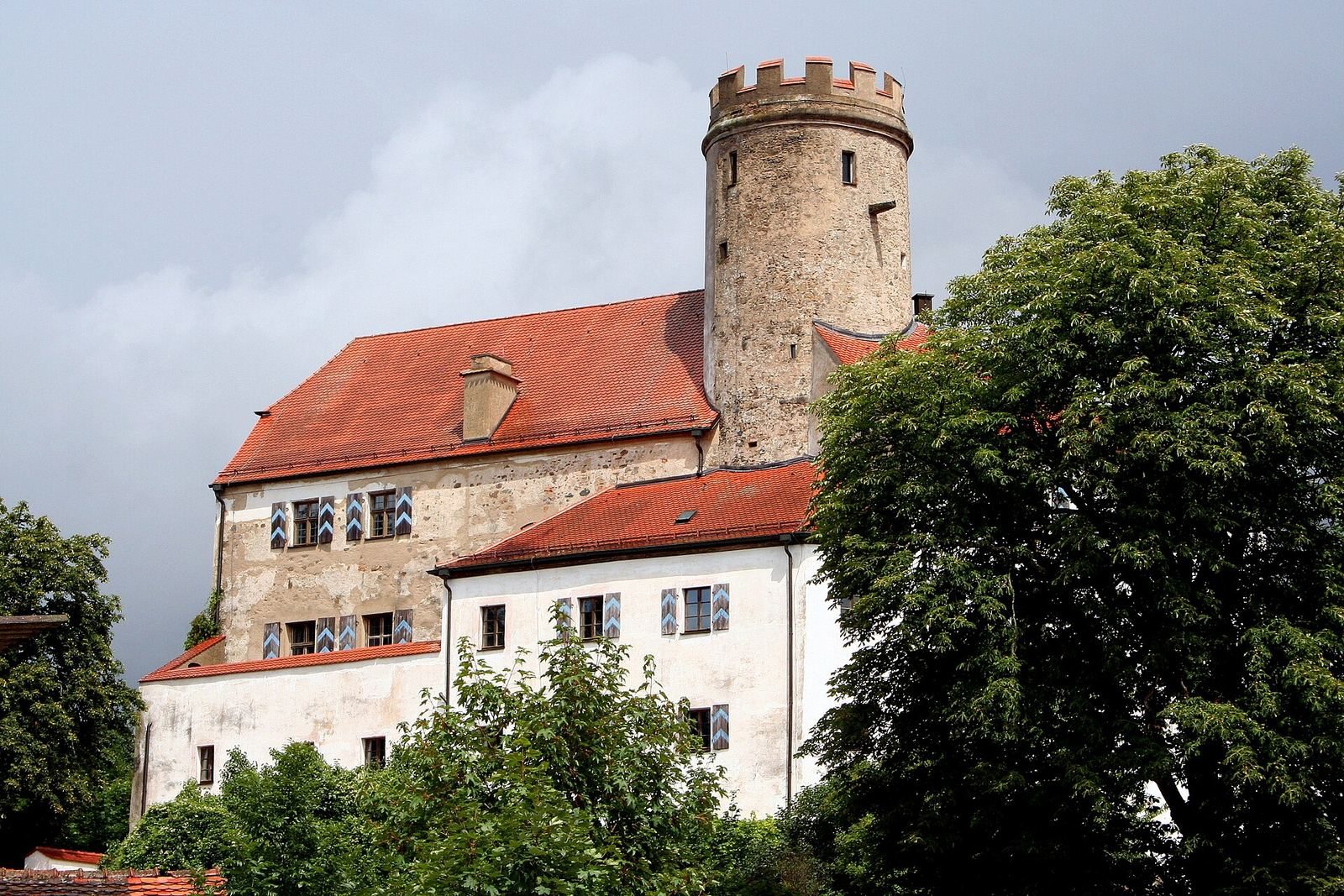
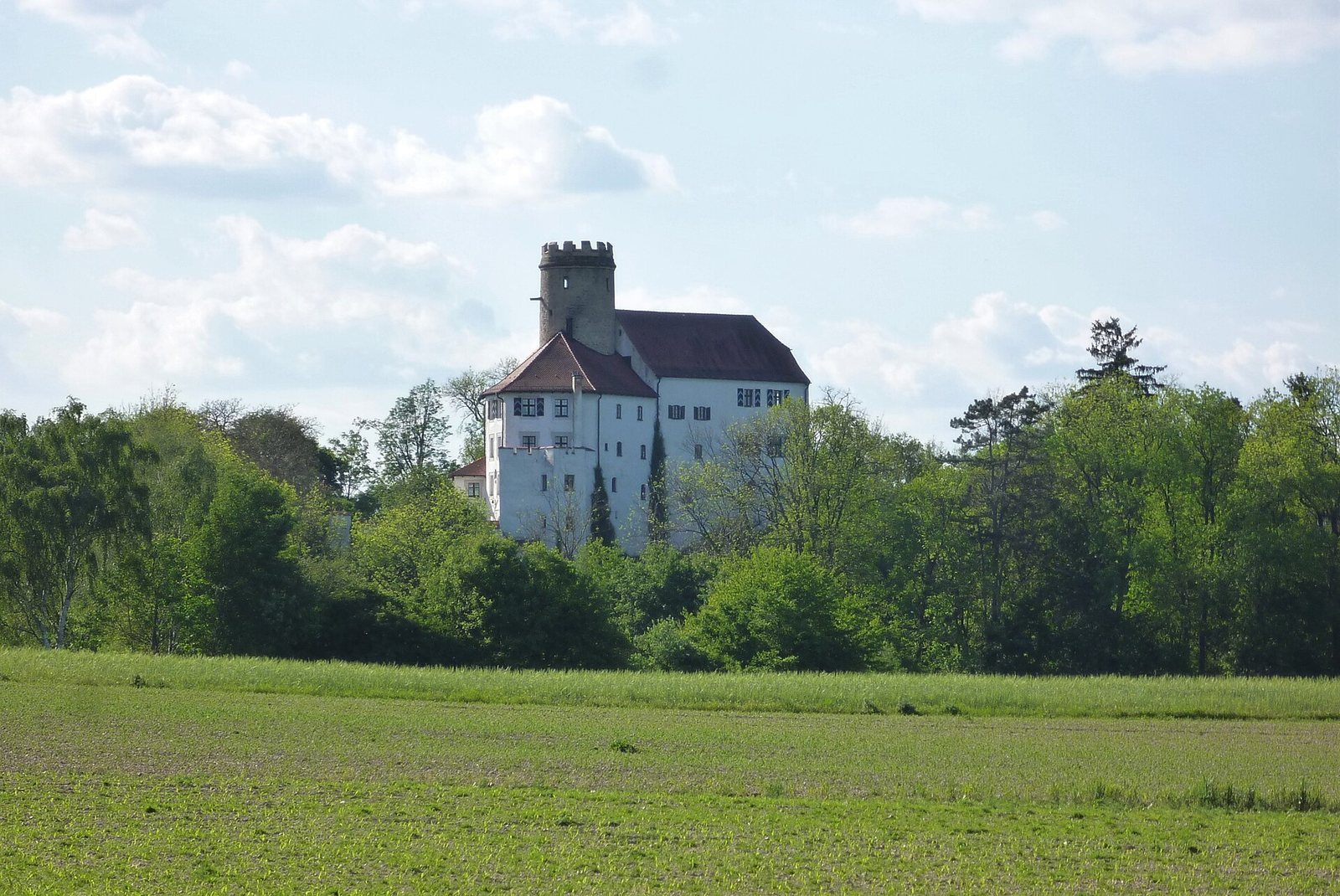
Thierlstein is a two-winged castle that developed around its keep. Its eastern part includes a three-storey building, while a medieval wall encloses the complex. The castle was also called Lichtenstein, a name used for the keep and adjoining residence around 1360 and recorded in 1367. The name refers to the pale quartz rock beneath the castle. A 1721 engraving by Bavarian topographical artist Michael Wening shows a multi-part complex of three storeys, with a tower, apparently the keep, rising two storeys above the buildings. A battlemented wall and corner tower surround the group in the engraving.
Castle buildings
Keep and residential hall
The round keep is six metres across, with rubble-stone walls two metres thick. Its entrance stands twelve metres above ground. Arnold Ritter had a battlemented crown added to the tower from 1895 and made other small changes in a Neo-Gothic style. A three-storey residential hall adjoins the keep; it has a raised, open terrace edged with battlements.
Residential wings
The eastern building is medieval and was altered around 1900. The north wing rises three storeys beneath a half-hipped roof, whose ends are partly sloped, and has stepped additions. The west building dates to the eighteenth century.
Enclosure and grounds
Castle wall
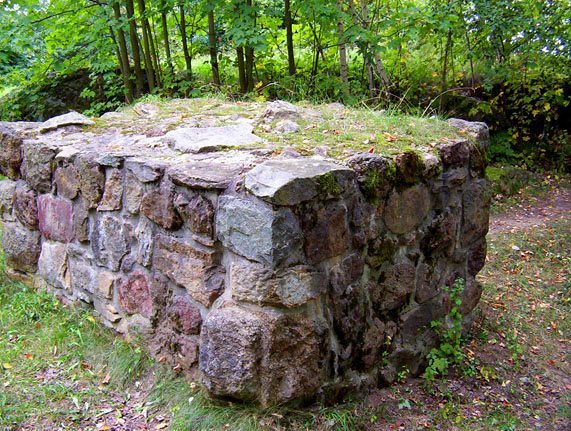
The medieval enclosure wall is made of granite rubble and includes a two-flight staircase, gates, and a shell tower, a tower open along its inner side.
Park building
A nineteenth-century timber-framed building in the park has a shallow-pitched gable roof and decorative wooden-strip ornament.