Trebula Balliensis: An Ancient Samnite and Roman Settlement in Italy
Site at a Glance
- Rating
- 4
- Popularity
- Low
- Country
- Italy
- Primary era
- Iron Age
- Eras represented
- Iron Age, Classical
- Civilizations
- Roman, Samnite
- Site type
- Settlement
- Remains
- Town
On this page13 sections
History
Trebula Balliensis was an ancient settlement at modern Treglia, Italy. It had a settled core by the ninth century BCE, before Rome’s foundation, and its beginnings are attributed to the Osci, an ancient people of southern Italy. The Caudine Samnites, a Samnite group, occupied the site around the sixth century BCE.
Samnite settlement and Roman relations
Trebula received Roman citizenship in 303 BCE, alongside Arpinum. After Pyrrhus of Epirus was defeated in southern Italy, the city became an allied community of Rome. During the Second Punic War, the major conflict between Rome and Carthage, Trebula sided with the Carthaginian commander Hannibal, as did Capua and other Campanian communities. The Roman general Quintus Fabius Maximus recaptured it in 215 BCE. An inscription in the Samnite language indicates that Trebula retained its own civic organization even after Hannibal’s invasion.
Roman urban growth
Roman urban development within the Samnite walls began in the second century BCE. Trebula probably became a municipium, a community incorporated into Rome with local civic institutions, only after the Social War, when Rome’s Italian allies fought for citizenship. Under Augustus, Rome’s first emperor, the settlement appears to have received a new group of settlers, but it did not become a colony.
The Trebulanus district was counted among Campania’s fertile lands considered for distribution to poorer Roman citizens in a proposal by Servilius Rullus. Trebula was also known for its wines, whose reputation had grown by the time of the Roman writer Pliny the Elder.
Names and archaeological investigation
The forms Trebula Balliensis and Trebula Balliniensis distinguished this city from Trebula Mutuesca and Trebula Suffenas. The geographer Ptolemy used the name Trebula alone, while Pliny included a distinguishing name; the variations may reflect differences in manuscript transmission.
The ancient city is identified with modern Treglia, and the Monti Trebulani take their name from it. An earlier proposed location south of the Volturno was considered mistaken; local antiquarians placed the city at Treglia. William Hamilton, the British ambassador in Naples, excavated at Trebula in 1758 and 1766. Later investigations included an emergency excavation in the settlement’s center in 1976. A project to enhance the archaeological site began in 2007, with archaeologist Domenico Caiazza preparing its archaeological work in coordination with regional and provincial authorities.
Remains
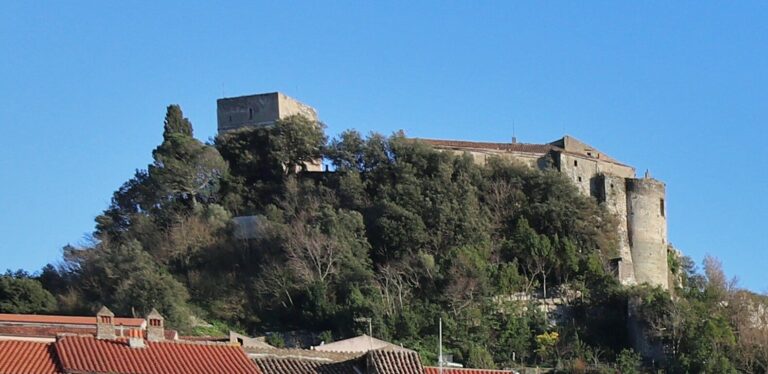
The ancient settlement occupied two main areas in rugged, mountainous terrain with few level stretches. An elevated acropolis, the settlement’s fortified high area, stood on Monticelli hill at 477 metres, while a lower Samnite-Roman area occupied the La Corte plateau. Substantial Samnite walls enclosed both. The archaeological area lies northeast of modern Treglia, in the central Monte Maggiore massif below Pizzo San Salvatore, about 10 kilometres north of the Volturno and 13 kilometres northeast of Capua.
Public buildings and water supply
Roman theatre and civic finds
The remains of a Roman theatre lie in the southwestern part of the ancient city. Statues and public inscriptions have repeatedly been found nearby, and some are now preserved in the Campanian Museum at Capua. These discoveries have prompted the proposal that the forum, the central public space of a Roman town, was located in this part of Trebula.
Aqueduct
Investigations in the late nineteenth century examined part of an aqueduct at Trebula.
Public baths
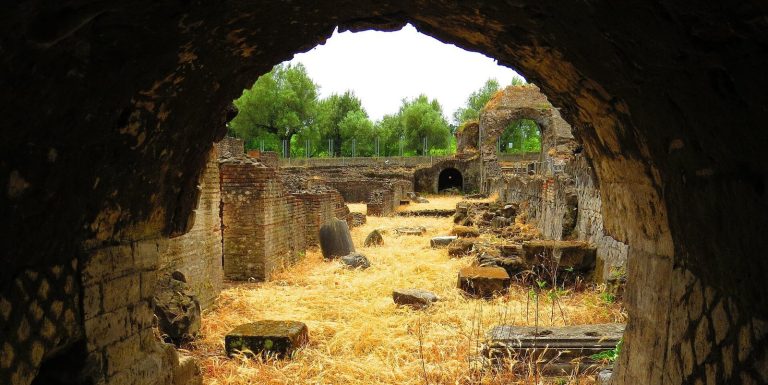
An emergency excavation in 1976 uncovered public baths in the center of the ancient settlement. Later work restored the baths and revealed further rooms and two paved roads beside them. The complex may be the baths described as Constantinian in an inscription.
Gate, tombs, and earlier industry
Western gate
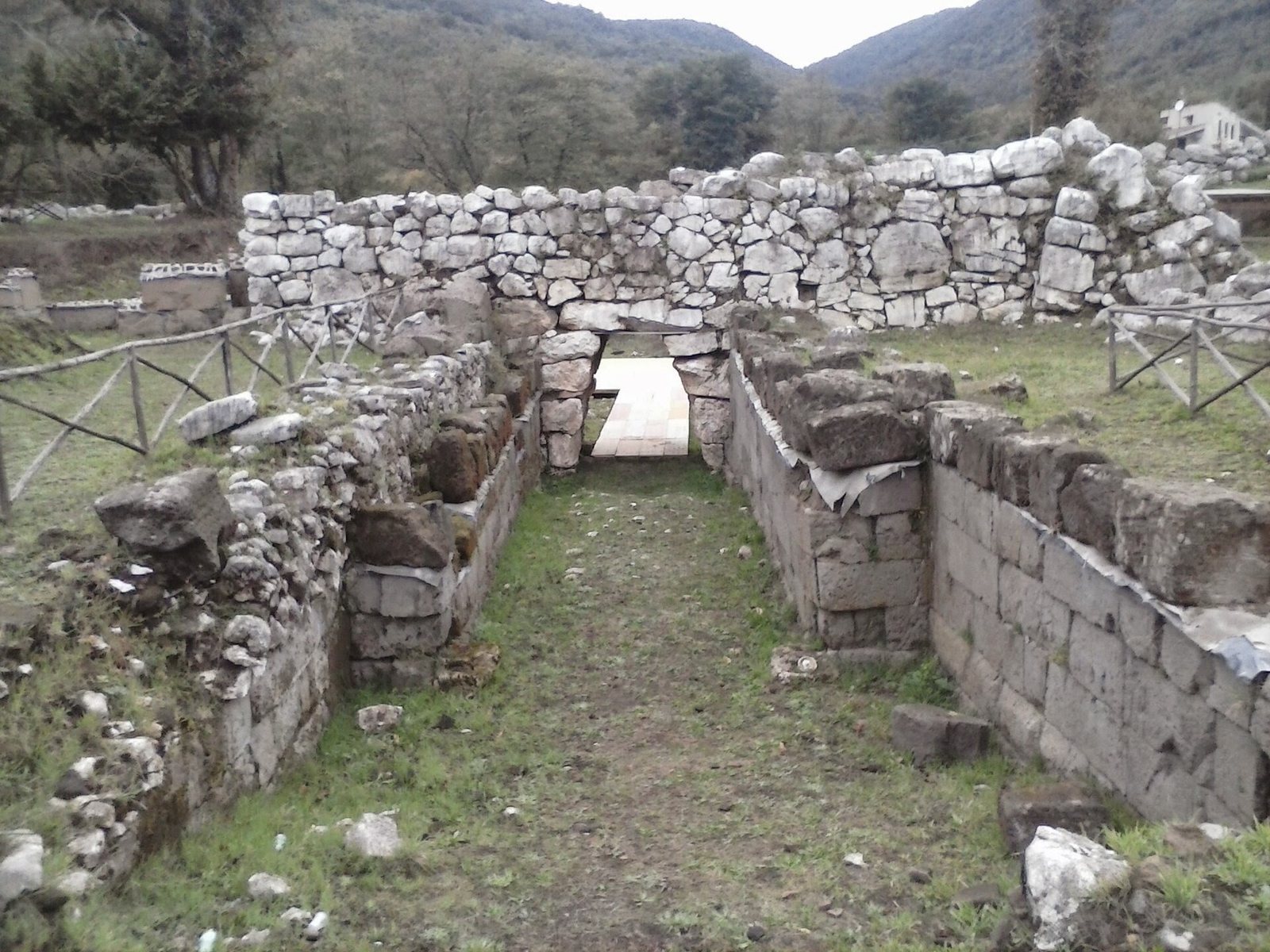
Excavations exposed a large western gate built from massive stones. Its outer entrance has a pincer-shaped arrangement, leading into an inner corridor. It may be the largest gate of this type in Europe.
Tombs
A large chamber tomb partly below ground has been excavated; it may be the same tomb looted by Hamilton. Investigations also covered numerous tombs from the Roman imperial period and Samnite burials containing rich grave goods.
Pre-Roman furnace
A furnace dating to before Roman rule was uncovered beneath material laid down during construction of the walls.