Aquae Cutiliae: Roman Baths and Healing Springs in Italy
Site at a Glance
- Popularity
- High
- Country
- Italy
- Primary era
- Classical
- Eras represented
- Classical
- Civilizations
- Roman
- Site type
- Sanitation
- Remains
- Baths
On this page11 sections
History
Origins and sacred waters
Aquae Cutiliae was a Roman thermal-spring and bath complex near Cittaducale in Italy. Dating to the 2nd century BC, it had a monumental character associated with late Republican and early Imperial rural Sabina. Ancient Italian tradition described Cutiliae as an important center of the Aborigines, a people said to have lived in the region before the Sabines. The site’s name came from a nearby settlement called Cutiliae or Cutilium, whose precise location is uncertain.
The baths were built around cold mineral springs believed to have healing properties. Pliny and Celsus praised the waters, particularly for treating stomach disorders. The complex may initially have served as a sanctuary to Vacuna, a Sabine goddess. Nearby Lake Cutilia, also called Lake Paterno, was likewise sacred to Vacuna and was enclosed by a fence. Classical writers considered it the center of Italy, and the scholar Varro called it the country’s “navel.” Dionysius of Halicarnassus also associated the area with worship of Victory, the divine personification of triumph.
The Flavian retreat
In the later 1st century AD, the baths became a fashionable retreat for the Flavian dynasty, which ruled Rome during that period. Suetonius describes a villa at Cutiliae where Vespasian spent each summer, and says his son Titus stayed there as well. Vespasian died at Aquae Cutiliae on 23 June AD 79, after increasingly severe intestinal illness. The possibility that excessive bathing in the cold water contributed to his death remains uncertain. Titus also died at the site. He may have been born there on 30 December 39, although Suetonius places his birth in Rome.
Later use and archaeological work
Aquae Cutiliae appears as “Aqve cvtillie” on the Peutinger Table, a medieval copy of a map of Roman roads, along the Via Salaria. The baths remained in use into the 4th or 5th century AD. Part of the complex on the third terrace may have collapsed in the 3rd or 4th century, perhaps after an earthquake or during the Lombard conquest of parts of Italy; it was not rebuilt.
Remains found in 1890 led to the first excavations. Further work between 1969 and 1984 and from 2007 to 2012 revealed more of the complex and its surroundings.
Remains
Terraces and bath buildings
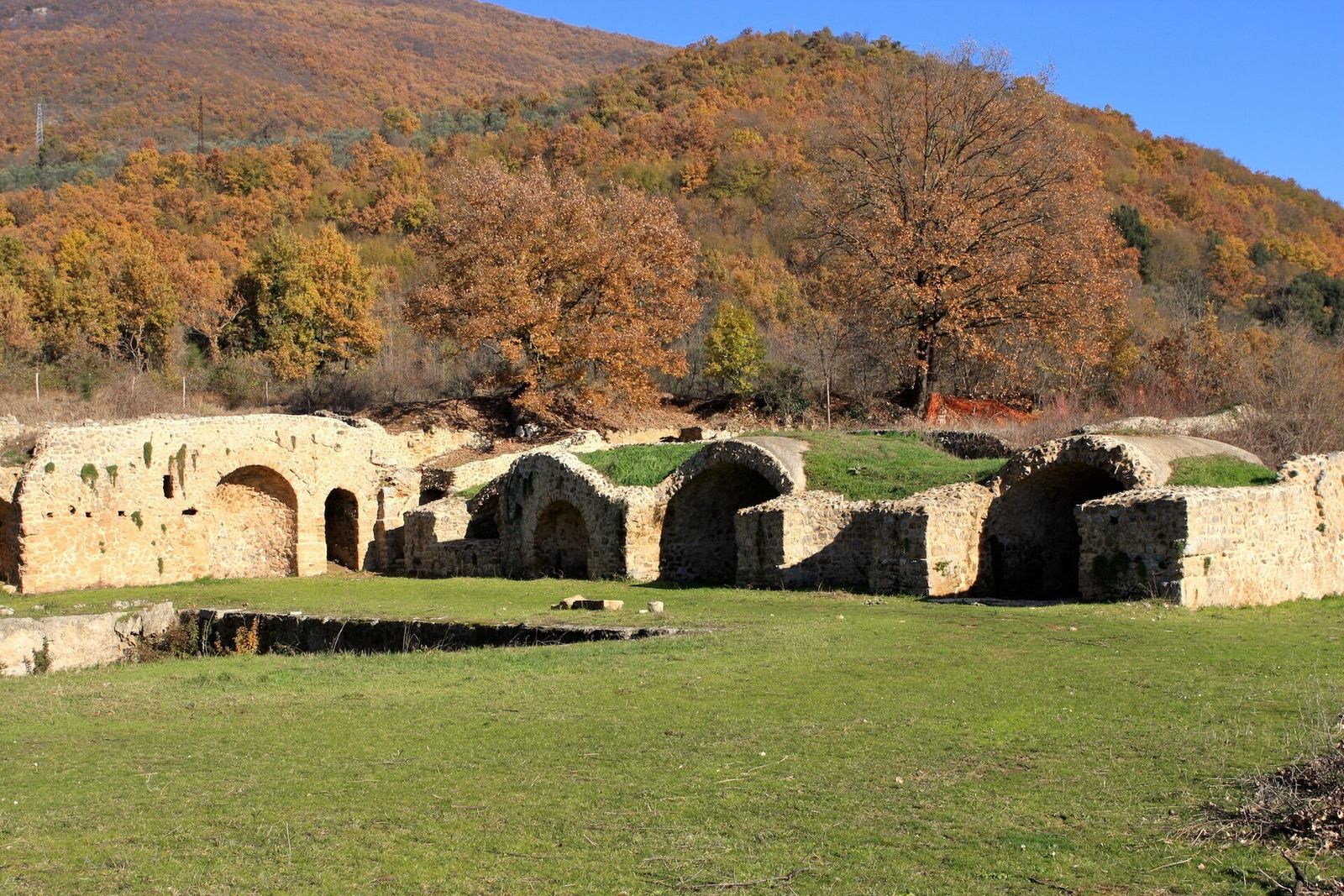
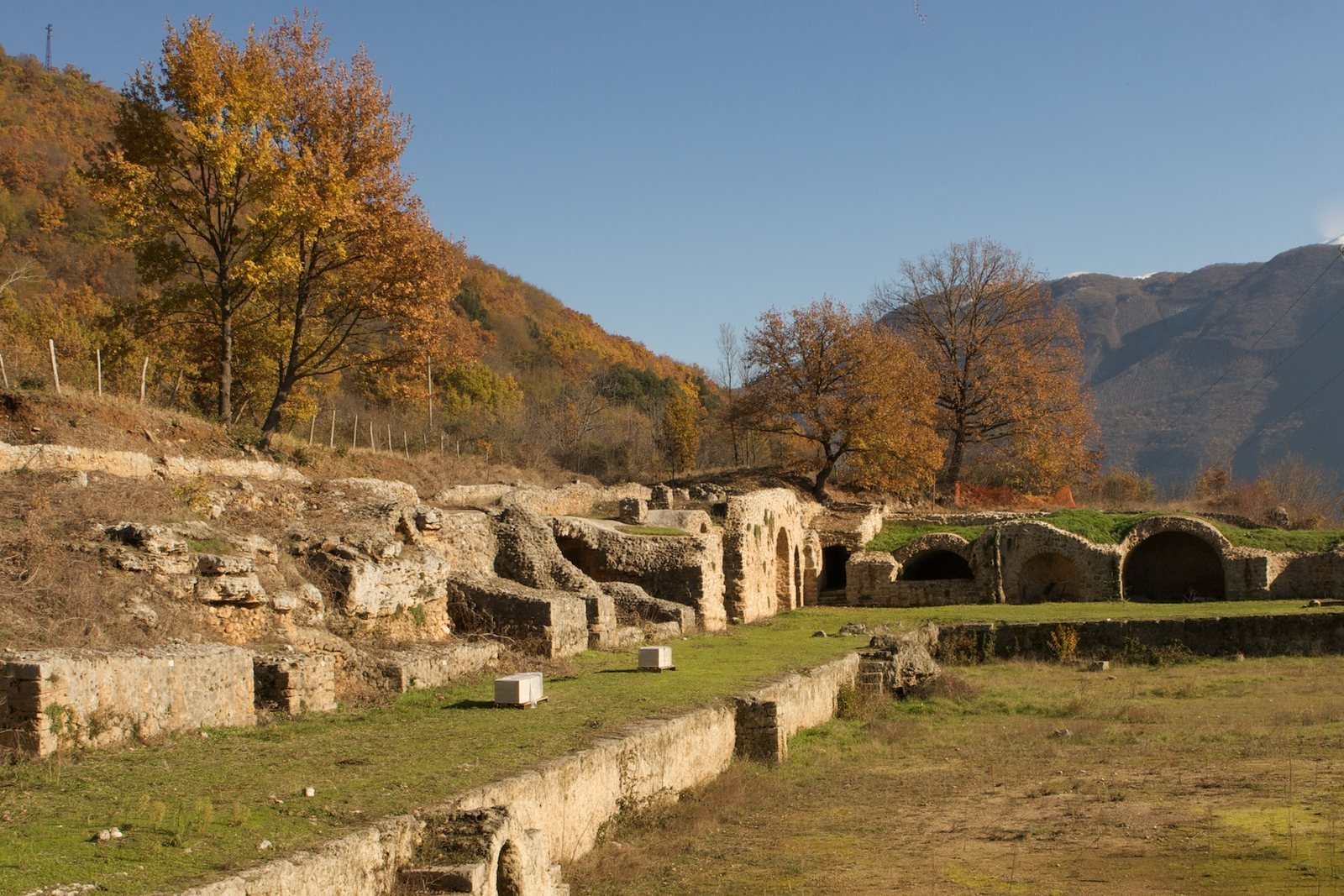
The remains extend for about 400 metres across four terraces in the San Vittorino Plain, roughly 9 miles east of Rieti and about 2 kilometres west of Lake Cutilia. Modern thermal buildings stand in Castel Sant’Angelo. The complex drew on sulfurous springs whose water was intensely cold. The nearby lake was known for floating, plant-covered islands, including one described at its center. Mineral substances in the water partly hardened the vegetation.
Swimming pool
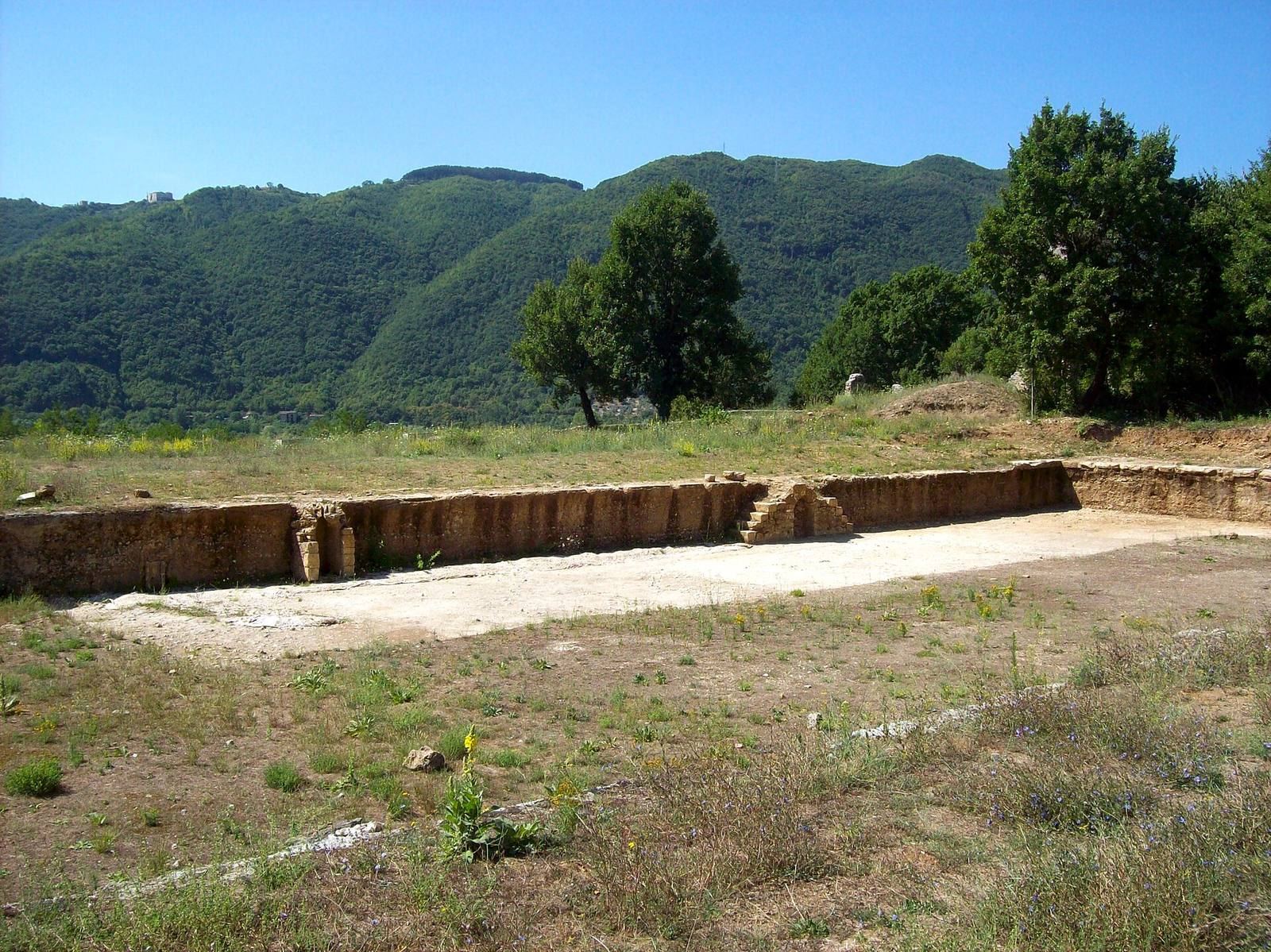
On the second terrace, a large swimming pool was cut directly into the rock. It measures about 60 by 30 metres, with steps running along the two longer sides. An underground spring may have supplied it. The pool remained in use until the 4th century and was enlarged in several stages.
Water structure
On the north side, niches and rooms arranged around a rounded end formed a nymphaeum, a monumental water structure commonly incorporating a fountain.
Heated rooms
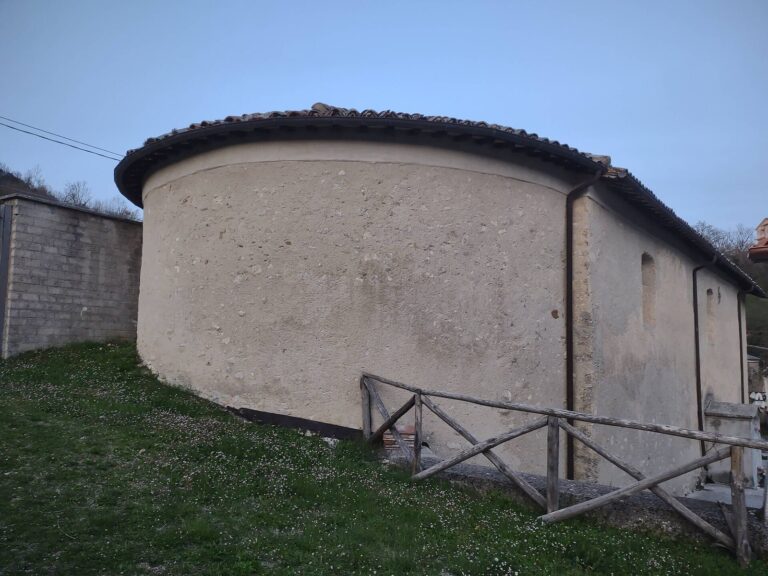
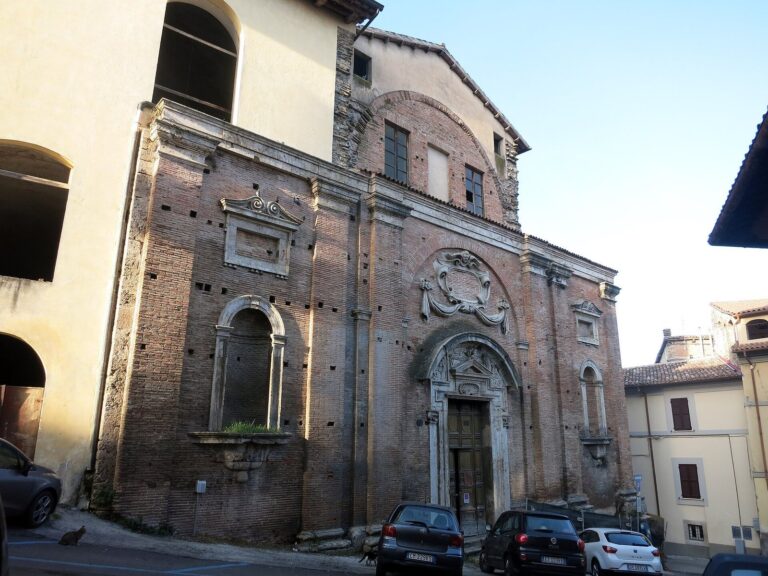
On the west side, rooms dating to the Flavian period heated spring water for bathing. They lie beneath a later church and mill.
Third-terrace pillars
Five pillars remain visible on the third terrace. They probably belonged to a covered colonnade near a corridor.
Ancient road
Excavations between 2007 and 2012 exposed a broad section of ancient road, several hundred metres long, at the level of the first terrace. It runs just outside the enclosure walls.