Sant’Antonio Abate Church: A Church in Rieti’s Former Hospital Complex
Site at a Glance
- Country
- Italy
- Primary era
- Early Modern
- Eras represented
- Classical, Early Modern
- Civilizations
- Papal States, Roman
- Site type
- Religious
- Remains
- Church
On this page8 sections
History
Sant’Antonio Abate Church is a Catholic church in Rieti, Italy, commissioned in 1570 to replace the small chapel at the Hospital of Sant’Antonio Abate. Designed by the Italian architect Jacopo Barozzi da Vignola, it was begun in the 16th century and completed in the 17th. Its plan later became a standard model for church design.
From hospital chapel to Vignola’s design
The church belonged to a hospital-and-cemetery complex that already existed by the early 14th century. The complex stood below the hill where the Roman city of Reate, the ancient name for Rieti, had developed. In July 1570, the Confraternity of the Blessed Sacrament, a Catholic lay association devoted to the Eucharist, commissioned Vignola to design a replacement for the hospital’s small chapel.
The design followed the reforms of the Council of Trent, a major Catholic council that shaped religious practice, and drew on the Church of the Gesù in Rome, a Jesuit church associated with the Catholic Reformation. Vignola did not supervise construction at first, in part because he was working for the Farnese, a prominent Italian noble family and arts patrons. Building proceeded slowly.
Completion and dedication
Vignola died in 1573 before the church was complete. Bishop Pietro Paolo Crescenzi may then have sought another architect to direct and finish the work, probably Onorio Longhi. Cardinal Crescenzi consecrated the church on 25 August 1620. Dedicated to Saint Anthony the Abbot, an early Christian ascetic whose example influenced the development of monasticism, it belonged to the Diocese of Rieti.
Hospital use, closure, and later work
The surrounding buildings continued to serve as Rieti’s civil hospital until 1972, when a new hospital opened at Campoloniano. The complex, including the church, then closed and was abandoned while a new use was sought. The church formerly hosted an annual blessing of animals during the celebrations for Saint Anthony; a parade of decorated horses continues to recall the tradition.
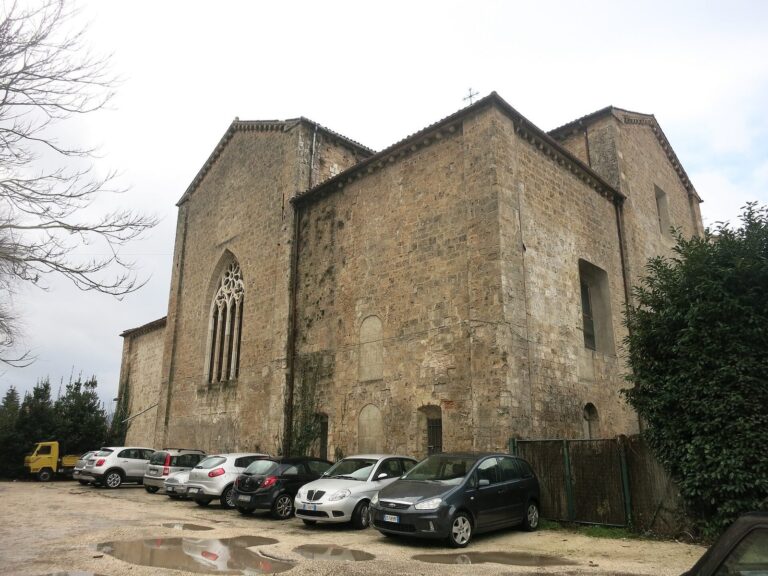
An earthquake damaged the church in 1997, and it was declared wholly unusable in 2003. Planned consolidation did not proceed after the property passed to a private company controlled by the region, since earthquake funds could not be used for private companies. Recovery work on the former hospital complex resumed in part in 2018, when some unsafe buildings behind the church were demolished. Regional funding enabled repairs to the doors and windows in 2019. A coin from the late 17th century was found inside the main entrance door during that work.
Remains
Setting and facade
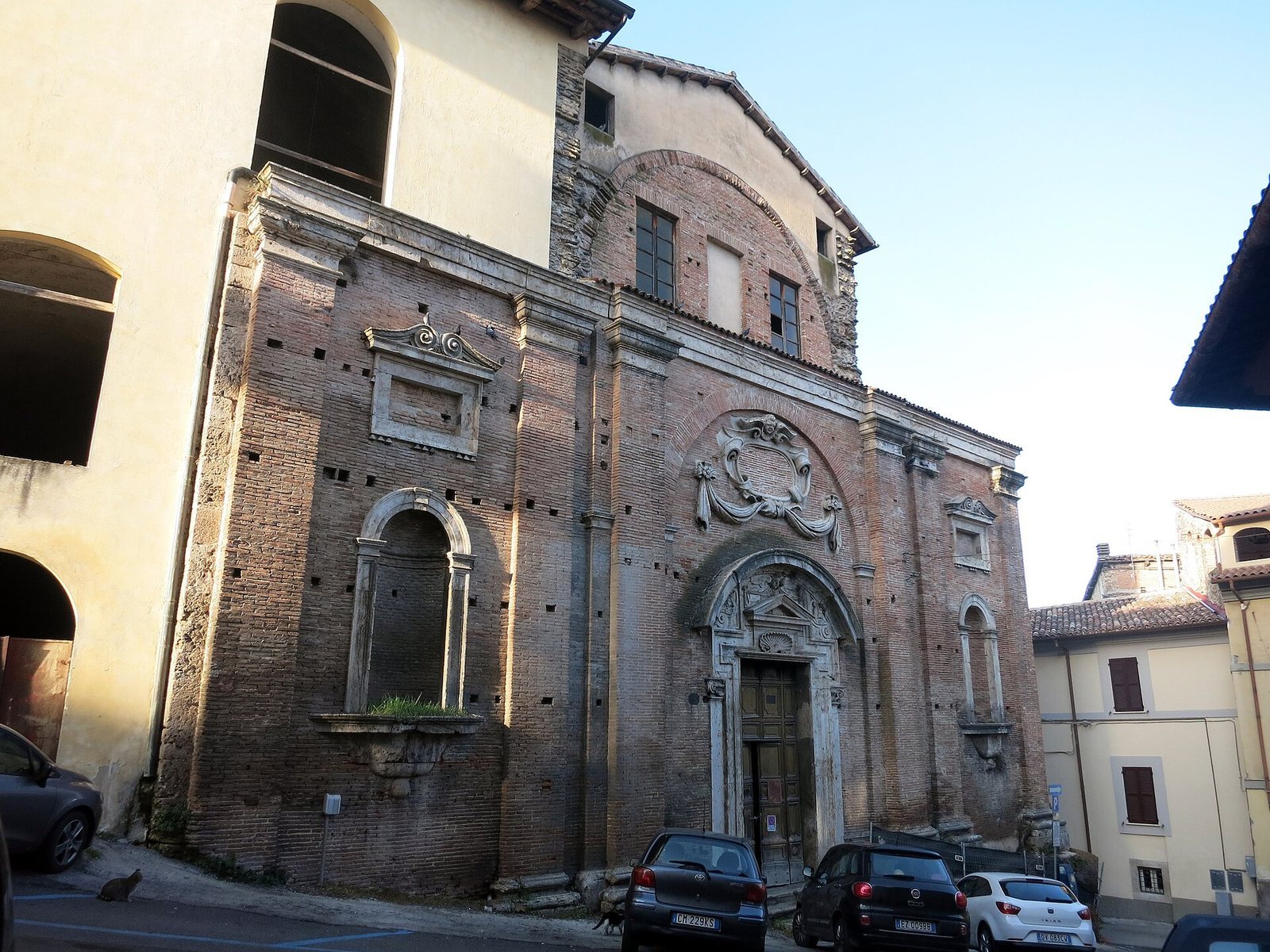
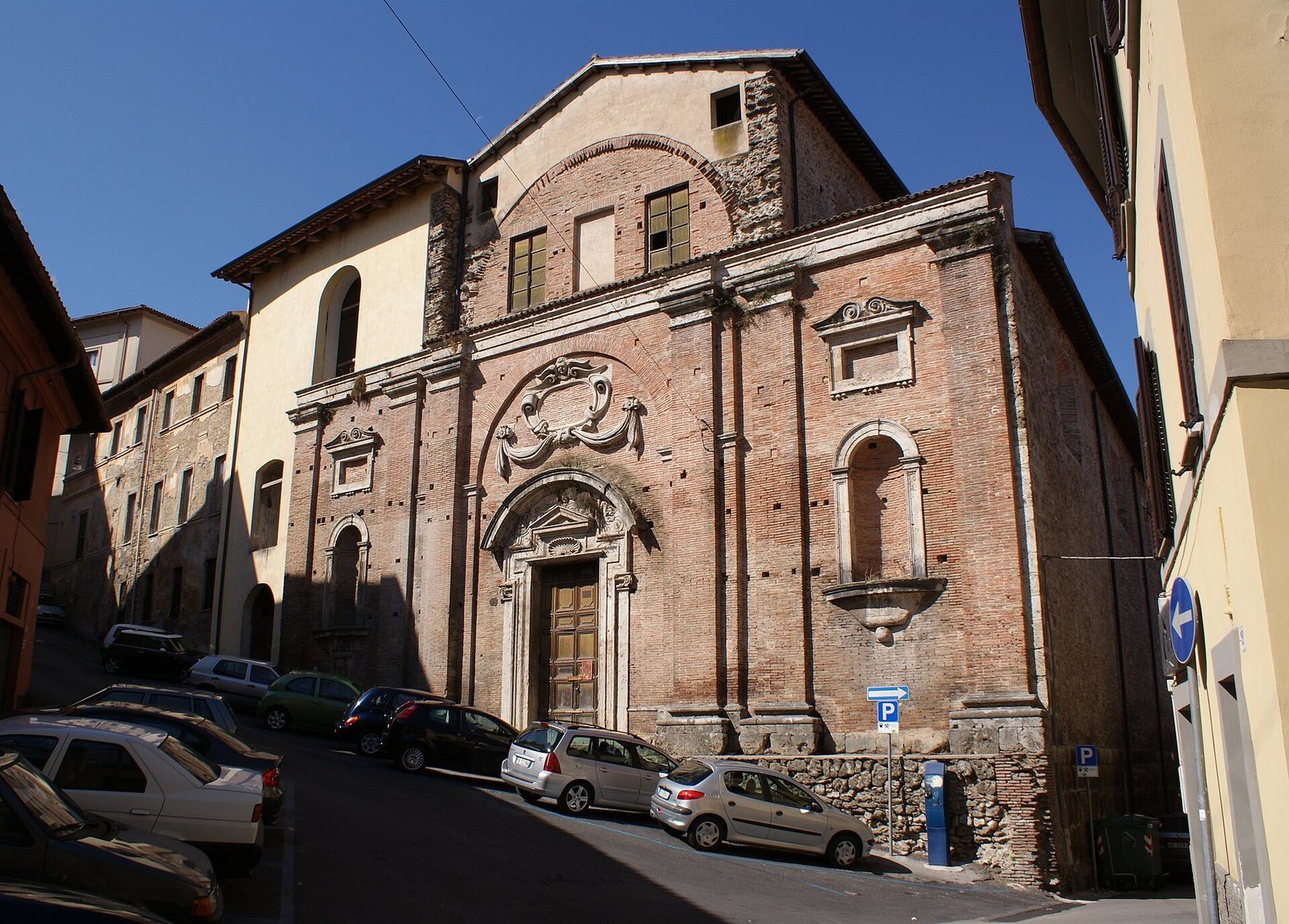
The church stands between Via Vignola, formerly Via dell’Ospedale, and Via Tancredi, once called Via Sant’Antonio Abate, near the line of the ancient Roman city wall. Large blocks of the wall remain visible as the church’s base on the eastern side of Via Tancredi. The steep slope of Via Vignola is accommodated by adjusting the level at which the facade rests. Vignola is credited with the facade’s proportions. Its decoration includes curved trim above the portal and a stucco frame with draped details. Aloisio Antinori associated these features with Onorio Longhi’s style, or more probably that of his son Martino; Pompeo Angelotti’s 1635 description attributed the church to Onorio.
Interior
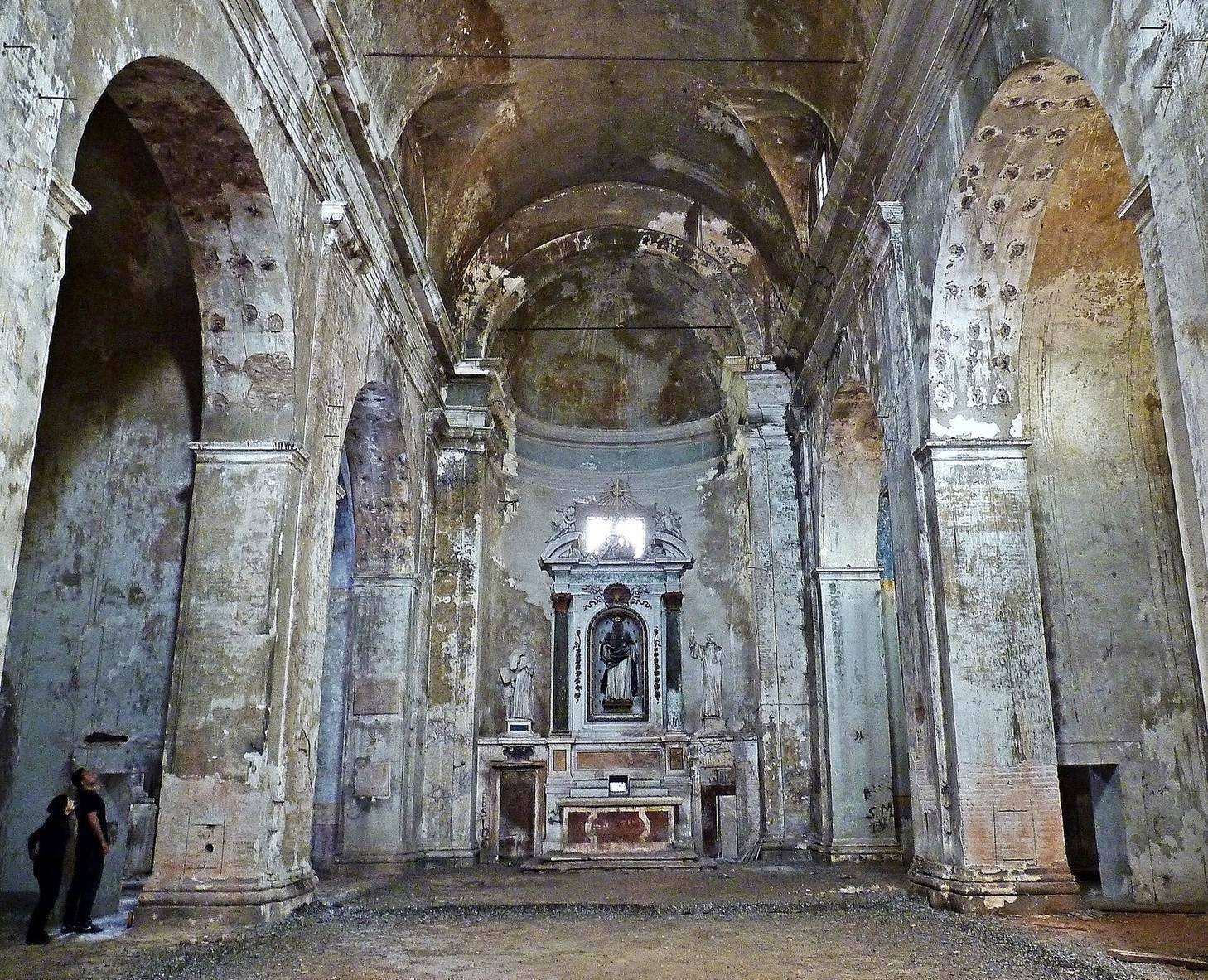
A large central nave is flanked by three chapels on each side. A tunnel-shaped barrel vault covers the nave, with curved spaces called lunettes where the vault meets the walls. At the far end, the nave terminates in a semicircular apse, or rounded end.
Condition and fabric
The church deteriorated severely after its closure. Cracks and separations affected its arches and vaults. Broken windows allowed pigeons inside, and their accumulated droppings damaged the original floor, which was uneven and detached in several places. Vandal inscriptions and other defacement also affected the interior.