San Giovanni: A Cemetery Church Dedicated to John the Baptist in Roccaranieri, Italy
Site at a Glance
- Popularity
- Very Low
- Country
- Italy
- Primary era
- Medieval
- Eras represented
- Medieval, Early Modern
- Civilizations
- Papal States
- Site type
- Religious
- Remains
- Church
On this page11 sections
History
San Giovanni is a Catholic cemetery church dedicated to John the Baptist in the valley below Roccaranieri, Italy. In Christian tradition, John preached and baptized Jesus; he is the village’s patron saint, and his feast is celebrated on June 24. The church is described as early medieval and stands over an earlier Roman-period settlement, while a separate dating places the foundation of the present building in the 12th century. It served as a parish church and, for centuries, as a cemetery and place of burial, and it belongs to the Diocese of Rieti.
Origins and medieval records
San Giovanni appears in written records by 948. Entries from 948 and 982 place it in an area called Pretorio, in Rieti territory at Plage, between the Salto and Turano rivers. The first record to name it as San Giovanni of Roccaranieri is a 1252 census of churches in the Diocese of Rieti. Ordered by Thomas, bishop of Rieti, the census lists the church among those controlled by San Salvatore Maggiore Abbey, a monastic community governed by an abbot. The church also appears in a list from 1398 and in later pastoral visits made on behalf of abbots and bishops of Rieti.
Parish and abbey authority
Until the 16th century, San Giovanni had its own parish. Until 1434, the abbot of San Salvatore Maggiore appointed parish clergy within the abbey’s territory and held authority over both religious and worldly affairs. The church’s priest was an archpriest, and his benefice, an ecclesiastical office or income attached to a church, included several settlements that have since disappeared. These were Ville de’ Rabelli, near present-day Fonte Rabelli, Ville de’ Venis, and Ville di Colle Imperatore.
The parish also included a chapel beside the walls of Roccaranieri castle. That chapel had no cemetery or baptismal font. In 1500, the income and duties of San Giovanni and San Pietro, a church inside Roccaranieri’s walls, were joined under one priest, who kept the title “Archpriest of San Giovanni Battista.” The arrangement ended in 1571, then began again in 1591.
Restoration and later use
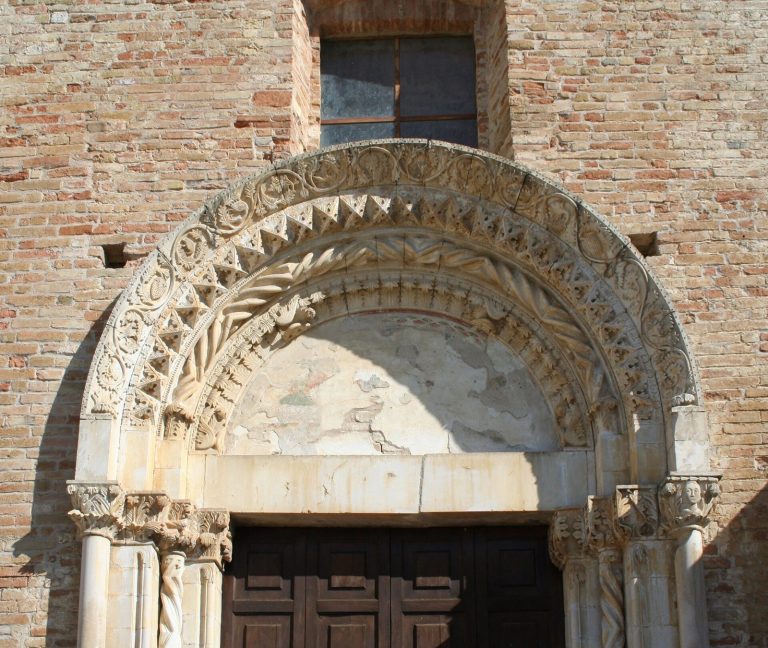
Pietro Caprioli restored the church in 1519, an event noted on the entrance portal. The work took place under commendatory abbots of San Salvatore Maggiore, an office that carried the abbey’s revenues and formal title without necessarily requiring the holder to lead the resident community. At the time, the abbots belonged to the Orsini d’Aragona family. The apse paintings may have been made during the restoration. A painted roundel with the family arms and a cardinal’s hat is associated with the abbacy of Napoleone and Francesco Orsini d’Aragona, dated 1513 to 1542.
In 1681, Giovan Francesco dè Laurentis made a pastoral visit on behalf of Cardinal Carlo Barberini, commendatory abbot of San Salvatore Maggiore from 1654 to 1703. A historic route from Roccaranieri reached the church through the village gate called Raili and along the Fonte Calla road, now Via Rieti. It crossed the Fosso della Mola at San Giovanni Bridge.
After the Second World War, the cemetery was adapted to burial regulations with the addition of burial niches and enclosing walls. In the second half of the 20th century, neglect and poor roof maintenance led to damage, vegetation growth inside the church, and deterioration of the paintings. Roof renewal began in the late 1980s. Work in 2000 addressed the flooring, the apse, and the roof; the apse paintings were restored in 2008–09. Further restoration followed in 2013 through the Varrone Foundation, with conservator Cecilia Gugliandolo.
Remains
Layout and exterior
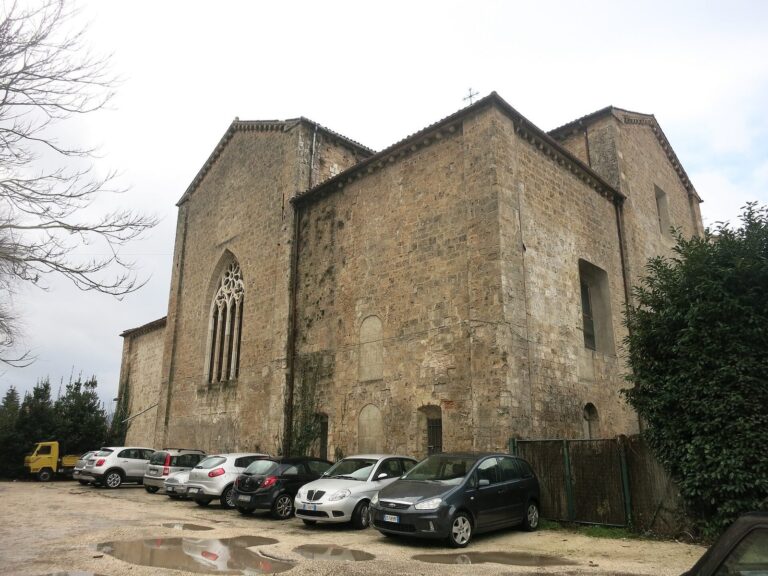
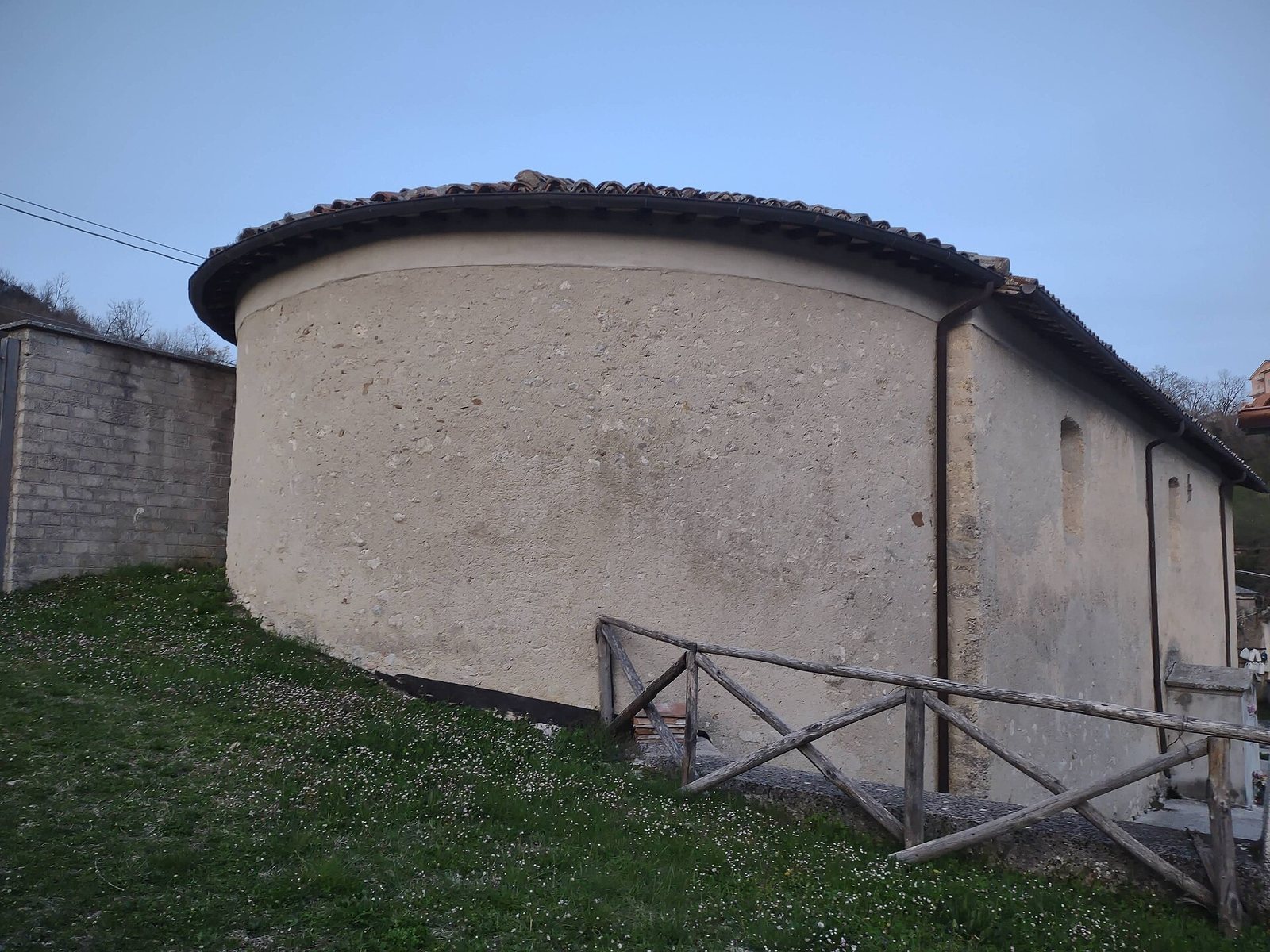
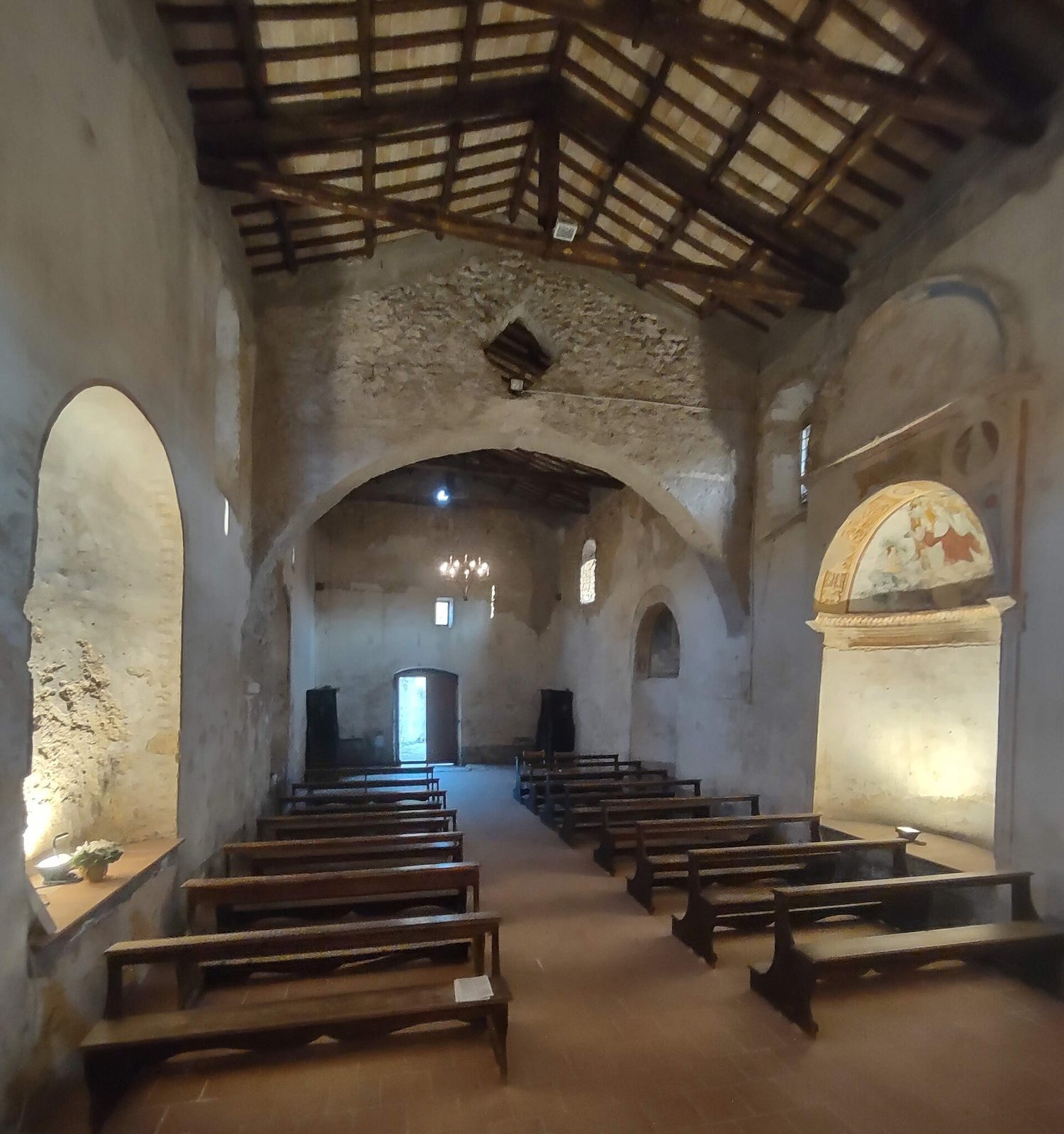
The church now stands within cemetery walls in the valley area called San Giovanni. Its rectangular plan has a single nave, four large recesses cut into the side walls, and an apse, the recessed end of a church, opposite the entrance. Some of the recesses are painted. A gabled roof, carried by timber trusses and beams, covers the building. The lime-plastered facade is also gabled, with a marble entrance portal set off-center and an inscribed lintel. Above it is a blocked rectangular window with an arched opening, while a cross-shaped opening pierces the pediment. Three stone corbels may once have supported a wooden porch. A band of solid bricks laid in a herringbone pattern crosses the facade.
Interior and paintings
Nave structure
A pointed arch supported by pilasters, shallow rectangular wall supports, divides the nave at its midpoint. Marble cornices top the supports. Six high-set arched windows light the nave. The roof structure includes timber trusses, beams, smaller joists, and tiles.
Apse cycle
The apse contains a 16th-century fresco cycle by an unnamed painter whose work has been associated broadly with the Umbria region. The arch depicts the Annunciation, when Gabriel tells Mary she will bear Jesus, with the archangel on the left and Mary on the right. Above it, the semi-dome, the curved half-dome over the apse, shows the Coronation of the Virgin among eight angels and Saints Peter, Paul, Sebastian, John the Evangelist, Roch, and Stephen. A purple band bearing a passage from Matthew 11:11 separates this scene from the paintings below.
Three episodes from John the Baptist’s life fill the curved apse wall beneath the semi-dome. The birth and naming scene shows Elizabeth resting after childbirth as Zechariah presents the baby and writes his name on the ground. The baptism of Jesus occupies the center. The beheading appears in connection with Herod’s feast and Salome’s dance.
Other interior paintings
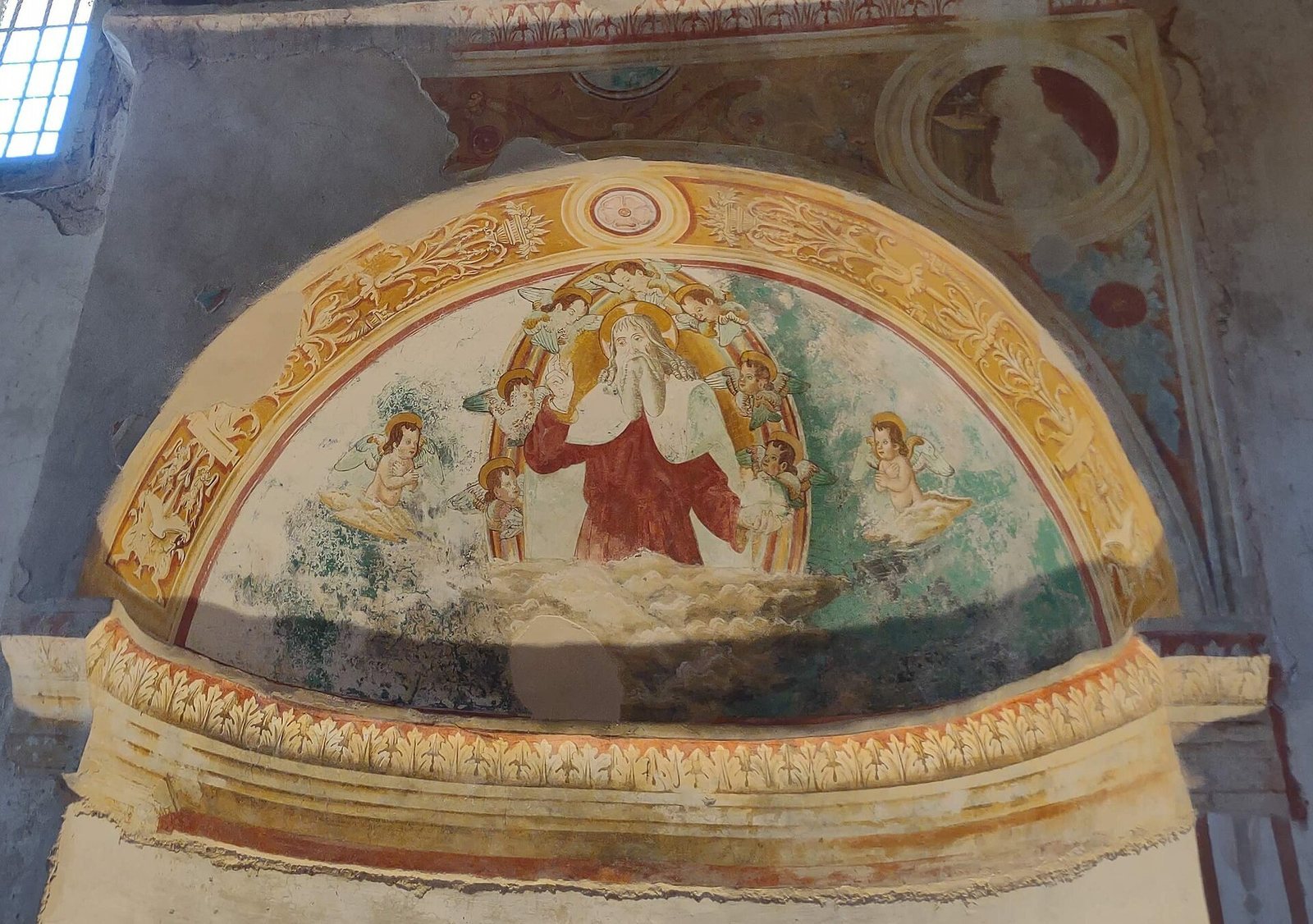
A painting of Saint Lucy appears at human height on the left support of the apse arch. The first large niche on the left side of the nave contains a frontal, half-length image of Christ blessing. He raises his right hand and holds an open book in his left. The next niche shows God the Father blessing between two angels, in a composition linked to the Umbrian school, a broad regional painting tradition. An earlier attribution distinguished the paintings in these two niches from the apse cycle.
Condition of the paintings
The paintings remain visible but are in poor condition, with particularly severe damage on the right side of the apse wall. Moisture has affected the painted surfaces. Along the mountain-facing exterior, the ground rises above the interior floor, reaching the level of the painted wall near the apse. A paved road built beside the church in the second half of the 20th century accelerated ground movement and directed rainwater toward the building. A waterproof layer added against the outer apse wall during a later cemetery expansion has only partly reduced the problem.