San Salvatore Maggiore: A Benedictine Abbey in Italy
Site at a Glance
- Popularity
- Medium
- Country
- Italy
- Primary era
- Medieval
- Eras represented
- Classical, Medieval, Early Modern
- Civilizations
- Lombard, Papal States, Roman
- Site type
- Religious
- Remains
- Monastery
On this page14 sections
History
Foundation and early influence
San Salvatore Maggiore is a former Benedictine abbey in Concerviano, Italy, founded in 735 by Lucerio da Moriana and other Frankish monks during the reign of Lombard king Liutprand. Lucerio had been associated with Tommaso da Moriana, who refounded Farfa in 721. As newcomers in the Lombard kingdom, the monks received privileges that helped establish their community.
Gifts from private donors, nobles, officials, the Lombard court at Spoleto, and the papal court in Rome rapidly enlarged the abbey’s possessions. Pope Stephen III confirmed its property. During the reign of Desiderius, two papal officials used the monastery as a supposed place of retirement while concealing their opposition to Constantine, a rival claimant to the papacy.
In 794, Abbot Usualdo exchanged letters with Alcuin of York, an Anglo-Saxon scholar and cleric who advised Charlemagne. Six years later, Charlemagne, king of the Franks and Lombards and later emperor, received the allegiance of the abbots of Farfa and San Salvatore Maggiore while travelling to Rome. He granted both communities imperial status and protection.
Gifts and privileges continued through the ninth century. Pope Paschal I presented the abbey with two altar cloths embroidered in gold, while its monks acquired relics of Hippolytus, an early Christian martyr venerated as a saint. The community maintained a Frankish form of worship rather than adopting the Roman rite, or pattern of worship. Pope Leo IV threatened excommunication unless the monks conformed.
From the eighth century, the abbey accumulated lands across the Sabina, Piceno, Marsica, Rome, and the districts surrounding the monastery. Its nullius dioecesis status exempted it from a local bishop’s religious authority and made it directly subject to the pope. Imperial protection, its position, and long-standing agreements with Farfa helped it extend its influence over the following centuries.
Destruction, rebuilding, and changing allegiance
Saracen raiders burned and destroyed the monastery in 891. After they were driven from the Sabina, the abbey was rebuilt, and its church was reconsecrated in 974. The renewed community received support from Emperor Otto II and his Byzantine-born empress, Theophanu. The monks dedicated a fresco in the rebuilt church to the imperial couple.
Relations with Farfa remained close from the late ninth into the early tenth century. Abbot Landuino of San Salvatore and Abbot Ugo I of Farfa maintained contact through letters and agreements. Their monasteries shared property and church interests, and monks travelled between them. San Salvatore’s abbots also disputed ecclesiastical rights with bishops elsewhere.
By at least the eleventh century, the abbey had a workshop where monks copied books for churches and monasteries; popes also used its work. In the twelfth century, the wider contest between the papacy and the empire affected its political ties. After the 1122 Concordat of Worms, an agreement within that struggle, San Salvatore shifted from imperial protection toward direct papal control.
Territorial power and disputes
In 1155, Emperor Frederick I sought the abbey’s loyalty by offering protection. In 1191, Pope Celestine III placed it under papal protection and confirmed its property, including land between the Salto and Turano rivers, from the Paganico stream to Rieti. Pope Honorius III renewed that protection in 1221. Under Frederick II, however, the monastery again faced competing claims. Pope Gregory IX ordered defenses for its castles in 1239, and imperial officials occupied its lands in 1241. It returned temporarily to imperial control, then came back under papal authority after Frederick’s death in 1250.
In 1268, after the Battle of Tagliacozzo, the abbey sheltered Henry of Castile, a Castilian prince, for two weeks. Abbot Egidio surrendered him to King Charles I of Anjou on 7 September. Disputes with the bishop of Rieti over church authority and revenues, alongside tensions between the monks and their vassals, later weakened the abbey. In 1282, several dependent castles submitted to the commune of Rieti. The monastery was required to take part in the commune’s parliament and help pay for its new walls.
The abbey’s lands formed a territorial lordship governed through statutes drawn up by the abbot and representatives of its castles. A list from 1385 names settlements including Mirandella, Vallecupola, Longone, and Capradosso. Meetings convened by later abbots also regulated religious life. In 1338, King Robert of Anjou assigned Capradosso to Cittaducale while ordering compensation for the abbey. In 1373, Pope Gregory XI commissioned a visitation and reform after the monastery had fallen into serious spiritual and moral decline.
Commendation and suppression
In 1399, San Salvatore’s administration was placed in commendam, an arrangement that entrusted an abbey’s office and income to a holder who was not necessarily the resident head of its monks. Initially temporary, the system gave commendatory abbots and their families increasing control over the property and revenues. After the last abbot elected by the monks, Battista Orsini, died around 1447, Pope Nicholas V established the arrangement permanently, ending the monks’ right to choose their leader. In 1494, Pope Alexander VI formally joined San Salvatore’s commendam with Farfa’s.
Warfare damaged the surrounding territory. In 1460, troops serving the Italian commander Jacopo Piccinino burned and plundered the area. In 1495, two hundred soldiers of Charles VIII of France stopped at the abbey after trying to sack Grotti. During this period, isolated settlements near the abbey’s castles were abandoned. Commendatory abbots undertook work at the monastery in the early sixteenth century. In 1554, Cardinal Ranuccio Farnese arranged a visit by Jesuit Nicolás Bobadilla to present the Catholic reform movement known as the Counter-Reformation to the monks and clergy.
Pope Paul V incorporated the abbey and its dependent priories into the Cassinese Congregation, a reforming group within the Benedictine tradition, in 1614. Pope Gregory XV revoked the measure in 1623, beginning a dispute that lasted more than thirty years. On 12 September 1629, Pope Urban VIII suppressed the Benedictine abbey at the request of Cardinal Francesco Barberini. The 34 monks were expelled, made secular clergy, or priests outside a religious order, and assigned annual pensions. The suppression ended San Salvatore’s independent monastic life after nearly nine centuries.
Later use and modern restoration
Some former abbey revenues supported a seminary established at Toffia. From 1628 to 1635, Piarist fathers, members of a Catholic order particularly devoted to education, operated a mission at the monastery. It later served as an administrative center for abbey lands under the Apostolic Chamber, alongside the castle of Longone. In 1746, the seminary moved from Toffia into the monastery and remained there until 1841.
In 1841, the former abbey lands were divided between the newly established Diocese of Poggio Mirteto and the Diocese of Rieti. The bishop of Poggio Mirteto received the title of Abbot of San Salvatore Maggiore. In 1925, parishes in the former abbey territory were assigned to Rieti, whose bishop became perpetual abbot. Passionist fathers were responsible for the monastery from 1839 to 1854, but left because of its isolation, difficult roads and winters, and the cost of maintaining its buildings. From 1855 it hosted autumn stays for seminarians from Poggio Mirteto; in 1880, the Diocese of Rieti also began using it for summer stays.
The Marsica earthquake of 13 January 1915 severely damaged the abbey. A restoration campaign carried out between 1926 and 1932 caused further collapses, particularly in the eastern range. Salesians used the complex as a summer residence from 1950 to 1960 and undertook maintenance. The monastery was abandoned in 1960, although weddings continued in its church. After the two dioceses jointly held the property, they sold the ruins and 7,800 square metres of land in 1979. The purchasing family sold the property to the Municipality of Concerviano in 1986.
Restoration work carried out from 1989 to 2014 included the church and the rest of the complex in successive phases. Archaeological investigation during the work traced layers of construction and occupation, adding to knowledge of the abbey’s origins.
Remains
Setting and layout
The abbey stands on a level, isolated part of the Letenano plateau, 821 metres above sea level, on the mountainous divide between the Salto and Turano valleys. The nearby settlement of Vaccareccia lies to the northwest and Pratoianni farther to the northeast. A stream valley separates Vaccareccia from the monastery; the stream begins at a spring near the abbey known as the Fonte del Cardinale.
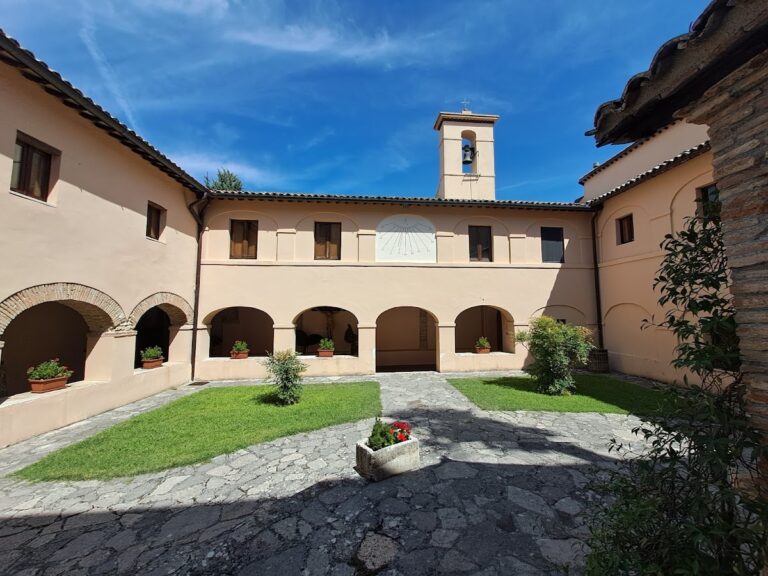
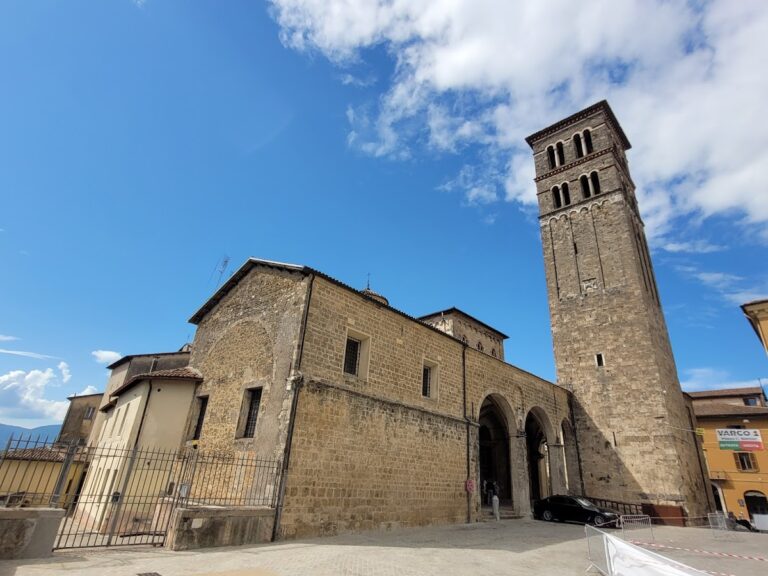
The complex consists of a church and three other building ranges enclosing a square courtyard measuring 50 by 50 metres. The four ranges differ in age and architectural character. The church occupies the southern side and runs east to west. The eastern range adjoins it, while the northern range faces Pratoianni and the western range faces Vaccareccia.
Church
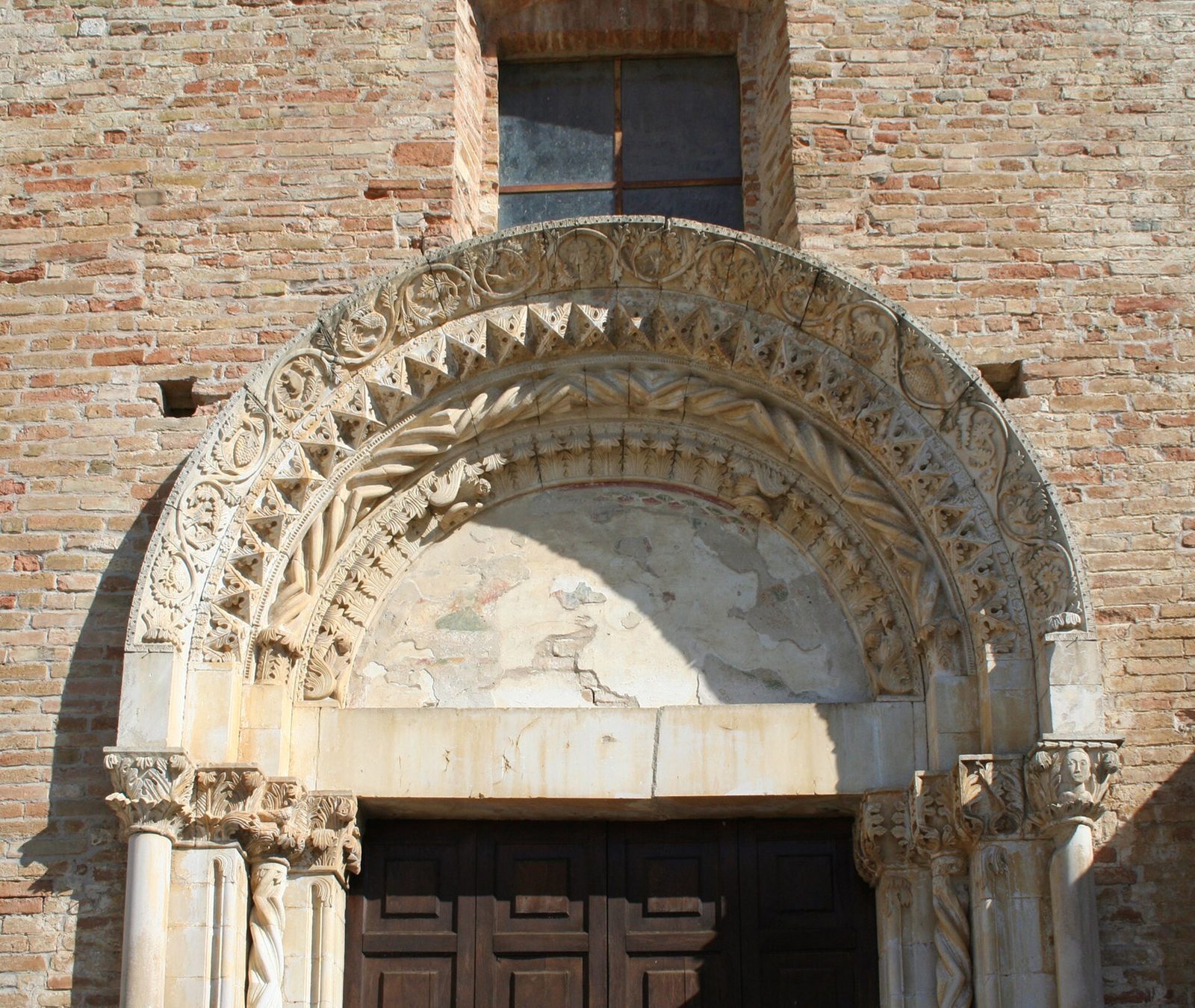
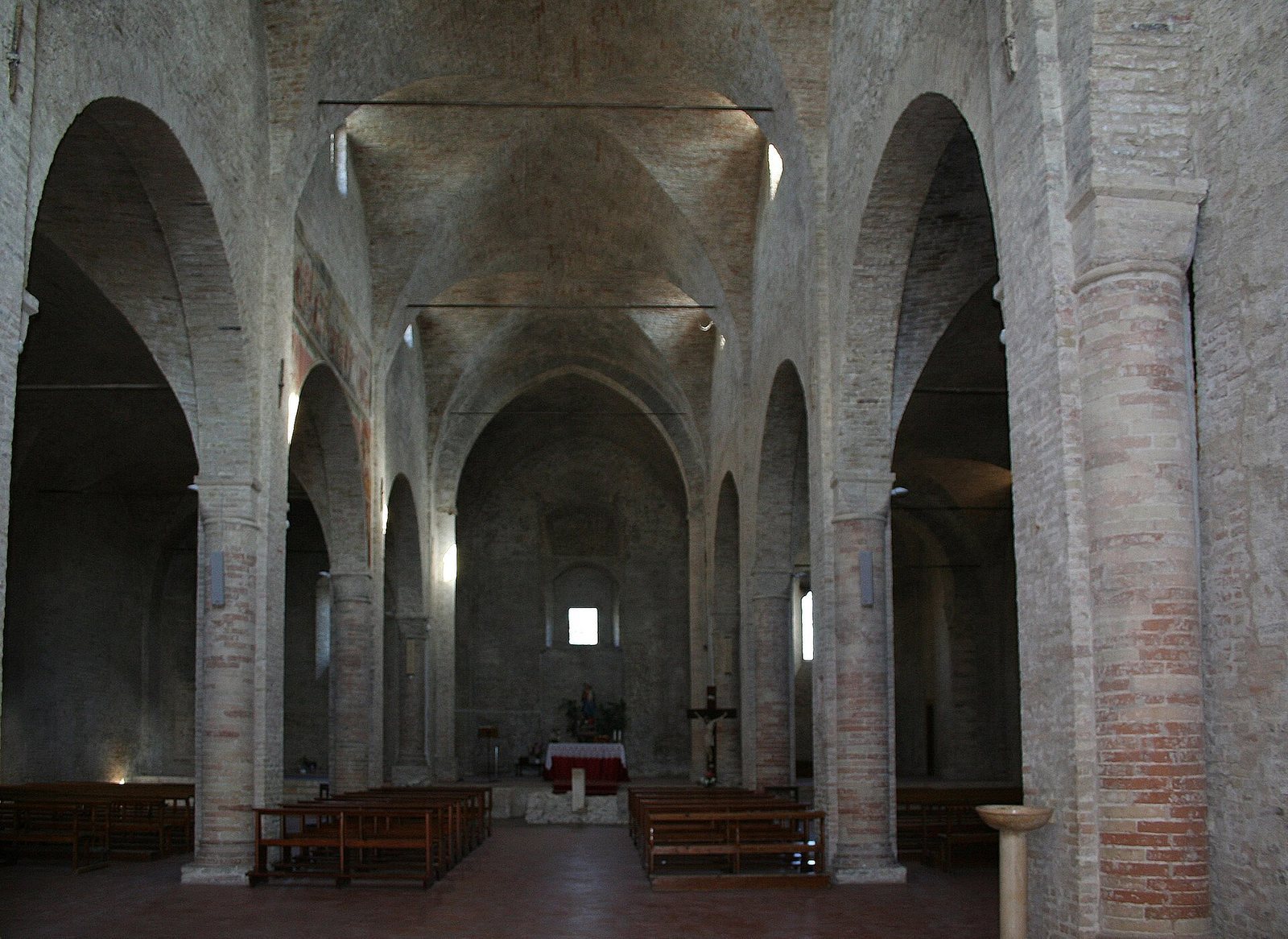
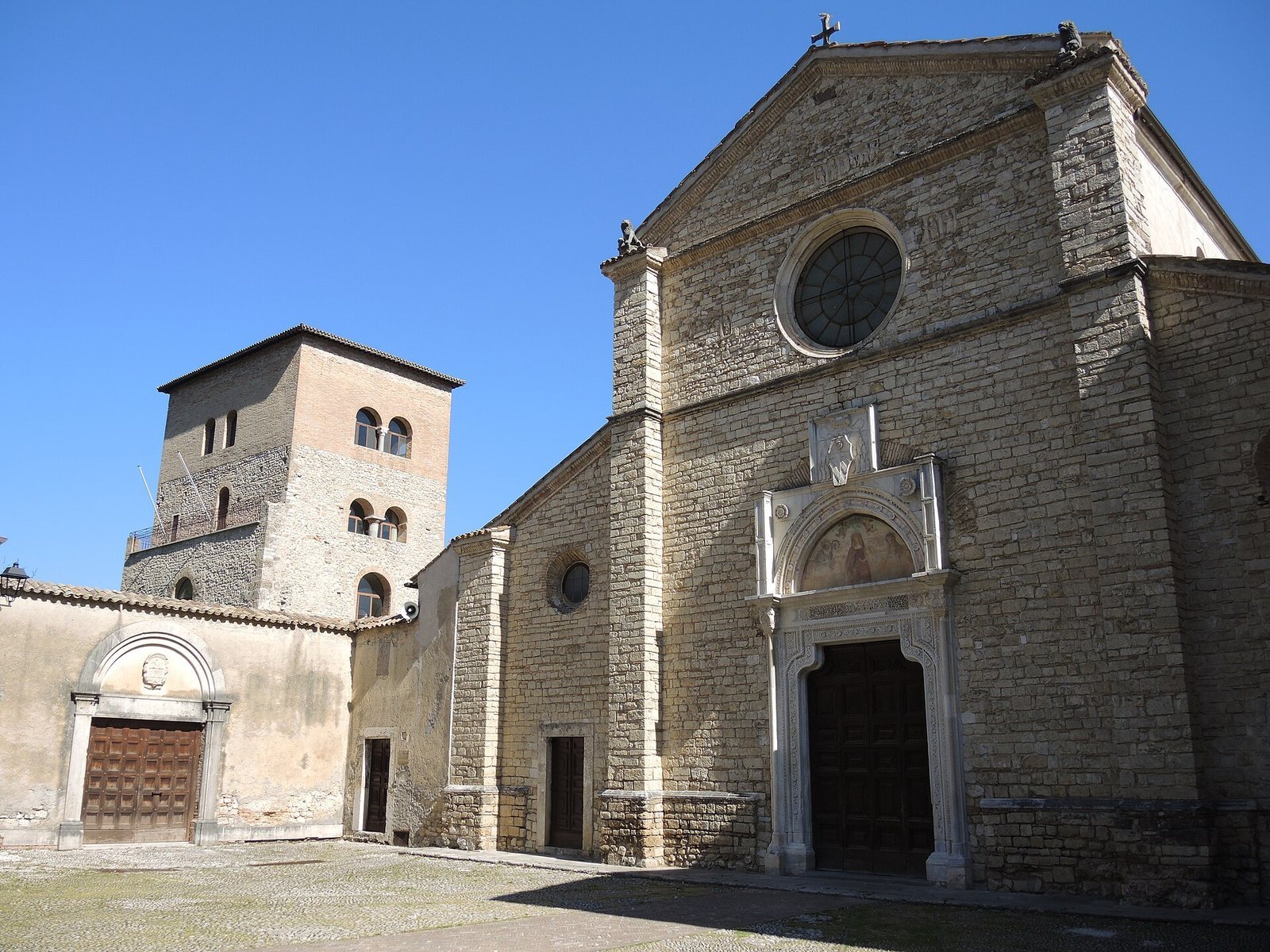
The church has a single nave, side chapels, and a raised area around the altar. That area, probably part of the medieval church of the tenth or eleventh century, stands substantially above the nave floor. A massive square bell tower rises against the church’s right side near the transept. The present façade is Baroque and has a simple entrance portal; traces of medieval wall paintings remain inside.
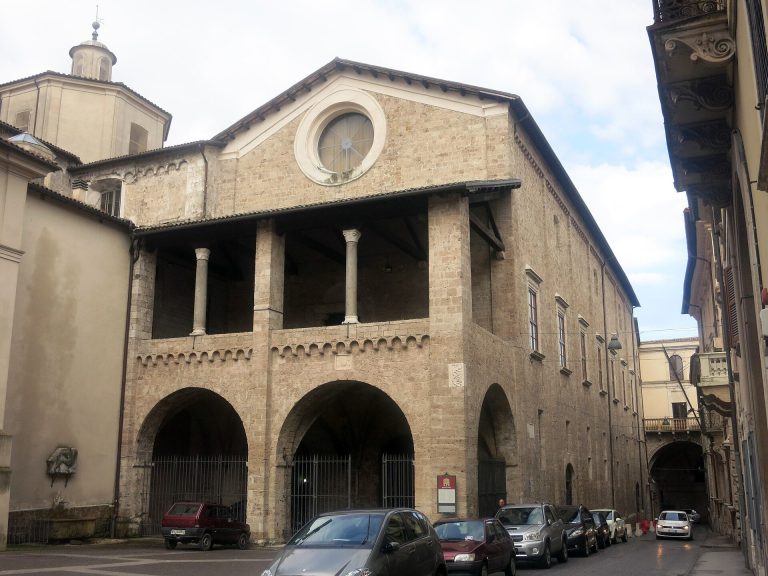
A seventeenth-century engraving shows an open portico in front of the church, formed by five arches: a larger one in the middle and four smaller arches in pairs at the ends. The 1506 portal has panels depicting the abbey’s castles, including representations described as showing inhabited and ruined settlements.
Eastern wing
Among the oldest parts of the complex, the eastern wing originally contained the refectory, the chapter room where the monks met, kitchens, a dormitory, and accommodation for guests. A corridor beside the kitchens led to the refectory along the eastern wall. There, a fountain carried water from the nearby spring. Its basin was made from a section of a sarcophagus inscribed with the name Sesto Tadio.
Northern wing
The northern range was built to provide defense, shelter, and storage. During the Renaissance it was adapted as a residence for the commendatory abbot. The work thickened its walls and added a new façade facing the courtyard.
Western wing
The western range was built later than the other principal sections and served administrative and ceremonial purposes, including use as a court and tribunal. An eighteenth-century addition, made after the abbey’s suppression, provided a chapel and dormitory for seminarians.
Roman remains and water supply
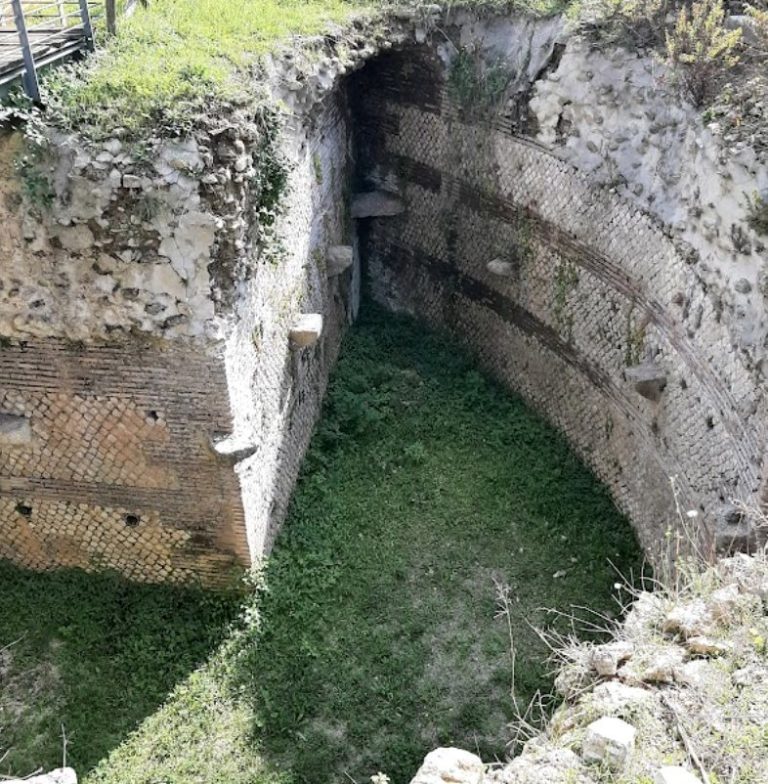
Roman structural and decorative elements found during restoration indicate that the church and eastern wing were probably built over a villa dating to the first or second century CE. The villa may have belonged to the senator Tadio Nepote. An inscription commissioned by his wife, Mulvia Placida, described his career. The villa probably stood near a Roman road identified as the Via Caecilia in a proposal made in the late nineteenth century.
The Fonte del Cardinale lies just uphill from the abbey. Its water feeds a stream that passes through the gorge below Vaccareccia, where the village mill stood. Farther downstream the watercourse is called the Rio di Fonte; it joins the Salto below the artificial Lago del Salto, near Bivio Concerviano. The monastery also operated a mill near the spring.
Condition and conservation
Collapses and looting affected the complex, and many architectural ornaments, inscriptions, paintings, and marble slabs were removed. A few photographs preserve evidence of some objects formerly kept inside. Conservation work has consolidated the buildings, repaired masonry with traditional and modern materials, and improved their resistance to earthquakes. The extensive repairs have reintegrated the complex while preserving evidence of its successive building phases.