St Nicholas Church in Jüterbog: A Medieval Gothic Church
Site at a Glance
- Popularity
- Medium
- Country
- Germany
- Primary era
- Medieval
- Eras represented
- Medieval, Early Modern, Modern
- Civilizations
- Electorate of Saxony, German, Holy Roman Empire, Kingdom of Prussia
- Site type
- Religious
- Remains
- Church
On this page14 sections
History
Medieval origins and construction
St Nicholas Church is a Gothic church in Jüterbog, Germany, dedicated to St Nicholas of Myra, an early Christian bishop venerated as a saint. It was first mentioned in 1307 and was probably consecrated in 1488, a date indicated by an inscription in the council gallery. A church dedicated to St Catherine, consecrated in 1221, may have preceded it.
The nave gained an additional bay in the late fourteenth century, followed by extensions on its north and south sides in the early fifteenth century. The west towers were built separately from the nave. After they settled, builders closed the gap between the towers and the church, completing the tower work around 1500. The north tower’s construction appears to have been faulty, accounting for the different form of its top. Its curved Renaissance hood was finished in 1617.
Reformation-era events
In the early sixteenth century, the church became connected with the indulgence campaign of Johann Tetzel, a Dominican friar. An indulgence was a grant within Catholic practice relating to the remission of temporal punishment for sin. Albert of Brandenburg, a prominent churchman and prince, commissioned Tetzel to collect money toward the construction of St Peter’s Basilica in Rome. A saying attributed to Tetzel claimed that when coins sounded as they fell into the coffer, a soul moved toward heaven.
Martin Luther later recalled in his table talks that Tetzel preached in Jüterbog because he was not allowed to enter nearby Wittenberg. As more members of Luther’s congregation travelled to Jüterbog to purchase indulgence letters, Luther published his 95 Theses in 1517, an event that began the Protestant Reformation. A local legend retold by Theodor Fontane in his travel writings, published between 1862 and 1889, tells how the knight Hans von Hake stole Tetzel’s coffer after buying an indulgence in advance for the theft.
Thomas Müntzer preached at the church as a guest at Easter in 1519. His radical views challenged both the Catholic Church and Luther. From 1524 he took part in the German Peasants’ War; after his capture, he was executed. A plaque inside the church commemorates his sermon.
Later use and conservation
Renovations took place in 1821–24, 1877 and 1934–36. The west tower keeper’s apartment was used by the Young Congregation after the Second World War, but has stood empty since a church renovation in the 1960s. Roof work followed in 1974, and the interior was renewed between 1986 and 1994. The original paintwork on the wooden gallery panels was restored in the 1970s, and wall paintings were restored in the 2000s. A soldier memorial south of the church, on the former St Nicholas cemetery, was dedicated in 1923.
Remains
Plan and exterior
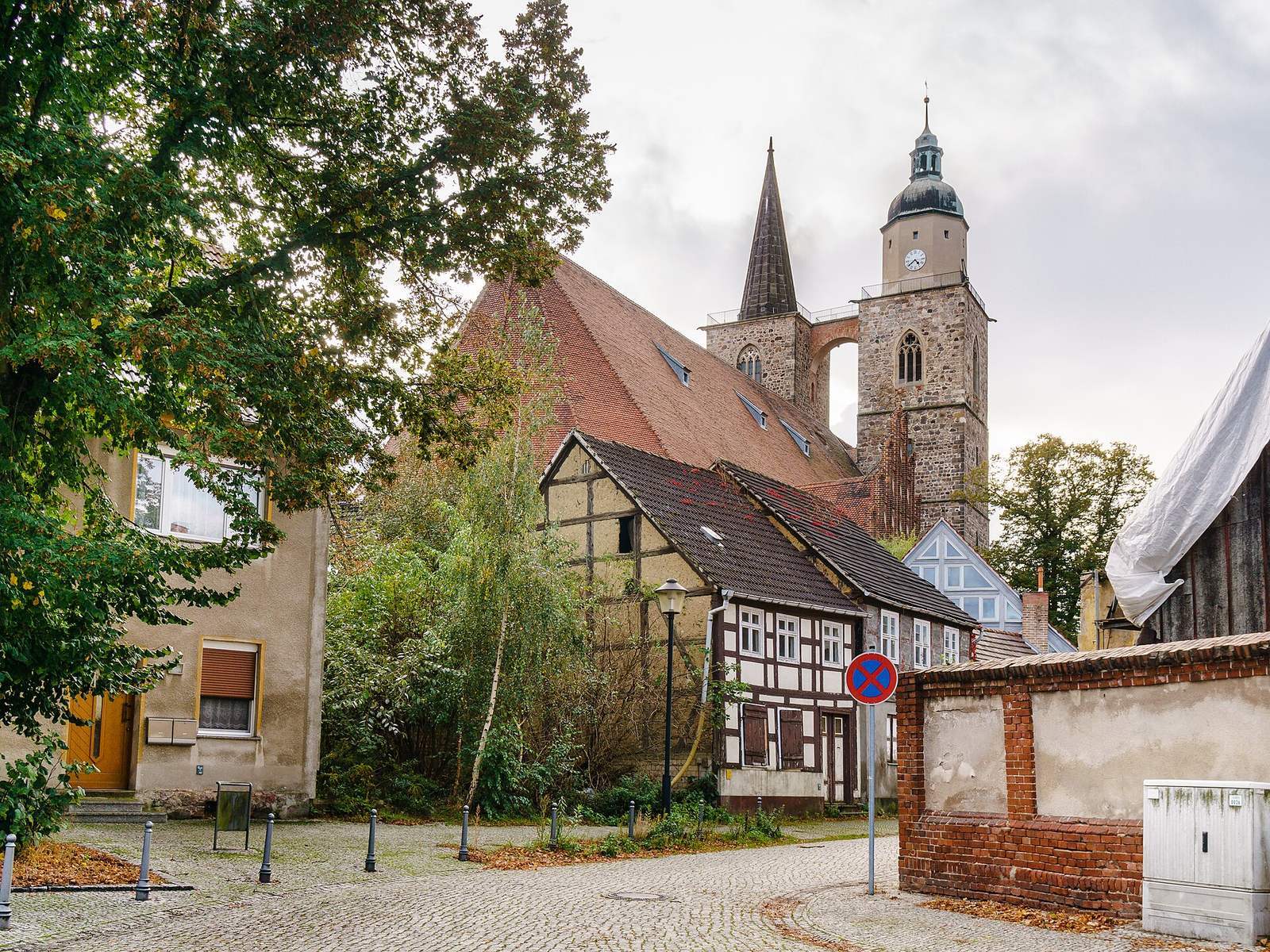
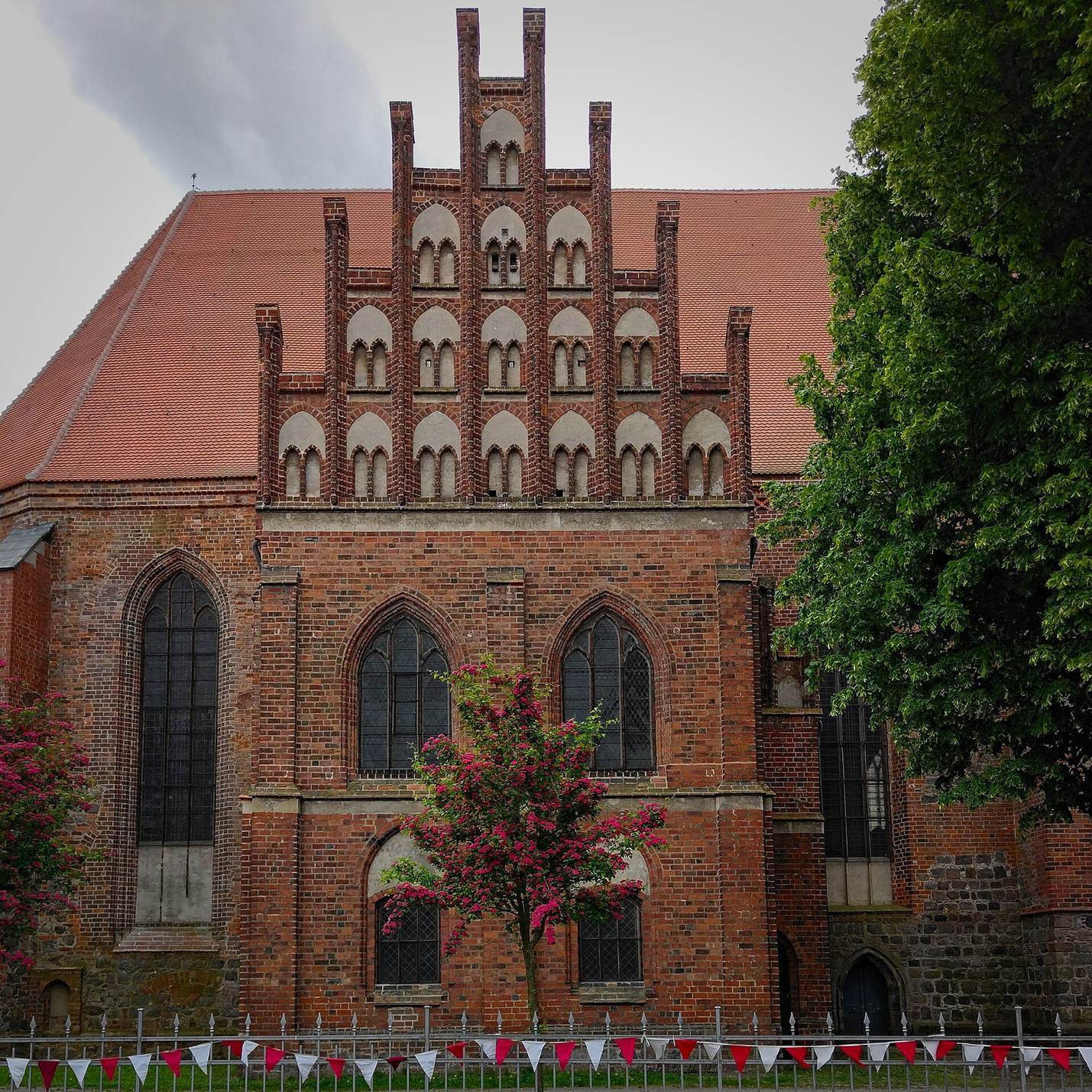
Measuring 71 metres long and 23 metres wide, the church is the largest sacred building in the Jüterbog region and the town’s largest medieval church. It stands between Nikolaikirchstraße and Große Straße and overlooks the old town. Its three-aisled hall plan has a nave and side aisles of similar height, a five-bay nave, and a choir. Red brick forms most of the nave, with sections of fieldstone; exterior buttresses support its tall-windowed walls. The two-storey extensions on the north and south include a northern structure resembling the court loggia at Jüterbog’s town hall. The church’s overall construction has also been compared with St Mary’s in nearby Wittenberg.
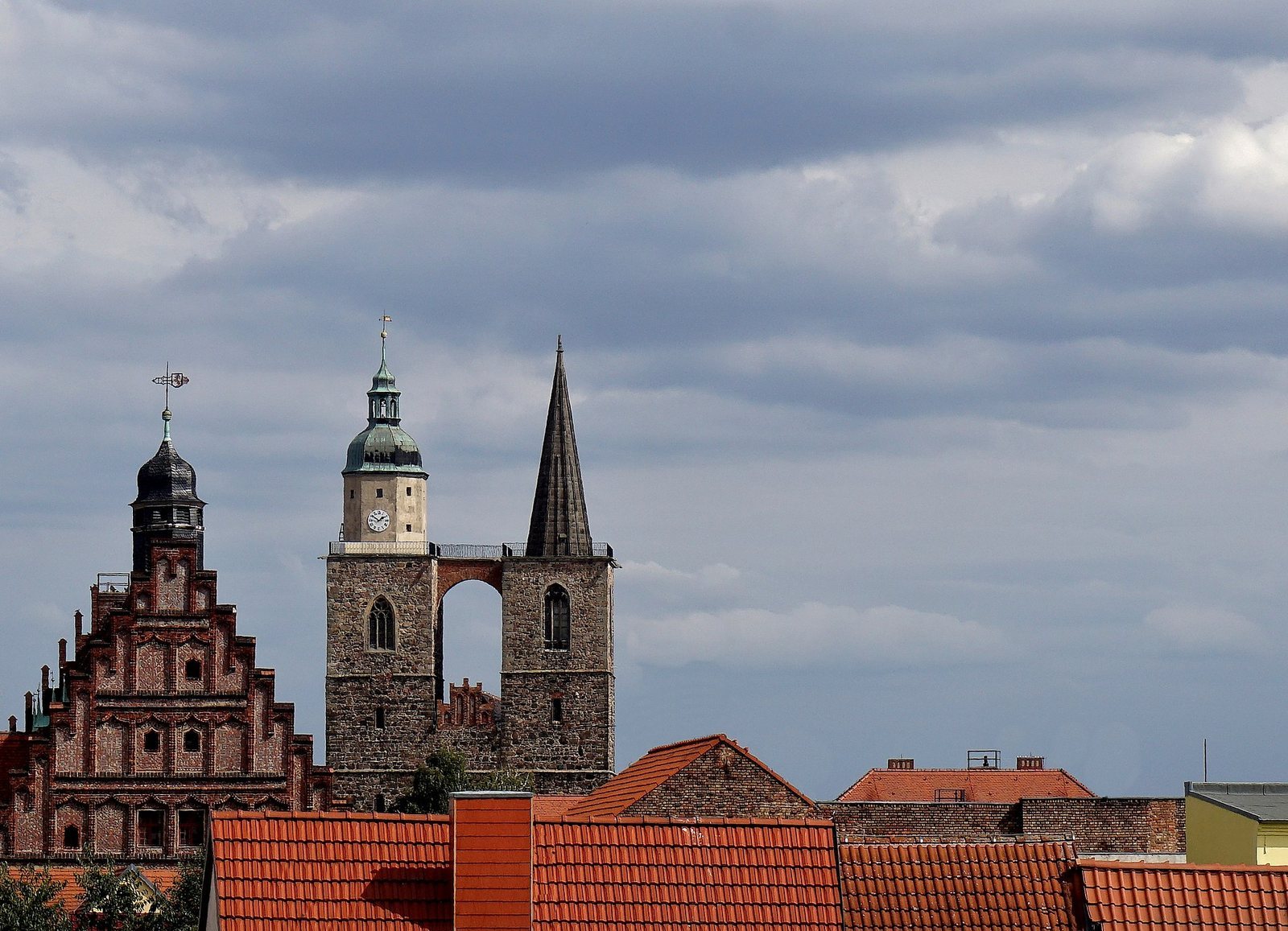
Two five-storey fieldstone towers, detailed with sandstone, rise at the west end and reach about 60 metres. Their upper storeys are taller and have larger windows, while an arched bridge joins the towers. The north tower ends in an octagonal lantern and hood; the south tower has a pointed stone top and a viewing platform at the bridge’s level, reached by 217 steps. Between the towers, the sandstone Gothic main portal bears a nearly life-size figure of St Nicholas, with a small rose window above it.
Interior and furnishings
Painted decoration and memorials
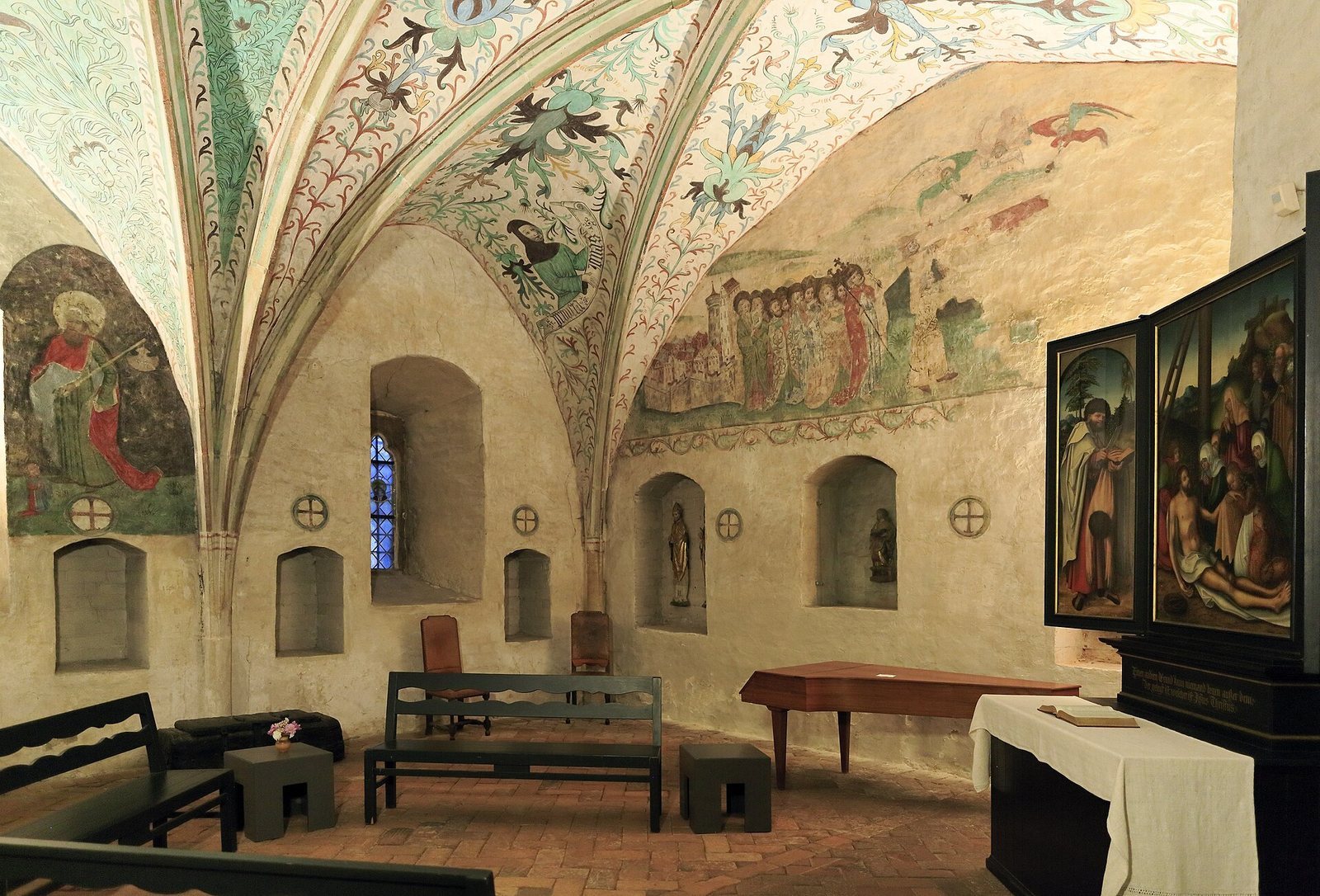
The interior has brightly coloured decoration and wall paintings. Vine patterns ornament the arches, and fifteenth-century images of saints, including St Maurice, appear on the walls. Stone memorials commemorate clergy and dukes, among them Georg Carl Losius, who died in 1740, August Olearius, who died in 1746, and Christoph Marschal, who died in 1712.
High altar and retables
The raised high altar has floral carving, coloured putti (childlike figures in art), and a central painting of Christ in the Temple in Jerusalem, framed by paired columns. Its Baroque upper section, dated 1700, includes a triangle bearing the Tetragrammaton, the four-letter name for God, presented as a symbol of the Christian Trinity. The predella, or lower part of an altarpiece, depicts the Last Supper. A medieval high-altar retable, an ornamental structure behind an altar, dates to the 1430s and has been installed in a new arrangement.
South chapel and ambulatory
The south chapel’s retable has a central panel depicting the Passion of Christ, dated to about 1515–20 and attributed to the workshop of Lucas Cranach the Elder. Its vaulted ceiling is supported by intersecting ribs and bears symbols of the Evangelists. In the ambulatory, the passage around the choir, a north window shows a Madonna with a radiant halo, dating to about 1490.
Galleries, pulpit and sacrament house
Wooden galleries run along the sides of the church. Dating from the seventeenth and eighteenth centuries, they carry 57 picture panels dated 1585; the council gallery is on the north side. The decorated wooden pulpit, made in 1608, has niches containing figures of the Evangelists, Peter, Paul and the Good Shepherd. Figures of the risen Christ, putti and angels ornament its canopy, which helps project the speaker’s voice. A late Gothic sacrament house, a structure for storing the Eucharist, was built in 1507–08.
Organs
The main organ was built by Wilhelm Rühlmann in 1909. It has 49 stops, which control sets of pipes, and a pneumatic action that uses air pressure to connect the keys to the pipes. A smaller positive organ, a compact pipe organ, was made by Christoph Werner in 1657. With five voices, it is the oldest surviving organ in Brandenburg.
Indulgence coffer
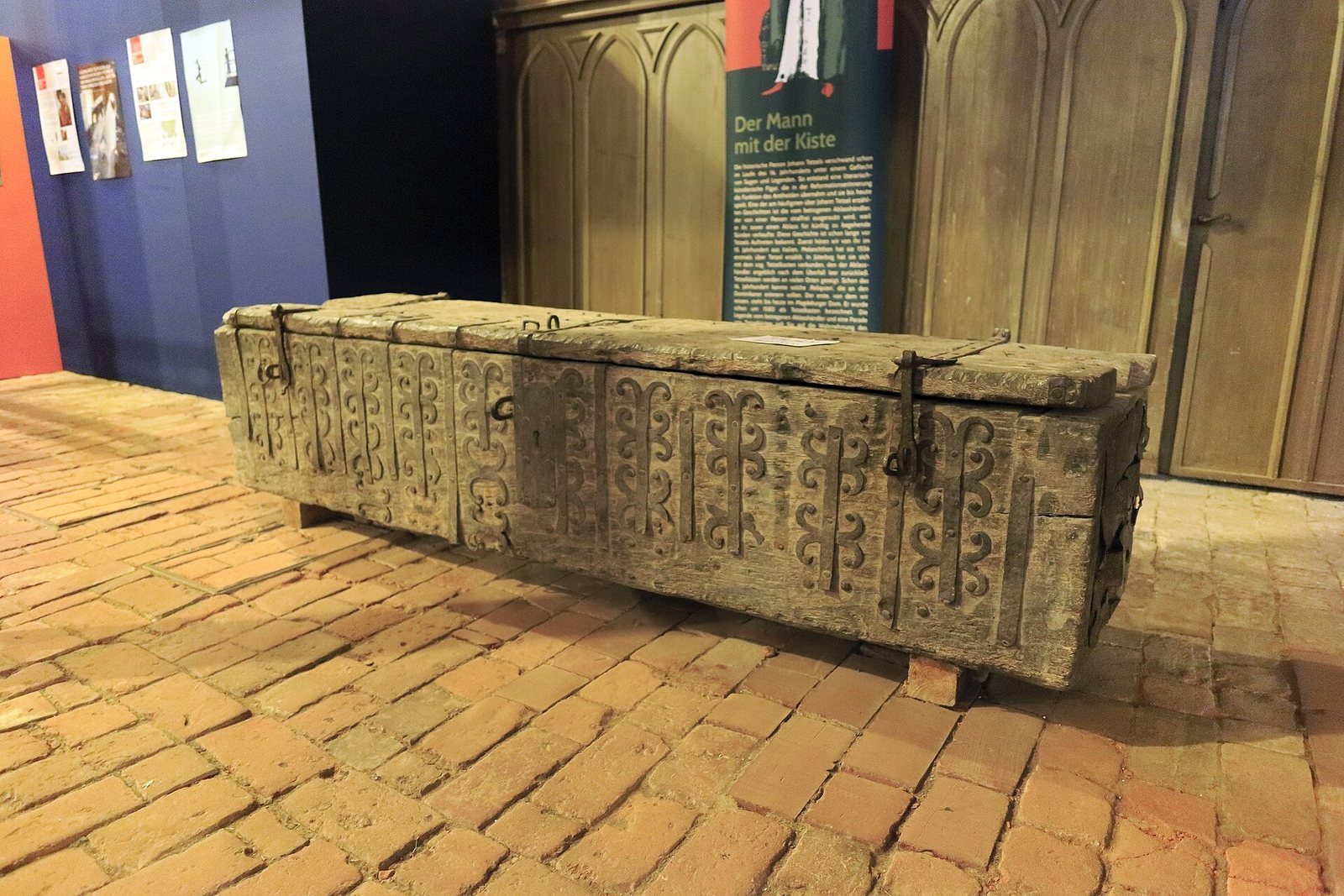
A small chapel contains a rare surviving indulgence coffer associated with Johann Tetzel.
Soldier memorial
South of the church, on the site of the former St Nicholas cemetery, the stone memorial takes the form of a sarcophagus encircled by columns and brick arches.