Nidum: A Roman Auxiliary Fort in Wales
Site at a Glance
- Popularity
- Medium
- Country
- United Kingdom
- Primary era
- Classical
- Eras represented
- Classical
- Civilizations
- Roman
- Site type
- Military
- Remains
- Fort
On this page10 sections
History
Nidum was a Roman auxiliary fort at Cwrt Herbert near Neath in Wales, United Kingdom. Established around AD 74 on the territory of the Silures, a people of Iron Age and Roman-era Britain, it belonged to the early Roman occupation of Wales and probably dates to the governorship of Julius Frontinus, a Roman military commander and provincial governor. Auxiliary soldiers served in units separate from the legions. Nidum formed part of a network of forts and roads across southern Wales.
Roman occupation and communications
The fort’s area was reduced soon after it was first built. It was abandoned around AD 125, then occupied again around AD 140 after reconstruction in stone. This second period of use lasted until about AD 170. Following roughly a century out of military use, the fort served the military again from AD 275 to 320.
The size of the early garrison is uncertain. It may have included up to 1,000 men and horses, while another estimate suggests perhaps 500 auxiliary soldiers.
The Antonine Itinerary, a Roman register of roads and distances, places Nidum 14 miles east of Leucarum (Loughor) and 27 miles west of Bomio, an unidentified fort possibly at Cowbridge. It lists Bomio as 28 miles from Isca Augusta at Caerleon, and gives a distance of 23 miles westward from Leucarum to Moridunum (Carmarthen). Proposed local routes include the predicted alignments RR60c eastward and RR60d westward, as well as an unidentified route northeast to the established road RR622. That road led to Y Gaer (Brecon) via Coelbren Fort at Banwen, about 18 km from Nidum, and was among the Welsh routes traditionally associated with the name Sarn Helen.
The southwest gateway was found during work on the A474 in 1949, and the southeast gateway was discovered the following year. Excavations followed in 1958, 1962, 1984–85 and 2011. Nidum is protected as a Scheduled Ancient Monument and is cared for by Cadw, the Welsh Government’s historic environment service.
Remains
Nidum’s almost square plan covered 3.3 hectares before the fort was reduced to 2.3 hectares. It stood on a low plateau on the west bank of the River Neath. Much of its area now lies beneath the grounds and playing fields of Dwr-y-Felin Comprehensive School, near the Roman Way housing estate.
Layout and earthworks
Plan and setting
The fort’s reduced footprint and defensive remains reflect its successive phases of construction. The site’s position on the plateau above the river forms part of its physical setting.
Timber defenses
During the timber phase, four parallel ditches and an earth bank with a tower defended the fort. Together, these defenses extended more than 12 m.
Gateways
Earlier gateway
Post-holes uncovered in 2011 show that towers at an earlier gateway projected beyond the wall line. The gate lay northwest of the reduced fort’s ramparts. Its projecting towers gave defenders positions from which to attack people entering through the passage. This arrangement appears to have been unique in first-century Britain, although similar structures had existed 200–300 years earlier.
Southern gateways
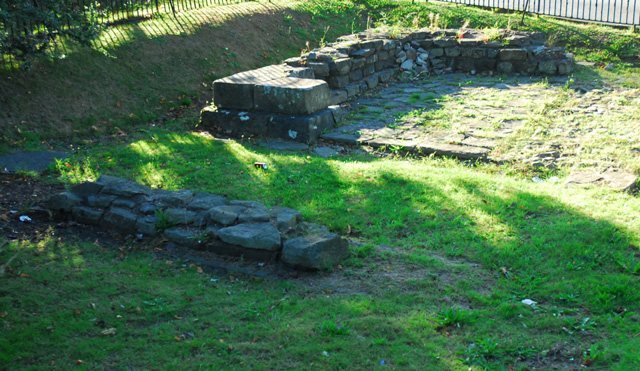
After the southern gateways were excavated in 1949 and 1950, their stonework was set out in two small enclosures bounded by iron railings. One is beside the A474 and the other at a housing-estate corner beside Roman Way. The remains include the bases of two gate towers, a double passage between them and part of the ditch around the ramparts. A timber bridge would have crossed the ditch.
Excavated finds
Finds from the fort include roof and floor tiles, part of a first-century amphora, a large ceramic vessel used to transport and store goods, and kitchen and tableware dating from the earliest construction phase to the early second century. One or two pottery fragments date to the middle of the second century. Six coins range from the reign of Augustus, Rome’s first emperor, to that of Trajan, who ruled from AD 98 to 117. Some objects were once displayed at Neath Museum; after the museum closed, they were placed in storage.