Catacombs of Saint Gaudiosus: An Early Christian Cemetery in Naples
Site at a Glance
- Popularity
- High
- Country
- Italy
- Primary era
- Early Modern
- Eras represented
- Classical, Medieval, Early Modern
- Civilizations
- Habsburg, Habsburg Spain, Kingdom of Naples, Roman, Spanish
- Site type
- Religious
- Remains
- Tomb
On this page17 sections
History
The Catacombs of Saint Gaudiosus are an underground Christian cemetery in Naples, Italy, probably developed in the fourth or fifth century over an existing Greco-Roman burial ground. They lay in the Sanità district, outside the ancient and medieval city, where Roman law allowed burials. The catacombs became associated with Saint Gaudiosus, a bishop, or senior Christian cleric overseeing a diocese, whose tomb drew veneration.
Early cemetery and the cult of Saint Gaudiosus
Tradition tells that Gaudiosus came to Naples from North Africa after a shipwreck. He was buried in the catacombs between 451 and 453. Saint Nostrian, an earlier bishop of Naples, was already buried there, but Gaudiosus’s grave became a focus of devotion. The burial ground formed part of a wider landscape of natural caves and older tombs beyond the inhabited city.
Repeated mudslides from Capodimonte hill buried the Sanità area, which remained uninhabited through the Middle Ages. Urban settlement began around the sixteenth century, and the catacombs returned to use for burials.
Renewed burial and Dominican alterations
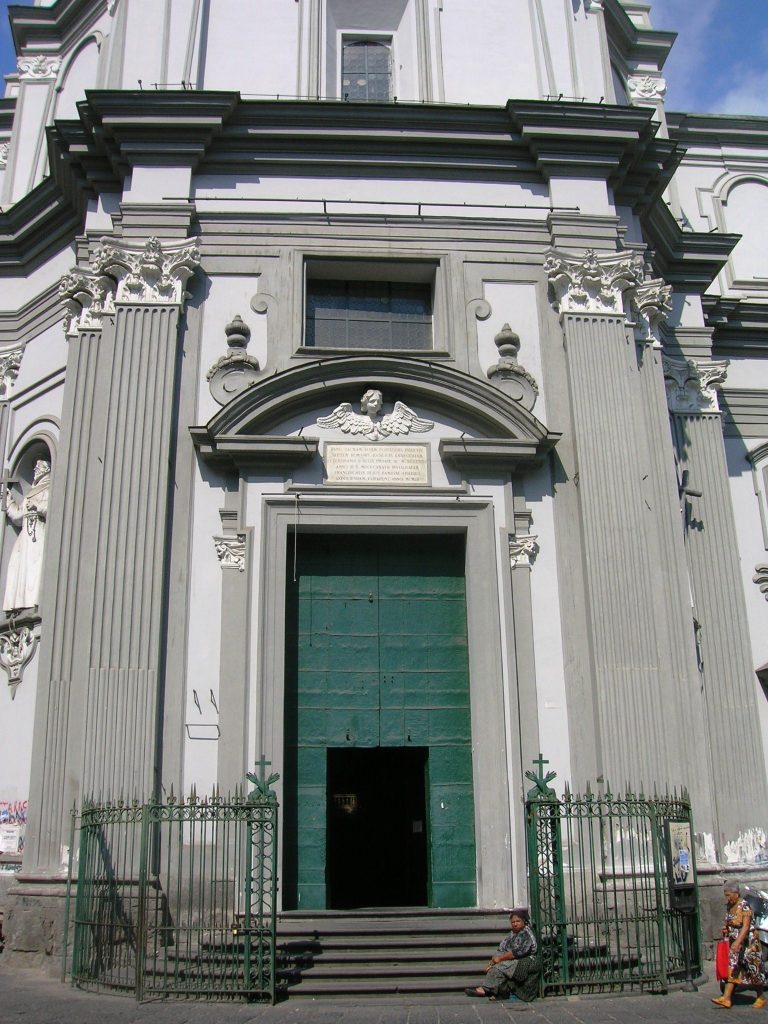
In the seventeenth century, the Dominicans, a Catholic religious order, built the Basilica of Santa Maria della Sanità above an older church or chapel associated with Saint Gaudiosus. The order owned the basilica and enlarged the underground cemetery, changing its earlier arrangement and destroying parts of it. After the plague of 1656, large limestone caves in the valley also served as an extensive open-air cemetery.
Burial customs in the catacombs included leaving bodies in stone niches to dry. Some wealthy people received wall burials: the body was set upright, with the head exposed, while the remaining bones were later placed in an ossuary, a repository for human bones. The practice was prohibited in 1637 amid concern about the condition of the catacombs. Those named as recipients included Sveva Gesualda, princess of Montesarchio, in 1611; an unnamed woman in 1618; Scipione Brancaccio, baron of Alfano and a Spanish army officer, about 1622; and Marco Antonio d’Aponte, marquis of Sant’Angelo and a Royal Council official, in 1624. Others included the painter Giovanni Balducci, about 1630; magistrate Diego Longobardo, in 1632; Alessandro d’Afflitto, in 1635; and the noblewoman Maria de Ponte.
Later changes and changing practices
During the rule of Joachim Murat, king of Naples from 1808 to 1815, many bones were taken from the drying rooms. Bones were moved again at later dates to make room for people who died in epidemics, including victims of the cholera outbreak of 1836.
The ambulatory became a place where Neapolitans prayed for souls in purgatory, understood in Catholic teaching as undergoing purification after death before entering heaven. As popular customs connected with the cult of the dead came to be viewed as incompatible with Christian teaching, the archbishop of Naples ordered skulls removed from the ambulatory in the 1960s.
Remains
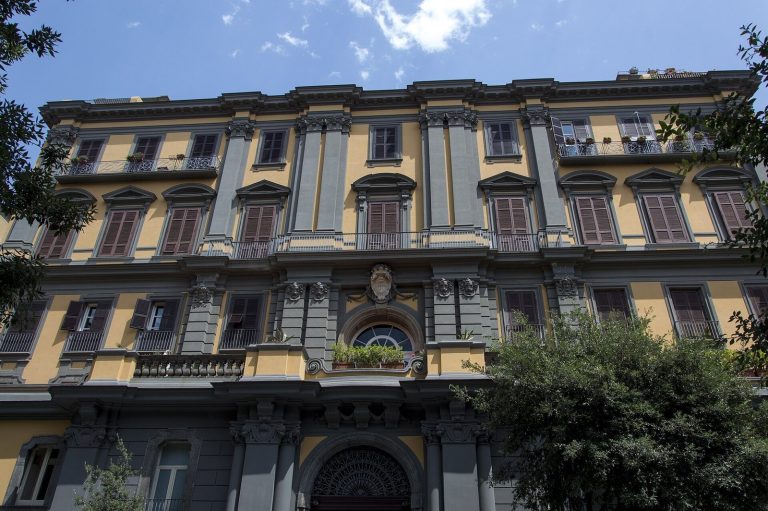
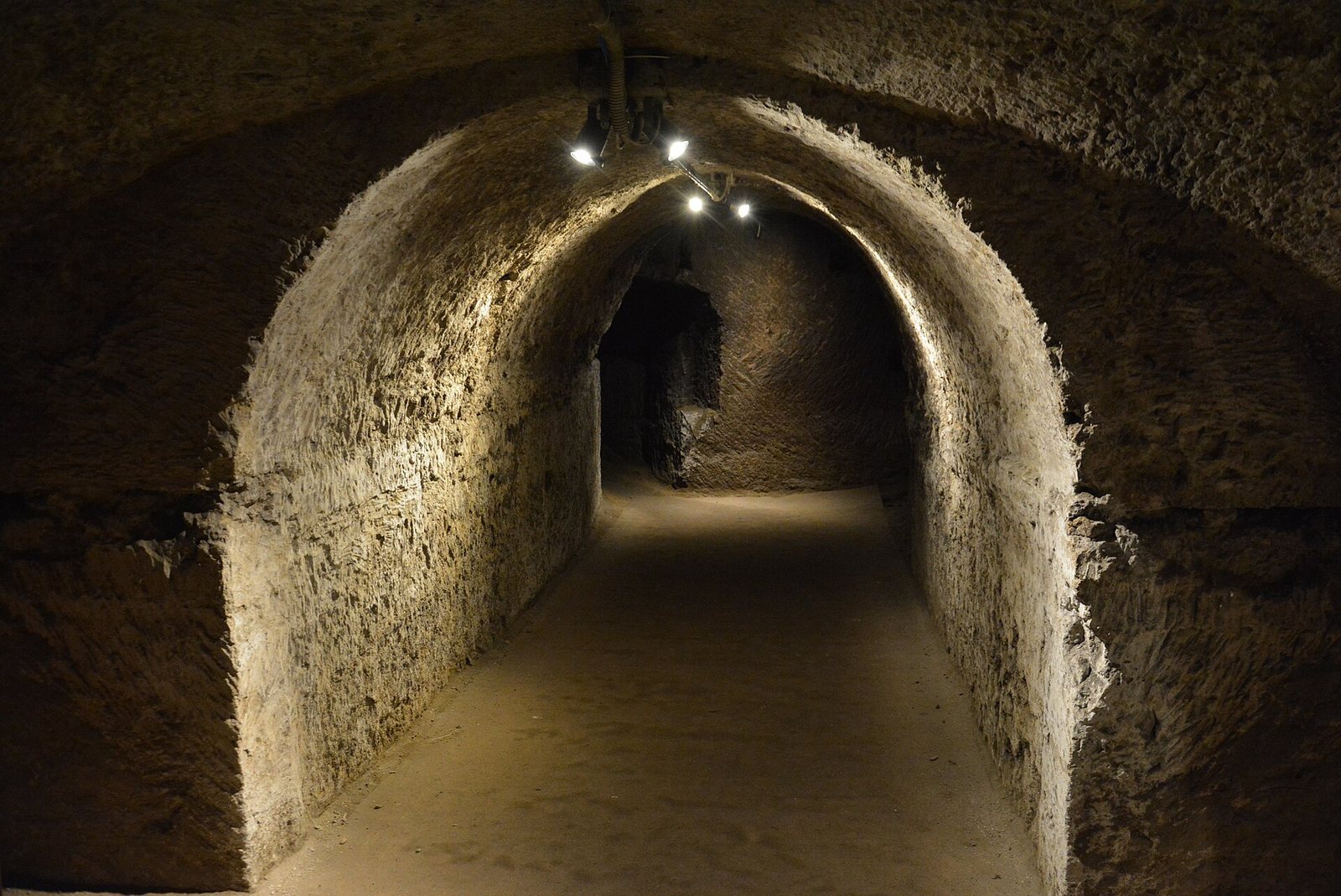
The catacombs occupy the Sanità valley between the hills of Vomero and Capodimonte, a landscape of natural caves and fissures. The Basilica of Santa Maria della Sanità stands above the underground cemetery, which is entered through the basilica’s crypt. Corridors branch from the main entrance, with narrower passages leading into burial chambers. The complex combines early Christian tombs and painted decoration with burial spaces altered or added in the seventeenth century.
The basilica and crypt
Church and crypt layout
The basilica’s main altar and presbytery, the area around the altar traditionally reserved for clergy, stand about 10 metres above the main church floor and are reached by two side staircases. Beneath the altar, the spacious crypt has a principal altar and ten side altars, which cover former entrances into the catacombs. The entrance to the oldest section is to the right of the principal altar.
Altars, paintings, and sacred images
Relics of martyrs from Rome’s Catacombs of Saint Sebastian were placed in the crypt altars. Behind the altars, late seventeenth-century frescoes by the Neapolitan artist Bernardino Fera portray the martyrdoms of saints whose relics rest there. A ninth-century fresco shows the Virgin and Child with two saints, possibly Gaudiosus and Nostrian. A separate, faint early Christian fresco of the Virgin was detached from a wall of the old church after a mudslide.
The first chapel on the basilica’s right holds the icon of Our Lady of Health, venerated from the fifth or sixth century and regarded as Naples’s oldest Marian icon. A wooden statue of Saint Vincent Ferrer stands to the left of the altar.
Early Christian burial chambers and decoration
Corridors and tomb forms
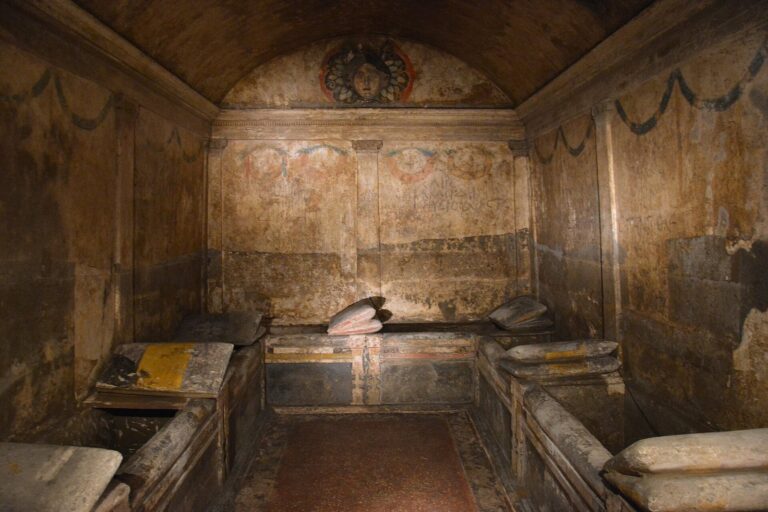
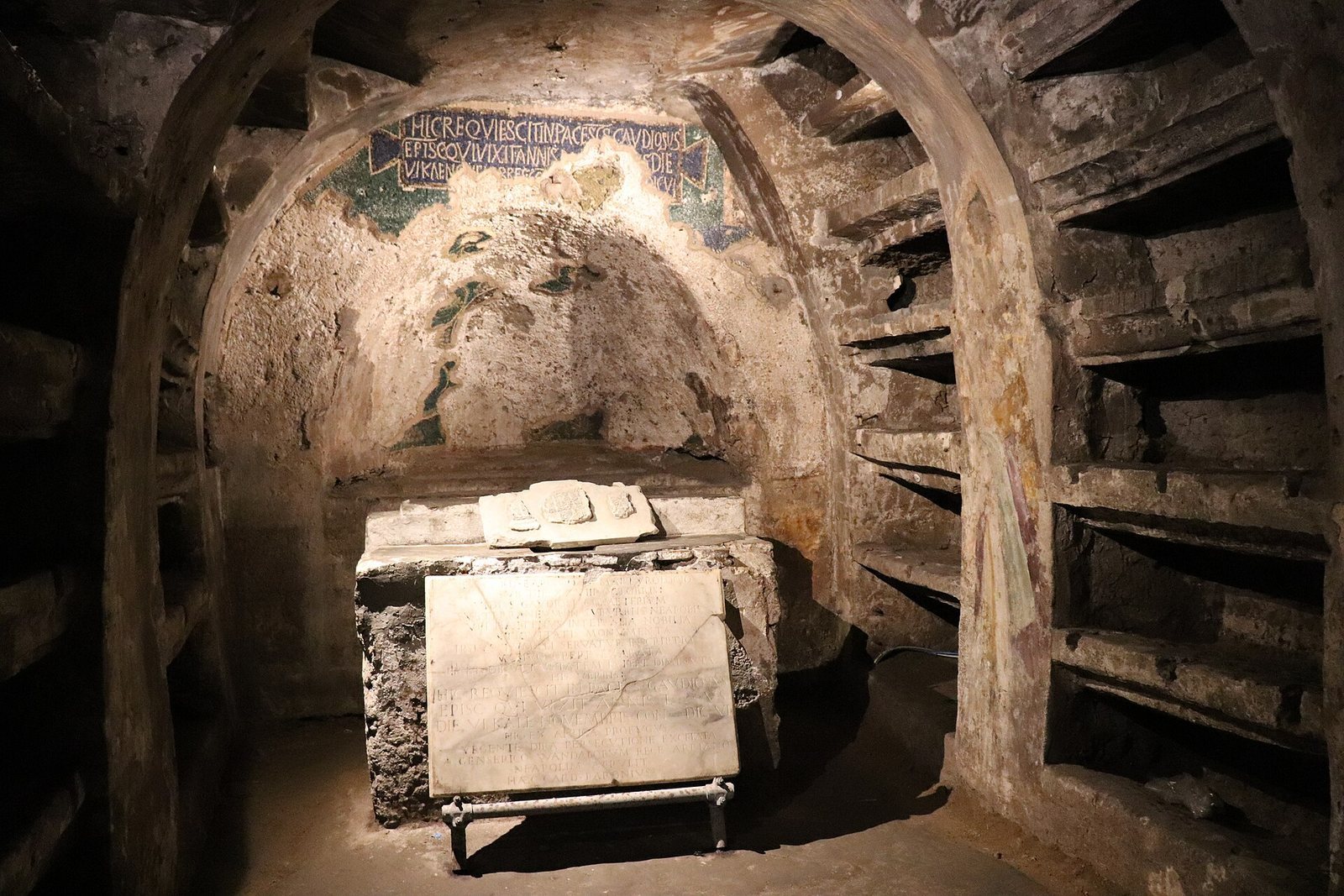
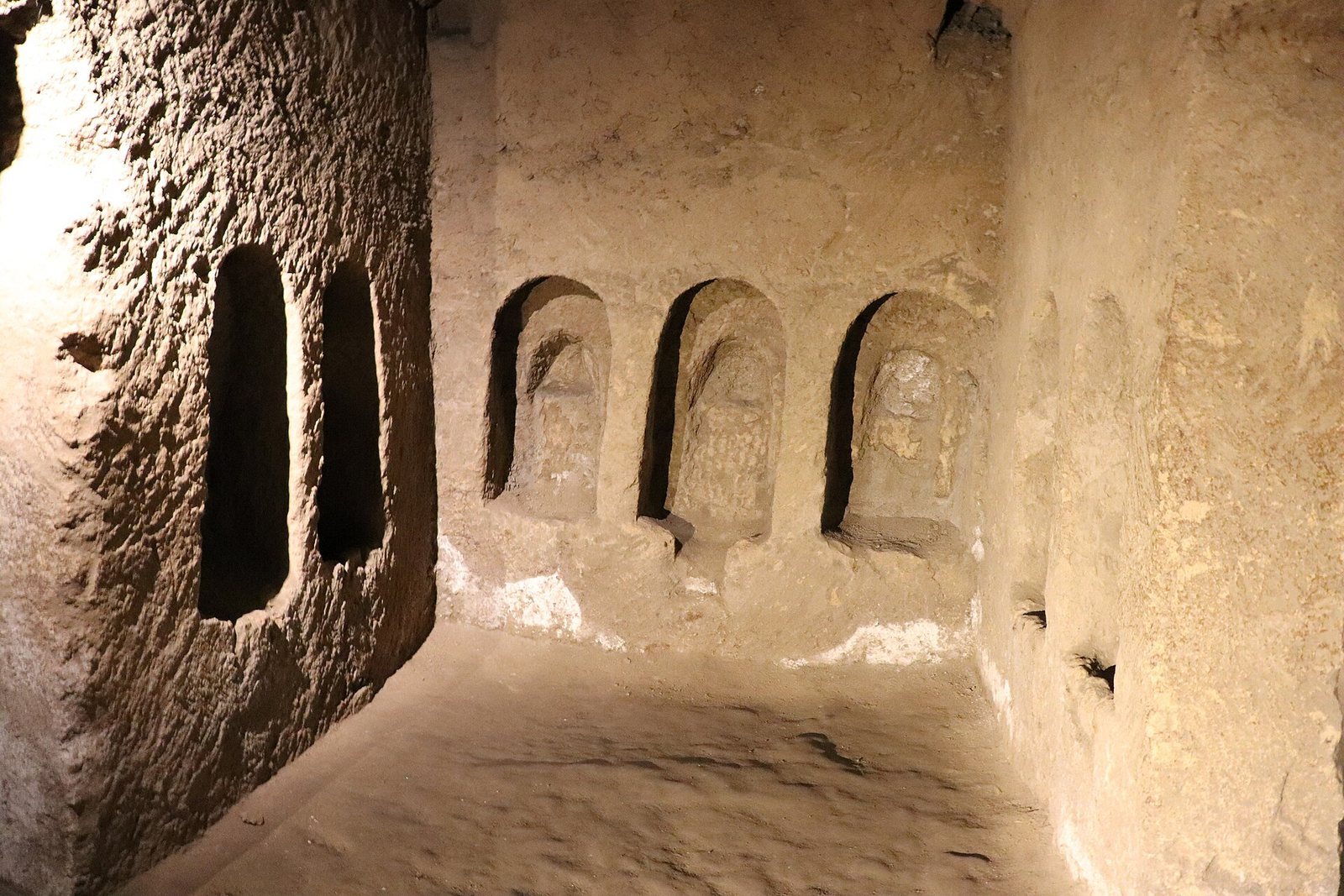
Rows of loculi (horizontal niches for individual burials) line the corridor walls. Arched burial recesses, known as arcosolia, are often set in separate rooms called cubicula (small burial chambers); graves cut into their floors are called formae (floor burials). Mosaics and frescoes from the fifth and sixth centuries decorate the walls of some chambers and the vaulted ceilings of their arched tombs.
The tomb of Saint Gaudiosus
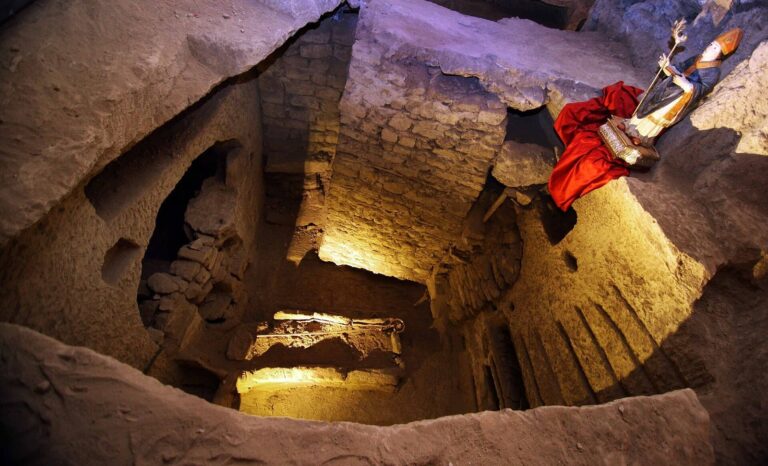
Gaudiosus was first buried in a richly decorated mosaic tomb within a separate chamber. His body was later placed in a separate sarcophagus, which also served as an altar. An inscription above it names the deceased and records his death. The inscription remains exceptionally well preserved, while the tomb mosaic is badly damaged; its surviving design appears to show a haloed Gaudiosus among leaves and grape clusters.
The chamber of Saint Nostrian
Nostrian’s burial chamber is better preserved. Its tomb mosaic depicts a radiant cross, while ceiling paintings place Christ at the centre and represent the four evangelists as a calf, lion, angel, and eagle. A portrait of Saint Catherine of Siena, a fourteenth-century Italian religious writer associated with the Dominican tradition, was commissioned by the Dominicans and painted by Giovanni Balducci in the seventeenth century.
Other mosaics and painted tombs
One chamber has two mosaic-covered tomb recesses. In one, a pair of doves drink from a cup among grape leaves, an image of the saints enjoying eternal life. The other shows a stylized sarcophagus beneath a radiant cross, flanked by lambs, expressing the saints’ attainment of eternal life through Christ’s victory over death.
Another well-preserved mosaic depicts a phoenix with outstretched, flame-like wings and a crown at its feet. The bird holds a medallion bearing a cross and the Greek letters alpha and omega, signs of God’s all-encompassing power. The phoenix represents Christ’s victory over death.
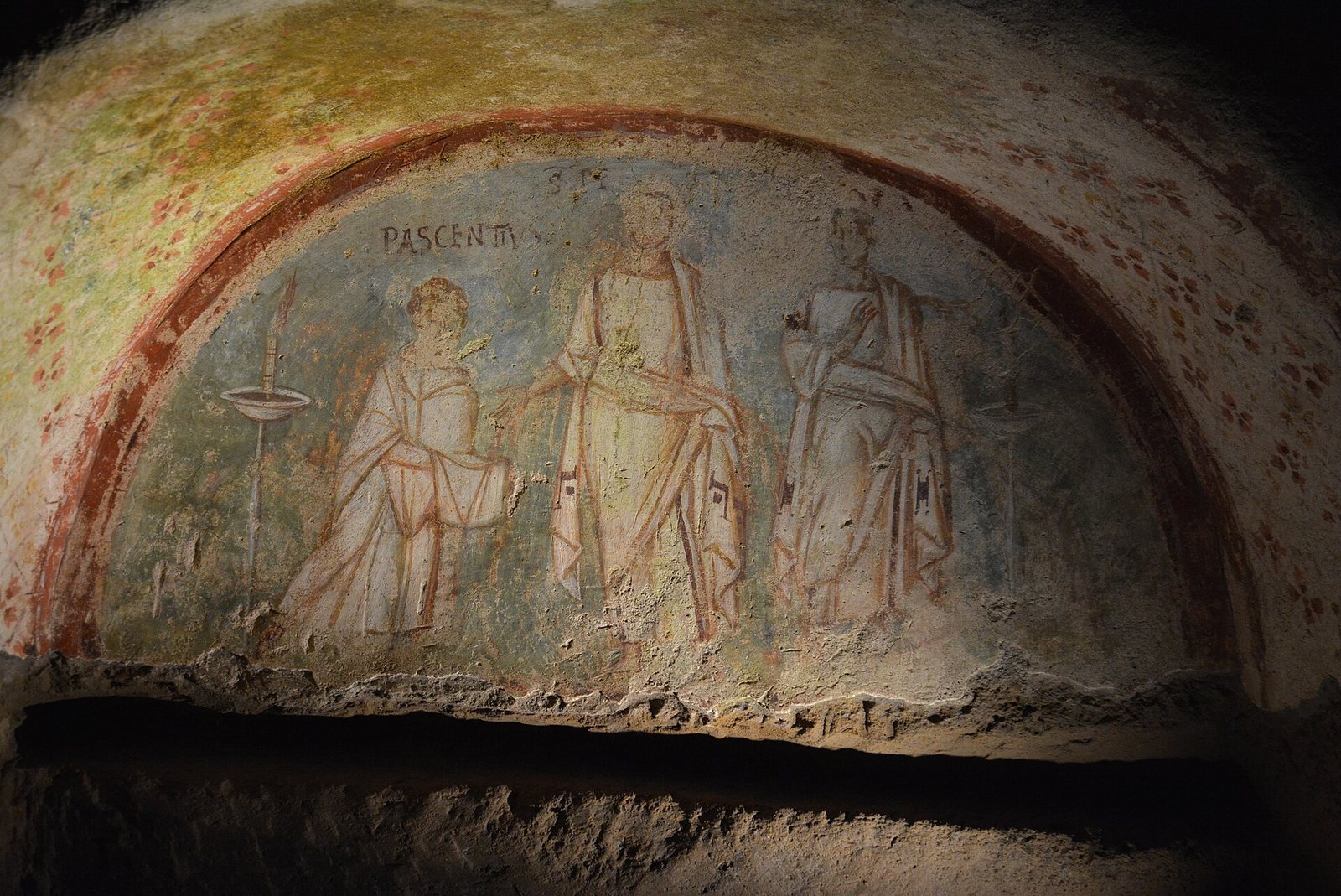
A fresco above the tomb of Sossius, a deacon, or ordained minister serving the church, and martyr, shows a radiant cross with Saint Stephen and Sossius. Sossius raises his right hand as he preaches the Gospel. In another fifth-century fresco, Pascentius, apparently from Africa, kneels before Saint Peter, one of the apostles. A separate catacomb fresco depicts the victory of Death.
Seventeenth-century burial areas
Drying rooms
Behind the crypt’s principal altar, the Dominican expansion included rooms for drying bodies. Dozens of upright niches were cut into the tuff, a rock formed from compacted volcanic ash, to serve as seats, with urns placed below them. Bodies were set on the seats to dry; the resulting mummified or skeletal remains were later transferred to private tombs or a communal ossuary.
Ambulatory and wall burials
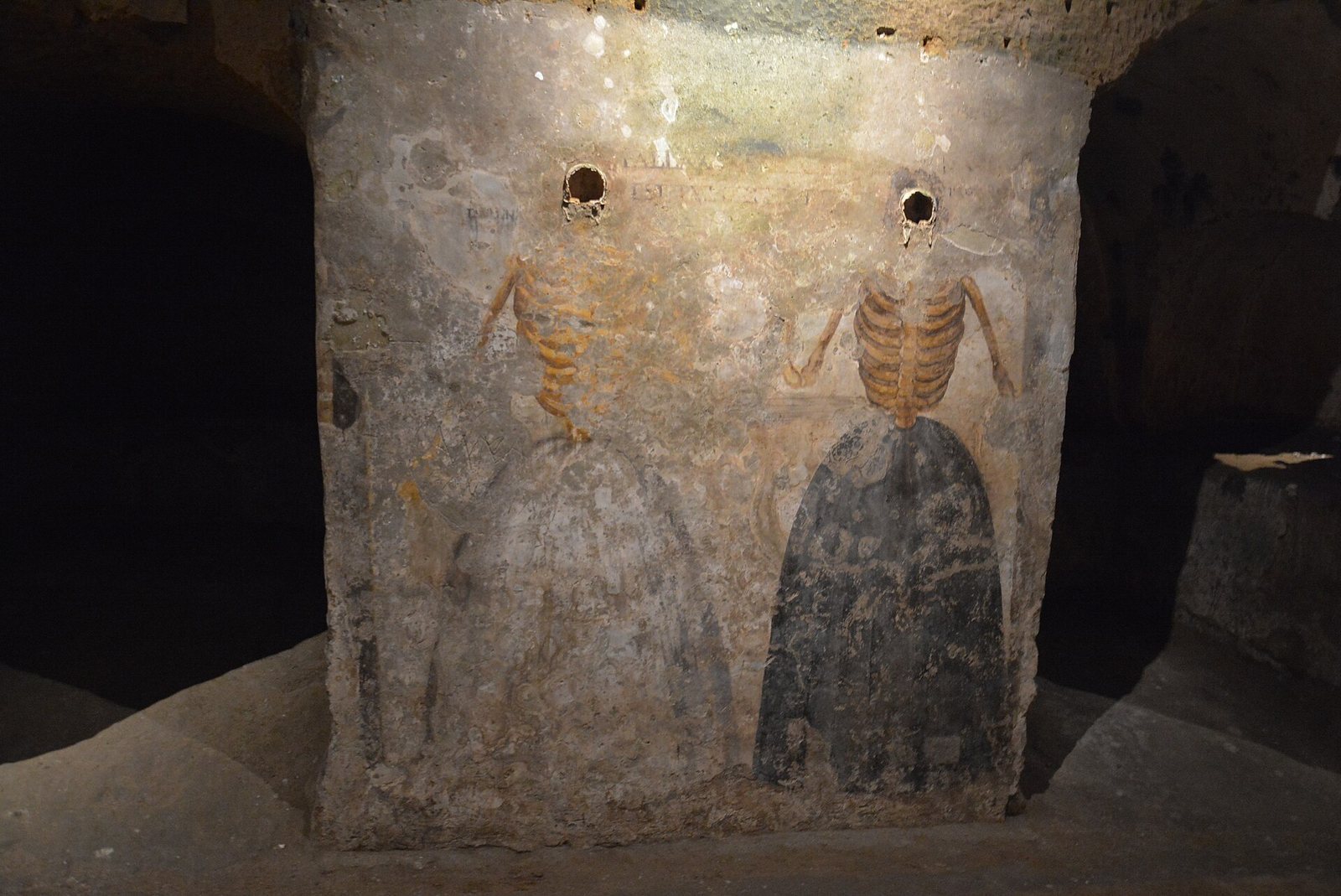
Beyond the drying rooms, a long corridor was adapted as an ambulatory for burials. The dead were placed upright in niches and enclosed with their heads left exposed. Painted partitions showed headless figures wearing the deceased’s clothing and insignia, alongside inscriptions with names, titles, and epitaphs. Small openings above the paintings held skulls. Skulls remain in wall openings, while humidity has damaged the surrounding surfaces.
Cistern and other surviving features
An ancient drained cistern beneath the basilica’s right-hand chapel was also used for burials in the seventeenth century. Its graves imitate early Christian niches, arched tomb recesses, and floor burials; the cistern now forms an exit from the catacombs. Near the entrance stands a late seventeenth-century sculpture of the dead Christ, carved from tuff.
The surviving catacombs represent a small portion of the original complex. Most skulls in the wall openings are smaller than modern human skulls; differences in diet and healthier living conditions have been proposed as possible explanations.