Cristallini Hypogeum: Four Greek-Period Tombs in Naples
Site at a Glance
- Popularity
- Medium
- Country
- Italy
- Primary era
- Classical
- Eras represented
- Classical
- Civilizations
- Ancient Greek
- Site type
- Burial
- Remains
- Necropolis
On this page12 sections
History
The Cristallini hypogeum is a group of four underground tombs in Naples, Italy, built by the Greek community of Neapolis, ancient Naples, between the late fourth and early third centuries BCE. They formed a cemetery outside the city walls, beside a road northwest of the ancient city. The complex takes its present name from Via dei Cristallini.
Use from the Hellenistic period
The tombs remained in use from the Hellenistic period, which began after Alexander the Great’s death and saw Greek culture spread through successor kingdoms, into the Roman imperial era. The surrounding ravine gradually filled with alluvial deposits, eventually burying the tombs beneath material reaching as much as 15 metres in height.
Rediscovery and study
In 1889, Baron Giovanni di Donato encountered one of the tombs while work in the garden of his palace reached a depth of about 12 metres. Investigations continued until 1896 and revealed all four tombs. Gennaro Aspreno Galante published the complex, and Giulio De Petra issued a study of its inscriptions in 1898.
Research resumed in 1985, followed by further studies, including a synthesis focused on Tomb C. Restoration work began on 23 September 2020.
Remains
Setting and plan
The four independent tombs are cut into tuff, a soft volcanic stone, and lie side by side at slightly different angles. Their entrances originally faced a road running along a natural tuff cliff, with other burial chambers nearby. The complex is now beneath later buildings and is reached by an underground passage from a modern building on Via dei Cristallini. The tombs share a façade design with a large entrance between two half-columns or flat wall supports.
Chambers and burial places
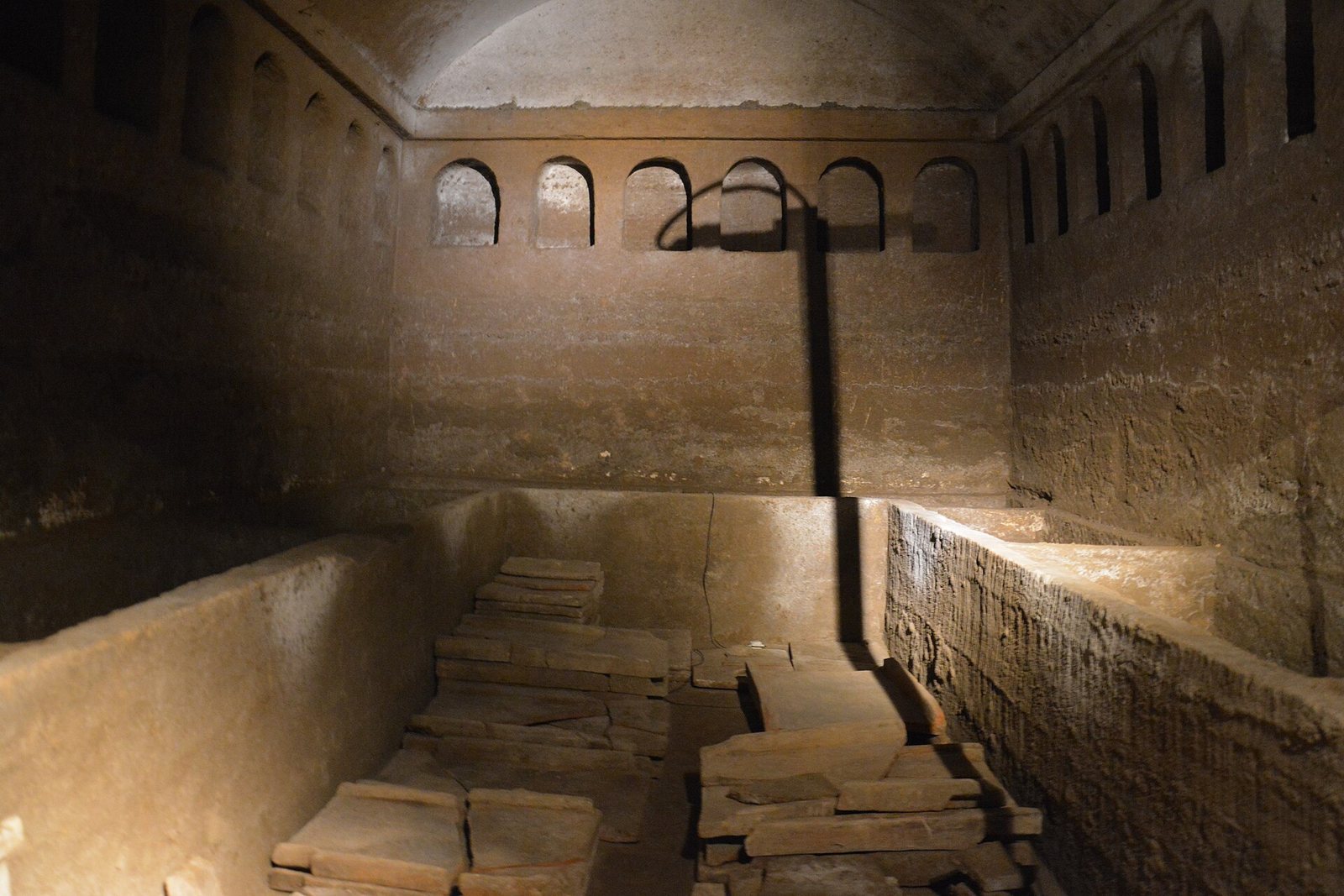
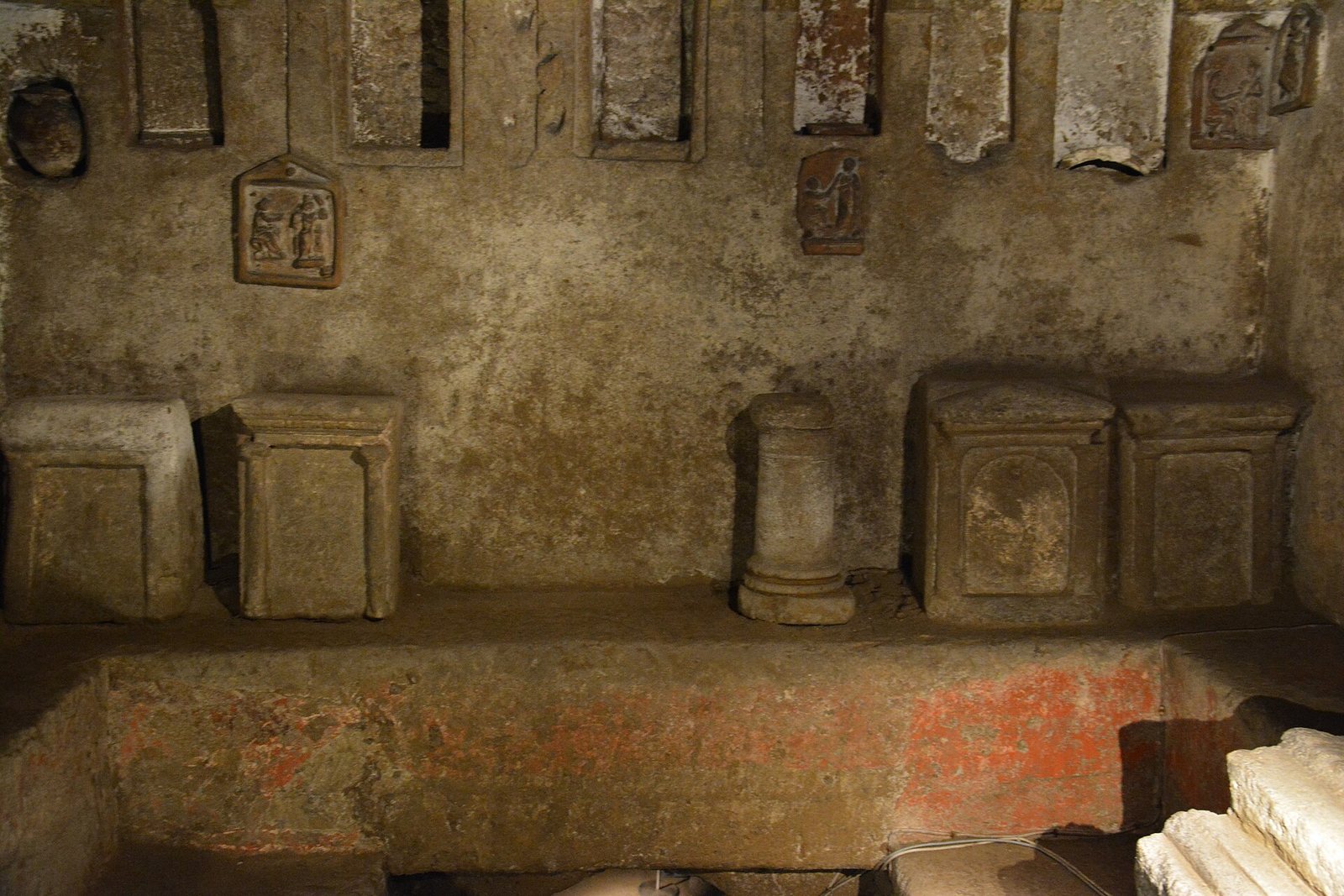
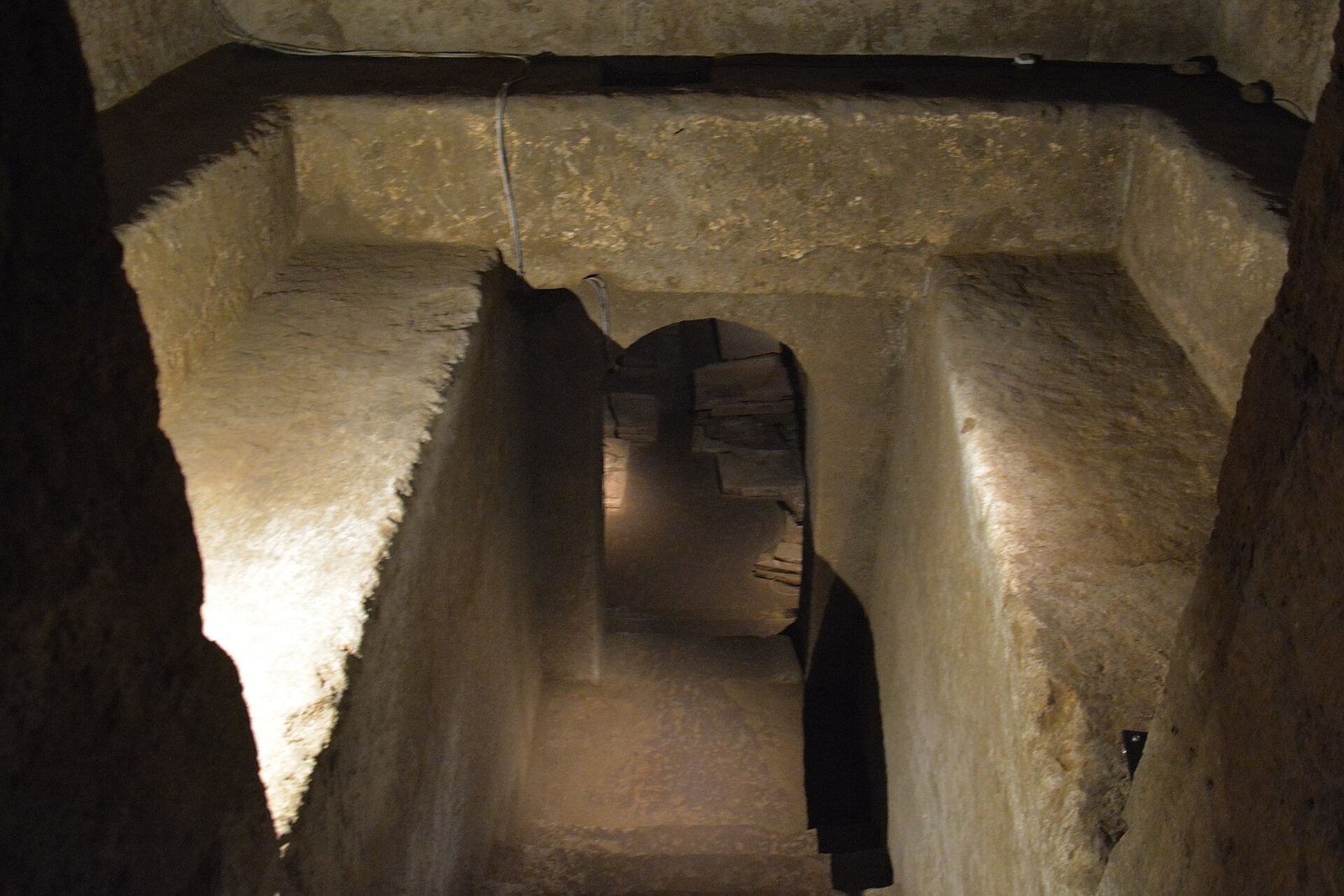
Each tomb has an approximately square upper chamber, about 3.70 by 3.00 metres, with benches against the walls and a staircase occupying most of the floor. The stairs descend to a longer rectangular chamber measuring about 3.70 by 6.70 metres, with slight differences among the tombs. The upper rooms were used to pay respects to the deceased, while the lower rooms held the burials. Their ceilings have barrel vaults, continuous curved forms, and the architectural details were carved directly into the tuff.
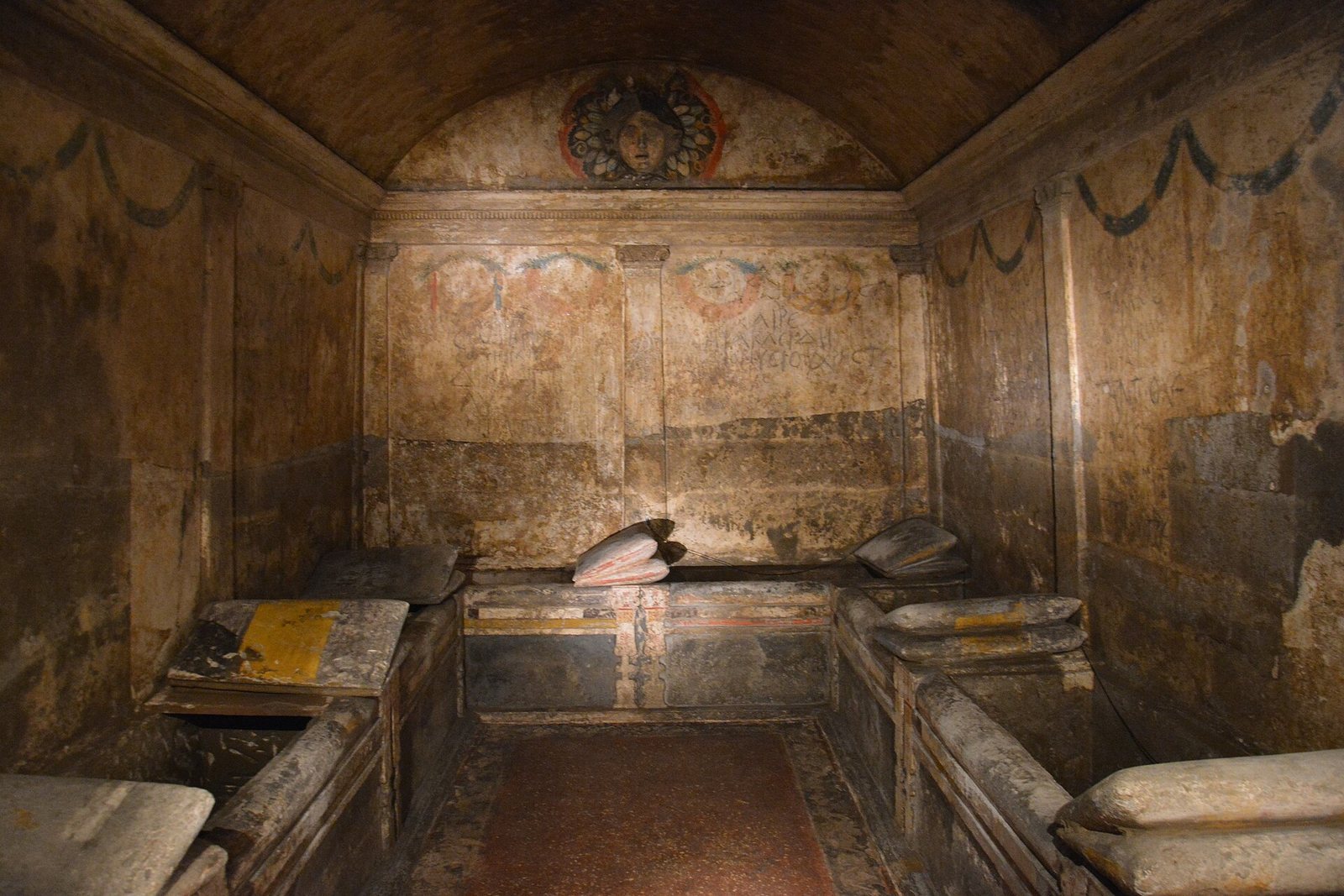
In each lower chamber, benches about 70 to 80 centimetres wide and high were shaped into burial places along three walls. Each long wall held three places shaped like couches, and the rear wall held two. The deceased were laid on these surfaces with carved and painted cushions and mattresses in red, blue, purple, and yellow.
Individual tombs
Tomb A
Tomb A was originally decorated with eight shallow relief carvings. One of them survives.
Tomb B
Tomb B was found almost intact and retains wall paintings, amphorae, or large storage jars, and altars.
Tomb C: entrance and upper chamber
Tomb C is the best-preserved of the four. Two columns at its entrance support an architrave, the horizontal beam above columns, and the entrance probably once had a pediment above it. The upper chamber has a double-pitched roof and two decorative friezes. One uses the Ionic style, known for its scroll-shaped capitals, and is painted red, blue, and white. The other is black and white, with griffins, flowers, and male and female heads.
Tomb C: painted and carved decoration
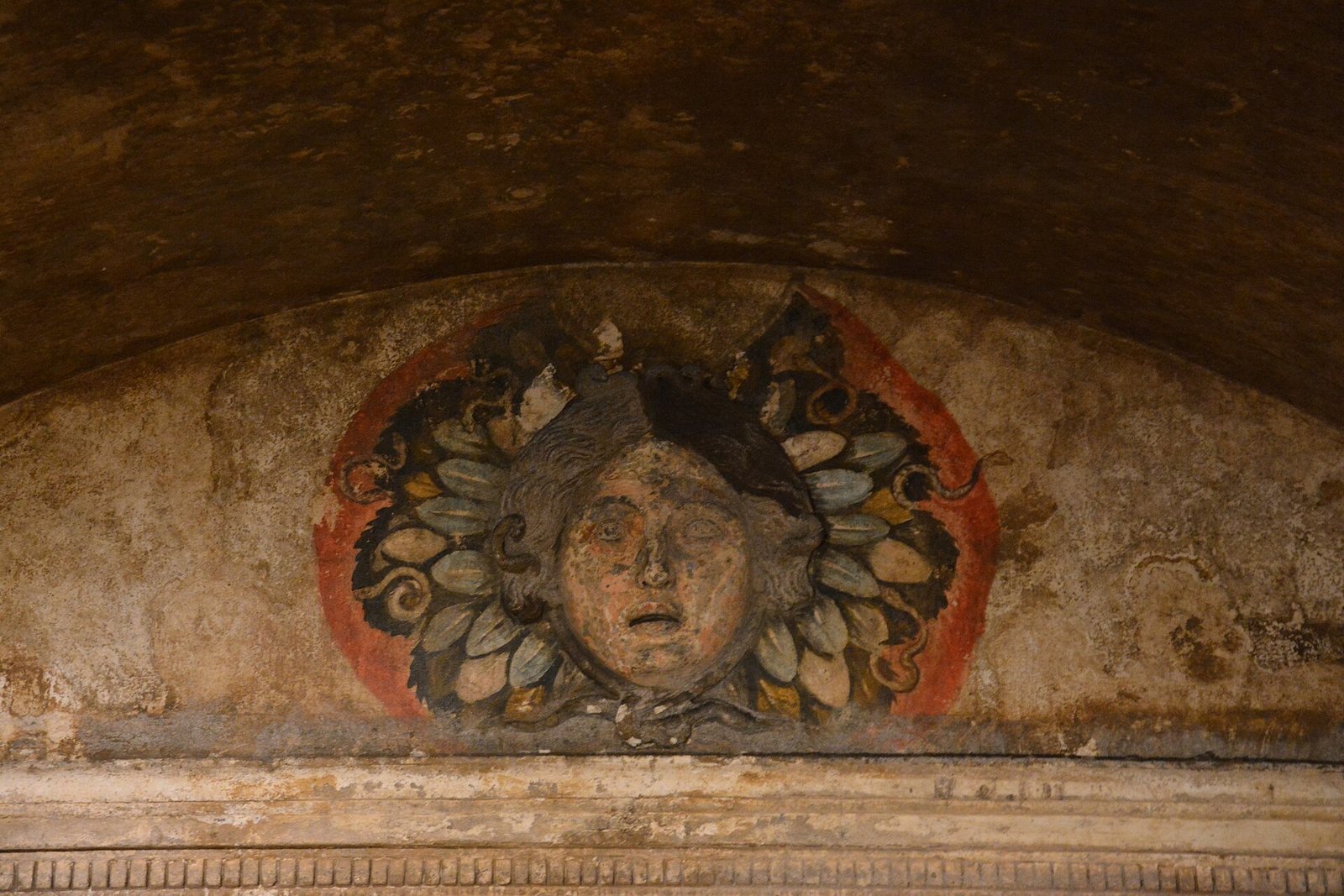
In the lower chamber, garlands accompany carved architectural forms. These include flat wall supports with sculpted capitals, a horizontal beam decorated with small tooth-like blocks and an alternating oval-and-point pattern, and a framed triangular panel beneath a gabled roof. A semicircular recess in the rear wall contains a carved and painted image of Medusa’s head on an aegis, a protective garment or shield associated with Greek deities. Paintings on the entrance wall show a jug, two candelabra, and a suspended golden dish containing figures of Dionysus, the Greek god associated with wine and festivity, and Ariadne, a figure in Greek myth associated with him. The candelabra’s shafts and animal-paw-shaped bases remain visible. Painted laurel wreaths in golden bands appear above the burial couches, and the floor is red. The painting of Medusa’s head was reconstructed to investigate the use of limewash painting followed by tempera applied to a dry surface.
Tomb D
Tomb D has numerous burial niches in its walls. A Latin inscription found inside provides evidence that the tomb was reused during the Roman period.