Bardi Chapel: A Family Chapel in the Basilica of Santa Croce
Site at a Glance
- Popularity
- High
- Country
- Italy
- Primary era
- Medieval
- Eras represented
- Medieval
- Civilizations
- Republic of Florence
- Site type
- Religious
- Remains
- Chapel
On this page20 sections
History
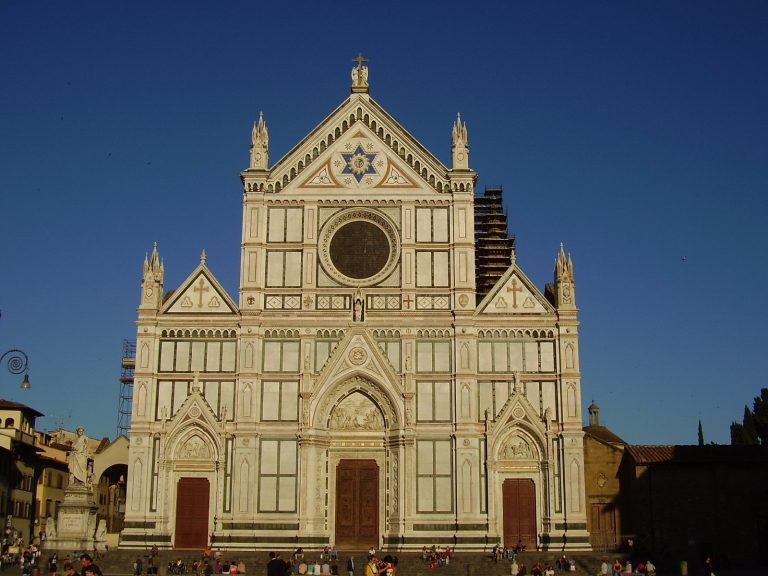
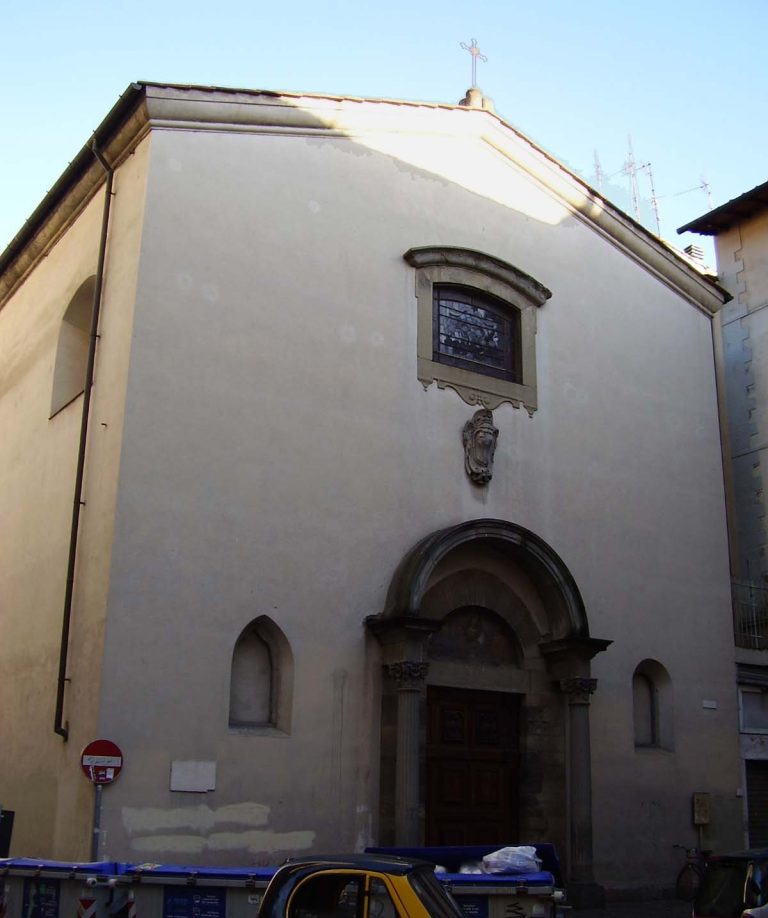
The Bardi Chapel is a family chapel in the transept, the crosswise arm of a church, of the Basilica of Santa Croce in Italy. Santa Croce served a Franciscan convent, whose friars belonged to an order shaped by poverty and preaching. The Bardi family, wealthy Florentine merchants and bankers, commissioned the chapel for their use.
Commission and painting
The chapel’s wall-painting cycle dates to about 1325, after the paintings in the nearby Peruzzi Chapel. A halo around Saint Louis of Toulouse places the cycle after his canonization in 1317. Giotto, a leading Italian painter known for giving figures volume and expressive presence, is generally credited with the work. Assistants may also have contributed, and Maso di Banco and the unidentified Master of Figline have both been proposed. A 1953 attribution of the whole cycle to Maso di Banco instead received little support in later research.
Interpretation and influence
The cycle’s relatively unbearded image of Francis has been interpreted as reflecting the Conventual Franciscans’ reshaping of their founder’s image. The Conventuals were one branch of the Franciscan order, and this interpretation connects the chapel’s imagery with their move away from some of Francis’s emphasis on poverty.
Ghiberti and Vasari both referred to the chapel. Its Franciscan scenes later influenced Florentine painting. About 150 years after the cycle was made, Domenico Ghirlandaio drew on its imagery for the Sassetti Chapel in Santa Trinita.
Rediscovery and restoration
Seepage and repeated floods in the basilica contributed to the paintings’ poor condition in the eighteenth century. They were whitewashed in 1714 and uncovered again in 1852. Gaetano Bianchi then restored them, adding extensively; those additions were later removed and stored in rooms near the basilica’s sacristy. The fresco above the chapel entrance was uncovered in 1937.
Leonetto Tintori began another restoration in 1958, continuing into the early 1960s. He removed nineteenth-century additions and left damaged areas unfilled, while the work recovered the authentic appearance of many faces. Examination showed that parts of the original painted surface remained in good condition. After restoration, the Bardi paintings were in better condition than those in the nearby Peruzzi Chapel.
Remains
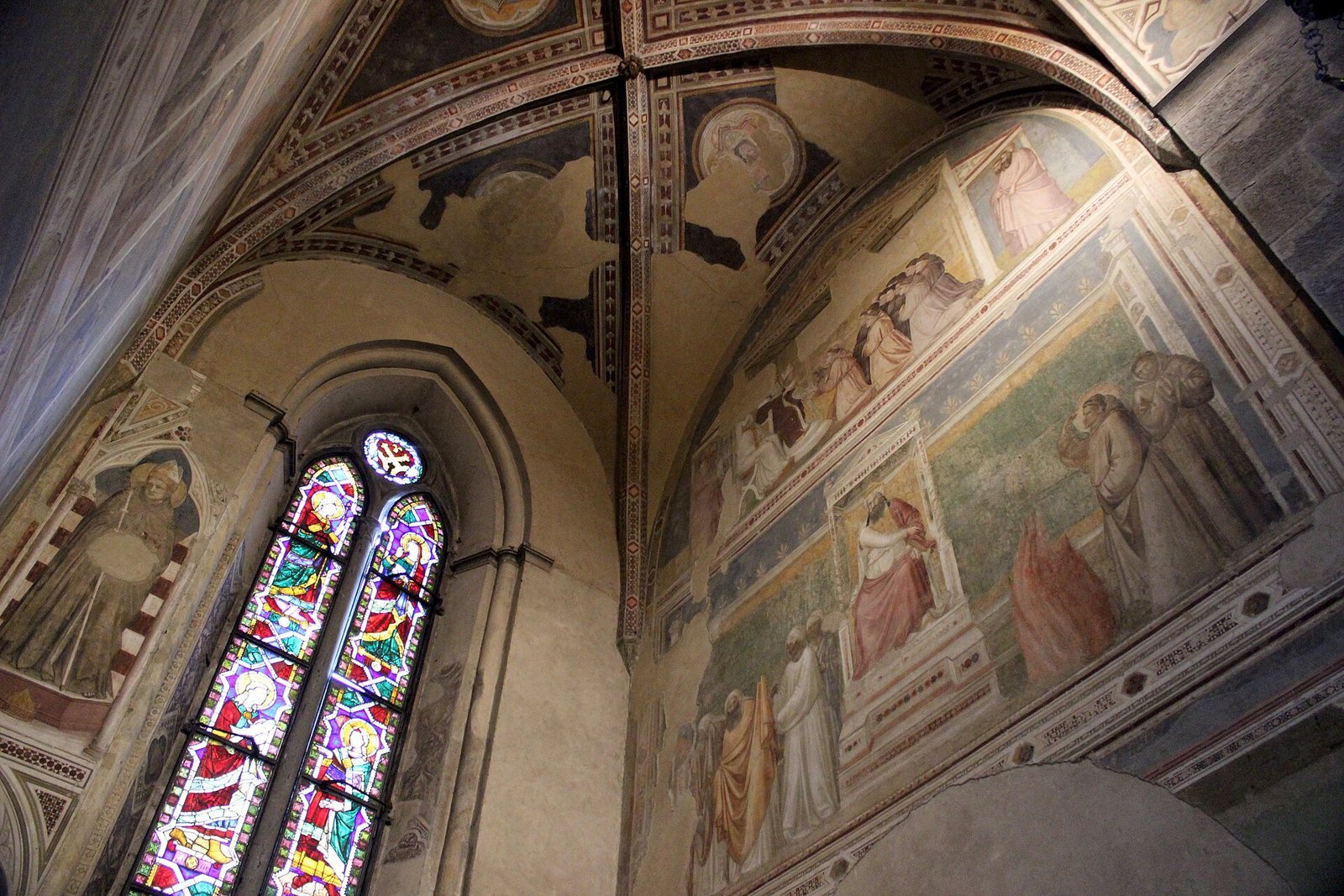
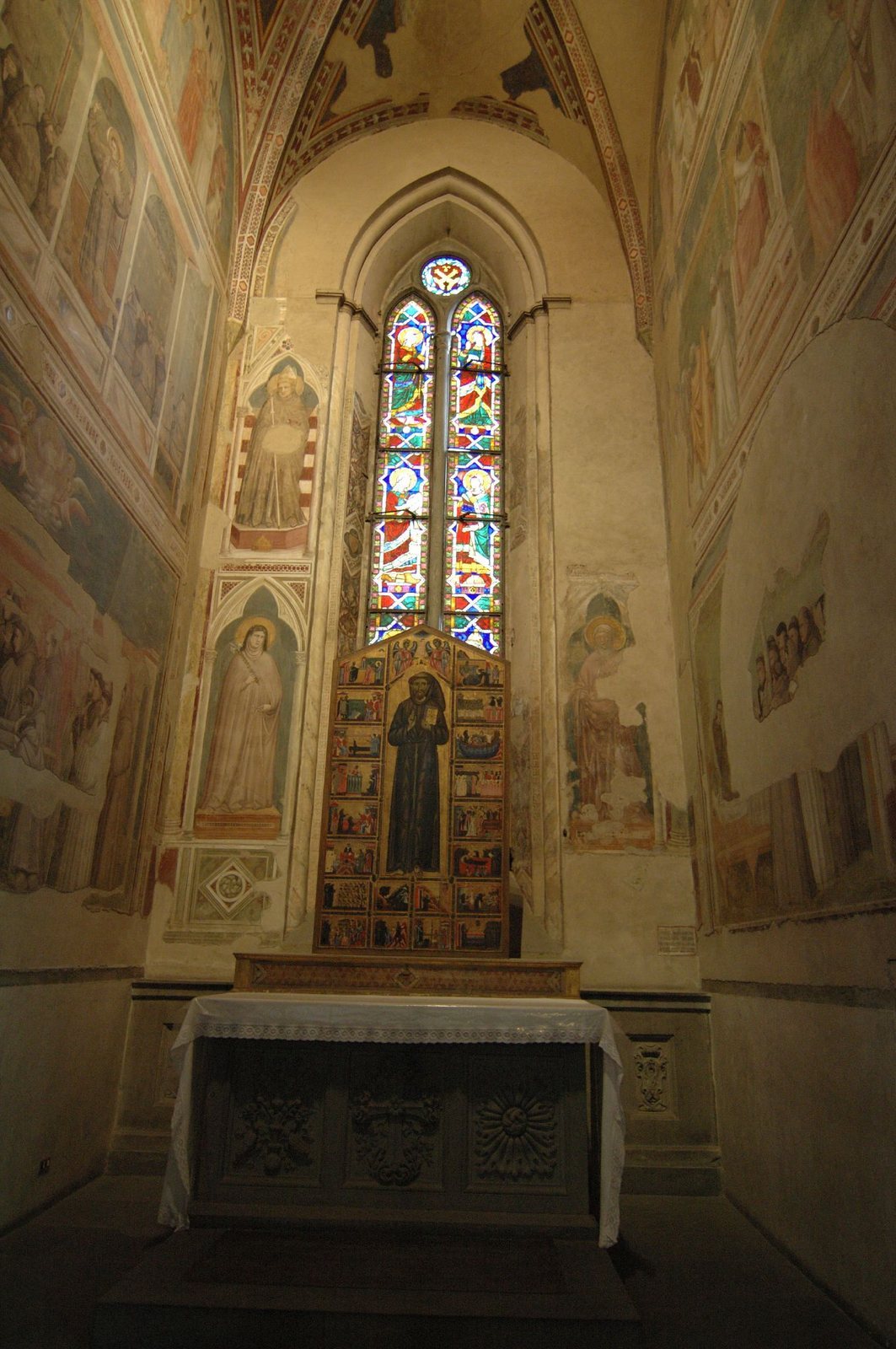
The chapel is a simple, single-bay space with flat side walls, a pointed-arch window in the back wall, and a rib vault, a ceiling supported by intersecting ribs. Its wall cycle combines fresco, painting on wet plaster, with pigment applied to dry plaster, a method called a secco. Much of the work uses the latter technique, which allowed faster execution and suited Giotto’s heavy workload and extensive use of workshop assistants. The scenes have muted, grayish colors, rapid, expressive brushwork, broad drapery, and open backgrounds. Painted perspective lines converge toward the centers of the compositions.
Scenes from the life of Saint Francis
The six narrative scenes occupy the side walls. Each wall is divided into three fields, with a semicircular upper panel, called a lunette, above two rectangular panels. The sequence begins at the top of the left wall, continues at the top of the right, then moves through the middle and lower panels, alternating between the walls.
Renunciation of worldly goods
In the lunette, Francis, nearly naked and praying, is covered by the bishop’s cloak while his father, Bernardone, is held back by another man. The bishop is accompanied by religious figures. At the edges, boys throw stones at Francis as their mothers pull them away by the hair. Behind them is a large palace with rough-faced masonry along its base, windows, open galleries, and a column-surrounded central court. Its angled corner divides the opposing groups and creates a strong triangular shape within the scene.
Approval of the Franciscan Rule
Francis and his companions receive approval for the Franciscan Rule, the order’s religious principles and regulations, from Pope Innocent III. The pope sits beside two cardinals, while standing figures fill two side sections resembling aisles. The classical-style building has a pediment with a sculpted medallion of Saint Peter, suggesting a setting at the papal court. The figures are arranged across a broad rectangular field.
Appearance at the Assembly of Arles
Francis appears with raised arms before the assembled friars as Saint Anthony of Padua, a Franciscan friar known for preaching, addresses them. Benches run along the sides of the room. Its perspective makes the farther parts seem wider, giving the space a trapezoidal form. An arched doorway and the arches of the windows frame the figures in three-part groupings.
Trial by fire before the Sultan
The Sultan sits facing forward on a throne at the center of a room enclosed by walls painted in perspective. Textile decoration covers the high wall behind him. The room is open to the sky, with palm fronds visible above. Francis, accompanied by a friar, offers to undergo the ordeal, while the Muslim religious scholars recoil or withdraw. The figures occupy the foreground.
Funeral and ascension of Saint Francis
This panel combines three moments: friars mourning Francis, the physician Girolamo examining his stigmata, the bodily marks believed in Christian tradition to correspond to Christ’s crucifixion wounds, and angels carrying Francis’s soul heavenward in a halo. Francis lies on a raised platform before a straight wall painted with marble-like panels. Friars gather around him, while clergy and laypeople pay their respects at the sides. Three young clerics hold a banner on the right. A funerary monument damaged the painting, leaving visible gaps.
Visions of Friar Augustine and Bishop Guido of Assisi
The scene shows two rooms in which Friar Augustine and Bishop Guido experience visions of the recently deceased Francis while they are in the Gargano. Augustine rises from his bed as other friars react; in the second room, Guido lies in bed with attendants nearby. This is the most damaged scene, and almost all of Augustine’s figure has been lost.
Entrance arch, back wall, and vault
The Stigmatisation of Saint Francis
Above the entrance arch, outside the chapel’s main space, a separate scene shows the crucified Christ with three pairs of red seraph wings, belonging to a high order of angels, and rays striking Francis. The arid, fissured landscape represents Mount La Verna, with a falcon on its summit. Medallions beside the scene depict Adam and Eve. Although worn, the painting is generally considered to be entirely by Giotto.
Figures around the back-wall window
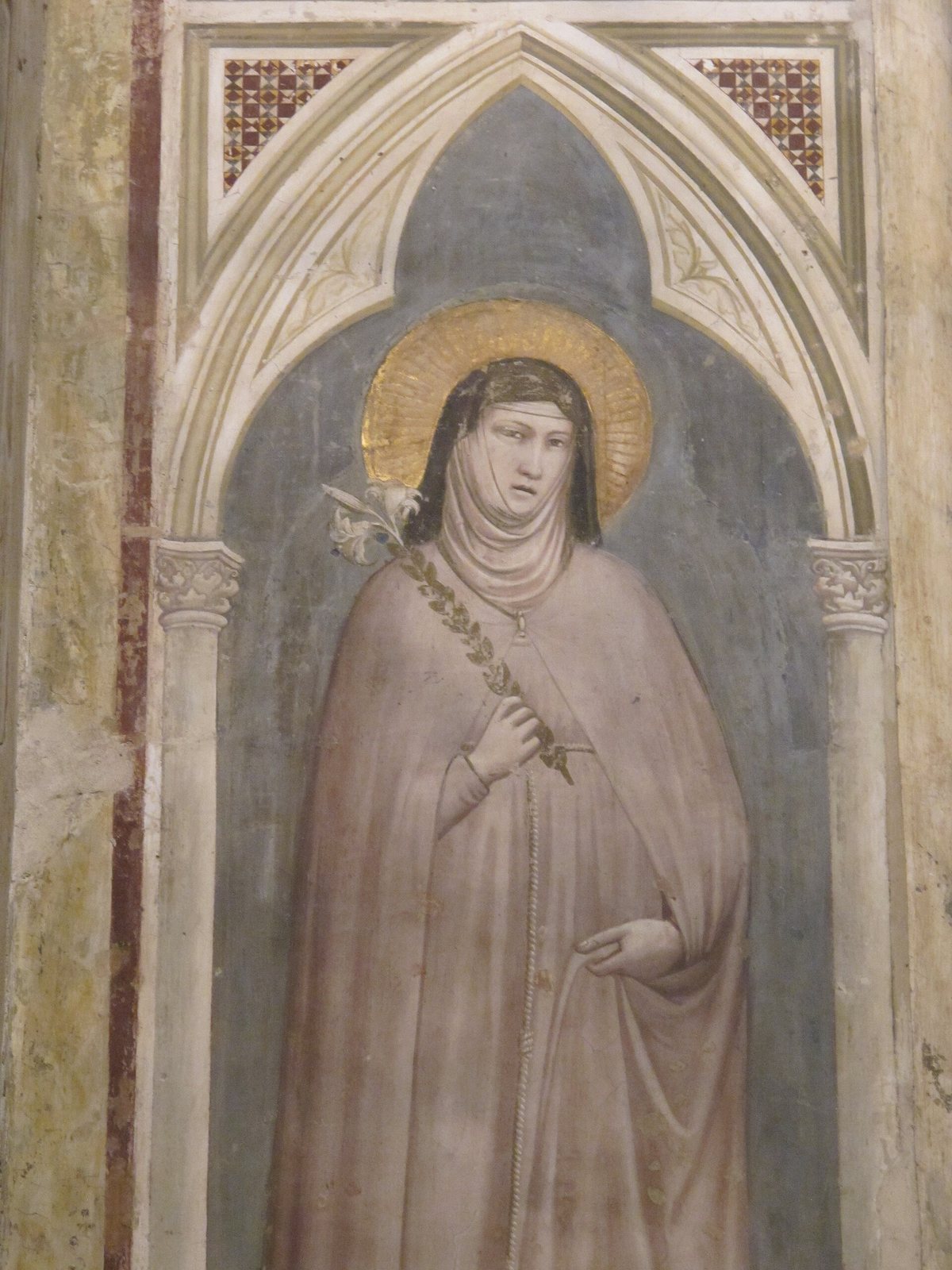
Full-length figures occupy framed spaces around the window. They include Saint Clare, Saint Louis of Toulouse, and a partly lost Saint Elizabeth of Hungary. Painted fragments of the framing also survive within the depth of the window.
Vault medallions and painted ornament
The four sections of the vault contain medallions with allegorical figures of virtues. A Franciscan holding a finger to his lips has been interpreted as Obedience; another figure represents Chastity, and a third may represent Poverty. Other figures are difficult to read. Diagonal ribs with geometric mosaic-like decoration divide the vault sections. Painted bands feature foliage scrolls, imitations of colored marble, faces among the leaves, and medallions with saints’ busts. Bust medallions also decorate the underside of the entrance arch, though their subjects are now difficult to identify.
Other paintings and stained glass
Painting of Saint Francis
An altarpiece on the altar depicts Saint Francis and scenes from his life. It was made by the late-thirteenth-century painter known as the Master of the Bardi St Francis; Coppo di Marcovaldo may also have worked on it.
Miracle of Saint Sylvester
A painting of the Miracle of Saint Sylvester is attributed to Maso di Banco. A foreground column divides two moments in the story and partly conceals the figures. Geometric buildings frame the action: a red-pink structure surrounds the saint’s miracle, while a white one frames the resurrected figures. Background ruins establish depth. The colors include dark blue, beige, reds ranging from brown to pink, and blue-green.
Stained glass
The chapel’s stained glass was designed by Jacopo del Casentino and came from the nearby Velluti Chapel rather than being made for the Bardi Chapel.