Englburg: A Castle in Tittling, Bavaria
Site at a Glance
- Popularity
- Medium
- Country
- Germany
- Primary era
- Medieval
- Eras represented
- Medieval, Early Modern, Modern
- Civilizations
- Duchy of Bavaria, Electorate of Bavaria, German, Holy Roman Empire, Kingdom of Bavaria
- Site type
- Military
- Remains
- Castle
On this page14 sections
History
Englburg is a castle in Tittling, Germany, built in the 11th century by the nobles of Hals. It probably served as a frontier fortress guarding the Golden Trail, a historic route linking the Passau region with Bohemia. Englburg is also one of the three castles whose name gave the Dreiburgenland, or Land of Three Castles, its name.
Medieval origins and rebuilding
In 1323, the Counts of Schwarzenstein received Englburg as a fief from the Counts of Hals, meaning that they held the land in return for service or allegiance. Duke Heinrich the Natternberger destroyed the castle in 1330, after which Wilhelm von Schwarzenstein rebuilt it. In 1394, citizens of Passau demolished Englburg during their feud with the city’s bishop, a conflict that also involved the destruction of fortifications around Passau. The rebuilding that followed established the basic layout that survives today.
The earliest known depiction of Englburg appears on Philipp Apian’s 1566 maps. Apian was a Bavarian cartographer of the 16th century.
Schwarzenstein and Taufkirchen
Hans Wolf von Schwarzenstein had the castle’s St George’s Chapel renovated in 1597. Two years later, the male line of the Schwarzenstein family ended. Englburg passed through the marriage of Marie Elisabeth von Schwarzenstein to the knight Burkhard von Taufkirchen, and the Counts of Taufkirchen lived at the castle until 1857.
Seventeenth- and eighteenth-century conflict
In 1634, during the Thirty Years’ War, a major European conflict fought from 1618 to 1648, Swedish forces destroyed Englburg. Wolf Christoph von Taufkirchen had it rebuilt soon afterward. In 1742, Pandurs, irregular light troops associated with the Habsburg military, devastated the castle.
Restoration and changing uses
In 1857, the last Count of Taufkirchen, Max Josef Friedrich, sold the castle, then close to ruin, to landowner and district administrator Max Niedermayer, who restored it. A fire in 1874 gutted the buildings down to their perimeter walls. The following year, master builder Stadler of Tittling restored the castle in its old style.
The East Bavarian Province of the English Ladies, members of the Catholic Institute of the Blessed Virgin Mary, acquired Englburg in 1929 for use as a convalescent home. During the Second World War it served as a military hospital, where the English Ladies cared for wounded people. After the war, the Red Cross used it as a lung sanatorium until 1950.
A major repair in 1950 preceded the return of guesthouse operations, which ended in 2004. The English Ladies continued to run the home until autumn 2005, when a shortage of new recruits led them to sell the property. On 21 August 1954, Federal President Theodor Heuss signed at Englburg the law by which the Federal Republic of Germany acceded to the Geneva Red Cross Conventions, treaties concerning the protection and treatment of people affected by war.
New owners acquired Englburg in October 2006. It was sold again at the end of 2010, and a thorough renovation began in 2011. The castle now accommodates apartments, offices, and commercial premises.
Remains
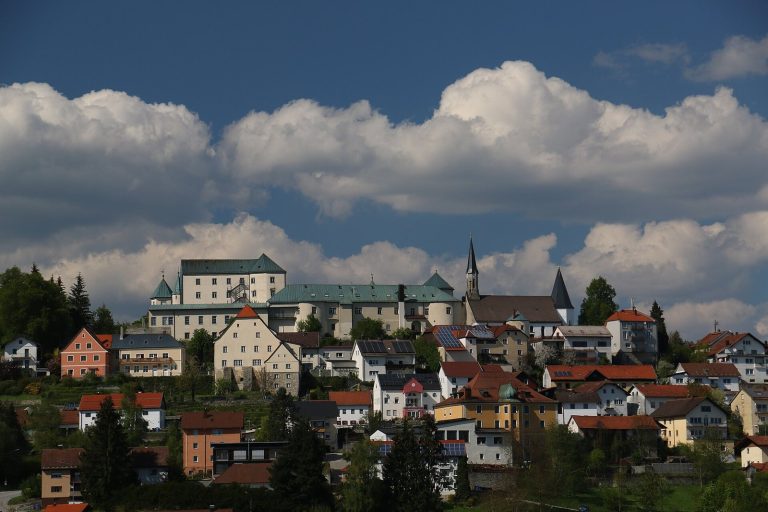
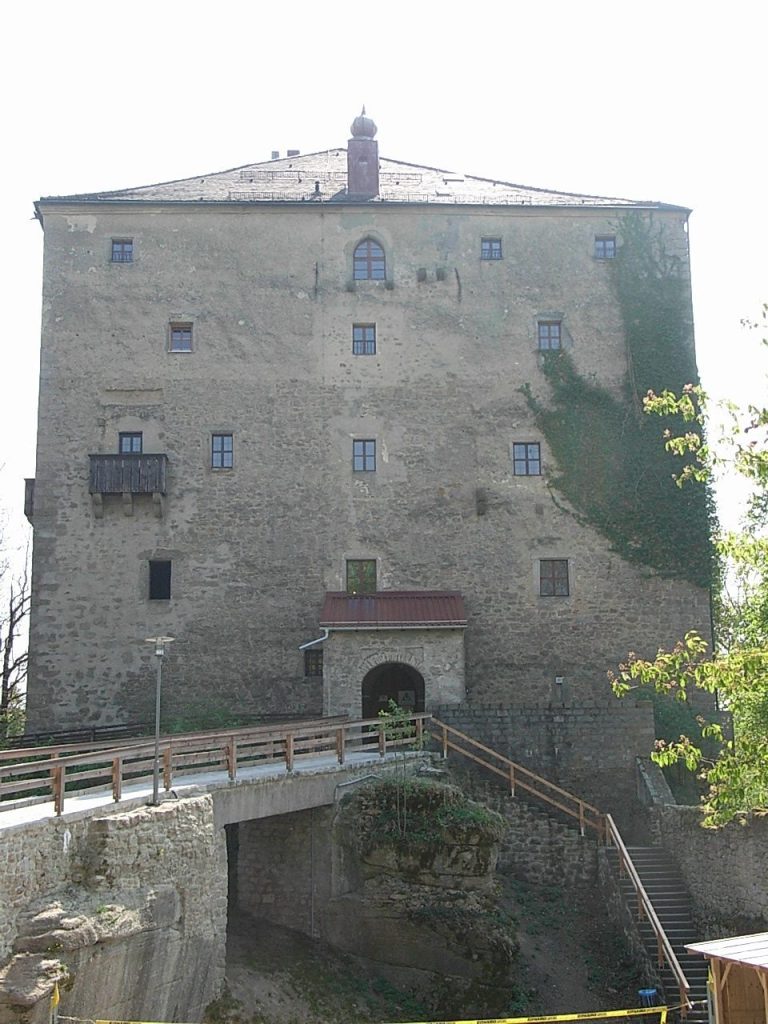
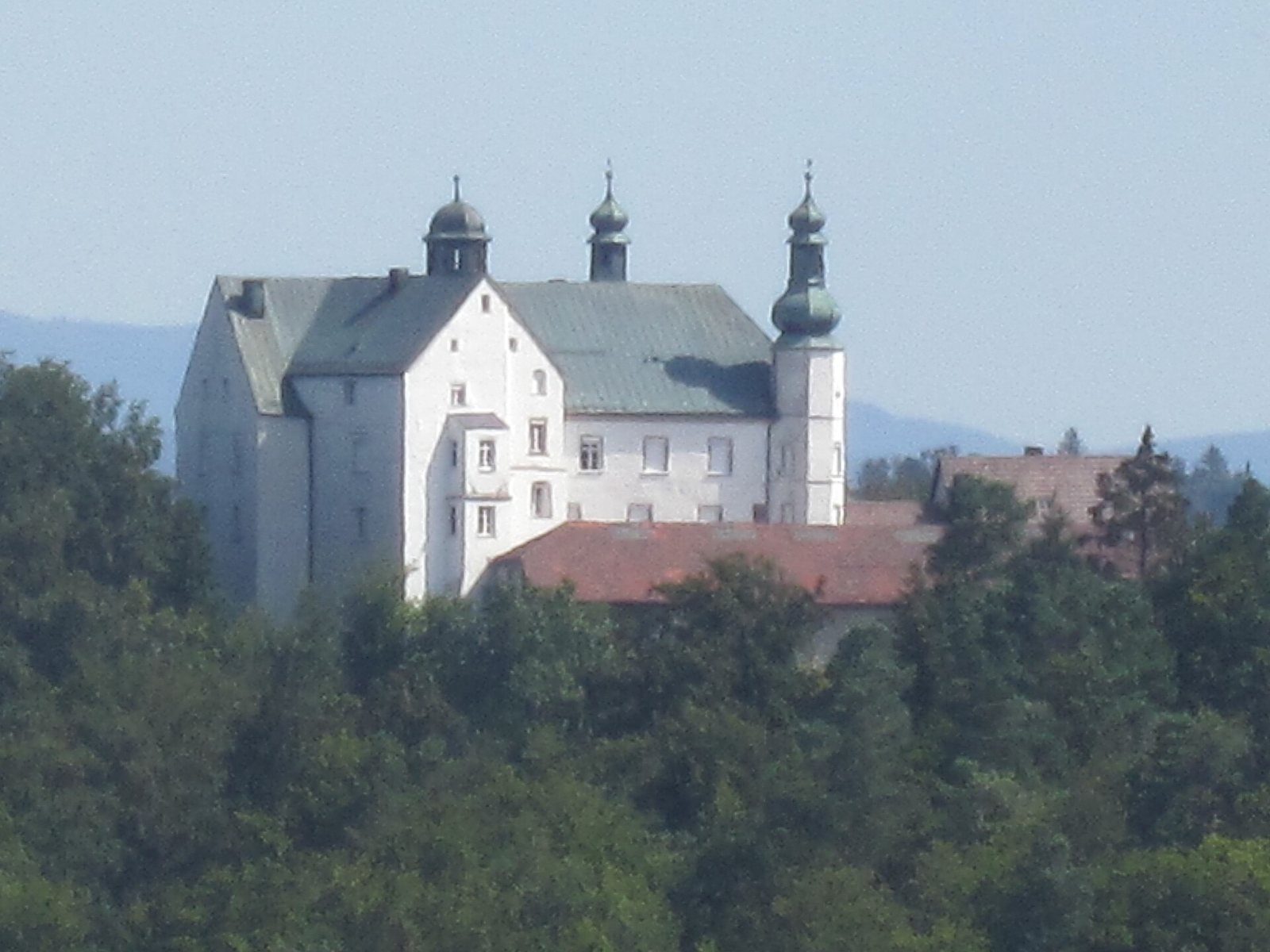
Englburg stands on a ridge in the Bavarian Forest, about 25 kilometres north of Passau, and can be seen from a considerable distance. Its irregular complex has a raised main building and an enclosed outer area beyond the main stronghold. The Upper Castle, east and south buildings, and a former local-court building to the north form its principal parts.
Castle buildings and defenses
Principal buildings
The eastern building formerly housed a well, while the southern building and the building to the north, associated with the estate’s local court, complete the main arrangement. The court was an estate-based authority that exercised local judicial powers.
Upper Castle and towers
Two octagonal corner towers on the Upper Castle have onion-shaped tops and lanterns. Along with a roof turret, they give the castle its characteristic outline. The corner towers were built between 1620 and 1650, possibly in response to Swedish incursions. A round tower from the medieval defenses survives on the north side. An observation tower was added to the Upper Castle during the 1875 restoration.
Stairways and servants’ wing
A new stairway was installed in the Upper Castle’s south wing in 1770. In 1774, Passau court master mason Anton Gärtler built another staircase, originally crowned by a fresco. The elongated servants’ wing was constructed at the same time.
Chapels and archaeological evidence
St George’s Chapel
The castle chapel occupies the upper floor of the Upper Castle. Dedicated to St George, a Christian saint and martyr, it dates from the 14th century and contains a Rococo altar. Rococo is an ornate style that developed in 18th-century Europe.
Forest chapel
The forest chapel stands on a hill north of the castle. Its exterior wall bears a fresco painted after the Second World War by the Englburg artist Wilhelm Niedermayer.
Subsurface remains
Buried remains beneath the castle and the later palace area include evidence from the late medieval and early modern periods.