Saint-Denys de la Chapelle: A Historic Parish Church in Paris
Site at a Glance
- Popularity
- Medium
- Country
- France
- Primary era
- Medieval
- Eras represented
- Medieval, Early Modern
- Civilizations
- French
- Site type
- Religious
- Remains
- Church
On this page13 sections
History
Early Christian traditions and medieval foundations
Saint-Denys de la Chapelle is a Catholic parish church at the Col de la Chapelle in Paris, France. Its surviving medieval structure comes from a rebuilding in 1204, in an early Gothic style with Romanesque features. Traditions connect the site with Saint Denis, an early Christian bishop and martyr associated with Paris, though the location of his tomb remains uncertain.
A Roman temple dedicated to Bacchus, the Roman god associated with wine and festivity, may once have occupied the site. Tradition places the founding of a Christian chapel here around 475 and credits Saint Genevieve, patron saint of Paris, with establishing it to house relics of Saint Denis after helping repel the Huns. The church stood near the Gallic sanctuary of Lendit and beside an ancient route between Paris and Saint-Denis. Pilgrims helped a village grow around the chapel, and it became known as La Chapelle. Some interpretations identify the church with the senior basilica, meaning older basilica, mentioned by Gregory of Tours, a sixth-century bishop and historian. The evidence behind this identification is difficult to distinguish from later tradition.
In 583, King Chilperic and Queen Fredegund buried their infant son Dagobert at the chapel. A monastic community followed in 625 under Abbot Dodon. Tradition says the chapel held Saint Denis’s relics until 636, when King Dagobert I transferred them to the Basilica of Saint-Denis. The transfer was followed by a decline in the chapel’s standing. After falling into disrepair, it was destroyed by Norse raiders in the ninth century.
Royal ceremonies, pilgrimage, and Joan of Arc
Bishop of Paris Maurice de Sully rebuilt the chapel in 1204. It later served as a stopping place for royal processions travelling to and from Saint-Denis. These included ceremonies involving the French royal oriflamme, a royal and military banner, queens’ coronations, and a king’s arrival in Paris after being crowned at Reims. The church was burned in 1358 during the Great Jacquerie, a French peasant revolt, and was subsequently restored.
Tradition holds that Joan of Arc spent the night of 7 September 1429 praying before the Virgin’s altar, attended Mass, and received Communion here. On the following day she led an unsuccessful attack on Paris, then held by English and Burgundian forces. The church later became part of several pilgrimage practices. Until 1616, monks from the Basilica of Saint-Denis came in procession every seven years to present the saint’s relics. An annual May pilgrimage went from Saint-Denys to Notre-Dame-des-Vertus in Aubervilliers by way of the Croix de l’Évangile. The church also began a Way of the Cross, a devotion recalling Jesus’s route to crucifixion, to the Basilica of Saint-Denis and served as the seventh station on a pilgrimage from Notre-Dame-des-Champs.
In 1657, Archbishop of Paris Jean-François de Gondi authorized the transfer of a bone of Saint Jerome from the Cistercian Abbey of Les Prés at Douai. His authorization also granted a forty-day indulgence, a remission of temporal punishment for sin. Louise de Marillac lived in La Chapelle from 1636 to 1641 with the Daughters of Charity, the Catholic community associated with Vincent de Paul, and came to pray at the church. The French priest Jean Eudes also prayed there.
Changes from the nineteenth century to the present
Prussian and Russian armies used the church as a stable in 1814 and 1815. The municipality of Paris acquired it under the annexation law of 16 June 1859. The following year, the industrial commune of La Chapelle became part of Paris, bringing an area of about 40,000 people into the city. To serve the growing population, the diocese established the parish of Saint-Bernard-de-la-Chapelle and enlarged Saint-Denys in 1895 by doubling its nave. A restoration in 1960 returned the church to its earlier appearance.
Construction of the much larger Basilica of Sainte-Jeanne-d’Arc beside the church began in 1930. It was built in thanksgiving for what was regarded as Joan of Arc’s intervention in France’s victory at the First Battle of the Marne, a major battle of the First World War in 1914. Saint-Denys de la Chapelle remains a parish church in the Archdiocese of Paris. Since 1995, its parish has been entrusted to the Community of Chemin Neuf, a Catholic community with an ecumenical vocation.
Remains
The church stands beside the Estrée, the ancient route between Paris and Saint-Denis, and preserves the structure rebuilt in 1204 on the platform of Saint Genevieve’s chapel. Its early Gothic construction includes Romanesque features. The surrounding area also reflects the successive locations of La Chapelle’s cemeteries and the later movement of religious memorials.
Church structure
Nave and supports
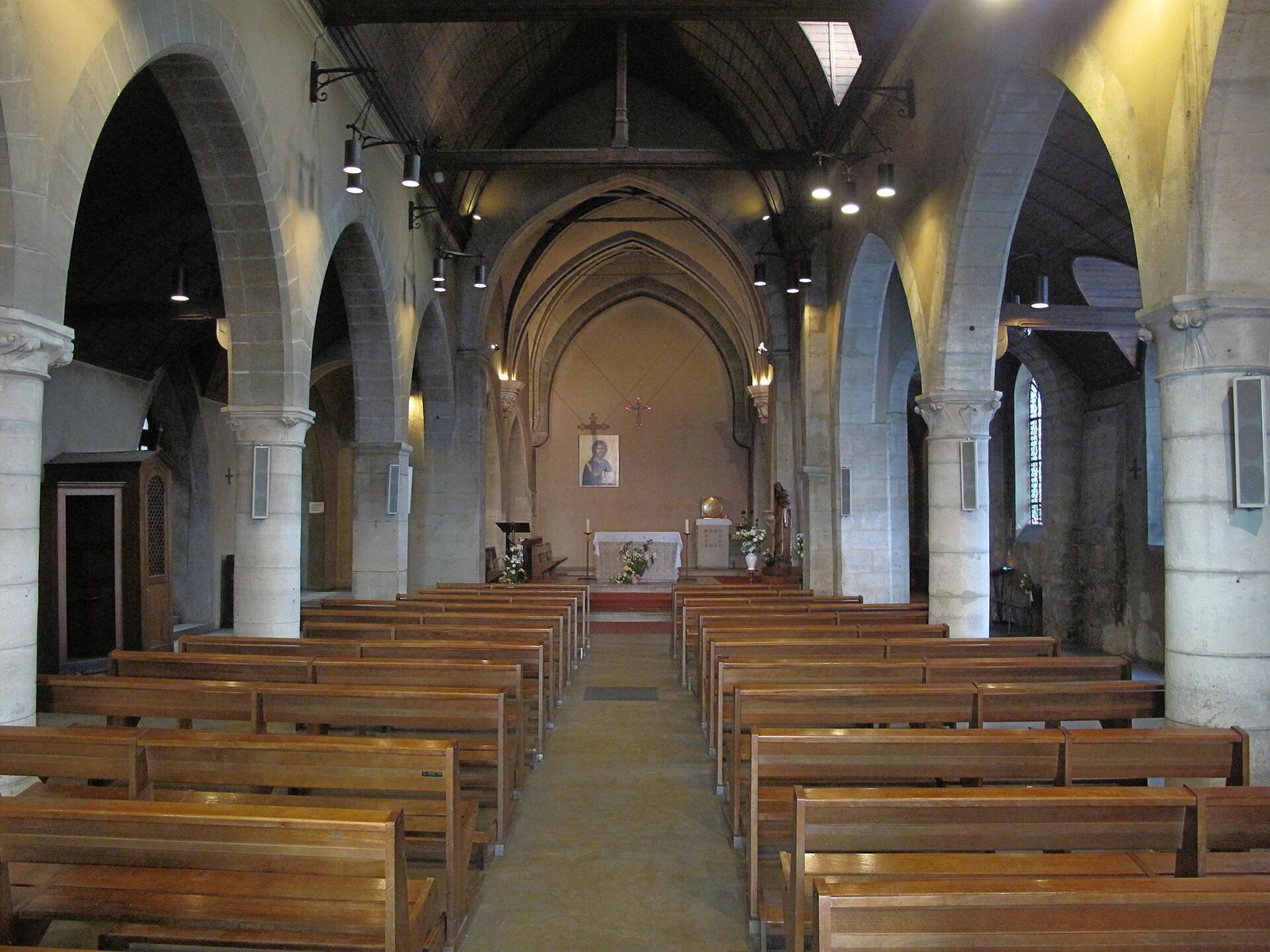
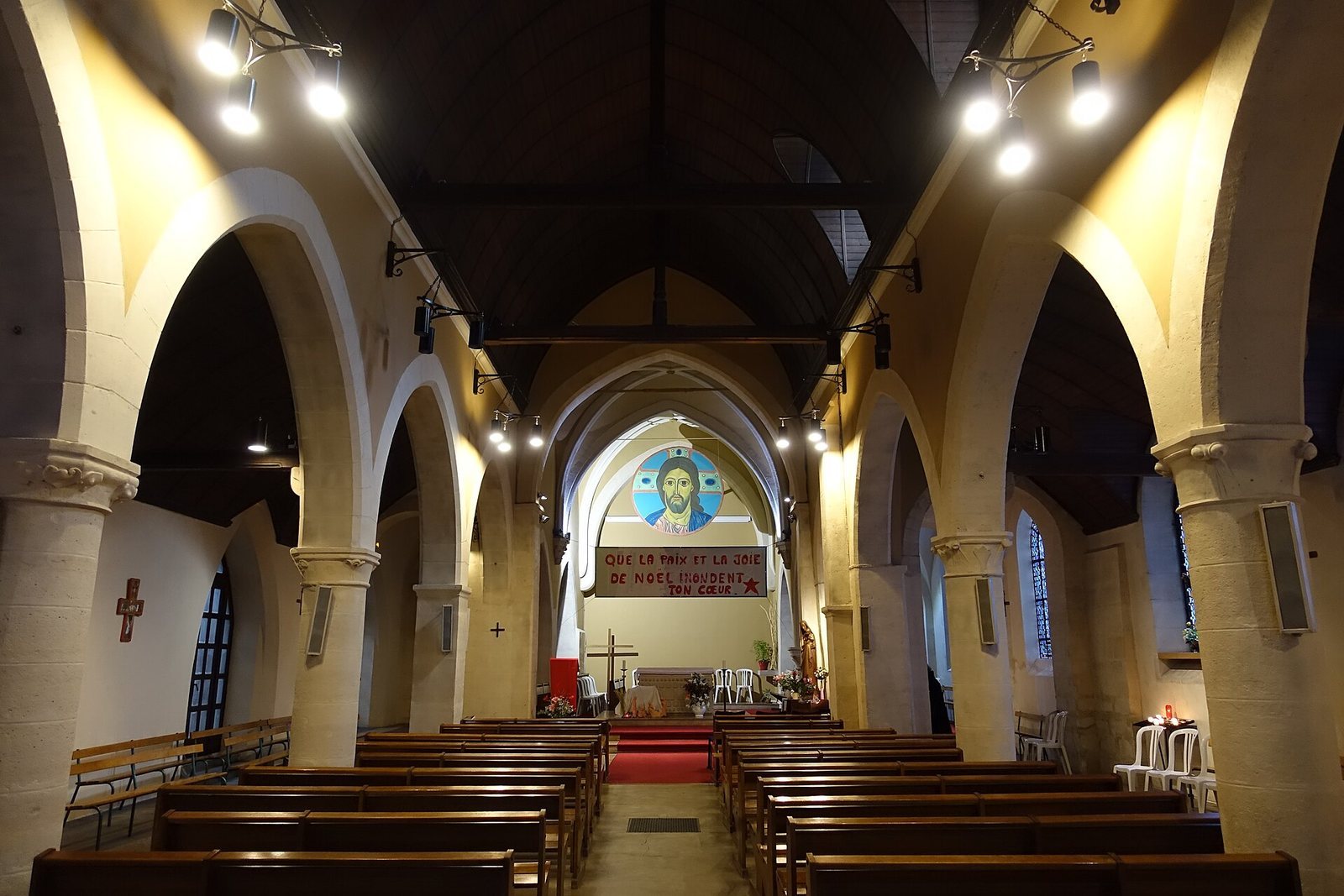
Three pairs of early Gothic pillars support the building. In the central nave, the church’s main interior space, rows of arches rest on columns and their carved capitals, separating it from the side aisles that run alongside it. The arches in those aisles are rounded. A massive cross-shaped pillar in the first section of the nave originally carried the weight of the bell tower built in 1770.
Facade and towers
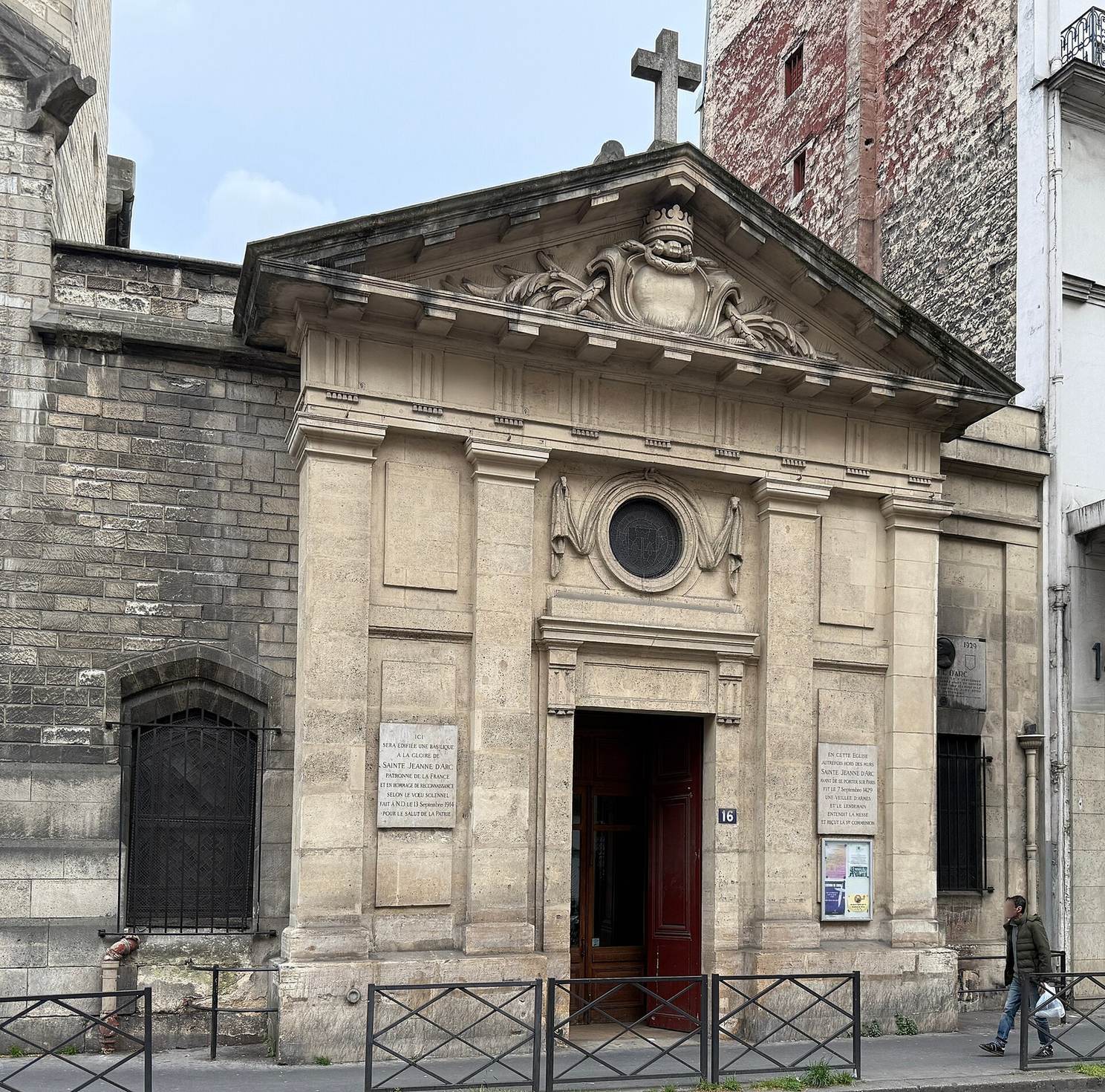
The thirteenth-century church had a porch tower, which was demolished in 1757 because it was at risk of collapse. The surviving facade, built under Louis XV, has a small porch framed by four flat wall columns in the Doric classical style and topped by a triangular pediment. A square bell tower erected in 1770 was taken down around 1930 because it too was in danger of falling.
Windows, sculptures, and church fittings
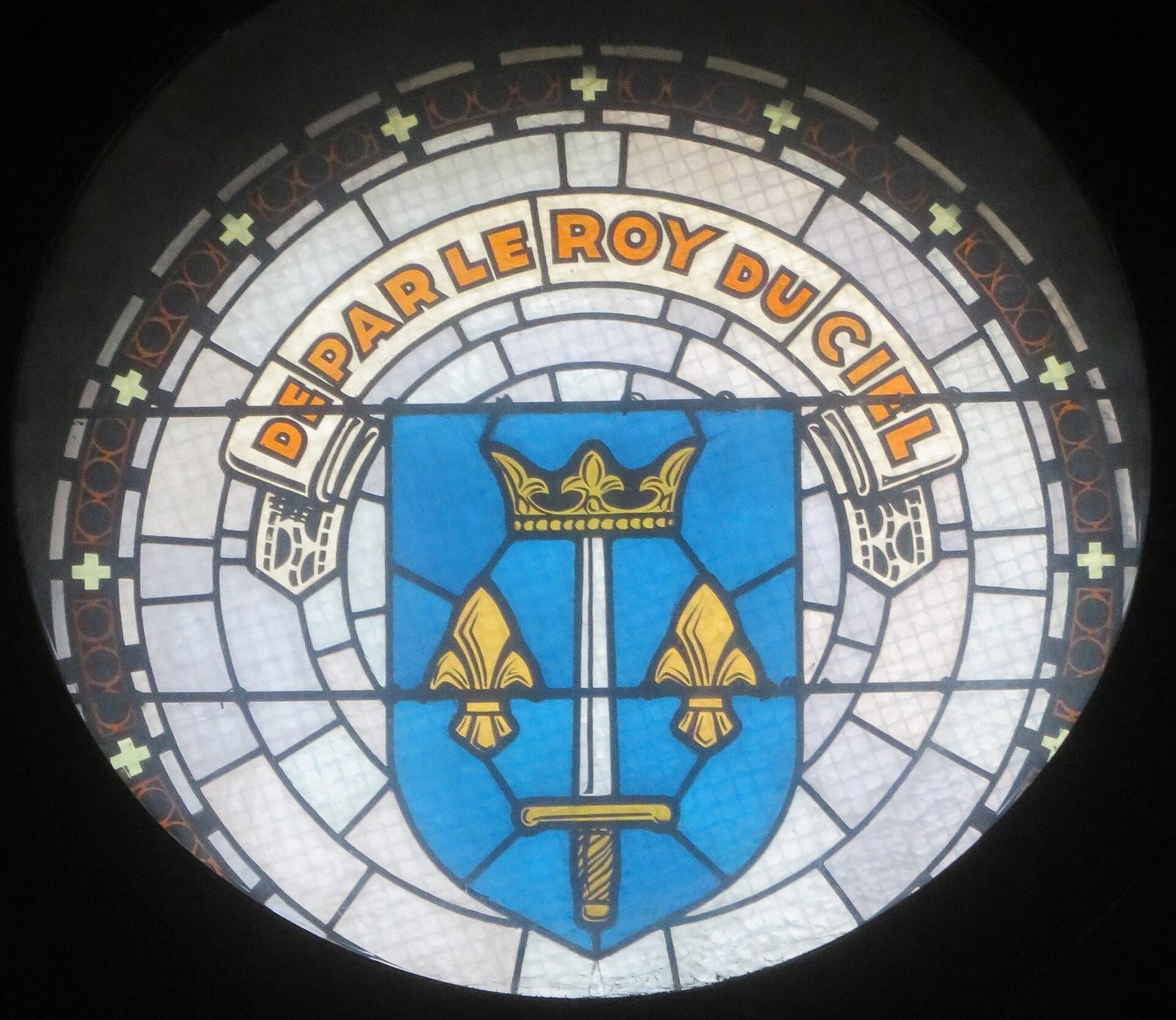
A stained-glass rose window shows two fleurs-de-lis beside a sword topped by a royal crown, recalling the royal processions associated with the church. Other stained-glass windows, made in the nineteenth and twentieth centuries, have elaborate geometric patterns. Plaques on the facade and inside the church commemorate Joan of Arc’s visit on 7 September 1429. A sculpture by Albert Pasche in a side aisle depicts her at the stake. Other sculptures include a polychrome Saint Joseph holding the Christ Child at the entrance and a Virgin and Child.
A cast-iron statue of Joan of Arc by Félix Charpentier, dated 1888, stood beside the church portal from 1894. Made at the Denonvilliers foundry in Sermaize-les-Bains, it was moved in 2004 to the forecourt of the nearby Basilica of Sainte-Jeanne-d’Arc. The church’s organ was renovated, and the restored instrument was inaugurated in a concert in 2014.
Cemeteries and moved memorials
La Chapelle’s burial grounds
The first cemetery lay across the Estrée from the church and extended north along the road. It was in use from 1204 until the early eighteenth century. A second burial ground was established behind the church at Place de Torcy in the eighteenth century. In 1804, it was replaced by the Marcadet cemetery.
Croix-Cottin
Parish churchwarden Philippe Cottin erected the Croix-Cottin, a votive monument associated with a religious vow, in the Place de Torcy cemetery in 1763. It was moved in 1887 to the forecourt of Saint-Pierre de Montmartre.
Adjacent basilica
The Basilica of Sainte-Jeanne-d’Arc stands beside Saint-Denys de la Chapelle and substantially overshadows the older church’s exterior.