Église Sainte-Élisabeth-de-Hongrie: A Baroque Parish Church in Paris
Site at a Glance
- Rating
- 4.6
- Popularity
- Low
- Country
- France
- Primary era
- Early Modern
- External website
- Open
- Eras represented
- Early Modern, Modern
- Civilizations
- French
- Site type
- Religious
- Remains
- Church
On this page20 sections
History
Église Sainte-Élisabeth-de-Hongrie is a Roman Catholic church in Paris, France, built as a Baroque church and monastery chapel in the Temple district during the seventeenth century. Construction began in 1628 under the master mason Louis Noblet, and Queen Marie de Medici laid the first stone on 14 May that year. Work stopped in 1631, before Michel Villedo resumed the project in 1643 and completed the church around 1646.
Foundation and Franciscan community
The church was consecrated on 14 July 1646 in a ceremony presided over by Queen Anne of Austria. Jean-François Paul de Gondi, then coadjutor to the archbishop of Paris and later Cardinal of Retz, conducted the consecration. The building was dedicated to Saint Elizabeth of Hungary and Notre-Dame of Pity. Saint Elizabeth was a thirteenth-century Hungarian princess associated with Franciscan spirituality and Christian charity, connections that shaped both the church’s dedication and its religious imagery.
From 1646 until 1792, the building served as the chapel of the cloistered Franciscan Third Order nuns known as the Dames of Sainte-Élisabeth. The Franciscan Third Order brought Franciscan principles to people and communities outside the orders of friars, and its regular form could include enclosed religious communities. The nuns educated girls and young women and cared for elderly people. Esprit-Madeleine Poquelin, the daughter of Molière, was probably associated with the community. The church bell was sponsored by the Duke of Angoulême, grand prior of the Order of Saint John of Jerusalem, and Charlotte de Montmorency.
Revolution and return to parish worship
The French Revolution brought the community’s expulsion. Municipal authorities of the Paris Commune removed the nuns on 29 August 1792. Their confessor, Georges Girault, known in religion as Father Séverin de Saint Jean, was arrested and imprisoned. He was murdered on 2 September 1792, later regarded as the first martyr of the Carmelites and beatified in 1926. The community’s chaplain, Father Élysée Guinain, was also arrested and imprisoned.
The former chapel became a flour depot called the Magasin Élisabeth, which remained in operation until 1802. Its campanile was destroyed during the Terror, the most violent phase of the Revolution, when arrests, political repression, and executions were widespread. The royal family was imprisoned nearby in the Temple Tower, and the church contains a painting depicting Louis XVI’s farewell to his family on 20 January 1793.
The building returned to Catholic worship in the early nineteenth century and became the parish church of the Temple district in 1802. It replaced Sainte-Marie-du-Temple, the earlier parish church within the Temple enclosure, demolished in 1796 or 1797. The former nuns and their pupils moved to 60 rue de Turenne. Marc-Antoine de Plainpoint served as parish priest from 1802 to 1813.
Nineteenth-century enlargement
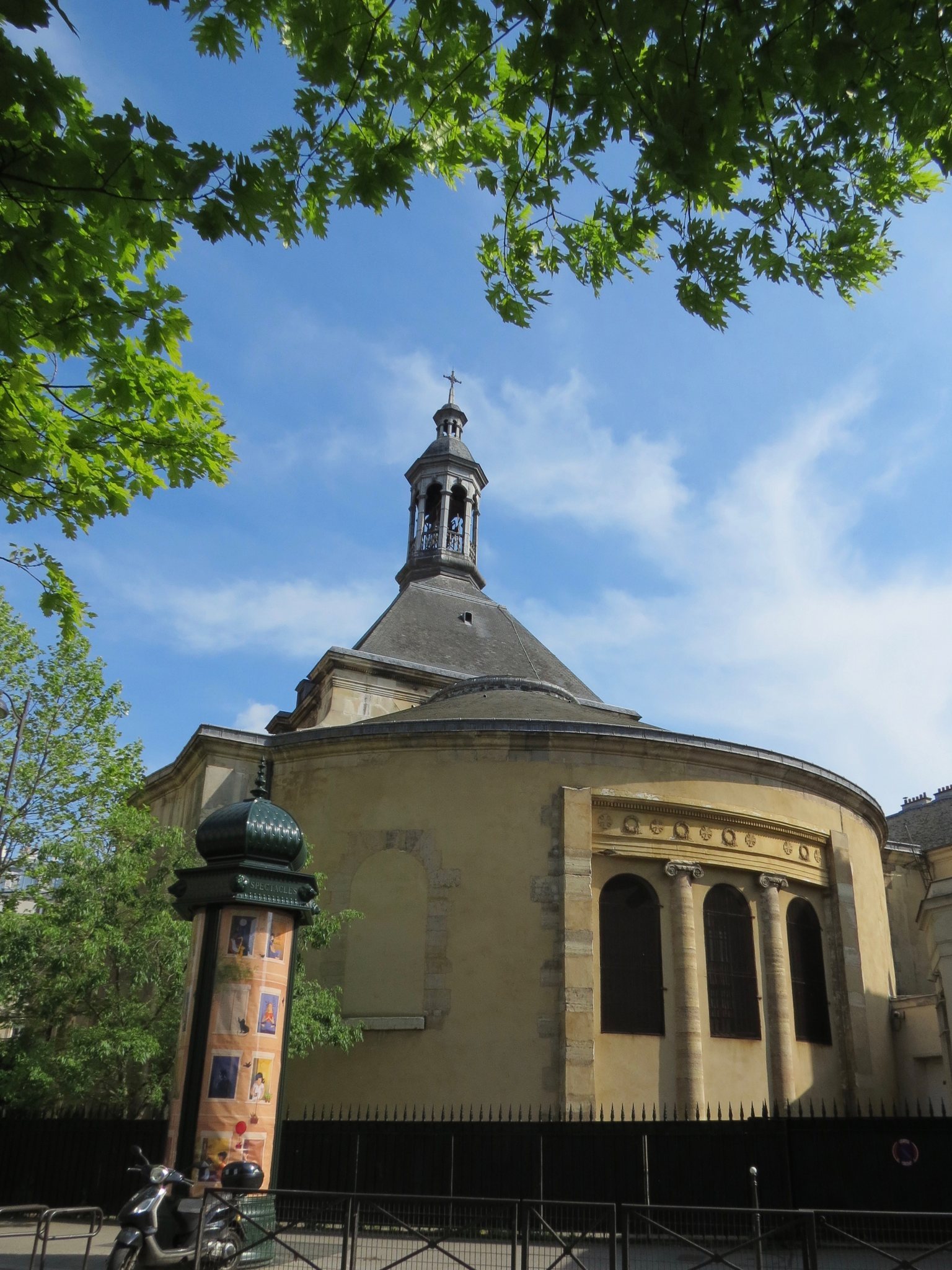
In 1815, Hyacinthe-Louis de Quélen celebrated a Mass for Louis XVI at the request of the bailiffs, commanders, and knights of the Order of Malta, the Catholic religious and chivalric order historically known as the Order of Saint John of Jerusalem. During the Restoration, the period of the restored French monarchy after Napoleon’s fall, the architect Étienne-Hippolyte Godde enlarged the church. He added a choir, an ambulatory, which is a passage running around the sanctuary, and two large chapels on the left. His axial chapel dedicated to the Virgin was demolished in 1858 when rue Turbigo was opened.
Parish priest Éloi Jousselin purchased carved choir-stall woodwork from Saint-Vaast Abbey in Arras in 1845. He also arranged for the installation of the main organ and the woodwork of the nave and side aisles. The Suret grand organ was inaugurated in 1853 and received the first medal at the 1855 Universal Exhibition.
Twentieth-century protection and religious associations
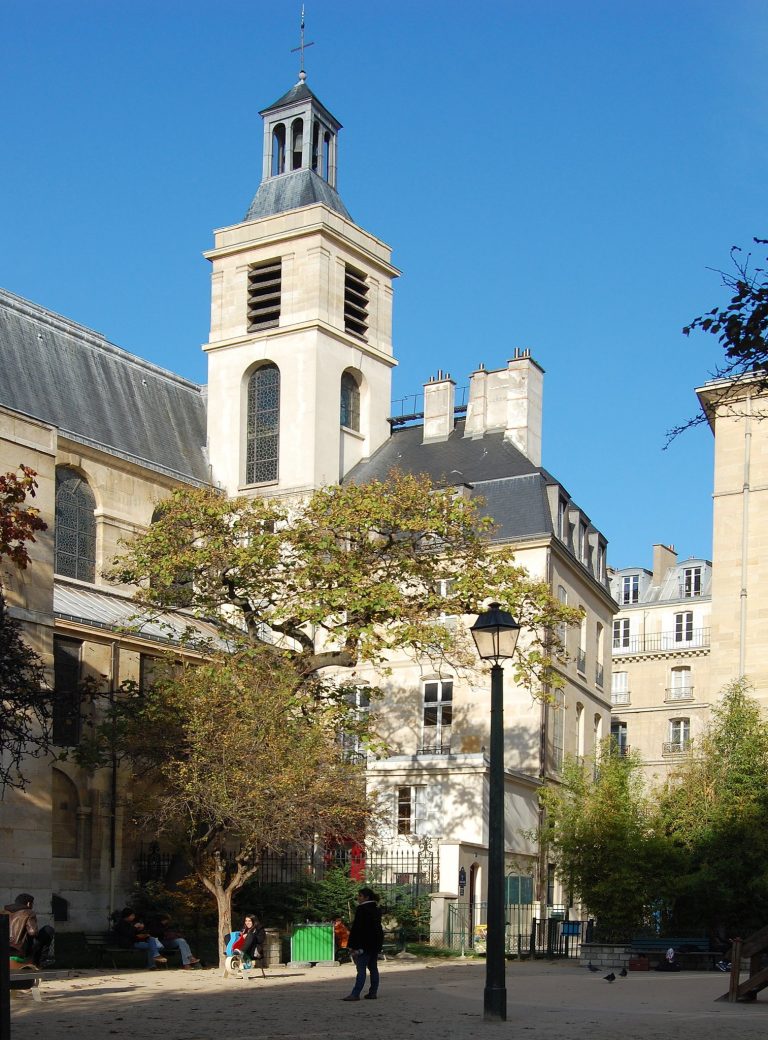
Albert Marcadé was parish priest from 1923 to 1947. During his tenure, the church acquired a new sacristy, a new campanile based on the original design, and a choir organ. The building was classified as a French historic monument in 1937. In 1938, while remaining a parish church, it also became the church of the Sovereign Order of Malta in France. The Sovereign Order of Malta continues to hold certain major services there. Jews were hidden in the church during the Second World War.
The City of Paris carried out restoration work in 1985. The main organ underwent substantial restoration from 1994 to 1999, returning it largely to its original composition and sound. In November 2007, the church hosted celebrations for the eighth centenary of Saint Elizabeth of Hungary’s birth, including a pontifical Mass, veneration of Saint Francis’s mantle, a procession to Notre-Dame de Paris with Saint Elizabeth’s heart relic, and a historical symposium. A plaque honouring Canon Marcadé was installed on the rue du Temple facade in 2015.
On 21 May 2016, the church was the starting point for a procession marking the 1,700th anniversary of Saint Martin’s birth. The procession ended at Saint-Germain-l’Auxerrois. The building remains a parish church attached to the Archdiocese of Paris and is protected through its historic-monument classification.
Remains
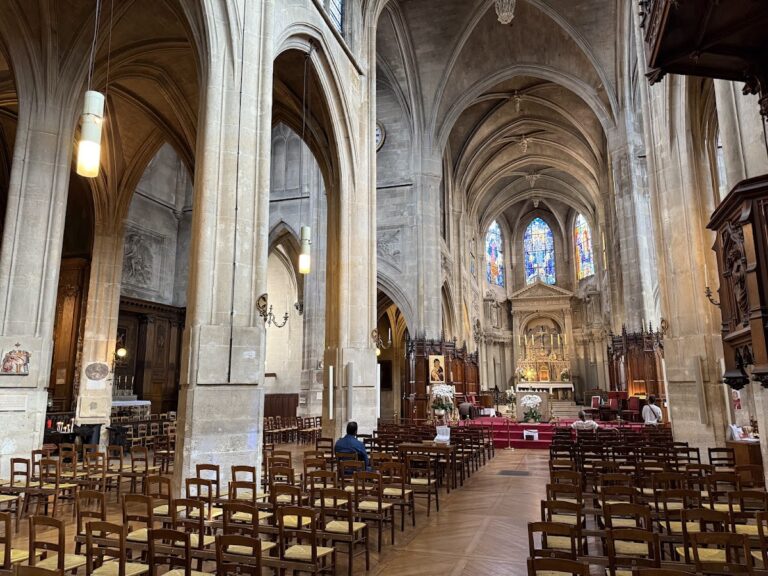
Église Sainte-Élisabeth-de-Hongrie stands at 195 rue du Temple in Paris’s 3rd arrondissement, bordered on one side by passage Sainte-Élisabeth. Its present form combines the original Baroque church with later classical, neoclassical, and nineteenth-century additions. The building contains a nave, two side aisles, a choir, an ambulatory, a campanile, a sacristy, and several additional rooms.
Facade and main structure
Classical facade
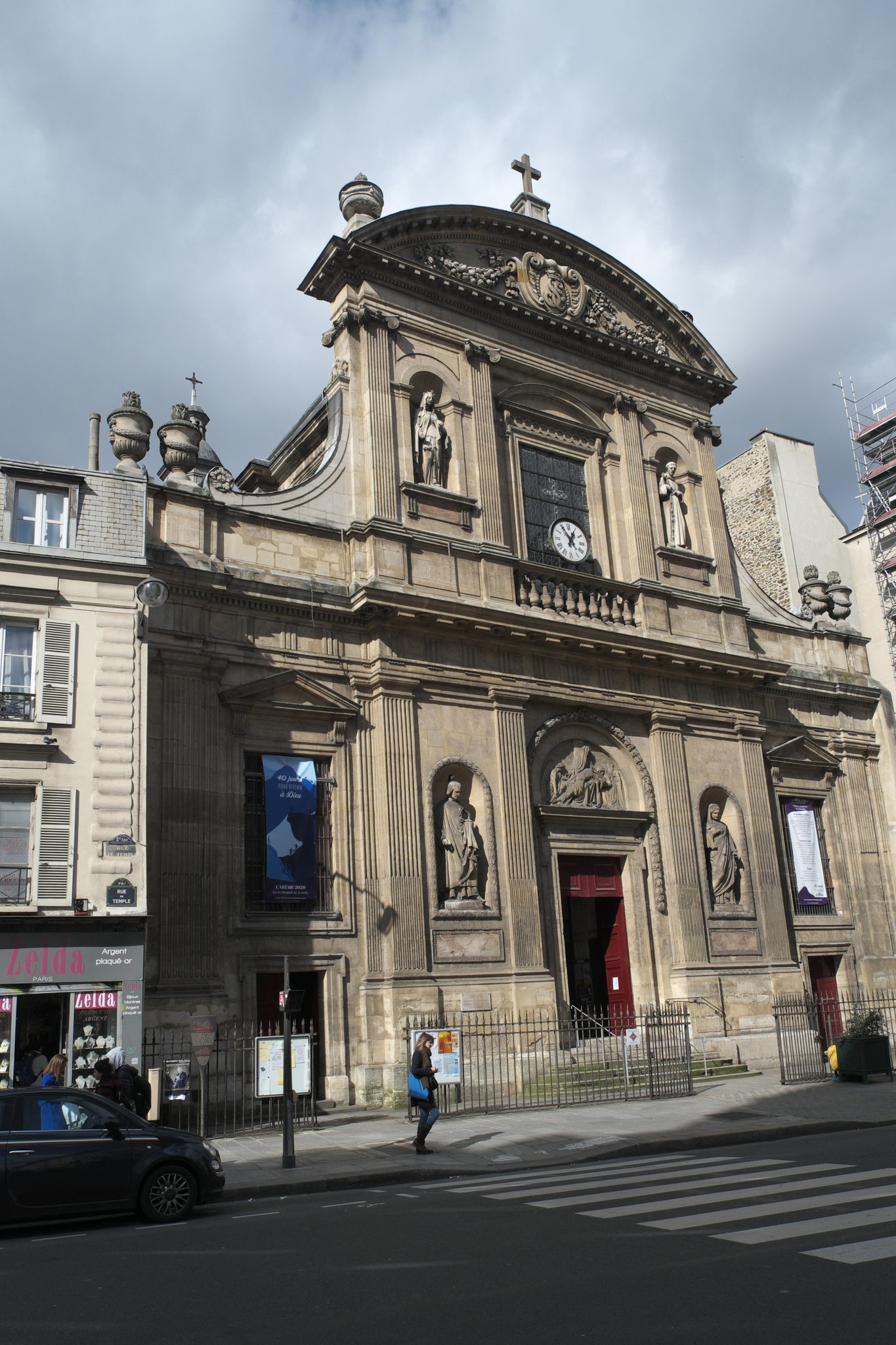
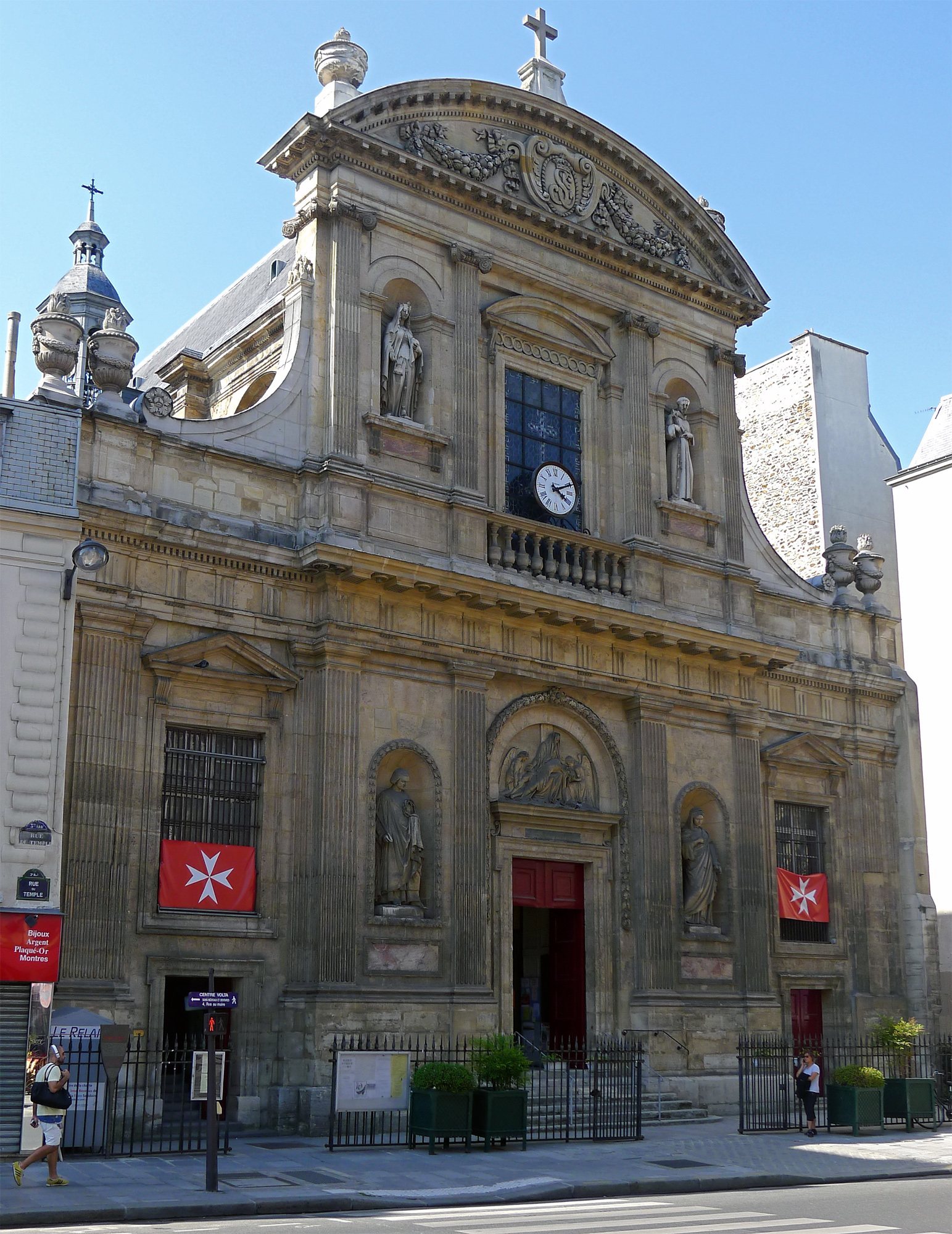
The surviving original facade is a classical composition inspired by Jesuit architecture and the Church of the Gesù in Rome. Pilasters, niches, and other classical elements organize its elevation. The tympanum contains Joseph-Michel-Ange Pollet’s Pietà, showing Christ being taken down from the Cross. Four statues added during the Second Empire, the period of Napoleon III’s rule from 1852 to 1870, decorate the facade. Saint Louis and Saint Eugenia stand on the lower level, while Saint Elizabeth of Hungary and Saint Francis of Assisi occupy the upper level.
Nave and later additions
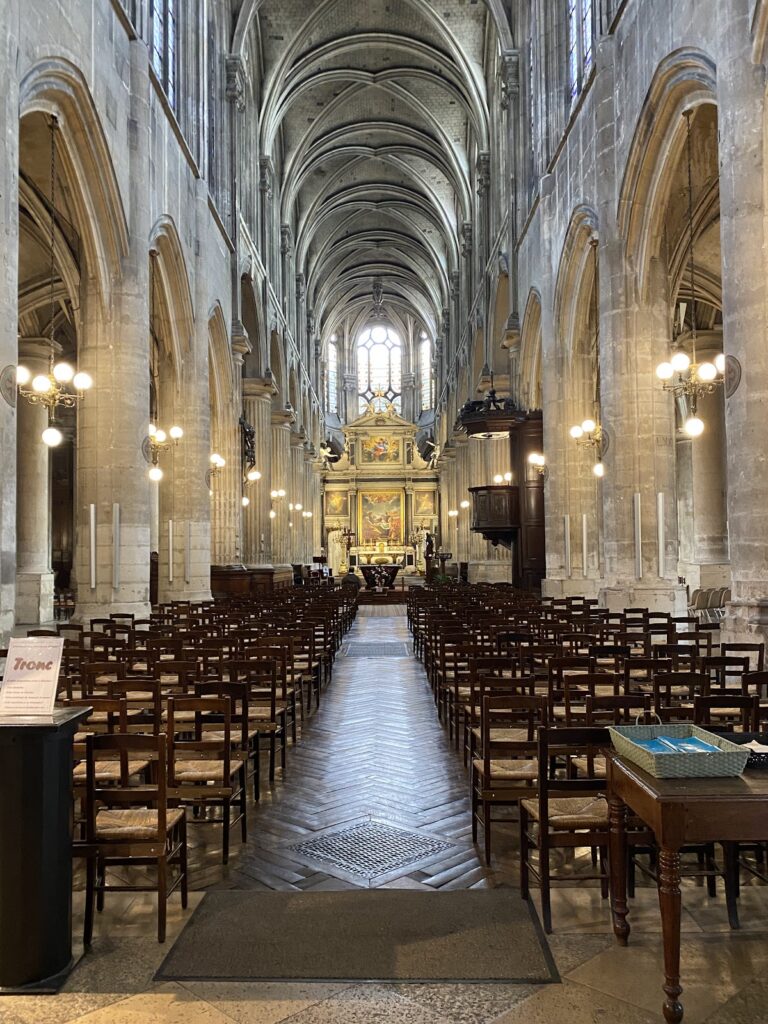
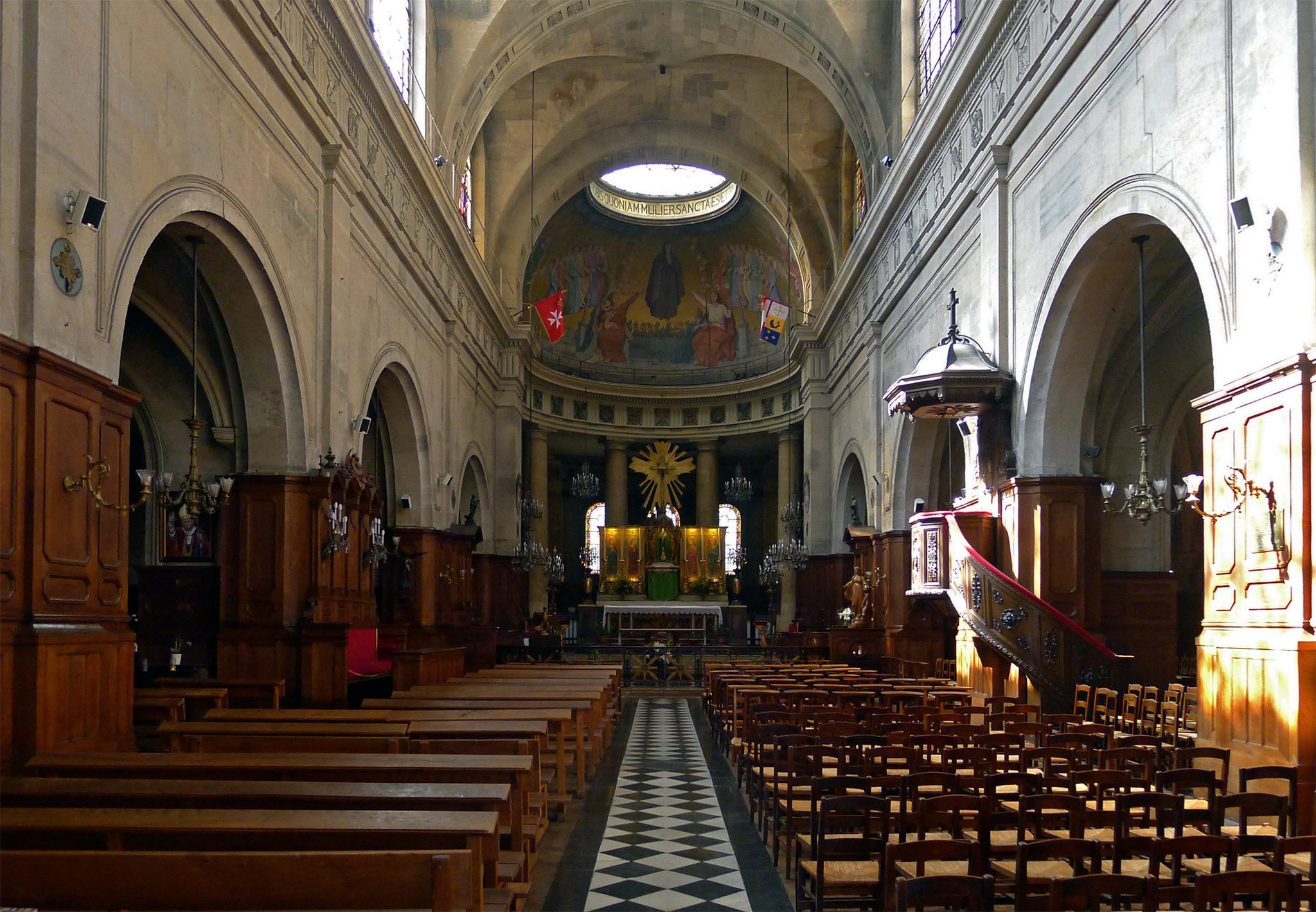
The original church had a four-bay nave, a flat-ended eastern end, one side aisle with four lateral chapels, and a choir occupying the site of the present Chapel of the Virgin. The later apse was shortened to make room for rue Turbigo. The nave retains a cornice and frieze decorated with liturgical symbols and the instruments of the Passion, together with a carved wooden pulpit and a churchwardens’ bench decorated with cherubs.
Choir and ambulatory
Choir
Godde’s nineteenth-century choir has four round classical columns and a half-dome. Its main altar is decorated with paintings of angels in adoration and a nineteenth-century bronze relief of the Resurrection. The choir also contains a wooden altar, choir stalls, and a wooden statue of the Virgin. Jean Alaux’s fresco on the half-dome, The Glorification of Saint Elizabeth of Hungary Welcomed by the Angels in Heaven, shows the saint wearing the Franciscan habit. The three theological virtues and the archangels Saint Michael and Saint Gabriel greet her.
Two choir windows made by the Lobin workshop depict The Miracle of the Roses and The Canonisation of Saint Elizabeth by Pope Gregory, the latter dated 1891. The choir organ stands behind the main altar. Built by John Abbey, it was installed around 1925 and modified by the former Gutschenritter establishments in the late 1950s.
Carved woodwork
The ambulatory contains 100 early-seventeenth-century wooden carvings in medium relief. Made around 1623 for the choir stalls of Saint-Vaast Abbey in Arras, they portray scenes from the Old and New Testaments. Their religious themes reflect the Counter-Reformation, the Catholic response to the Protestant Reformation shaped in part by the Council of Trent. The carvings were forgotten during the eighteenth century, recovered by the architect Victor Baltard, and installed in the church around 1845.
Paintings and triptych
A seventeenth-century Louis XIII-style wooden triptych in the ambulatory represents Christ on the Cross with the Virgin Mary and Saint John. The surrounding nineteenth-century frescoes include The Beatitudes by Guermann von Bohn, The Seven Sacraments by Paul Jourdy, The Last Judgement by Adolphe Roger, and The Seven Works of Mercy by Jean-Louis Bézard. Another work by Roger shows Christ welcoming children.
Sacred Heart altar
The Altar of the Sacred Heart stands in the left ambulatory. It includes an elaborate altar and a statue of the Virgin Mary. Its bronze frontal relief is said to represent the death of Saint Elizabeth of Hungary.
Chapels and side aisles
Side aisles
The side aisles contain the statue of the Virgin of Notre-Dame de la Paix, a statue of Saint Thérèse of the Child Jesus near the catechism chapel, a Virgin and Child, and statues of Saint Joseph and Saint Anthony of Padua. They also contain confessionals and the seventeenth-century baptismal font from Saint-Sauveur Church. Dated 1654, the font remains in use.
Chapel of the Virgin
The Chapel of the Virgin contains a statue of the Virgin Mary dedicated to Notre-Dame de la Paix and an altar decorated with paintings of the three theological virtues by Abel de Pujol. Merry-Joseph Blondel’s large painting Elizabeth Placing Her Crown at the Feet of the Image of Our Lord is also installed there, together with a plaster statue of Saint Elizabeth made by Louis-Denis Caillouette in 1845.
Two stained-glass windows illuminate the chapel. An anonymous painting shows Mary of Bethany at prayer, with Martha of Bethany arguing with Christ in the background.
Catechism chapel
The catechism chapel, also called the Gospel room, contains four nineteenth-century semicircular canvases mounted on its walls.
Stained glass and other artworks
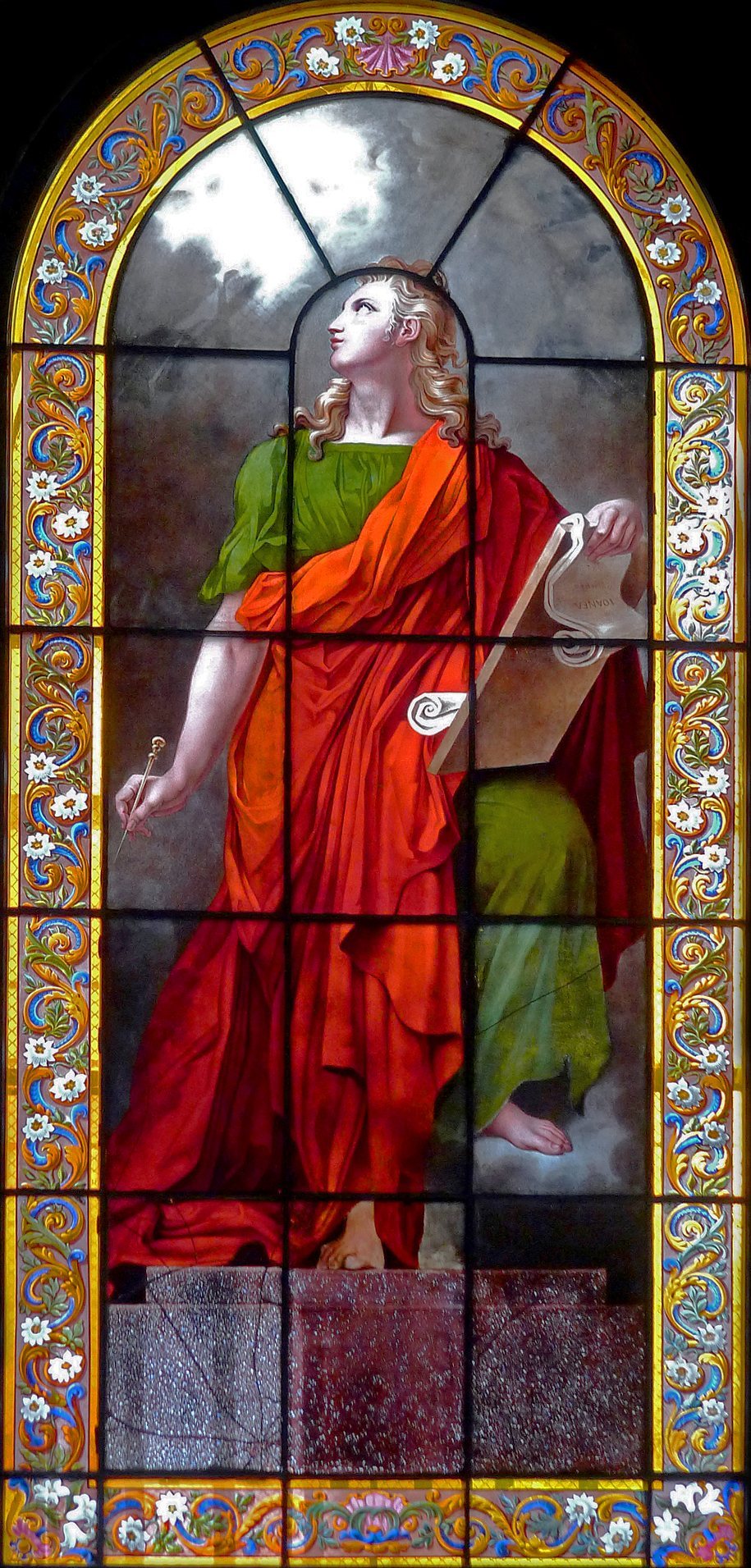
Among the church’s stained glass are windows from the 1820s depicting Saint John the Evangelist, Saint John the Baptist, and Saint Joseph. The glass-painting workshop of the Sèvres Manufactory produced them from designs by Abel de Pujol. Other nineteenth-century windows were made by the Warren-White and Edward Jones workshop and by the Lobin workshop of Tours.
Other works include a sixteenth-century Pietà from Troyes attributed, with some uncertainty, to the Master of Chaource; two statues of Saint Elizabeth; an unidentified wooden painting representing Georges Girault; and a painting of Saint Genevieve guarding her flock. The church also contains nineteenth-century wooden panels illustrating the life of Saint Genevieve and a Stations of the Cross made by Sergio Birga in 2009.
Organs
The tribune organ at the rear of the nave is the largest instrument built by Louis Marie and Paul Louis Suret. Inaugurated in 1853, it has three keyboards, 39 stops, and 30 pedals. The Gutschenritter firm later modified it, and the Giroud manufacture restored it from 1994 to 1999. That work reconstructed the original composition except for the Euphone, replaced by a Plein-Jeu, and reconstructed the free-reed stops as beating-reed stops. The organ is classified as a historic monument.