Arles-Fontvieille Hypogea: Neolithic Burial Monuments in France
Site at a Glance
- Popularity
- Medium
- Country
- France
- Primary era
- Stone Age
- Eras represented
- Stone Age
- Civilizations
- Unclassified
- Site type
- Burial
- Remains
- Necropolis
On this page14 sections
History
The Arles-Fontvieille hypogea are four partly underground burial structures near Fontvieille, France, built during the Neolithic, the later part of the Stone Age associated with farming and polished stone tools. Their similar architecture suggests they were built at roughly the same time, probably in the second half of the fourth millennium BCE. They remained in use through the third millennium BCE.
The group comprises the hypogea of Cordes, Bounias, la Source, and Castelet, together with the associated Coutignargues dolmen. The four hypogea are classified as historic monuments, with classification dates of 1889, 1894, and 1900.
Discovery and later interpretation
Cordes had been known for generations before historian Louis Mathieu Anibert described it in print in 1779. At an unknown date, looters entered through an opening in its ceiling. Its size and position at the ridge summit have prompted the interpretation that it may have been a ceremonial sanctuary rather than a collective tomb. It is also known as the Cave of the Fairies and Roland’s Sword. Local stories imagined the monument as the scabbard of Durandal, the sword of Roland, a hero of medieval French legend. Other tales placed treasure attributed to the Moors inside, guarded by a serpent or by a druid, a religious specialist in ancient Celtic societies, asleep for a thousand years. The Tarasque, a monster in Provençal tradition, was also linked to the site.
Bounias and la Source were discovered by chance in 1866 by Bounias, a deputy mayor of Fontvieille who owned the land. The first excavations were not scientifically controlled, but the human remains recovered from the two monuments, representing about 100 individuals, established their use as burial places. Castelet had been noted by Véran in the eighteenth century; archaeologist Paul Cazalis de Fondouce excavated it methodically in 1876. The work uncovered remains of about 100 people and many objects. Castelet also served as a blacksmith’s workshop for nearly four centuries.
Cazalis de Fondouce, Marius Huart, and Nicolas excavated the Coutignargues dolmen in 1876. The Brothers of the Christian Schools of Arles also worked there, and Gérard Sauzade carried out further research in 1972. The group was once called the Arles hypogea and is now more commonly known as the Arles-Fontvieille hypogea.
Remains
The four hypogea lie near Montagne de Cordes. Cordes occupies the western, highest part of the ridge, facing the Castelet plateau. Castelet lies in an oval artificial mound north of a road, while Bounias, la Source, Cordes, and the Coutignargues dolmen are among low hills to its south.
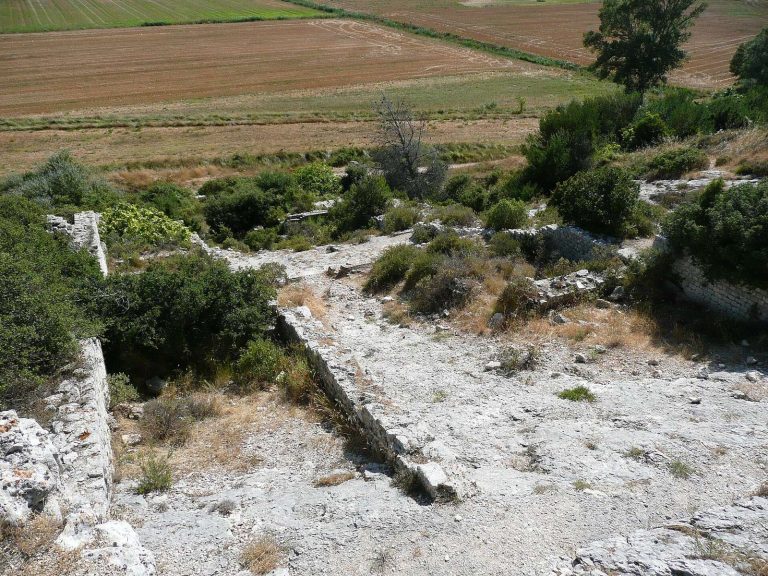
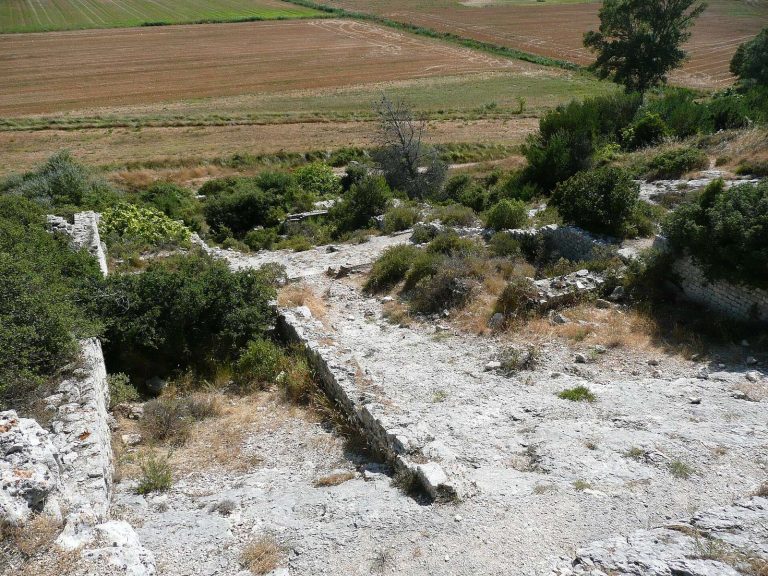
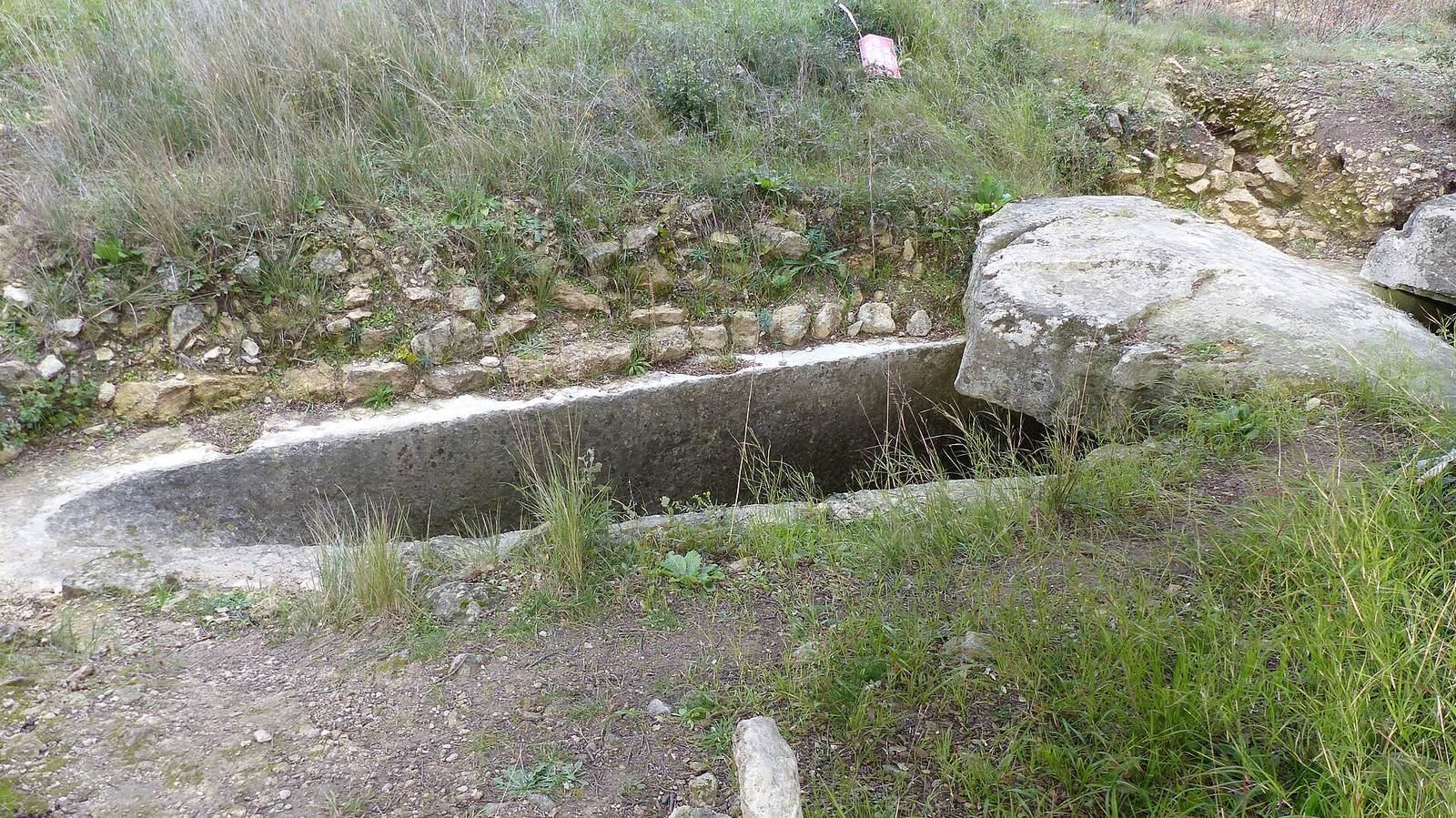
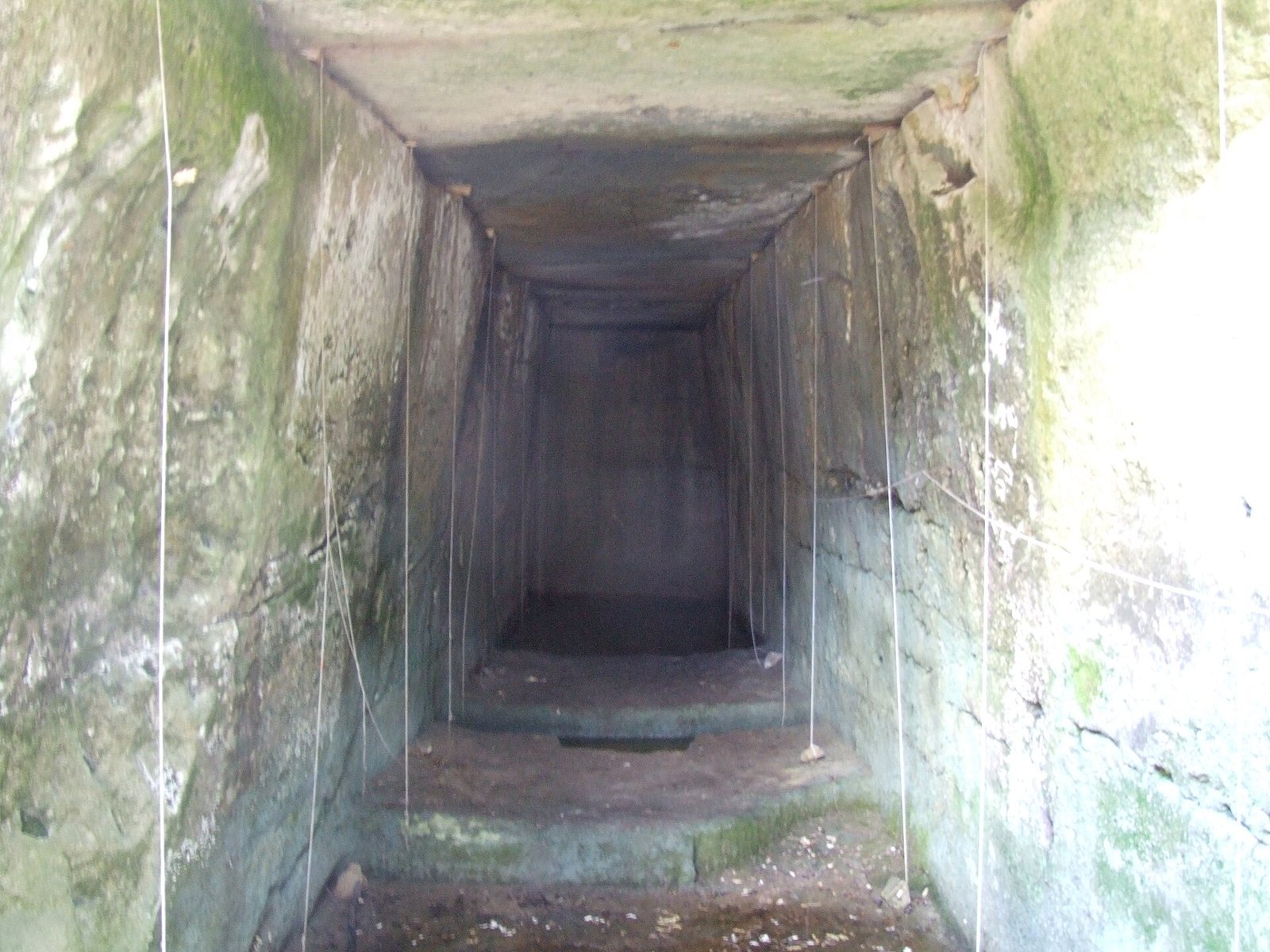
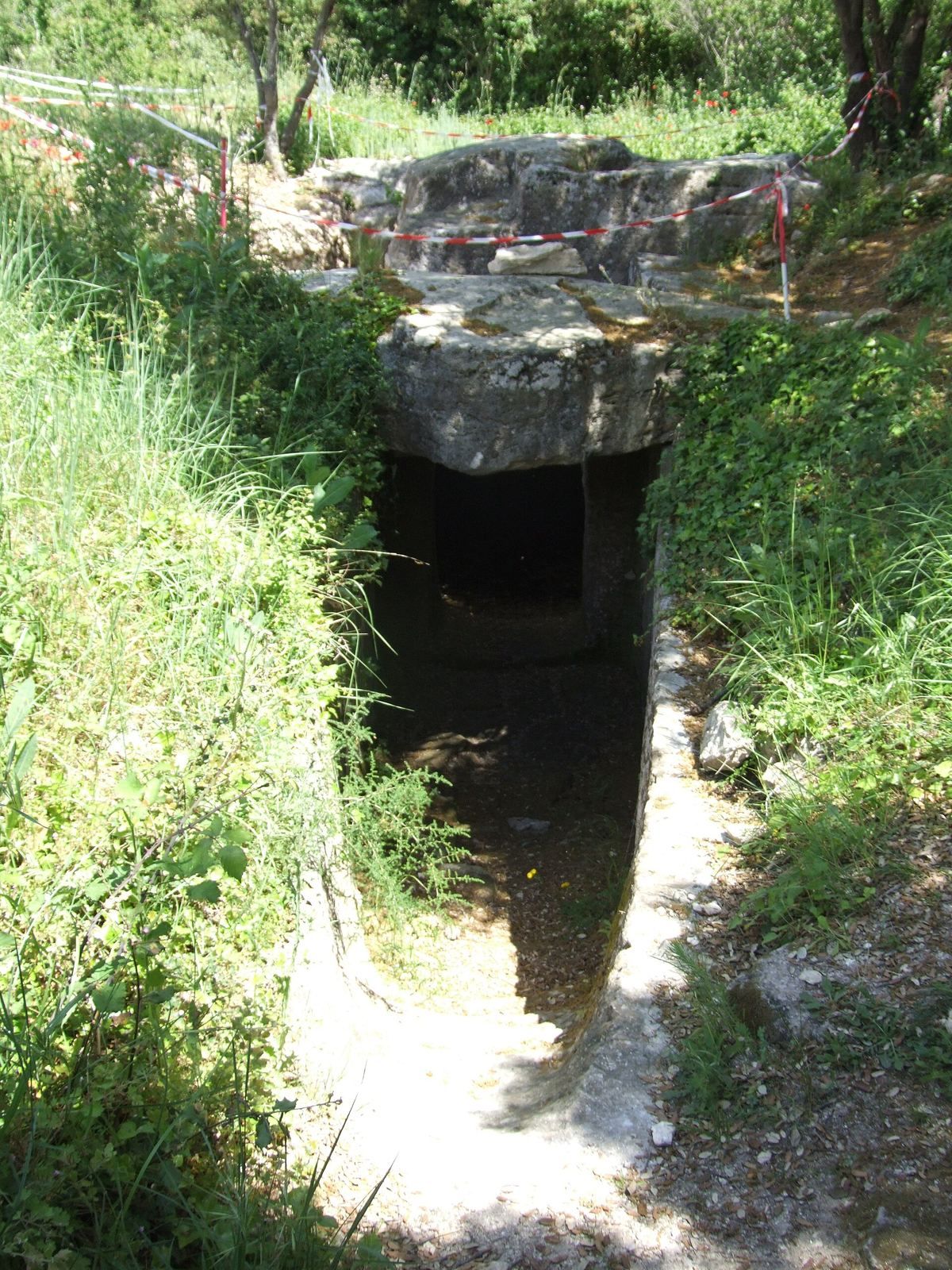
The monuments combine trenches excavated into the ground with roofs made from large stone slabs. Their usual plan has a descending, stepped entrance leading to an antechamber and then to a long, rectangular or slightly trapezoidal burial chamber. This arrangement resembles that of covered-gallery tombs.
Cordes hypogeum
Staircase and burial gallery
Cordes is the largest hypogeum in France and one of the largest in the Mediterranean region. Montagne de Cordes rises 65 metres; around 2500 BCE, it was the highest of three islands in the Rhône. The monument begins with a staircase 10.5 metres long and 2.7 metres wide, descending 3.4 metres. Its entrance chamber has two symmetrical side spaces. An arched doorway, 2.5 metres high and 2.65 metres wide, opens onto a 5.5-metre passage leading to a terminal gallery about 25 metres long. The gallery narrows from 3.8 metres wide at its entrance to 2.85 metres at the far end. Seven roof slabs, each 0.7 to 1.3 metres thick, cover it. The whole cavity is 42 metres long and reaches four metres below the surface. A rounded earthen mound covers the main chamber’s roof.
Separate slab near Cordes
A separate slab near the hypogeum is broken into four pieces and measures 7 metres high and 3 metres wide. It may have served as a marker stone.
Bounias hypogeum
Built beneath a burial mound, Bounias follows a plan resembling Cordes but on a less monumental scale. A 2.5-metre access ramp leads to a 3.7-metre vestibule, partly sheltered by the first roof slab. Its trapezoidal doorway is made of molasse, a soft sedimentary rock; the doorway is 0.5 metres thick, with rounded upper corners. Beyond it, a gallery 12.1 metres long and 2.5 to 2.8 metres high is covered by seven successive slabs. Finds include arrowheads, a flint blade, a hemispherical ceramic cup, and a fragment of a mallet.
La Source hypogeum
Chamber and mound
The smallest of the four, la Source takes its name from a spring at the foot of a nearby cliff. It measures 16.6 metres overall. Its long, slightly trapezoidal gallery is 12 metres long, 2.7 metres wide near the entrance and 1.9 metres at the far end, with a height of about 2.4 metres. Seven closely fitted stone slabs cover it. The fourth slab bears about a dozen cup-shaped marks, several curved lines, and a roughly circular design with four rays and a long curved stem. A burial mound 38 metres in diameter covered the tomb. A rock-cut boundary trench survives for about 10 metres along its west-northwestern side; upright stones set into the trench held the mound fill.
Finds
Finds from la Source include human bones, a small polished axe, arrowheads, blade fragments, two perforated fox canines, a beige-grey flint perforator, and a serpentine pendant. The beads comprise eight elongated, subconical steatite beads, a light-green, jasper-patterned marble bead shaped like an olive, and another subconical bead. Other objects include three small copper-plate fragments, an awl made from a rabbit shinbone, and pottery of varying coarseness, including a sherd with a double-knob handle.
Castelet hypogeum
Gallery and later alteration
Also called Arnaud Cave, after the family that owned the property when it was discovered, and Blacksmith’s Cave, Castelet has a gently sloping access ramp shaped like half a boat. Its gallery is 10.8 metres long. A blacksmith made a quadrangular opening through the third roof slab; this opening is known as the blacksmith’s chimney.
Finds
The human remains include a vertebra pierced by an arrow. Objects from the hypogeum include 584 soapstone beads, 114 beads of variscite, one gold bead, arrowheads, javelins, and an archer’s wristguard. Other finds include axes, bone artefacts, shells, and pottery ranging from early undecorated ware to Bell Beaker pottery, a prehistoric tradition known for bell-shaped vessels.
Coutignargues dolmen
Also called the Coutignargues Cave or Saint-Continharda Dolmen, this monument has an access ramp leading to a burial chamber bounded by a head slab and projecting dry-stone walls, built without mortar. Its floor is paved with pebbles. Finds include a large flint blade, a dagger, arrowheads, olive-shaped serpentine beads, callaïs beads made from green or blue ornamental stone, beads fashioned from fish vertebrae, rock-crystal pendants, an awl made from rabbit bone, and seven picks made from quartzite pebbles.