Fondaco dei Tedeschi: Venice’s German Merchants’ Residence and Warehouse
Site at a Glance
- Popularity
- High
- Country
- Italy
- Primary era
- Early Modern
- Eras represented
- Medieval, Early Modern, Modern
- Civilizations
- Italian, Venetian
- Site type
- Economic
- Remains
- Caravanserai
On this page13 sections
History
The Fondaco dei Tedeschi was a Venetian residence and warehouse for German merchants beside the Rialto Bridge in Venice, Italy. A fondaco combined lodging, storage, and supervised trade, while Tedeschi means Germans. The institution took shape in the early thirteenth century, and its building is first recorded on 5 December 1228. Its beginnings are also dated to 1222 or 1225, though 1228 is the most commonly cited date. The building’s Renaissance form followed a fire and reconstruction between 1505 and 1508.
Establishment and trade
German merchants and craftspeople were based near the church of San Bartolomeo by the early thirteenth century. A Venetian archival document from December 1213 names Bernardus Teotonicus, a goldsmith. A similar trading institution may have existed before 1200, although merchants were not then gathered in one building. The name Fondaco dei Tedeschi first appears in 1268.
The Venetian Senate, the republic’s governing council, assigned the merchants a building beside the Rialto Bridge on the Grand Canal. It served as both accommodation and a warehouse for goods traded with Germany. By concentrating foreign merchants and their goods in one place, the institution allowed Venetian authorities to supervise commerce and collect customs duties. Northern and central European merchants were expected to live there and keep their trading offices and storage on the premises. Boatmen could not take them elsewhere with their goods, and Venetians were barred from lodging them, although that restriction was not always obeyed. Visitors who were not merchants could choose their own accommodation. Merchants ceremonially handed their weapons to the Fontegher, the Venetian official who assigned rooms.
The Fondaco’s trade connected Venice with northern Europe and the eastern Mediterranean, and goods continued north toward the Alps. Imports from northern regions included leather, furs, metals, horn, wool, and linen. Venice sent out spices such as saffron, pepper, ginger, nutmeg, cloves, cinnamon, and sugar, as well as olive oil, almonds, figs, citrus fruit, preserved foods, and wines including Malvasia and Chierchel. Other traded goods ranged from coral, pearls, precious stones, and Murano glass to silk, cotton, damask, velvet, brocade, gold thread, camlet and boccasin cloth, paper, and books. The Nuremberg exchange linked Italian commerce with other European commercial centers.
In the early sixteenth century, merchants from Nuremberg and Augsburg shared the leading position at the Fondaco. Communal meals seated merchants at two tables arranged partly by precedence. The Nuremberg table included people from Nuremberg, Cologne, Basel, Strasbourg, Speyer, Worms, Mainz, Frankfurt, and Lübeck; the Regensburg table included people from Regensburg, Augsburg, Ulm, Biberach, Ravensburg, Constance, Vienna, Enns, Linz, Gmunden, Salzburg, and Ljubljana. In early modern usage, the term German could also include Hungarians, Austrians, and Flemings, and some uses extended into the nineteenth century. Merchant families included the Nuremberg Imhoff, Koler, Kreß, Mendel, and Paumgartner families, and the Augsburg Fugger and Höchstetter families. The Fuggers maintained local offices at the Fondaco by the late fourteenth century.
Three Visdomini, patrician officials from Venice’s hereditary ruling elite, presided over the institution. Its staff also included a public goods-weigher, two accountants, and a guardian known as the fonticajo. The building grew in the fourteenth century to incorporate houses belonging to the Polani family. Each year, clergy from San Bartolomeo visited on Christmas Eve and on the year’s final day. In the sixteenth and seventeenth centuries, public masked balls lasting three days and nights took place there before Carnival began. The German merchants also commissioned Albrecht Dürer to paint The Feast of the Rose Garlands for San Bartolomeo.
Fire and Renaissance rebuilding
A fire destroyed the Fondaco during the night of 27–28 January 1505. Within five months, the Senate had decided to rebuild it. While work proceeded, the German merchants stayed temporarily in houses belonging to the Lipoman family beside the Rio de Santa Fosca. Venice paid for the reconstruction, completed between 1505 and 1508. The rebuilding is attributed to Giovanni Giocondo of Verona, with Antonio Abbondi supervising the work.
After the Venetian Republic
Following the fall of the Venetian Republic in 1797, the Fondaco’s commercial institution was permanently abolished and its property confiscated. Under Napoleonic rule, the building was assigned to the state treasury in 1806. After 1815, during Austrian rule, it housed the customs administration and other financial offices. In the nineteenth century, merchant Vittorio Tedeschi was a leading figure associated with the Fondaco and maintained connections with Transylvanian nobility and the Austro-Hungarian Empire. From 1870 to 2011, the building served as Venice’s main post office.
The Benetton Group bought the building in 2008. A proposal by Dutch architect Rem Koolhaas to convert it into a shopping and exhibition center drew local opposition. In 2012, a national architecture committee rejected major proposed changes, including removing part of the roof to add a storey, placing escalators in the courtyard, and installing a floating dock on the Grand Canal. OMA, the Office for Metropolitan Architecture, subsequently revised the design. Renovation and adaptation took place in 2014–2016, and the building reopened in October 2016 as a shopping center operated by LVMH, with a public cultural space. Its commercial use ended in spring 2025 after LVMH did not renew its lease.
Remains
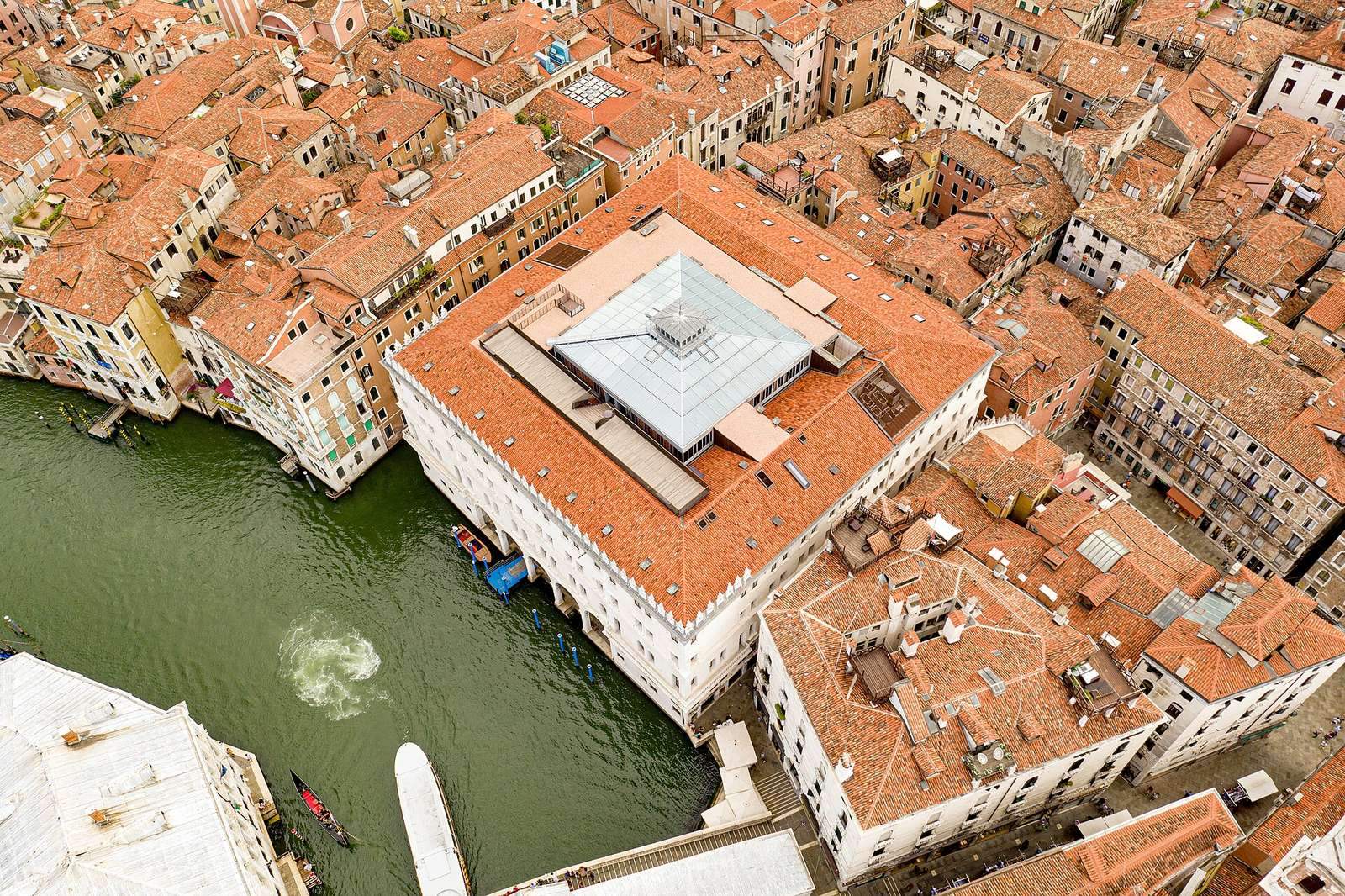
The large, square-plan building is arranged around an inner courtyard and consists of four building sections. Its surviving form reflects a substantial Renaissance rebuilding. It contained 56 rooms, additional storage areas, and space for more than 100 merchants, a similar number of servants, and administrative officials.
Building layout and exterior
Canal frontage
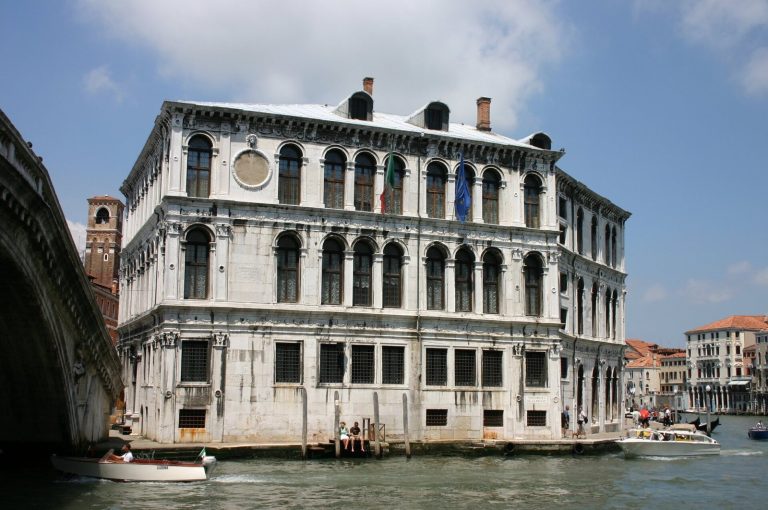
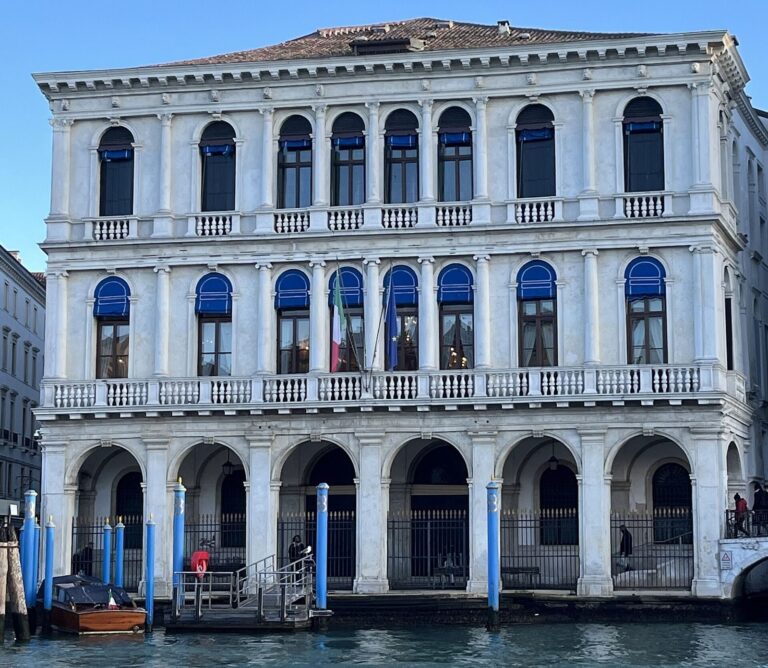
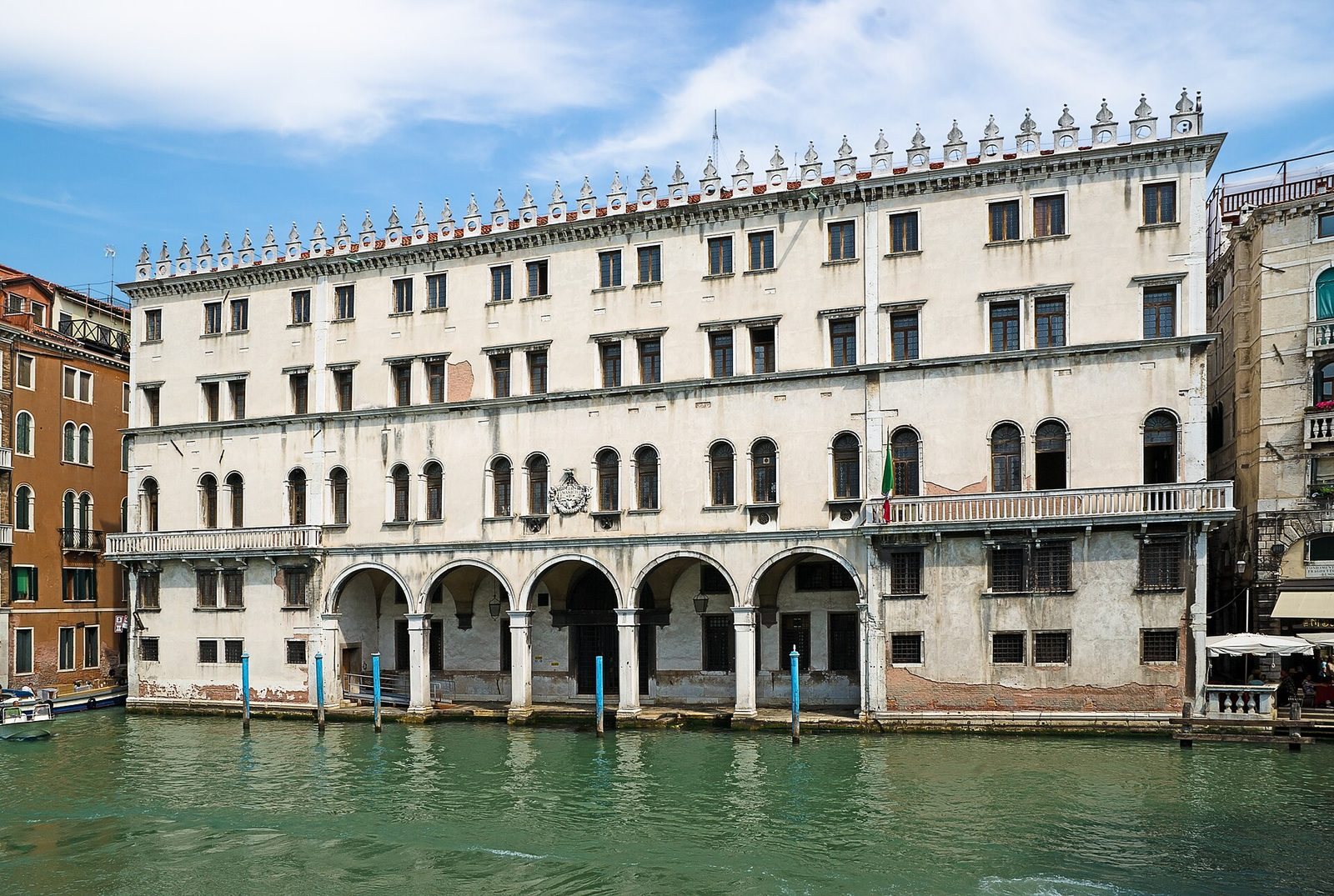
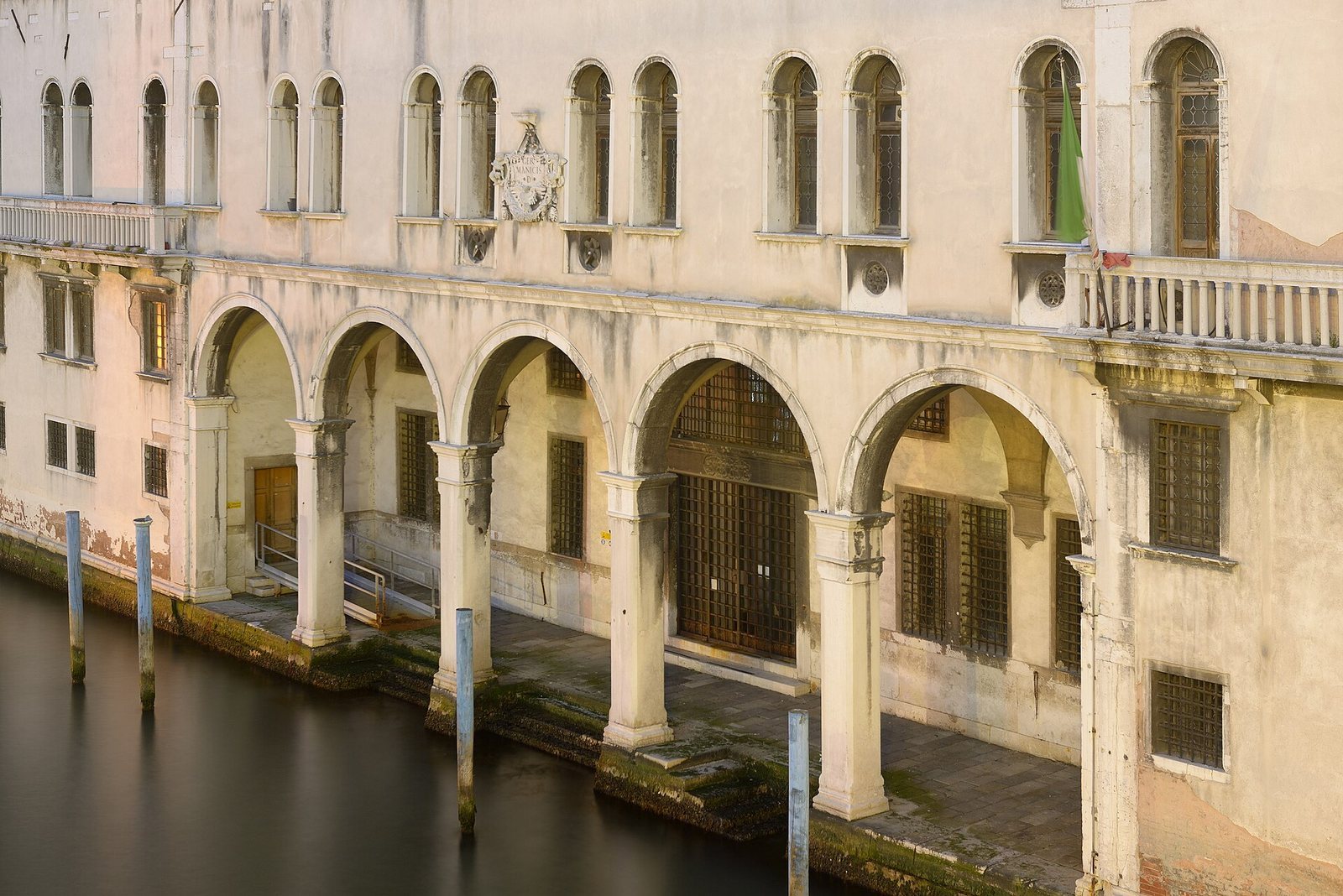
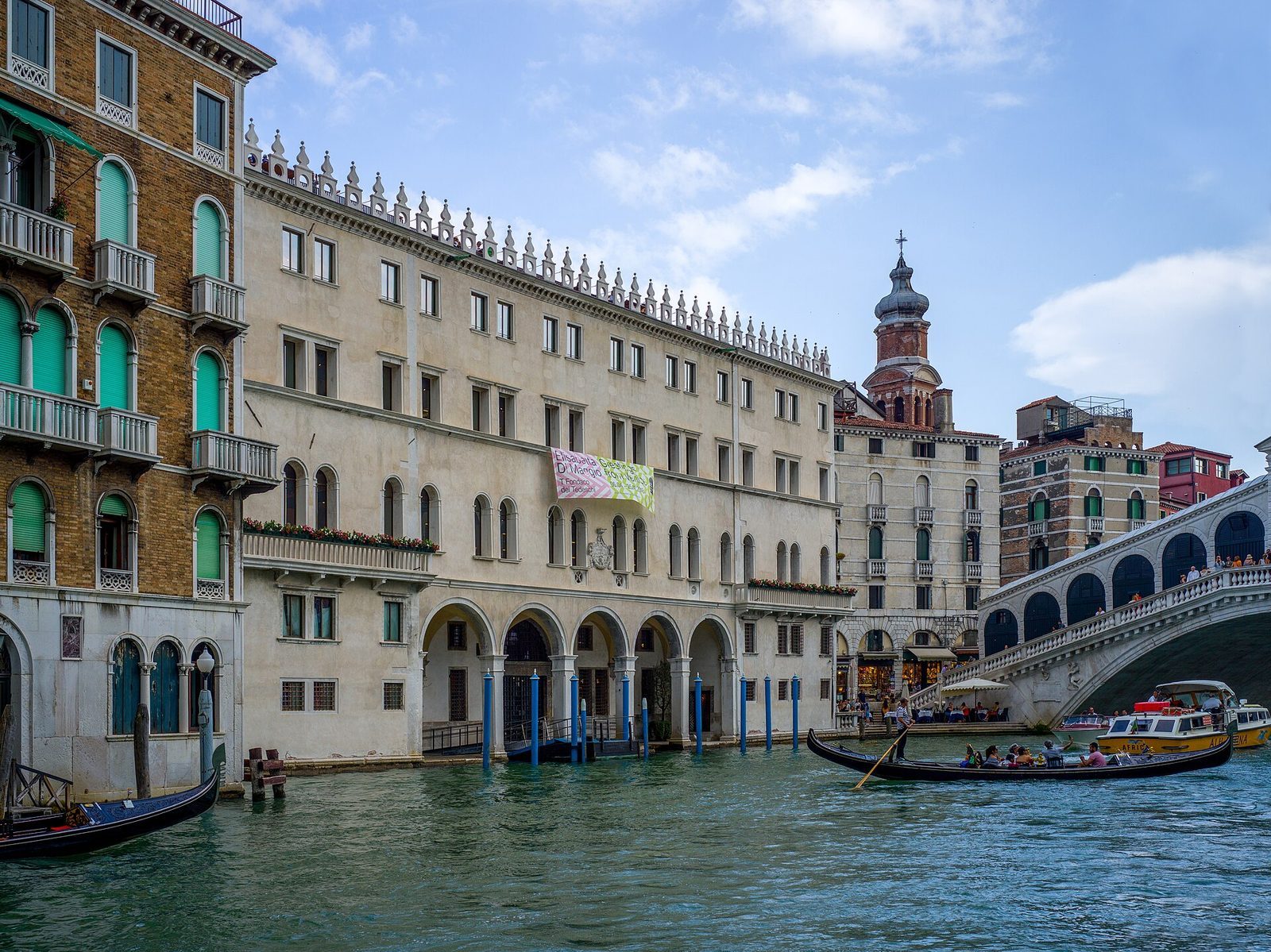
Five large round arches form a portico on the Grand Canal side, where boats could load and unload goods. The canal-facing loggia is a covered, open-sided gallery with five bays. Storage occupied the ground floor, where goods could be brought in from the water; merchants’ living quarters and shared dining areas were on the upper floors.
Upper elevations
The exterior has long rows of windows divided by vertical bars and tall, narrow windows with pointed arches. These are arranged symmetrically with smaller square windows on the upper storeys. The roofline has notched crenellations with circular openings topped by spheres. A large wall clock installed in 1571 remains among the building’s decorative features. The arrangement of the stairs has been compared with that of Wakala al-Ghauri, a historic commercial lodging complex in Cairo. Broad lower arches paired with smaller arches above have also been compared with the design of the Great Mosque of Damascus.
Inner courtyard
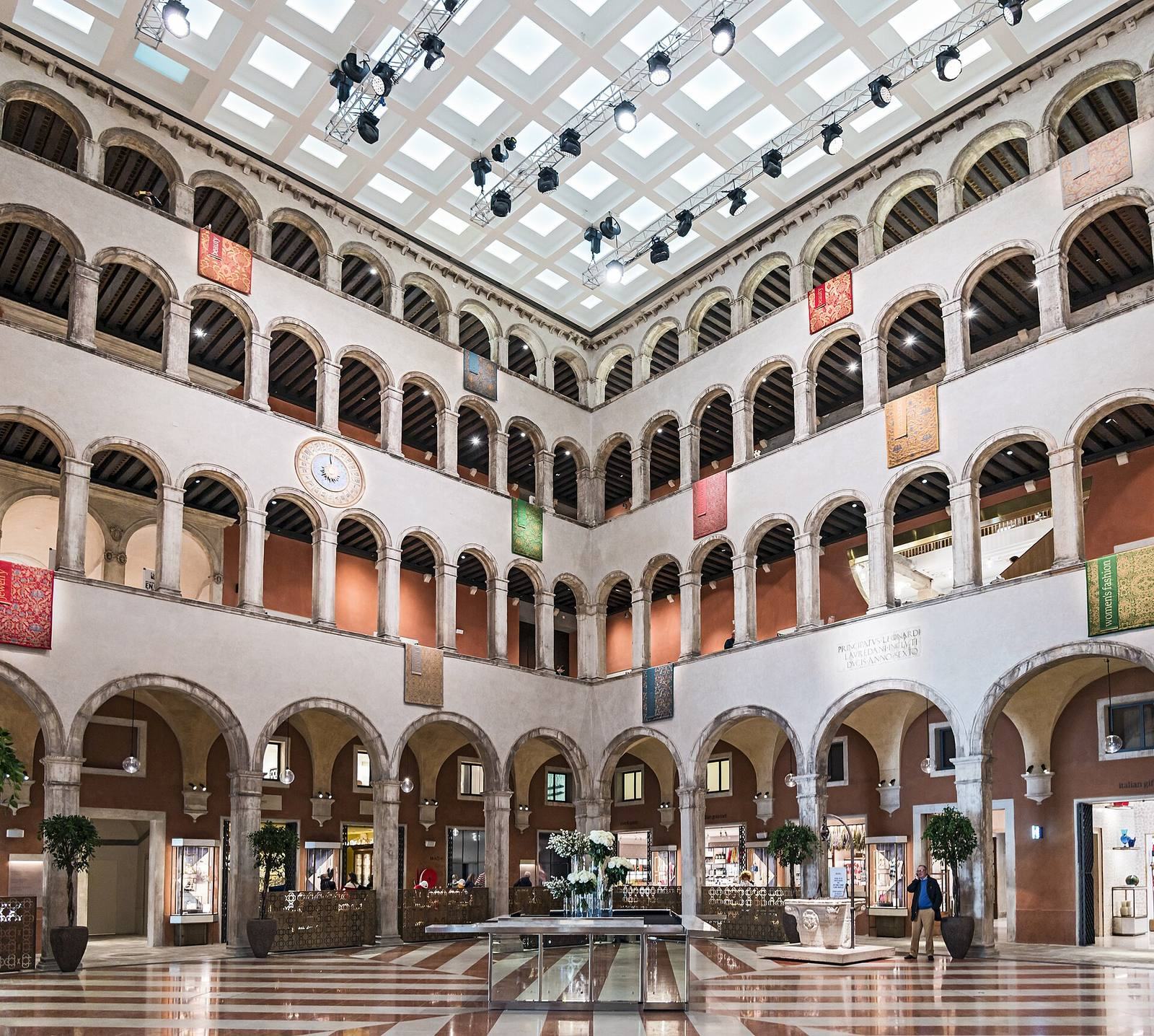
An old well survives in the courtyard, now covered by a glass-and-steel structure with recessed panels resembling a coffered ceiling. The covering also forms a new floor above the courtyard. A later loggia accommodates escalators as part of the building’s adaptation.
Painted decoration
Exterior frescoes
Giorgione and Titian painted the exterior façades around 1508. Their frescoes showed men and women in varied or foreign dress, nude figures, and local officials. The lagoon’s humid, salty conditions caused most of the painted decoration to deteriorate, leaving fragments and traces of color. Anton Maria Zanetti’s prints from around 1760 preserve images of frescoes that could still be made out at that time. Sections were detached from 1937 and conserved at several locations, including the Doge’s Palace and the Gallerie dell’Accademia; surviving fragments are also associated with Ca’ d’Oro.
Identified remnants of Giorgione’s work include The Nude, painted in a niche, and fragments of female figures. Detached works by Titian include Compagno della calza, measuring 241 by 159 centimeters; Justice, 212 by 346 centimeters; Combat of Giants and Monsters, 157 by 320 centimeters; Allegory, 157 by 328 centimeters; and Fight of a Putto with a Dragon, 155 by 375 centimeters. A putto is a child figure in European art.
Interior decoration
The building’s interior decoration included works associated with Paolo Veronese, Titian, and Tintoretto. The banquet hall held an image of the Savior attributed to Titian, Tintoretto’s painting of Diana in a chariot pursued by the Hours, and gilded leather painted by Veronese with fables and stories. Paintings of Jupiter, Juno, and other deities also decorated the hall. Almost all traces of this interior decoration have been lost.
Traces of commercial use
Merchants’ marks carved into the stone of the columns identify rooms used to store goods. These marks remain visible evidence of the building’s trading and warehousing functions.