La Almoloya: An El Argar Political and Administrative Center in Bronze Age Spain
Site at a Glance
- Popularity
- Medium
- Country
- Spain
- Primary era
- Bronze Age
- Eras represented
- Bronze Age
- Civilizations
- Unclassified
- Site type
- Settlement
- Remains
- Town
On this page13 sections
History
Argaric settlement
La Almoloya is a settlement of the El Argar culture in Spain, occupied during the Bronze Age from about 2200 to 1550 BC. El Argar was a Bronze Age society in southeastern Iberia. La Almoloya served as a major political and administrative center, where wealth was concentrated. About 250 people lived there during more than six centuries of activity.
Its inhabitants belonged to a hierarchical society. Argaric communities developed pottery and metalworking, using bronze, silver, and gold for weapons and ornaments. Most of the metal raw material used at La Almoloya is thought to have come from the Sierra Morena, about 300 kilometres away. Some extraction may also have taken place at the As mine.
The settlement was eventually abandoned. The wider Argaric society is thought to have collapsed amid poor management of natural resources and human-caused environmental damage, especially deforestation. These factors have not been established as the cause of La Almoloya’s abandonment.
Investigations and interpretations
Spanish archaeologist Emeterio Cuadrado brought La Almoloya to wider attention in 1944. New investigations began in 2013 as part of the La Bastida de Totana archaeological research project, led by the Autonomous University of Barcelona.
Excavators uncovered grave 38 in 2014. Radiocarbon dating places the burial at around 1700 BC. The high-status woman and man buried there have prompted interpretations of women’s political standing. The woman may have held authority over a territory rather than only leading a settlement, and silver objects in other high-ranking women’s graves at La Almoloya also point to substantial political status for women.
One proposal suggests that La Almoloya may have been a ceremonial or sacred center as well as a political one. In this interpretation, rites may have taken place in the hall, and the people in grave 38 may have held religious roles. It further proposes that the man represented the Sun and the woman the full moon. This reading draws on the hall’s orientation, comparisons with ritual spaces in the Near East, and the close relationship between political and religious life in the period.
Remains
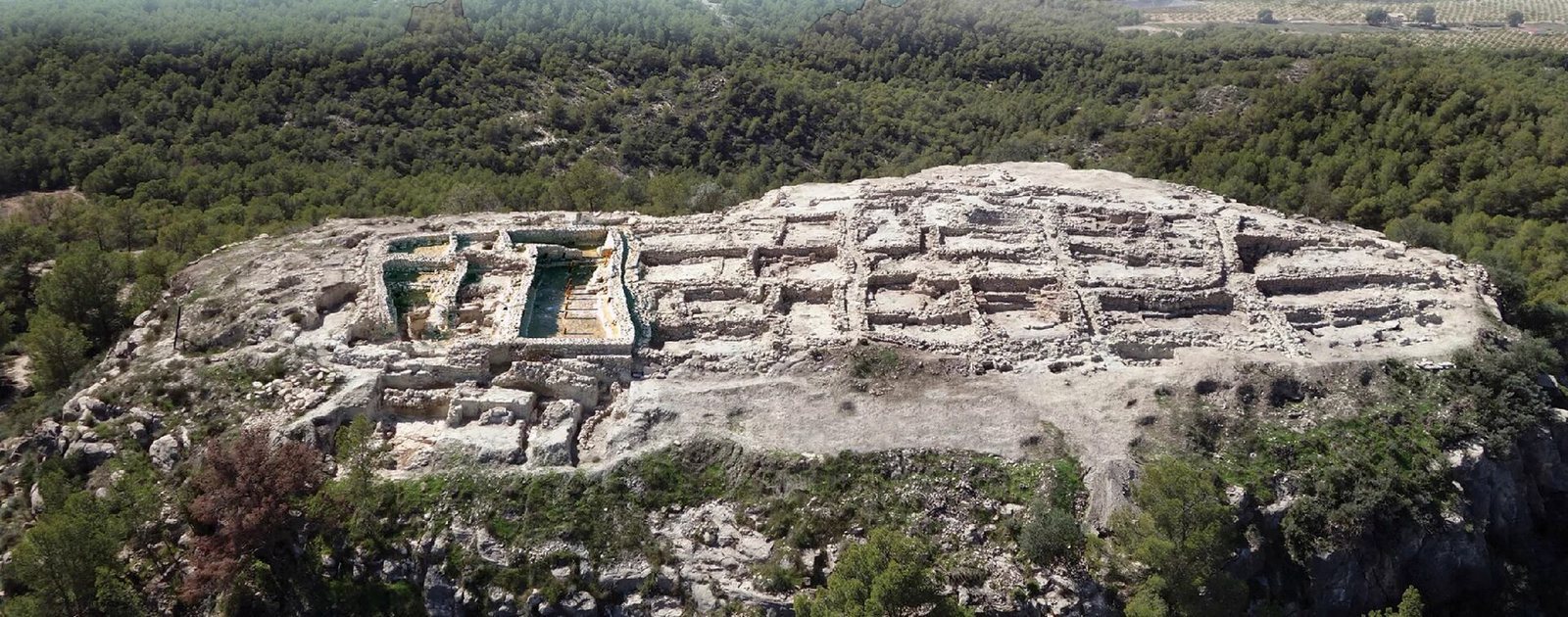
The settlement occupies a flat limestone hill at an elevation of 561 metres and covers about 3,800 square metres. The hill consists mainly of conglomerate and fossil-bearing limestone. Ravines, hills, and mountain ranges over 500 metres high surround the site, with broad views across much of the Río Mula district. Nearby springs include La Portuguesa, about 2,100 metres away, Las Anguilas at about 2,200 metres, and Fuente la Higuera at about 3,300 metres. Houses stood on the hilltop platform, separated by narrow streets and drains.
Buildings and water supply
Houses and enclosure
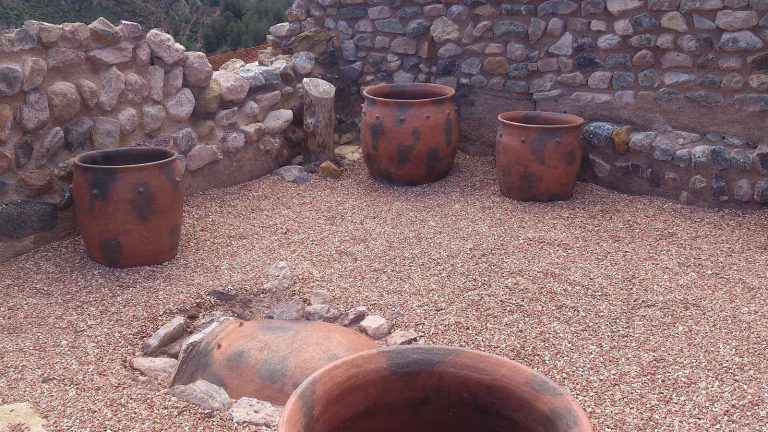
A stone enclosure appears to have defended the western, southern, and northwestern sides of the summit. Stone walls were coated with mortar and bound with lime. Producing lime required organized work and kilns that reached about 900°C. Residential buildings covered about 300 square metres and contained eight to twelve rooms for domestic tasks, metalworking, grinding grain, weaving, and storage. Roofs combined timber poles or trunks, branches, and layers of hardened mud.
Palace hall
The palace included a hall of about 70 square metres, furnished for gatherings and ceremonies. Benches along the walls could seat up to 64 people, while twelve posts set in a zigzag pattern supported the high roof. A ceremonial podium stood before a hearth that provided heat and light. The hall may have been used for meetings, hearings, celebrations, and political decisions.
Cistern
An oval cistern held up to 12,000 litres of water. Thick layers of clay and marl lined its walls to make the structure watertight.
Burials and human remains
Burial customs
Around 76 single and double graves lay beneath houses. The dead were buried either in stone-slab containers called cists or in urns. The recorded remains comprise 55 adults, including 33 women and 22 men, and 28 infants. In each case, the dead were placed with their arms and legs bent close to the body.
Grave 38
The remains of the woman and man in grave 38 were placed together in an urn beneath the floor of the palace hall. The woman, aged about 25 to 35, had a silver diadem, a band-like ornament worn on the head, on her skull. Other grave goods included semi-precious stones; gold, silver, and copper objects; daggers; objects for stretching the ears; rings; chains; and ceramic vessels inlaid with silver foil. The assemblage also contained ivory and amber. The diadem has been interpreted as an emblem expressing social values and requiring respect. A female infant, identified as the couple’s child, was buried separately elsewhere at the site.
Skeletal evidence
Examination of several skeletons suggests that riding was common among men and that people made intensive use of their right arms. Men of the ruling class wielded bronze or copper weapons, including swords. Some individuals showed signs of infectious lung disease.
Decoration and small finds
Painted designs adorned many structures and walls, combining geometric patterns such as dots, lines, circles, and triangles with naturalistic imagery. Small, simple clay figures, usually depicting cattle, were also found, along with a few ceramic vessels decorated with geometric designs.