Rudhall House: A Historic Manor House in Herefordshire
Site at a Glance
- Popularity
- Medium
- Country
- United Kingdom
- Primary era
- Medieval
- Eras represented
- Medieval, Early Modern, Modern
- Civilizations
- English
- Site type
- Domestic
- Remains
- Manor House
On this page4 sections
History
Rudhall House is a manor house in Rudhall, Herefordshire, United Kingdom, with origins in the late 14th century. Its history includes development by the Rudhall family, later changes under successive owners, and restoration in the 20th century.
Medieval origins and Tudor development
In the Tudor period (1485-1603), the manor passed to Herbert Westfaling II, who had married the Rudhall heiress. William Rudhall developed the house in the 16th century.
Later alterations and ownership
The house was extensively remodelled in later centuries and restored in the 20th century. In the early 19th century, it was reputedly a meeting place for Lord Nelson, the British naval commander, and Emma Hamilton during their tours of the Wye Valley. Alexander Baring, 1st Baron Ashburton, purchased the manor in 1830. Later owners included ornithologist Peter Scott and business executive John Harvey-Jones.
Rudhall House became a Grade I listed building on 25 February 1966. Grade I is England’s highest listed-building category, for buildings of exceptional interest.
Remains
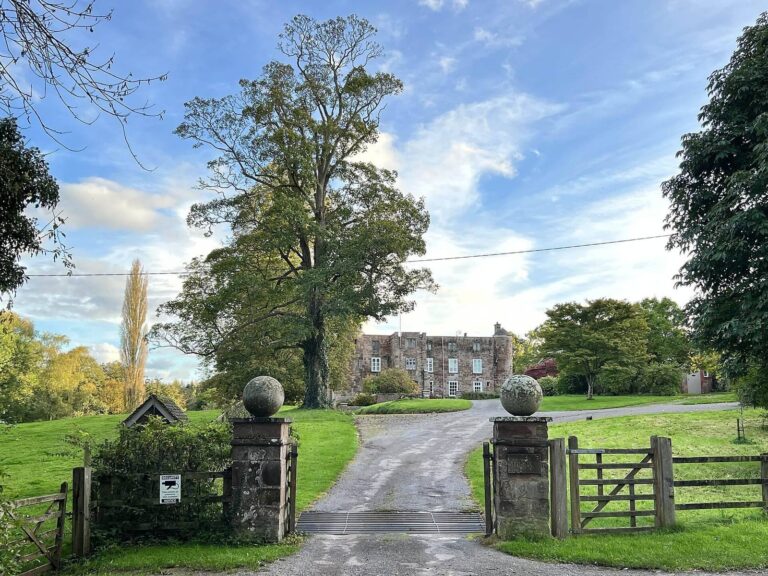
The house retains a form shaped by additions over several centuries. Wings added during the Georgian period (1714-1830) and Victorian era (1837-1901) extend to the south and east. Inside, extensive wood panelling includes both original work and later additions, alongside decorative carving in wood and stone. A Catherine Wheel badge, a spoked-wheel emblem associated with Saint Catherine and the Rudhall family, appears above the entrance porch.
The grounds include a stream and lakes. About 75 metres south-west of the house is the base of a medieval church cross.