Goodrich Court: A Gothic Revival House for an Armour and Antiquities Collection
Site at a Glance
- Popularity
- Medium
- Country
- United Kingdom
- Primary era
- Modern
- Eras represented
- Modern
- Civilizations
- British
- Site type
- Domestic
- Remains
- Castle
On this page8 sections
History
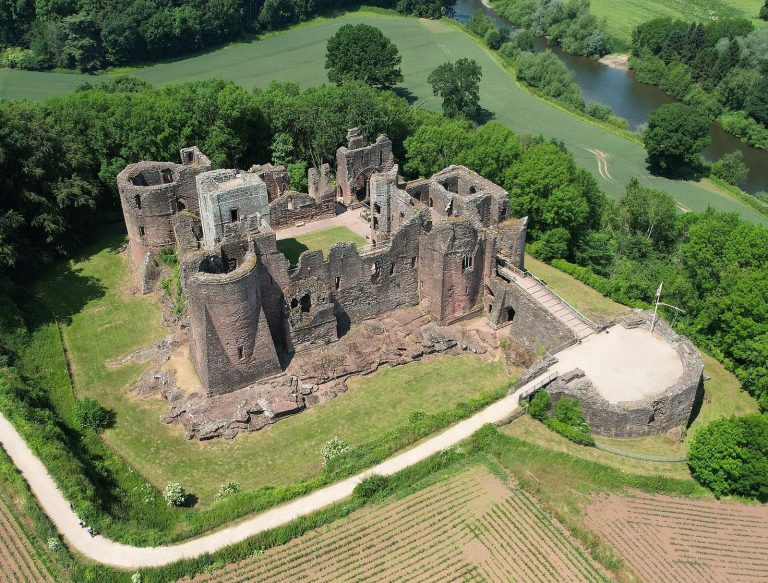
Goodrich Court was a house in the Gothic Revival style, which adapted forms from medieval Gothic buildings, completed in 1828 on a hilltop facing the ruined Goodrich Castle in the United Kingdom. Samuel Rush Meyrick commissioned it as a new ancestral seat after failing to buy the castle. Meyrick, an antiquarian interested in Welsh history, falsely claimed descent from Owain Gwynedd, a 12th-century ruler of Gwynedd. Seeking a genuine castle in the Welsh Marches, he visited Goodrich Castle in 1823 but could not purchase it. Edward Blore designed the new house.
The Wye Tour
Meyrick intended Goodrich Court to house his armour and antiquities. Much of his collection later passed to the British Museum and the Wallace Collection. In the years after the house was built, it became a stop on the Wye Tour, a popular scenic excursion along the River Wye. The poet William Wordsworth called the building “impertinent” and wished it removed.
Later ownership and demolition
After Meyrick died in 1848, Liberal Member of Parliament George Moffatt bought Goodrich Court. Moffatt and his heirs enlarged the property with additional buildings. During the Second World War, the house accommodated pupils evacuated from Felsted School in Essex. The pupils left in 1946, after which furnishings and fittings were stripped out. The house was demolished in 1949.
Remains
The house stood on a hilltop facing Goodrich Castle and was built of local red sandstone. Its design drew on the castle’s medieval architecture and combined a gatehouse, moat, battlements and towers. The overall effect was also compared to a French castle. Architectural historian Nikolaus Pevsner characterized the building as fantastical, with numerous towers designed to look fortified. Inside, the large Armoury hall held Meyrick’s armour collection. Heraldic emblems of Aymer de Valence, a prominent medieval English nobleman and lord of Goodrich Castle in the early 14th century, appeared in many details.
Surviving structures and grounds
Monmouth Gatehouse
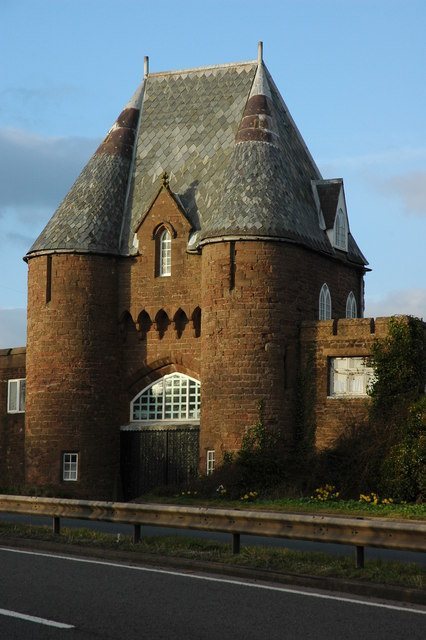
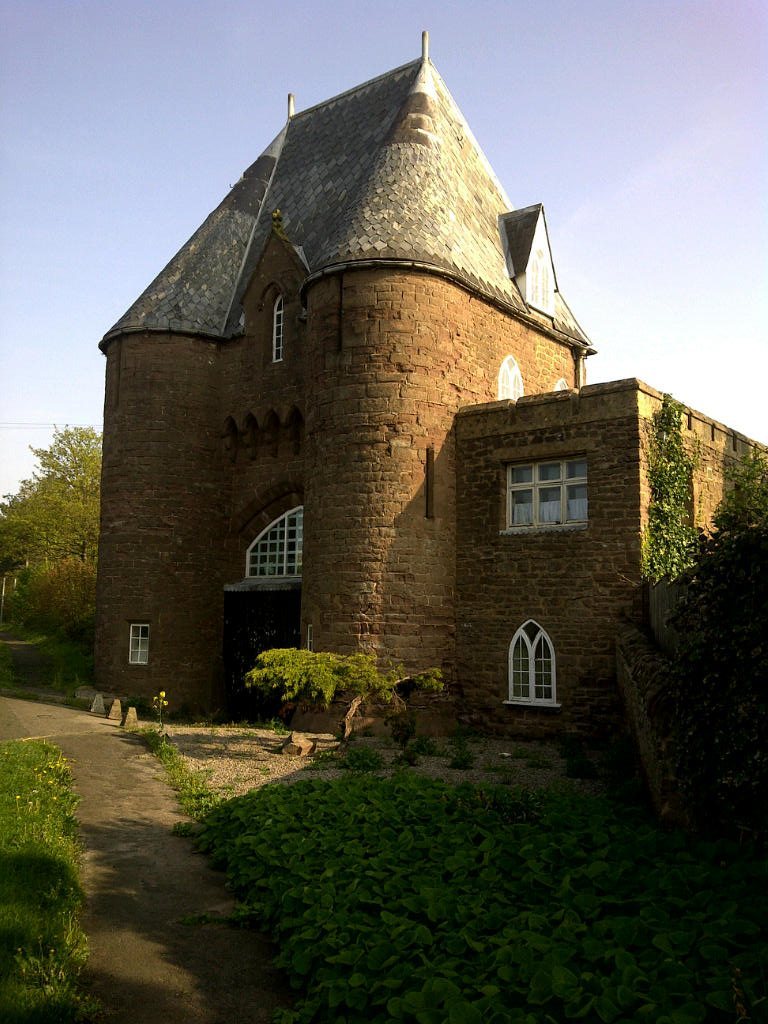
The Monmouth Gatehouse stands east of the main site, on the road toward Ross-on-Wye. Built of red stone, it has round towers and machicolations, projecting openings through which defenders could drop objects on attackers. It is used as a private residence.
Stables
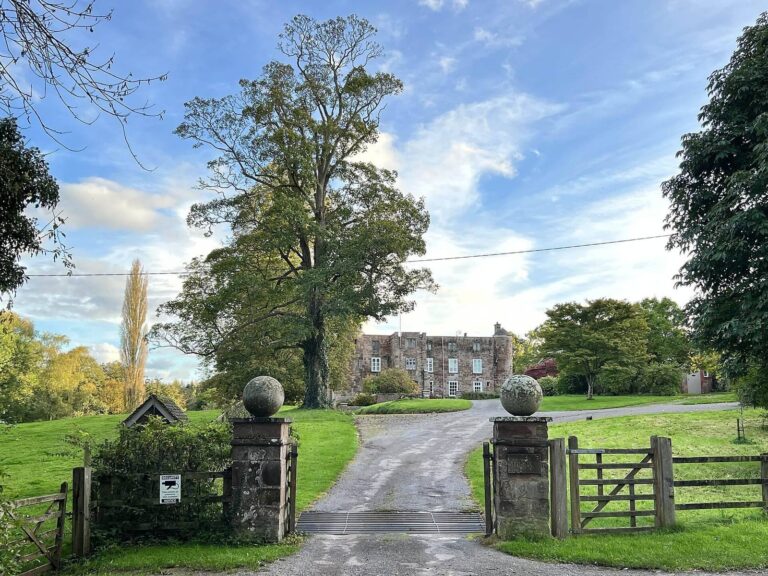
The stables are among the associated buildings that remain standing. Added during the ownership of Moffatt and his heirs, they were built in a style matching the original house.
Lodge, summerhouse and garden
A small lodge, a summerhouse and a walled garden also survive among the associated features. The former grounds are now a nature reserve.